La formulación de políticas sobre la migración venezolana en Perú 2017-2022: procesos, puntos de bifurcación y factores impulsores



This study examines Peruvian public policies on Venezuelan migration, identifying factors influencing their formulation and implementation while uncovering their behavioral patterns. Using a qualitative approach based on process tracing and thematic analysis of official documents, media narratives, and statistical data, the research identifies three phases of migration policy: (1) open-door policies, (2) securitization and restriction, and (3) invisibilization and normalization of irregular migration. These phases reveal a disconnect between political rhetoric and practical outcomes, with calculated tolerance for policy non-enforcement and migrant integration delegated to civil society and international organizations. The findings highlight incoherent migration policies marked by legal non-compliance, omission as a strategy, and limited state intervention. These dynamics are driven by advocacy coalitions excluded from decision-making, strained executive-legislative relations, and media-influenced public opinion. The study’s originality lies in its innovative combination of process tracing and thematic analysis to explain policy dynamics in contexts of institutional fragility.
Este estudio examina las políticas públicas peruanas sobre la migración venezolana, identificando los factores que influyen en su formulación e implementación, al tiempo que revela sus patrones de comportamiento. Utilizando un enfoque cualitativo basado en el process tracing y el análisis temático de documentos oficiales, narrativas mediáticas y datos estadísticos, la investigación identifica tres fases de la política migratoria: (1) políticas de puertas abiertas, (2) securitización y restricción, y (3) invisibilización y normalización de la migración irregular. Estas fases evidencian una desconexión entre el discurso político y los resultados prácticos, con una tolerancia calculada hacia el incumplimiento de las políticas y la delegación de la integración de los migrantes a la sociedad civil y a las organizaciones internacionales. Los hallazgos destacan políticas migratorias incoherentes, marcadas por el incumplimiento legal, la omisión como estrategia y la limitada intervención estatal. Estas dinámicas son impulsadas por coaliciones de incidencia excluidas del proceso de toma de decisiones, tensiones entre el Poder Ejecutivo y el Legislativo, y una opinión pública influenciada por los medios de comunicación. La originalidad del estudio radica en su innovadora combinación del rastreo de procesos y el análisis temático para explicar las dinámicas políticas en contextos de fragilidad institucional.

Migration; Venezuelan migration; migration policy; policy process; advocacy coalitions; Peru
Migración; migración venezolana; política migratoria; proceso de políticas; coaliciones de incidencia; Perú

1. Introduction
The purpose of this study is to identify the public migration policy of the Peruvian State in the face of the massive Venezuelan migration and to reveal the dynamics of reproduction of their formulation and implementation.
It seeks to answer the following questions: What have been the key characteristics of Peruvian migration policies? How have these policies evolved, and what factors have influenced their formulation and implementation during the 2017-2022 period? Have there been any changes in these policies, given that they have been developed across four presidential administrations? What factors have driven the design, redesign, and implementation of these policies, and how do these factors interact to shape their behavioral patterns?
The motivation for this research derives from the perception that most studies of public policies tend to focus on laws and norms (Van Meter & Van Horn, 1993), neglecting the distance between normative rhetoric and reality (Bardach, 1978; Elmore, 1979), which is fundamental to understand migratory policies. In line with this blind spot, few explanations are sought in the literature on this gap in migratory policies, and those that exist are insufficient.
Nevertheless, the lack of full adherence to the rule of law and the resulting disconnect between formal rules and actual behavior is a persistent issue in Latin American countries. This has prompted multiple studies, including North et al. (1999) on the difference between Latin America and North America in relation to political order; those of O’Donnell (2006) on the importance of informal actors and not only informal institutions in the region; of Haggard et al. (2008) on the relationship between property and contracting rights, institutions and coalitions of interests; of Helmke and Levitsky (2006) questioning whether studying only formal institutions is the only way to understand how politics and democracy function in Latin America; of Acemoglu and Robinson (2012) on the role of institutions in the failure of countries; or of Araujo (2009) on rules that are formally respected but not complied with; among many others. However, this concern about policies that are often rhetorical and not real has not been taken to the field of migration analysis. For Aron and Castillo (2020), the type of migratory policy and its changes could be explained by changes in the social profile of the migrant: first, professional middle classes and, after, impoverished classes. For Blouin (2021), “Peruvian immigration policy towards the Venezuelan population is part of a logic of immigration control.”
Acosta and Freier (2015) have analyzed the migration policy paradox in South America, highlighting how governments often combine restrictive discourse with pragmatic policy adjustments. Similarly, Cantor et al. (2015) provide a comparative perspective on the evolution of migration governance in the region. However, after 2017, when mass immigration began and a succession of presidential vacancies and government changes started in Peru, the specific political dynamics and institutional fragility that shaped Peru’s response to Venezuelan migration were better revealed. This research builds on these contributions by employing process tracing to examine how political instability, media influence, and electoral considerations influenced migration policymaking beyond its legal framework.
Our study argues that Peruvian migration policy has been shaped by political contingencies rather than a structured governance framework. This research identifies a persistent disconnect between policy outputs and policy outcomes, requiring an analysis of the policy process and the relationship between politics and policy (Lowi, 1964; Sabatier & Jenkins-Smith, 1993). By applying the Garbage Can Model (Cohen et al., 1972), this study suggests that migration policy in Peru was not the result of a deliberate, long-term strategy but rather a series of reactive decisions influenced by shifting political pressures, media narratives, and institutional constraints. Instead of a coherent approach, the country experienced three distinct policy phases under a single regulatory framework: i) Open-door policies (2017-2018), facilitating legal entry and temporary stay permits; ii) Securitization and restriction (2019-2020), marked by border controls and visa requirements; iii) Invisibilization and irregular migration (2021-2022), where migration ceased to be a political priority despite persistent challenges.
The study focuses on the case of Peru, a country with 33 million inhabitants, where the migration issue was never considered a public problem. In fact, the topic of immigration was never relevant in Peru, as opposed to the emigration of Peruvians to foreign countries. Between 1990 and 2018, about 3 million and 165 thousand Peruvians left the country and have not returned. Practically 10% of the Peruvian population moved abroad (INEI, 2021). However, Peru has always had very few immigrants: in 2017, there were barely 152,000 foreign citizens residing in Peru (INEI & IOM, 2018). That is why this issue was never on the national agenda. Nevertheless, this has changed, especially since 2017.
There used to be only 700 Venezuelan citizens residing in Peru in 2000. Ten years later, this number increased to 1,270, and 4,700 in 2015. The following year, in 2016, it increased to 27,000, and in 2017 to 200,000. Later, this increased to 862,000 in 2019 and finally to 1,301,315 Venezuelans registered in 2021 (SNM, 2021). The Interagency Coordination Platform for Refugees and Migrants estimated a total of 1,501,503 migrants, refugees, and asylum seekers in Peru by December 2022 (R4V, 2023). But irregular migration, unaccounted for, has multiplied lately. This contingent is part of the 7,320,225 refugees and migrants that have left Venezuela, of which 6,136,402 left for Latin American countries (R4V, 2023). However, the issue of migration in Peru is only one case of a world entering a phase of migrations not only south-north but also south-south and a world of States with a growing multicultural composition with new challenges (Bhabha, 2018). By analyzing the gap between policy discourse and implementation, this research contributes to the debate on migration policy in Latin America and offers a comparative framework for understanding similar cases in the region.
2. Methodology
This study employs a qualitative approach to analyze the Peruvian State’s migration policies concerning Venezuelan migration between 2017 and 2022, with a focus on the relationship between public policy and political dynamics. The selection of this approach reflects the exploratory nature of the subject, given the limited literature on the tensions between formal regulations and their effective implementation in Latin American migration contexts.
The study adopts the process tracing method (Bril-Mascarenhas et al., 2017; Collier, 2011; Beach & Pedersen, 2013), which allows for reconstructing the evolution of public policies through critical events, key decisions, and contextual changes. This method facilitates the identification of causal mechanisms connecting policy decisions to concrete outcomes. Additionally, thematic analysis was employed to examine media narratives, social perceptions, and statements from key stakeholders, enabling the extraction of behavioral patterns related to migration policies (Braun & Clarke, 2021).
2.1. Data Collection
The research is based on a methodological design that integrates diverse primary and secondary sources:
Analysis of official documents: A review of regulations, decrees, and public policies issued during the study period was conducted, with an emphasis on the 2017 Migration Law and subsequent executive decrees. This included an analysis of the implementation of the Temporary Stay Permit (PTP) and its impact.
Media content analysis: A comprehensive review of the coverage by the national newspapers El Comercio, La República, and Perú21 was undertaken. These outlets were selected for their representativeness, editorial diversity, and broad readership, as they are key sources of information for both policymakers and the general public. The analysis covered a six-year period, focusing on editorials, opinion columns, and relevant reports to identify changes in public perception and migration narratives.
Statistical databases: Data from the National Institute of Statistics and Informatics (INEI) and the National Superintendency of Migration (SNM) were used to analyze migration trends, living conditions of migrants, and migration flows. This included the ENPOVE 2018 and 2022 surveys, which provided key information on the demographic and socioeconomic characteristics of the migrant population.
2.2. Process and Analysis
The analysis was conducted in three main stages:
Timeline reconstruction: Timelines were created integrating key events, issued regulations, changes in public perception, and relevant political dynamics. These timelines identified inflection points in migration policy, such as the implementation of the PTP in 2017 and restrictive measures during the Vizcarra administration.
Thematic coding: Based on Braun and Clarke’s (2021) recommendations, the following thematic analysis stages were undertaken:
Familiarization with data and transcripts.
Initial coding of relevant narratives.
Generation of themes and subthemes related to migration policies, political-institutional tensions, and media perceptions.
Comparative analysis: The findings that emerged from the analysis of laws and regulations, the documentary and bibliographic review, the review of events in newspapers, and the migration statistics were permanently triangulated.
The analysis considers political variables, including executive-legislative relations, media-driven narratives, and policy shifts, alongside social variables, such as integration barriers and the living conditions of Venezuelan migrants. The inputs for the analysis came from several sources: news of events organized in a timeline, legal norms, political decisions, and statistical data. These inputs entered the black box of processing, where they were organized, triangulated, and analyzed into specific processes most affected by one or more of the drivers found: advocacy coalitions, tensions between the Executive and Legislative branches, and the weight of public opinion. The resulting outputs were the actual public policies expressing the discrepancy between policy and politics.
2.3. Integrative Approach
Rather than relying on probabilistic causal relationships, this study employs process tracing to connect micro-level political decisions with macro-level migration trends, constructing a coherent narrative of policy evolution. Timelines track regulatory changes, migration flows, and administrative processes, revealing critical junctures that shaped the transition from open-door policies to restrictive measures and, ultimately, to the invisibilization of migration issues.
By exposing the gap between policy rhetoric and practical outcomes, this study demonstrates how Peruvian migration governance has been shaped more by political maneuvering than by a structured long-term strategy. This approach provides a comprehensive perspective on the multifaceted nature of migration policymaking, integrating both state-driven actions and the role of external actors.
2.4. Limitations and Ethical Considerations
The study faces limitations related to the availability and quality of secondary sources, particularly in analyzing public opinion. While diversity of perspectives was prioritized, the findings reflect dominant narratives in the media and official discourses. The period 2017-2022 was taken because that was the span of the boom and bust cycle of the topic on the public agenda. The high turnover of officials and managers in public entities, as well as the pandemic, prevented the accumulation of experience on the subject and the acceptance of interviews.
3. Results
This methodology and its techniques allowed us to identify the central characteristic of Peruvian migration policy, its phases, and the variables that influenced its formulation and implementation. We will present three topics in that order.
3.1. Central characteristic of Peruvian migratory public policy
With the data collected, it was possible to define that we were dealing with a type of policy based on the political use of migration policy. The tolerance of non-compliance with laws explains this, the use of omission as a deliberate policy, and the abandonment of real policy to the disorderly concurrence of the actors in a modality like that of the garbage can model (Cohen et al., 1972). The clearest expression of this type of policy is the contrast between the profuse principled policy and the relative inaction of the state to facilitate the insertion of migrants. Of the 35 main norms dedicated to migration issues in Peru, 30 refer to legal documentation and migration control, and only five are related to hiring foreign workers and occupations passing through the country (SNM, 2023). In the education sector in 2019, only one-fifth of Venezuelan families managed to enroll their children, having access problems related to document requirements, lack of school certificates, and placement in equivalent grades through special tests (Alcazar & Balarín, 2020). In the health sector, their right to Comprehensive Health Insurance was recognized late, although this was formal due to lack of resources. No special programs or increased resources have been generated for these issues. In the end, the integration of Venezuelans into the country has been carried out almost entirely by their own means and in coordination with the Peruvian people.
Why is there an inconsistency between what is regulated and what is effective? The concept of forbearance, as proposed by Holland (2016), helps clarify how political leaders in Peru intentionally use public policies for political advantage. This approach differs from simple non-enforcement due to state inefficiency. It contrasts with the broader Latin American context, where citizens and authorities often disregard the rule of law (Méndez et al., 2002).
Peru’s immigration policy exemplifies forbearance, where omission is strategically used. Decision-makers design and enact laws with the knowledge that they will not be enforced, either because of their complexity or the lack of resources for implementation. This approach turns policy into rhetoric rather than a genuine solution. According to McConnell and Hart (2019), the study of public policy has been characterized by a bias toward the study of the administration’s actions; however, it has not focused on analyzing its lack of action. It is important to highlight that doing nothing is also a public decision; it is “deciding not to decide,” and lack of action does not mean a lack of motivation: there may be a reason behind not taking action (Dente & Subirats, 2014).
In Peru, as in many other countries, the state is aware of the gaps that do not guarantee the rights of the population. Therefore, when problems occur, politicians show varying levels of permissiveness toward breaking the law. At the same time, it knows how to act by omission, that is, the Executive Branch does not oppose but is not proactive. It simply allows institutions specialized in the immigration issue to act ex officio and bring other issues to the agenda, blurring the initial problem to turn it, in this case, into a battering ram of regional geopolitics or a weapon that benefits the fight between the Executive power and Congress.
This is what Schneider (2001) called “saprophytic policies,” that is, there are policies that hang on other policies. In this case, the political confrontation between the Executive and Congress was superimposed on top of the immigration issue until the last phase in 2020-2021, when it lost relevance as a public issue and was abandoned after being used to the maximum in previous years.
This type of process highlights the subordination of the public policy agenda to political priorities. Migration policy in Peru often functions as rhetoric, serving as a political strategy rather than a comprehensive solution to migration challenges.
Phase One (2017-2018) focused on territorial access through the PTP and Lima Group but lacked integration measures. Phase Two (2018-2020) shifted to restrictive policies focusing on border control and securitization, influenced by public security concerns. Phase Three (2020-2022) saw the state’s retreat from active policy, leading to the invisibilization of migration issues and the normalization of irregular migrant status. This progression contrasts with the experience of more institutionalized Latin American countries, such as Costa Rica or Chile, where a better balance between politics and policy enables more effective law enforcement and coherent migration strategies (Franco & Scartascini, 2014).
3.2. The phases of the Peruvian migratory policy
In addition, we found the following three stages of migration policy: opening, restriction, invisibilization and normalization of irregular migration. We will first explain the stages and then the drivers of the policy.
Phase 1: Open-door Policy | Phase 2: Securitization | Phase 3: Invisibilization and irregular migration | |
|---|---|---|---|
| President Kuczinsky | President Vizcarra | President Sagasti | President Castillo |
August 2016 - March 21, 2018 | March 23, 2018 - November 15, 2020 | November 17, 2020 - July 28, 2021 | July 29, 2021 - December 7, 2022 |
|
|
|
|
3.2.1. Phase One: open-door policy during the Kuczynski government (August 2016 - April 2018)
A new government without a parliamentary majority emerged after Pedro Pablo Kuczynski’s narrow victory in the 2016 presidential elections in Peru. Facing an unfavorable parliamentary configuration with the opposition of Fuerza Popular holding 73 seats out of 130, Kuczynski’s government operated under the constant threat of presidential impeachment, limiting its actions (Vergara & Watanabe, 2019).
Regional leadership. Despite this internal challenge, Kuczynski marked a shift in foreign policy, particularly in Peru-Venezuela relations. Criticizing the actions of the Venezuelan President, he denounced human rights violations at the United Nations General Assembly in September 2016 (Andina, 2016). Under Kuczynski’s leadership, Peru played a pivotal role in forming the Lima Group in August 2017, advocating for democratic elections in Venezuela. The conflict between the Peruvian government and the Venezuelan regime was so acute that the Venezuelan ambassador to Peru and the Peruvian chargé d’affaires in Caracas were expelled (BBC Mundo, 2017a; 2017b).
Implementation of the PTP. In response to the growing Venezuelan migration, Peru implemented the PTP on January 3, 2017, allowing migrants to identify and work in the country. The PTP allows migrants to apply for residency. Still, this process is complicated for most since it requires proof of work activity (Acosta, Blouin, & Freier, 2019), and 88.5% of Venezuelan migrants were working without a contract by 2018 (INEI, 2018). The PTP, in fact, was much more important than the regulatory frameworks that came out shortly after, the Legislative Decree on Migration (D.L. 1350) and its corresponding regulation (March 27, 2017), and the National Migration Policy (April 27, 2017). The government issued migration regulations that uphold, in principle, the rights of migrants. However, the effective policy was the PTP, which opened the doors to immigrants coming to Peru but was not complemented with a budget for the labor, social, and health insertion of the million Venezuelan migrants who had entered then. One can say that the Peruvian migration policy consisted of territorial opening without an equivalent policy of social opening and inclusion of Venezuelans in Peruvian society.
Thus, President Kuczynski’s migration policy can be understood from the two-tier theory formulated by Putnam (1988) and Jacobsen (1996), which states that a country’s foreign and internal policy can play interchangeable and mutually reinforcing roles. Jacobsen (1996) developed the idea that the country of origin can manipulate the migratory flow to overwhelm the host country, which, in return, may decide to receive them as refugees to discredit the other country by suggesting that it persecutes its own citizens. In the case of Peru, in early January 2017, Kuczynski enacted regulations to regularize the situation of Venezuelans, thereby attempting to capitalize on the anti-Maduro sentiment of a portion of Peruvians.
End of the Open-Door policy and political shifts. This political game of Kuczynski finished in March 2018 when the congressional majority forced him to resign from office, surrounded by allegations of corruption related to the Lava Jato case and vote buying in Congress. Kuczynski left his successor the difficult legacy of this utilitarian immigration policy, with several hundred thousand migrants crossing the northern border every quarter. The open-door policy as a source of geopolitical support ceased to be sufficient. Figure 1 shows the strong increase in the entry of Venezuelan migrants in this government period until the first quarter of 2018.
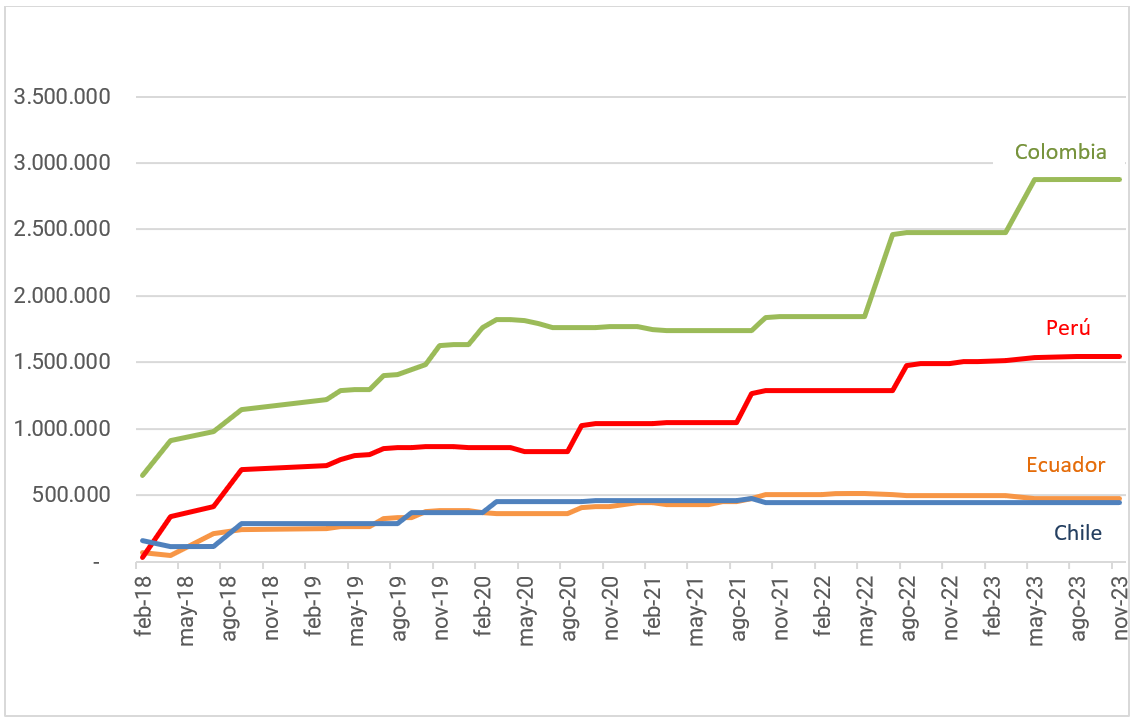
Font: R4V Interagency Coordination Platform for Refugees and Migrants from Venezuela (2023)
3.2.2. Phase two: the restrictive migration policy during Vizcarra’s administration (April 2018 – March 2020)
Government survival and migrant incrimination. Martín Vizcarra took office on March 23, 2018, representing a change in immigration policy, with a new use of the immigration issue raising the flag of citizen security. He gradually abandoned his predecessor’s direct anti-Maduro foreign policy. However, Vizcarra’s government was even weaker than Kuczynski’s as it did not have the support of the office party or any other party in Congress (Paredes & Encinas, 2020; Dargent & Rousseau, 2021; González, 2021; León, 2019). In this context, Vizcarra tried to survive by resorting to an alliance with public opinion, for which he targeted corruption, represented by Congress, and relied on the citizen perception that Venezuelan migration was the cause of citizen insecurity.
The new president did not change anything from the previous migration policy during the first months of his government. However, this changed in June 2018, when the restrictive migration policy began, first by requesting new documents to obtain the PTP (Vargas, 2018), and then, since April 2019, by the administration joining the campaign to accuse migrants of being the cause of citizen insecurity. In that sense, Vizcarra used the issue of Venezuelan migration again, now at the national level, to gain support for the confrontation against Congress, which Fujimorism principally led.
The shift in Peruvian public opinion. Zambrano and Hernández (2021) have proposed that this shift is due to the change in the social profile of the migrants, who, by 2018, would have ceased to be middle class. But that shift happened earlier. In part, it can be explained by the notorious increase in immigrants that took place during President Vizcarra’s government. When Kuczynski entered the presidency in August 2016, 15,486 migrants entered in quarter 3 of that year; when he was removed from the presidency in March 2018, 338,004 migrants had already entered Peru. From the moment Vizcarra was already in office, the numbers skyrocketed: more than 100,000 migrants began to enter Peru every quarter, making a cumulative net migration until the first quarter of 2020 of more than 861 thousand Venezuelan immigrants. There were more, counting illegal immigrants. In short, Vizcarra experienced the migratory wave at its highest peak. According to the report of the SNM (2021), as of the fourth quarter of 2021, about 1,286,464 entries were registered; some were migrants in transit to Chile or other countries, and others would later become returnees. Public opinion began to express its discomfort. According to a survey conducted by El Comercio-IPSOS in April 2019, 67% of Lima citizens did not support Venezuelan immigration, and 54% said that this had caused an increase in crime and criminal activities (Alayo, 2019).
The criminalization of Venezuelan citizens. In addition to citizen rejection, several media outlets have encouraged this anti-immigrant spirit. However, as Pecho (2019) explains, “the arrival of Venezuelan migrants has not necessarily increased crime victimization rates in Peru.” According to data from the Police Department, crimes committed by Venezuelans barely represented 1.38% of the total crimes committed in the country, a significantly low proportion for the number of Venezuelans living here. But President Vizcarra himself joined the deportation of criminal immigrants by going to the military airport in Lima along with the Minister of Interior, Carlos Moran, to oversee the departure of Venezuelans (Gestión, 2019). At the end of April 2019, the Government initiated the Safe Migration Plan, and migration operations against illegal migration intensified on the northern border (MININTER, 2019). The executive authority needed the population’s support in its confrontation with Congress.
In the end, he could not save himself from the presidential impeachment either. The first impeachment attempt against President Vizcarra took place on September 2, 2020, and was unsuccessful, but the second attempt took place on November 2, 2020, and went through with no issue (Ortiz, 2020).
3.2.3. Phase three: invisibilization and irregular migration (November 2020 - December 2022)
Survival and integration of migrants. Throughout the Venezuelan migration crisis, many migrants have been forced to survive and integrate into the informal sectors of the Peruvian economy and society. Demographically, most Venezuelan migrants have been in the working-age population, particularly in the 25-29 and 30-34 age groups. However, the growth of the 0-4 age group, representing children born in Peru, indicates increasing settlement. This demographic shift is further reflected in the dependency ratio, which measures the proportion of minors and older adults relative to the total migrant population. In 2018, this figure stood at 20.8%, but by 2022, it had doubled to 42.1% (INEI, 2022).
Despite signs of settlement, life for migrants in Peru remains challenging. As a result, the number of migrants perceiving Peru as a transit country rather than a destination has increased. In 2018, 93.8% of Venezuelan migrants intended to stay in Peru, while only 6.2% planned to move to another country. By 2022, this shift had occurred, with 75.3% intending to stay and 24.7% seeking to leave (INEI, 2018; INEI, 2022). This shift underscores the growing challenges Venezuelan migrants face in Peru, where integration into the formal labor market is still limited.
Many of this population were inserted into the informal market as the fastest way to make an income (Defensoría del Pueblo, 2020). In 2018, only 11.5% of the Venezuelans employed had an employment contract, which increased to 19.2% in 2022. But self-employed workers have increased: in 2018, dependent workers were 74.9%, and in 2022, they were 64.4%; self-employed workers increased in the same period from 20.5% to 29.3% (INEI, 2018; INEI, 2022). Informality is associated with low wages and precarious labor rights. At the end of 2020, according to monitoring data gathered by the United Nations Refugee Agency (UNHCR), 90% of Venezuelan migrants had precarious jobs or were not working at all (Salazar, 2021). Of this total, about 50,000 families survived on economic subsidies managed by International Organizations and NGOs (Lucas & Salazar, 2020).
Evidently, six years after the beginning of the Venezuelan migratory wave to Peru, there has been a gradual insertion of migrants in different fields, although with little official support and always maintaining large social protection gaps. Regarding the education sector, at the end of 2019, there were 130,000 Venezuelan children and teenagers without access to school in Peru, according to numbers from UNICEF (Ziegler, 2020). By June 2020, 13% of the school-age group had not been able to enroll in an education center (Castro, 2021). By 2022, 95% of children were enrolled in pre-school education and 93.8% in secondary education (INEI 2022). After six years, the integration of children and young people into schools is almost complete.
In contrast, the health sector has made less progress. In 2018, only 8.5% of the Venezuelan population had access to some insurance coverage. Of this group, 53% had access to SIS or subsidized public insurance, 29.4% to Bismarckian social insurance, known as EsSalud, and 17.1% to private insurance (INEI, 2018). In 2022, 73% of migrants still do not have insurance, and of those who do, 20% have SIS, and 5.4% have EsSalud. The majority (22.8%) go for consultations in pharmacies or drugstores, 31.7% do not seek care due to lack of money, and 19.3% due to lack of insurance. A total of 26.2% reported having suffered from COVID-19.
COVID-19: The interruption of the Venezuelan migrant’s insertion. The COVID-19 pandemic significantly affected the integration of Venezuelan migrants. The migration issue was always of second order in the public agenda, but with the pandemic, it became invisible even at the highest levels as a resource for political accumulation (Blouin, 2021; Freier & Espinoza-Vera, 2021). This shift in migration policy towards the invisibilization of the issue did not occur when President Francisco Sagasti took office on November 17, 2020, but much earlier, in the middle of President Vizcarra’s administration, when the COVID-19 pandemic began in March 2020 and a strict quarantine imposed. Because of the pandemic, 33% of the Venezuelan working population lost their jobs, 50% were at home and could not work as usual, 37% said they were not stocked up and had no money to do so, and 40% had to go out to buy some products but did not have money (Equilibrium CenDe, 2020). Venezuelan immigrants in Peru could not go out into the streets, where many of them were working.
According to a report by the Defensoría del Pueblo (2020), COVID-19 meant refugee and migrant population job loss, inability to afford food, evictions due to lack of rent payment, discrimination, and barriers to obtaining legal documents. “Two out of three Venezuelans live in a vulnerable situation, nine out of ten are unemployed or have a precarious job, and seven out of ten have less than three meals a day, according to the UNHCR report at the end of 2020” (France24, 2021). The seriousness of the situation even led some Venezuelan migrants to think about returning to their country, a moment that President Maduro knew how to take advantage of politically by sending airplanes to Peru to pick up those who wanted to return to their homeland.
Irregular migration: The normalization of irregular status. As migration barriers increased, a significant number of Venezuelan migrants found themselves in irregular status, unable to navigate the bureaucratic and legal frameworks set in place. Many became irregular due to expired documents that could not be renewed, primarily because of high processing costs, the necessity to return to Venezuela for documentation, or long waiting times at the Peruvian Migration Office. For others, the lack of documentation from the onset, as well as limited access to formal legal avenues meant they were already living and working without the proper permits. Additionally, Peru’s informal economy, where identity documents are often not strictly required for employment, further facilitated the perpetuation of irregular migration.
This surge in irregular migration has distorted the official migration data, with regular entries no longer providing an accurate reflection of the actual migration flows. Regular entries through border posts had increased dramatically in earlier years, from 28,387 in the first quarter of 2017 to 338,004 in the first quarter of 2018. By the fourth quarter of 2019, this number had reached 863,000, and by the end of 2020, it had surpassed 1 million. However, the COVID-19 lockdown in March 2020 temporarily halted regular migration flows, marking a critical turning point. Migration numbers began to slow in 2022, not only due to pandemic-related restrictions but also due to the sharp rise in irregular migration. According to the latest INEI survey (2022), 30.6% of Venezuelans reported that they did not register their entry at a checkpoint during their last migration, compared to just 2% in 2018. Furthermore, by 2022, 88.3% of respondents lacked a passport, and 42.9% did not possess a migration permit to remain in Peru.
The increasing prevalence of irregular migration was particularly evident along the Peru-Ecuador border, once a hub for regular crossings. As the demand for official entry documents, such as visas, intensified, the border began to mirror the characteristics of other international illegal crossings. People increasingly turned to clandestine routes, where organized smuggling gangs facilitated illegal entries, exposing migrants to various forms of exploitation, abuse, and danger. Lita Orrego, head of the Migration Department in Tumbes, reported a dramatic decline in the number of Venezuelans arriving at legal checkpoints due to the introduction of visa requirements, from 1,200 daily arrivals to just 30-50, highlighting the shift toward irregular migration (El Comercio, 2019).
This normalization of irregular migration is reflective of the deepening vulnerability faced by Venezuelan migrants. The growing reliance on informal, unauthorized routes and the inability to access legal and safe migration channels not only undermines the regulatory frameworks of migration management but also exposes migrants to further marginalization, insecurity, and exploitation.
3.3. Drivers of these types of policies and their variations
The general hypothesis, arising from the reconstruction of the migratory process in Peru and confirmed by the timeline, affirms that the Peruvian State’s immigration public policies do not necessarily focus on the response to this new social problem caused by the presence of immigrants but on its repercussion or political sense in the national political scenario.
Therefore, in this case, regulated migration policy is one thing, and actual migration policy is another. The outcome of the formulation process relegates the problem to the background; thus, politics, understood as strategy and tactics, has priority over policy, understood as the program. Survival actions of successive governments are more important than the interests of those affected. Politics takes precedence over policy (IADB, 2006).
The question is what the reasons for the configuration of this type of processing of public migration policy have been. Let us review the drivers of this process.
3.3.1. Advocacy coalitions, service providers and decision-makers
One of the conditions or factors that explain this type of migratory policy is related to the fact that the “coalitions promoting migratory public policies” consist of a community of actors weakly connected to the government’s decision-making core. The group of stakeholders committed to immigrants rarely manage to put their objectives on the Executive’s agenda, and if they do, they expose themselves to the reinterpretation of the proposals.
In the Peruvian case, the current migration policy does not necessarily coincide with official public policy and has been designed and implemented among different actors. The Ministry of Foreign Affairs and the SNM have the leadership in the documentation required of migrants. International support agencies (IOM, UNHCR, PAHO, etc.) had taken the lead in humanitarian and social support, at least during the first three years when the migratory phenomenon was on the rise, without much participation of the State’s social ministries. These three groups—legal, humanitarian, and public service providers—comprise the central elements of what is known as the Advocacy Coalition Framework (ACF), a concept developed by Sabatier and Jenkins-Smith (1993) to understand policy processes through a systemic and coalition-based perspective.
The ACF theory argues that there may be one or more advocacy coalitions in policy subsystems but that, generally, one is more dominant, and others represent a minority. Among them, there is a process of learning and negotiation (Weible & Jenkins-Smith, 2016; Weible & Sabatier, 2007). In this case, in 2009, the Intersectoral Work Group for Immigration Management was formed by the Peruvian Ministry of Foreign Affairs initiative, a Bureau officially constituted by Supreme Decree Nº 067-2011-PCM on July 27, 2011. This included all the actors and advocacy coalitions involved, among which international organizations played a key role. But of all the advocacy actors, the Executive Ministries in charge of the social and labor area were those who had the best interlocution capacity, never having nonetheless a main role in the decision-making inside the leadership group of the Peruvian State, composed of the President, the Prime Minister and their strategic advisors.
This imbalance in power dynamics between advocacy coalitions and the core decision-making bodies partly explains the parallel paths between actual and normative public policies. Public migration policy no longer reflected the original statements and principles outlined in Supreme Decree 015-2017-RE, which approved the National Migration Policy 2017-2025. Instead, it became increasingly shaped by the concrete policy measures adopted by the executive, characterized by a top-down approach. At the same time, the community of international organizations, NGOs, and volunteers activated bottom-up programs and projects to support migrants, creating a dual-track system of policy and practice. In this context, the PTP emerged as the actual migration policy during Phase One, as it was a direct response to the immediate needs of Venezuelan migrants. Similarly, in Phase Two, the government’s Safe Migration Plan was implemented, though it was again a response to the growing political tensions and migration challenges. By Phase Three, however, the state’s failure to act and shifting focus to other priorities became evident, reflecting a lack of coherent and sustained leadership in migration management. This failure persisted and became more pronounced in the following years, making it clear that migration policy had largely been relegated to the efforts of international and local civil society organizations, with limited governmental intervention.
Thus, the fragmented and reactive nature of migration policy in Peru can be understood as a direct consequence of the weak connections between the advocacy coalitions and the political landscape that shaped them. The interplay between formal migration policy, driven by top-down executive measures, and the informal efforts of advocacy coalitions highlights the disconnect between the government’s stated policy intentions and the actual support available to migrants. This dynamic has shaped the migration experience in Peru, with policies often failing to meet the needs of the migrant population.
3.3.2. The institutional regime and the Executive-Congress correlation of forces
The special regime type during the 2016-2021 period in Peru strongly impacted the formulation of public migration policy. In general, the institutional context has influence over the coalitions of actors and, in particular, over the most relevant decision-maker, the President of the Republic, who creates a viable transition from the original idea to the policy options. The discussion about regime types in Latin America has been extensive (Thibaut, 2011; Valenzuela & Linz, 1989; Mainwaring & Shugart, 1996; García, 2007), resulting in a shared opinion about the predominance of presidential or semi-presidential regimes.
However, the particularity about the 2016-2021 government period, when the Venezuelan migration wave coming to Peru took place, is that the Executive had to face a Congress with a dominating opposition, which harmed the Peruvian presidentialism. Therefore, the governments that faced the migration problem were weak because they did not have a strong parliamentary group or a majority in Congress to count as allies. The traditional balance of power broke, and the parliamentary counterweight proved much stronger than the central power. These weak governments explain the stability or instability of public policies (Pereira, Singh, & Mueller, 2011). In this case, they pushed governments to switch to political survival mode, focusing on tactical moves rather than solving problems through public policies. All because of the threat of impeachment, as in fact happened in Peru with three presidents who were impeached or forced to resign in the span of three years, Pedro Pablo Kuczynski, Martín Vizcarra, and Manuel Merino, the latter, a president who was in office for barely five days in November 2020.
In this precarious political environment, presidentialism temporarily ceded power to Parliament, with opposition forces, particularly Fujimorism, playing a significant role in decision-making. While Congress did not have the power to rule, it was able to veto initiatives from the Executive, creating a tense standoff. As Tsebelis (2006) explains, the presence of veto players—actors with the power to block policy proposals—strongly determines the degree of policy stability. In Peru’s case, the opposition’s ability to veto the President’s proposals contributed to a volatile policy-making environment, where migration policy, among other issues, became a secondary concern as the government focused on managing political crises rather than long-term governance.
This dynamic of power struggle and political survival resulted in inconsistent and reactive policies, including migration-related ones. The inability of the Executive to maintain control over its policy agenda due to the influence of veto players and the threat of impeachment directly influenced the formulation and implementation of migration policies, often undermining coherent and sustainable responses to the growing migration crisis. As the political instability continued, policymaking was characterized by short-term tactical shifts rather than developing a comprehensive, forward-thinking migration strategy.
3.3.3. The weight of public opinion and the media
With this combination involving coalitions of actors and a precarious institutional regime, the value of public opinion as a support for survival became crucial. However, public opinion is in permanent construction and change, even more so in the Peruvian case, because of its divided nature during the 2016 presidential elections. In societies with high levels of informality and chronic crises of representation, there are no stable electoral groups. The demos are liquid and inconstant because everything focuses more on flow than structure (Bauman, 2000). In this continuous dispute for the symbolic capital of the majority, whoever wins could break the tie in his favor. That is why the Executive sought an alliance with the media. However, the media also had its own agenda and constructed narratives to push the decision-makers in a specific direction. In Peru, most print and television media belong to a business group. Therefore, the decision-maker can become a prisoner no longer of most of the public opinion but of the opinion makers. As Edwards and Wood (1999) once wondered: Who Influences Whom?
Thus, the dynamics of Peruvian democracy can be quite anti-democratic and become a post-truth struggle. Michelsen and Tallis (2018) state that there is “a sense that truth-telling has been one of the casualties of our era” (p. 8). Resorting to lies or half-truths has always been part of conducting national and international power politics. However, in this case, there has been almost a total disregard for factual evidence in political discourse. Hopkin and Rosamond (2018) define post-truth politics as a distrust feeling visible in “experts” who hold a degree of authority. Consequently, these post-truth politicians fabricate their own facts. They make statements based on their own self-interests and continue to impose them, regardless of the evidence accumulated against them (Lockie, 2017).
The issue involving immigrants was caught in the crossfire between the Executive body and the Parliament during the 2016-2021 five-year period. For political leaders and the Lima Group, it was easy to build a romanticized image of the immigrant in order to construct a political and social truth that would support the formulation of an open-door migration policy. However, at the same time, when the Venezuelan migration wave was higher, politicians found it more convenient to victimize and criminalize immigrants, relying on cases of violence used as propaganda by the media. They built a narrative that went in the opposite way to the original one.
Thus, the interplay between public opinion, the media, and political actors in Peru reveals how migration policy became a battleground for competing political forces rather than being based on consistent values or evidence.
In this environment, the media’s role as an agenda-setter and opinion-shaper became increasingly significant, often shaping the narrative around migration in ways that served political agendas rather than addressing the real challenges migrants faced. Initially, migration was romanticized to justify open-door policies. Still, as migration flows increased and public services strained, the media amplified anxieties, reinforcing perceptions of migrants as a social and security threat. This feedback loop influenced policymakers, who, driven by political survival and short-term gains, shifted toward restrictive and securitizing measures, often disconnected from long-term governance strategies. In this environment, media narratives dictated political priorities, turning migration policy into a reactive instrument rather than a structured response to a complex social phenomenon. Ultimately, the media’s agenda-setting power proved decisive, shaping discourse and steering policy toward political expediency rather than sustainable migration management.
4. Discussion
As we have shown, migration policies must be read in the hands and not so much in the verb. Our central finding is that Peruvian immigration policy has been formulated based on the accumulation of forces of the Executive Branch, prioritizing politics over public policies. It has made it a political strategy rather than a solution to the problem, a public policy. While a single general migration law was passed in 2017, three distinct policies emerged over the course of the Venezuelan migration crisis: the open-door policy, the policy of securitization and restriction, and the policy of invisibilization and irregular migration. These policies were not designed to solve the migration issue effectively but to manage their political impact in the national context. The tolerated non-compliance with the regulatory policy and the flexibility in the modification of migration policies led us to the conclusion that the public migration policies of the Peruvian state do not focus on responding to the new social problem given by the presence of immigrants but on their repercussions or political meaning in the national political scenario.
This approach differs from the views that reduce public policies to laws and norms, which one can find in many migration studies. The four policies, open door, securitizing, invisibilization, and irregular migration, were the actual “courses of action” using Lahera’s (2002) definition of public policies. If this is so, it is necessary to readapt some classic theses of political science, especially the one that states that “public policy is the program of action of a public authority” of Meny and Thoening (1992), or Dye’s (1972) more taxing definition that established that “a public policy is what governments decide to do or not to do.” It would be necessary to reread these definitions based on the experience of many countries. Pasquino’s (2011, p. 262) criticism of this reductionist approach to public policy is direct: “This limitation to public [state] actors [...] is restrictive because it eliminates other actors, who are not public, but who may participate in the production of one or more public policies.” In countries with weak states, the statist reading does not explain options for solutions of multiple origins and divergent implementations, as is the Peruvian case and probably that of many south-south migratory processes. Entering the field of public policy means entering the complexity of real politics.
The Peruvian case exemplifies the complex nature of migration governance, where public policies evolve in response to a mixture of political pressures, social dynamics, and external factors. The three phases of migration policy were driven more by the political need to respond to domestic political pressures and public opinion than by a coherent, long-term strategy to address the challenges of migration. These shifting policies highlight how migration issues in Peru were often treated as tools for politics.
This study calls for reevaluating the traditional understanding of public policy, especially in contexts where state institutions are weak or fragmented. The Peruvian experience demonstrates that public policy is not simply a product of formal decision-making but a complex negotiation among various political, social, and institutional actors. Understanding migration policy requires acknowledging the dynamic interplay between state and non-state actors, as well as the broader political environment. In countries like Peru, which face large-scale migration, the policy formulation process cannot be understood in isolation from the political realities that shape the priorities and responses of the government. This understanding offers a more comprehensive view of how migration policies are created, implemented, and ultimately affect the experiences of migrants themselves.
The Peruvian case demonstrates that migration policy is not an isolated process but one embedded in power struggles, public discourse, and international dynamics. By linking micro-level political decisions with macro-level migration trends, this study offers a comparative model for assessing how states manage migration amid institutional fragility and political uncertainty. Ultimately, this research calls for a perspective shift in migration policy analysis, moving beyond legalistic interpretations to examine the interplay of political, social, and institutional factors.
References
Acemoglu, D., & Robinson, J. A. (2012). Why nations fail: The origins of power, prosperity and poverty. Profile Books.
Acosta, D. A., & Freier, L. F. (2015). Turning the Immigration Policy Paradox Upside Down? Populist Liberalism and Discursive Gaps in South America. International Migration Review, 49(3), 659-696. https://doi.org/10.1111/imre.12146
Acosta, D., Blouin, C., & Freier, L. F. (2019). La emigración venezolana: respuestas latinoamericanas [Working Paper 3]. Fundación Carolina. https://www.fundacioncarolina.es/wp-content/uploads/2019/04/DT_FC_03.pdf
Alayo Orbegozo, F. (2019). El 67% de limeños no está de acuerdo con la inmigración venezolana al Perú. El Comercio. https://elcomercio.pe/lima/sucesos/67-limenos-acuerdo-inmigracion-venezolana-peru-noticia-630720-noticia/?ref=ecr
Alcazar, L., & Balarín, M. (2020). La inclusión educativa de niños, niñas y adolescentes migrantes venezolanos en el Perú - una política que no se puede nombrar. Programa de Financiamiento para Investigaciones en Migración (PFIM).
Andina, Agencia Peruana de Noticias. (2016). Mandatario: Democracia en Venezuela requiere absoluto respeto a los DD. HH. Ofreció el apoyo de Perú para buscar una solución para el pueblo venezolano. Andina. https://andina.pe/agencia/noticia-mandatario-democracia-venezuela-requiere-absoluto-respeto-a-los-ddhh-631857.aspx
Araujo, K. (2009). ¿Se acata pero no se cumple? Estudios sobre las normas en América Latina. Lom Chile.
Aron Said, V., & Castillo Jara, S. (2020). Reacting to Change within Change: Adaptive Leadership and the Peruvian Response to Venezuelan Immigration. International Migration, 60(1), 57-76. https://doi.org/10.1111/imig.12761
Bardach, E. (1978). The Implementation Game: What Happens After a Bill Becomes a Law. Massachusetts Institute of Technology Press.
Bauman, Z. (2000). Liquid Modernity. Polity Press.
BBC Mundo. (2017a). “Cobarde” y “perro simpático”: Perú llama a consultas a su embajador en Caracas tras las palabras de la canciller Delcy Rodríguez contra el presidente Pedro Pablo Kuczynski. BBC Mundo. https://www.bbc.com/mundo/noticias-america-latina-39187982
BBC Mundo. (2017b). Perú expulsa al embajador de Venezuela, Diego Alfredo Molero, y el gobierno de Maduro responde echando al encargado de negocios de Lima en Caracas. BBC Mundo. https://www.bbc.com/mundo/noticias-america-latina-40907274
Beach, D., & Pedersen, R. (2013). Process-Tracing Methods: Foundations and guidelines. University of Michigan Press.
Bhabha, J. (2018). Can We Solve the Migration Crisis? Polity Press.
Blouin, C. (2021). Complejidades y contradicciones de la política migratoria hacia la migración venezolana en el Perú. Colombia Internacional, 106, 141-164. https://doi.org/10.7440/colombiaint106.2021.06
Braun, V., & Clarke, V. (2021). Thematic analysis: a practical guide. SAGE.
Bril-Mascarenhas, T., Maillet, A., & Mayaux, P.-L. (2017). Process tracing. Inducción, deducción e inferencia causal. Revista de Ciencia Política, 37(3), 659-684. https://doi.org/10.4067/S0718-090X2017000300659
Cantor, D. J., Freier, L. F., & Gauci, J. P. (2015). A Liberal Tide? Immigration and Asylum Law and Policy in Latin America. The University of Chicago Press. https://press.uchicago.edu/ucp/books/book/distributed/L/bo56364558.html
Castro, M. (2021). La emergencia educativa y los niños migrantes. Ojo Público. https://ojo-publico.com/3006/la-emergencia-educativa-y-los-ninos-migrantes
Cohen, M. D., March, J. G., & Olsen, J. P. (1972). A Garbage Can Model of Organizational Choice. Administrative Science Quarterly, 17(1), 1-25. https://doi.org/10.2307/2392088
Collier, D. (2011). Understanding Process Tracing. PS: Political Science and Politics, 44(4), 823-830. https://doi.org/10.1017/S1049096511001429
Dargent, E., & Rousseau, S. (2021). Perú 2020: ¿El quiebre de la continuidad? Revista de Ciencia Política, 41(2), 377-400. https://doi.org/10.4067/S0718-090X2021005000112
Defensoría del Pueblo. (2020). Personas venezolanas en el Perú. Análisis de su situación antes y durante la crisis sanitaria generada por el COVID-19 [Serie de Informes de Adjuntía n.º 2]. https://cdn.www.gob.pe/uploads/document/file/1481686/Informe-de-Adjunt%C3%ADa-N-002-2020-DP-ADHPD-Personas-Venezolanas-en-el-Per%C3%BA.pdf.pdf
Dente, B., & Subirats, J. (2014). ¿Cómo entender una decisión de políticas públicas? In B. Dente & S. Joan (eds.), Decisiones públicas: Análisis y estudio de los procesos de decisión en políticas públicas (pp. 35-67) Ariel.
Dye, T. R. (1972). Understanding Public Policy. Prentice-Hall.
Edwards, G. C., & Wood, B. D. (1999). Who Influences Whom? The President, Congress, and the Media. American Political Science Review, 93(2), 327-344. https://doi.org/10.2307/2585399
El Comercio. (2019). Las rutas ilegales de la migración: aumenta el ingreso irregular de extranjeros a Perú. El Comercio. https://elcomercio.pe/peru/piura/venezolanos-peru-venezuela-rutas-ilegales-migracion-aumenta-ingreso-irregular-extranjeros-peru-noticia-ecpm-678471-noticia/
Elmore, R. (1979). Backward Mapping: Implementation Research and Policy Decisions. Political Science Quarterly, 94(4), 601-616. https://doi.org/10.2307/2149628
Equilibrium CenDe. (2020). Solo un 34% de la población migrante venezolana en Perú se encuentra trabajando actualmente, revela reciente encuesta de Equilibrium CenDE.
France24. (2021). Dos de cada tres venezolanos están en una situación vulnerable en Perú, alerta ACNUR. France24. https://www.france24.com/es/minuto-a-minuto/20210308-dos-de-cada-tres-venezolanos-est%C3%A1n-en-una-situaci%C3%B3n-vulnerable-en-per%C3%BA-alerta-acnur
Franco, M., & Scartascini, C. (2014). La política de las políticas públicas: re-examinando la calidad de las políticas públicas y las capacidades del Estado en América Latina y el Caribe. Banco Interamericano de Desarrollo. https://doi.org/10.18235/0008493
Freier, L. F., & Espinoza-Vera, M. (2021). COVID-19 and Immigrants’ Increased Exclusion: The Politics of Immigrant Integration in Chile and Peru. Frontiers in Human Dynamics, 3, 1-10. https://doi.org/10.3389/fhumd.2021.606871
García Zanabria, J., Sánchez Aguilar, A., & Hidalgo Calle, N. (dirs.) (2018). Condiciones de vida de la población venezolana que reside en Perú: Resultados de la “Encuesta dirigida a la población venezolana que reside en el país” - ENPOVE 2018. Instituto Nacional de Estadística e Informática. https://www.inei.gob.pe/media/MenuRecursivo/publicaciones_digitales/Est/Lib1666/libro.pdf
García, M. (2007). ¿Presidencialismo o semipresidencialismo? Las funciones del Presidente de la República y del Presidente del Consejo de Ministros en el contexto de la Reforma del Estado. Perú Económico, 30(3).
Gestión. (2019). Presencia de venezolanos ha incrementado la incidencia delictiva en Lima, dice ministro de Interior. Gestión. https://gestion.pe/peru/presencia-venezolanos-incrementado-incidencia-delictiva-lima-dice-ministro-interior-nndc-268212-noticia/?ref=gesr
González, A. (2021). El Perú, donde la ciudad se ha dormido. Boletín ieee bie3, 21, 18-34. https://www.ieee.es/publicaciones-new/boletines_IEEE/2021/boletinIEEE_21.html
Haggard, S., MacIntyre, A., & Tiede, L. (2008). The rule of Law and Economic Development. Annual Review of Political Science, 11, 205-234. https://doi.org/10.1146/annurev.polisci.10.081205.100244
Helmke, G., & Levitsky, S. (eds.) (2006). Informal institutions and democracy: Lessons from Latin America. John Hopkins University Press.
Holland, A. C. (2016). Forbearance. American Political Science Review, 110(2), 232-246. https://doi.org/10.1017/S0003055416000083
Hopkin, J., & Rosamond, B. (2018). Post-truth Politics, Bullshit and Bad Ideas: “Deficit Fetishism” in the UK. New Political Economy, 23(6), 641-655. https://doi.org/10.1080/13563467.2017.1373757
Instituto Nacional de Estadística e Informática and Organización Internacional para las Migraciones. (2018). Inmigración extranjera en el Perú. In Estadísticas de la emigración internacional de peruanos e inmigración de extranjeros, 1990-2017 (pp. 79-99).
Instituto Nacional de Estadística e Informática. (2021). Estadísticas del Bicentenario. https://www.inei.gob.pe/media/MenuRecursivo/publicaciones_digitales/Est/Lib1806/files/downloads/Libro.pdf
Instituto Nacional de Estadística e Informática. (2022). Resultados de la Encuesta dirigida a la población venezolana que reside en el país - ENPOVE 2022.
Inter-American Development Bank. (2006). La política de las políticas públicas. David Rockefeller Center for Latin American Studies, Harvard University.
Interagency Coordination Platform for Refugees and Migrants. (2023). GTRM Perú. R4V Info. https://www.r4v.info/en/node/256
Jacobsen, K. (1996). Factors Influencing the Policy Responses of Host Governments to Mass Refugee Influxes. The International Migration Review, 30(3), 655-678. https://doi.org/10.2307/2547631
Lahera, E. (2002). Introducción a las políticas públicas. Fondo de Cultura Económica.
León, R. (2019). Vizcarra, retrato de un poder en construcción. Debate.
Lockie, S. (2017). Post-truth politics and the social sciences. Environmental Sociology, 3(1), 1-5. https://doi.org/10.1080/23251042.2016.1273444
Lowi, T. J. (1964). American business, public policy, case-studies, and political theory. World Politics, 16(4), 677-715. https://doi.org/10.2307/2009452
Lucas, O., & Salazar, E. (2020). El doble éxodo: La pandemia fuerza el retorno de venezolanos al país que dejaron. Ojo Público. https://ojo-publico.com/1919/el-doble-exodo-la-pandemia-fuerza-el-retorno-venezolanos
Mainwaring, S., & Shugart, M. (1996). Presidencialismo y sistema de partidos en América Latina. Revista Uruguaya de Ciencia Política, 9, 9-40. http://rucp.cienciassociales.edu.uy/index.php/rucp/article/view/393
McConnell, A., & Hart, P. (2019). Inaction and public policy: Understanding why policymakers “do nothing”. Policy Sciences, 52, 645-661. https://doi.org/10.1007/s11077-019-09362-2
Méndez, J., O’Donnell, G., & Pinheiro, P. (2002). La (in)efectividad de la ley y la exclusión en América Latina. Paidós.
Meny, Y., & Thoening, J. C. (1992). Las políticas públicas. Editorial Ariel.
Michelsen, N., & Tallis, B. (2018). Post-truth-telling in international relations. New Perspectives, 26(3), 7-15. https://doi.org/10.1177/2336825X1802600301
Ministerio del Interior (Perú). (2019). Cerca de mil venezolanos que ingresaron de forma clandestina fueron sacados del país. https://www.gob.pe/institucion/mininter/noticias/51863-cerca-de-mil-venezolanos-que-ingresaron-de-forma-clandestina-fueron-sacados-del-pais
North, D. C., Summerhill, W., & Weingast, B. R. (1999). Order, Disorder and Economic Change: Latin America versus North America. In B. Bueno Mesquita & H. L. Rood (eds.), Governing for Prosperity (pp. 17-58). Yale University.
O’Donnell, G. (2006). On Informal Institutions, Once Again. In G. Helmke & S. Levitsky (eds.), Informal Institutions and Democracy, Lessons from Latin America (pp. 285-289). John Hopkins University Press.
Ortiz, S. (2020). Congreso declaró la vacancia del presidente Martín Vizcarra. El Comercio. https://elcomercio.pe/politica/congreso-declaro-la-vacancia-del-presidente-martin-vizcarra-noticia/?ref=ecr
Paredes, M., & Encinas, D. (2020). Perú 2019: crisis política y salida institucional. Revista de Ciencia Política, 40(2), 483-510. https://doi.org/10.4067/S0718-090X2020005000116
Pasquino, G. (2011). Las políticas públicas. In G. Pasquino (ed.), Nuevo curso de ciencia política (pp. 259-286). Fondo de Cultura Económica.
Pecho, A. (2019). Migración venezolana: de la política “solidaria” al peligroso camino de la criminalización. Ideele Revista, 290. https://revistaideele.com/ideele/content/migraci%C3%B3n-venezolana-de-la-pol%C3%ADtica-%E2%80%9Csolidaria%E2%80%9D-al-peligroso-camino-de-la-criminalizaci%C3%B3n
Pereira, C., Singh, S. P., & Mueller, B. (2011). Political institutions, policymaking, and policy stability in Latin America. Latin American Politics and Society, 53(01), 59-89. https://doi.org/10.1111/j.1548-2456.2011.00109.x
Putnam, R. D. (1988). Diplomacy and domestic politics: The logic of two-level games. International Organization, 42(3). https://doi.org/10.1017/S0020818300027697
Sabatier, P. A., & Jenkins-Smith, H. C. (1993). The Advocacy Coalition Framework: assessment, Revisions and Implications for Scholars and Practitioners. In P. A. Sabatier & H. C. Jenkins-Smith (eds.), Policy changes and learning: an advocacy coalition approach (pp. 211-246). Boulder Westview Press.
Salazar, E. (2021, July 18). Millonarias compañías de delivery operan en un marco laboral y tributario difuso. Ojo Público. https://ojo-publico.com/derechos-humanos/companias-delivery-operan-un-marco-laboral-y-tributario-difuso
Schneider, B. R. (2001). La política de la reforma administrativa: dilemas insolubles y soluciones improbables. Revista del CLAD Reforma y Democracia, 20, 7-34.
Superintendencia Nacional de Migraciones. (2021). Características sociodemográficas de la migración venezolana en el Perú: Febrero 2017-Marzo 2021. https://cdn.www.gob.pe/uploads/document/file/3114204/Informe_Sociodem_2021_03.pdf.pdf?v=1652987552
Superintendencia Nacional de Migraciones. (2023). Nueva compilación normativa. Lima, SNM. https://www.gob.pe/institucion/migraciones/informes-publicaciones/4386750-nueva-compilacion-normativa-migratoria
Thibaut, B. (2011). Presidencialismo, parlamentarismo y el problema de la consolidación democrática en América Latina. Estudios Internacionales, 26(102), 216-252. https://doi.org/10.5354/0719-3769.1993.15406
Tsebelis, G. (2006). Gobiernos y parlamentos. In G. Tsebelis (ed.), Jugadores con veto. Cómo funcionan las instituciones políticas (pp. 120-149). Fondo de Cultura Económica.
Valenzuela, A., & Linz, J. J. (1989). Presidencialismo, semipresidencialismo y parlamentarismo. Estudios Públicos, (36), 5-70. https://www.estudiospublicos.cl/index.php/cep/article/view/1517
Van Meter, D., & Van Horn, C. (1993). El proceso de implementación de las políticas: Un marco conceptual. In L. Aguilar (ed.), La Implementación de las Políticas (pp. 97-141). Miguel Àngel Porrúa.
Vargas, G. (2018). La exigencia del pasaporte a la población venezolana: ¿qué buscaba esta medida y qué implica su levantamiento? IDEHPUCP. https://idehpucp.pucp.edu.pe/notas-informativas/la-exigencia-del-pasaporte-a-la-poblacion-venezolana-que-buscaba-esta-medida-y-que-implica-su-levantamiento/
Vergara, A., & Watanabe, A. (2019). Presidents without Roots: Understanding the Peruvian Paradox. Latin American Perspectives, 46(5), 25-43. https://doi.org/10.1177/0094582X19854097
Weible, C. M., & Jenkins-Smith, H. C. (2016). The Advocacy Coalition Framework: An Approach for the Comparative Analysis of Contentious Policy Issues. In B. G. Peters & P. Zittoun (eds.), Contemporary Approaches to Public Policy. Theories, Controversies and Perspectives (pp. 15-34). Palgrave Macmillan. https://doi.org/10.1057/978-1-137-50494-4_2
Weible, C. M., & Sabatier, P. A. (2007). The Advocacy Coalition Framework: Innovations and Clarifications. In P. A. Sabatier (ed.), Theories of the policy process (pp. 189-222). Boulder Westview Press.
Zambrano, O., & Hernández, H. (2021). La clase media en Venezuela: Definición, caracterización y evolución reciente. Inter-American Development Bank. https://doi.org/10.18235/0003067
Ziegler, G. (2020). Los nuevos de la clase. Saludconlupa. https://saludconlupa.com/series/salud-mental/los-nuevos-de-la-clase/