Deconstruyendo las narrativas existentes: una reevaluación crítica de las dinámicas de migración inducida por el clima en África y Namibia



This paper critically examines dominant narratives of climate and environmental migration in Africa, focusing on Namibia. It highlights the limitations of international definitions, which often frame mobility through crisis and displacement, obscuring local agency and adaptive practices. Drawing on mixed-methods fieldwork (2017-2023) in northern and central Namibia, through interviews, observations, and policy analysis, the study reveals that migration is shaped by the intersection of environmental stressors with socio-economic inequality, gender dynamics, and cultural traditions. In Namibia, seasonal and adaptive mobility patterns challenge deterministic crisis models, instead reflecting community resilience and strategic planning. Literature and policy reviews further show that rigid terms like climate refugee risk oversimplifyng complex drivers of movement. The study calls for a reframing of climate migration as a context-specific, adaptive strategy, and urges inclusive policies that integrate local knowledge and address underlying structural vulnerabilities. Migration should be seen as part of resilience-building, not just emergency response.
Este artículo examina críticamente las narrativas dominantes sobre la migración climática y ambiental en África, con un enfoque particular en Namibia. Se pone de relieve las limitaciones de las definiciones internacionales, que suelen enmarcar la movilidad en términos de crisis y desplazamiento, oscureciendo así la agencia local y las prácticas adaptativas. A partir de un trabajo de campo de métodos mixtos (2017-2023) realizado en el norte y el centro de Namibia, incluyendo entrevistas, observación y análisis de políticas, el estudio demuestra que la migración está configurada por la intersección entre factores ambientales, desigualdad socioeconómica, dinámicas de género y tradiciones culturales. En Namibia, los patrones de movilidad estacional y adaptativa cuestionan los modelos deterministas centrados en la crisis, y reflejan en cambio la resiliencia comunitaria y la planificación estratégica. Asimismo, la literatura y el análisis de políticas muestran que términos rígidos como refugiado climático corren el riesgo de simplificar en exceso los complejos factores que impulsan la movilidad. El estudio propone replantear la migración climática como una estrategia adaptativa y contextualizada, y aboga por políticas inclusivas que integren el conocimiento local y aborden las vulnerabilidades estructurales subyacentes. La migración debe entenderse como parte de la construcción de resiliencia y no únicamente como una respuesta de emergencia.

Climate migration; environmental mobility; Namibia; agency; resilience
Migración climática; movilidad ambiental; Namibia; agencia; resiliencia

1. Introduction
Current climate change represents an unprecedented acceleration of global environmental degradation, with its scale and pace intrinsically linked to contemporary industrial and energy systems (National Aeronautics and Space Administration, 2025). This acceleration has intensified risks to both human and ecological systems (Hausfather, 2017; Abhinav et al., 2020; National Research Council, 2020). Over the past decade alone, weather-related disasters have triggered more than 220 million internal displacements (Internal Displacement Monitoring Centre, 2024), while by the end of 2023, over 70% of global refugees and asylum seekers originated from countries acutely vulnerable to climate impacts (United Nations High Commissioner for Refugees, 2024).
Despite such correlations, the specific causal relationship between climate change and human mobility remains contested. Migration is inherently a multifaceted phenomenon, shaped by intersecting political, economic, and social drivers, making it difficult to isolate climate as a sole catalyst. Consequently, while shifting climatic conditions may alter habitability, they do not automatically trigger mass displacement, as such claims overlook the agency and diverse motivations of migrants. Compounding this complexity is the absence of a universally accepted definition for climate migrant (Caruso & Venditto, 2011). Definitions vary widely across contexts, with broader, less precise categorizations inflating estimates, while narrower ones risk excluding vulnerable populations. This terminological ambiguity not only obscures empirical analysis, but also has real-world consequences. It creates a legal vacuum in international law, leaving millions without formal protection despite their clear need for it. In the absence of binding frameworks and agreements, states are not obligated to recognize or assist those displaced by environmental factors, complicating migration management and obscuring the true scale of the crisis. Additionally, the occurrence of intersecting vulnerabilities, such as of poverty, weak governance, and environmental degradation interact to form a vicious cycle in which marginalised groups, lacking adaptive resources, become more vulnerable to climate impacts, which in turn deepen their displacement risk.
This paper critically reassesses prevailing discourses on climate-induced migration through a dual focus on Africa as a continent and Namibia as a case study. It interrogates the inadequacy of prevailing definitions and the crisis-driven narratives that dominate global policy discussions. The paper challenges the reductive framing of climate change as a primary and isolated migration driver, which often omits the structural underpinnings, such as colonial land dispossession, systemic poverty, and institutional fragility, that exacerbate vulnerability. These factors are routinely side-lined in technocratic, apolitical and environment-centric models of climate mobility. In Namibia, where environmental stressors like drought and desertification intersect with post-colonial land reform challenges and gendered access to resources, the paper demonstrates how ecological pressures are embedded within broader social and historical inequities.
Finally, the paper advocates for policy frameworks that reframe migration as a strategy of resilience rather than a symptom of crisis. This necessitates moving beyond technocratic solutions, such as borehole drilling or early-warning systems, to address root causes like land inequity, gendered resource control, and the exclusion of traditional ecological knowledge in governance. By integrating socio-historical context and community agency into climate adaptation planning, policies can better support the adaptive capacities already present within affected populations, rather than replicating colonial patterns of dependency. In doing so, the study calls for a decolonial reimagining of climate-migration discourse, one that prioritizes justice and self-determination alongside ecological sustainability. Following this introduction, section 2 critically interrogates dominant crisis narratives and the contested construct of the environmental refugee, with a focused subsection on the intersections of human security and vulnerability. The discussion then shifts to the African context, moving beyond environmentally deterministic frameworks by situating migration within broader socio-political and historical processes. This includes a detailed examination of Namibia as a case study. The subsequent methodology section 4 outlines the qualitative, context-sensitive approach adopted by the research. This is followed by a presentation and analysis of empirical findings, which are interpreted in light of the broader continental dynamics. The article concludes by synthesizing key insights and presenting a new interpretative framework that challenges dominant international narratives that treat climate as an isolated driver of migration. Instead, it highlights how systemic marginalization and unequal development trajectories fundamentally shape both adaptive capacity and migration decisions.
2. Challenging Crisis Narratives and the “Environmental Refugee” Construct
International efforts to categorize climate-induced migration have been dominated by eurocentric frameworks that prioritize environmental causality over socio-political context (Perez-Segura et al., 2025). Prevailing global discourses frequently rely on the reductive and legally ambiguous concept of the environmental refugee, shaped by deterministic and crisis-driven narratives. Popularised in media and policy debates, the term suggests that individuals are forcibly displaced solely due to environmental factors, such as droughts, floods, or sea-level rise. Although rhetorically powerful, this framing is both conceptually flawed and politically problematic (Hartmann, 2010).
The concept of the environmental refugee emerged in academic and institutional debates during the 1970s and 1980s, though its origins are often traced to Lester Brown of the Worldwatch Institute. The term gained formal recognition in 1984 through a report by the International Institute for Environment and Development and later in a United Nations Environment Programme document, authored by Egyptian scholar El-Hinnawi (1985). The term remains, however, contentious due to its lack of legal recognition, creating a legal vacuum. Although the 1951 Refugee Convention offers protection to individuals fleeing persecution based on race, religion, nationality, or political opinion, it does not extend to those displaced by environmental factors. In the absence of binding legal instruments, states are not obligated to recognise or support climate-affected migrants, leaving millions in precarious legal and humanitarian limbo (McAdam, 2012). On the other hand, it implicitly suggests that environmental factors operate in isolation (Caruso & Venditto, 2011). In Africa, where colonial legacies, economic marginalization, and weak governance exacerbate climate vulnerabilities, such definition risk obscuring the root causes of displacement. For instance, the Sahel’s migration flows are often simplistically linked to desertification, ignoring the role of armed conflict, ethnic marginalization, and neoliberal land policies in displacing pastoralist communities.
Initially, environmental refugees were defined as individuals compelled to abandon their traditional habitats due to severe environmental degradation that threatened their survival or significantly diminished their quality of life. Subsequently, this definition broadened to encompass displacement linked to industrial accidents, armed conflicts, and cumulative environmental stressors (Trolldalen et al., 1992). In an effort to refine categorisation, Bates (2002) proposed distinguishing migration triggers (acute vs. gradual environmental decline), duration (temporary vs. permanent), and degradation origins (natural vs. anthropogenic). However, these distinctions proved problematic in practice, as overlaps between categories blurred causal boundaries. For example, displacements initially deemed temporary often became permanent due to compounding socio-political factors, while ostensibly natural disasters were frequently intensified by human negligence or activity. Compounding these challenges, studies during this period frequently conflated cross-border refugees with internally displaced persons, inflating quantitative estimates and obscuring the specific role of environmental drivers.
The initial scholarly and policy approaches to climate-induced migration were heavily influenced by linear, cause-effect models that isolated environmental factors as primary drivers of displacement. This reductionist perspective, was critiqued by Jacobson (1988) as overly simplistic, as it artificially disentangled environmental stressors from the historical, economic, and political systems that shape vulnerability. For instance, colonial-era land dispossession in regions like sub-Saharan Africa and South Asia had already fragmented traditional resource management systems, rendering communities disproportionately susceptible to droughts or floods. Yet early frameworks, such as those proposed by El-Hinnawi (1985), framed displacement as a direct outcome of ecological change, neglecting how pre-existing inequalities, such as lack of land tenure rights or access to climate adaptation resources, mediated environmental impacts.
Myers (2002) further challenged this compartmentalization, arguing that poverty, often cited as an economic driver of migration, was itself a product of environmental degradation. In contexts like the Sahel, where desertification eroded pastoral livelihoods, or coastal Bangladesh, where salinization destroyed agrarian economies, environmental and economic precarity were inextricably linked. Attempts to categorize migrants as either environmental or economic thus collapsed under the weight of lived realities, where families displaced by cyclones, also faced unemployment, debt, and lack of assistance from the government. Such critiques underscored the futility of rigid typologies in capturing the structural violence underlying displacement, a term coined by Farmer (2004) to describe how systemic inequities (e.g., racialized poverty, neoliberal austerity) compound the effects of ecological crises.
Eurocentric assumptions further distorted early causal models. Frameworks developed in Global North institutions often portrayed environmental migration as an apolitical, technical issue, sidelining colonial histories and extractive economic policies that exacerbated vulnerability. For example, structural adjustment programs imposed by international financial institutions in the 1980s-1990s dismantled public services and safety nets across Africa, leaving communities ill-equipped to cope with climate shocks. Yet these dynamics were absent from dominant narratives that attributed displacement solely to natural disasters. Similarly, the legal invisibility of Indigenous land rights allowed states and corporations to appropriate territories for mining or conservation, displacing communities under the guise of green development. Early models, however, rarely connected such political-economic drivers to environmental mobility, instead reinforcing narratives of passive victims fleeing ecological chaos.
Methodologically, early studies relied on quantitative metrics (e.g., disaster frequency, temperature thresholds) that obscured qualitative realities. Surveys often reduced complex migration decisions to checkbox categories (e.g., flood displacement), ignoring how cultural practices, kinship networks, or generational aspirations influenced mobility. This epistemological narrowness, as argued by Black (2001), produced a statistical illusion of environmental causality, masking the agency of migrants who navigated overlapping pressures, portraying affected populations as passive victims of natural forces rather than as agents exercising adaptive strategies within constrained circumstances.
By the late 1990s, shift toward multicausal frameworks, adopted by institutions like the International Association for the Study of Forced Migration (n.d.) and Non Governmental Organisations (NGO), such as Christian Aid (2006, 2007), emerged as a direct response to these critiques shifting focus to forced migration as a broader category (Reuveny, 2005, 2007). By adopting the umbrella term forced migration, scholars acknowledged that environmental stressors intersected with natural and anthropogenic disasters, conflict, famines, and development-induced displacement. The evolution of terminology thus reflects both the limitations of early conceptual models and the growing recognition of environmental migration as a multifaceted phenomenon embedded in broader socio-ecological systems. This reorientation prioritized the involuntary nature of migration and the intersection of environmental stressors with systemic vulnerabilities, moving beyond rigid typologies to address the complex interplay of factors compelling displacement. It aligned with Sen’s (1999) entitlement/needs approach, which can be used to frame displacement/mobility as a failure of social systems to protect entitlements (e.g., food, housing) amid ecological change. Such paradigms reject the artificial separation of environmental and political drivers, instead situating climate mobility within broader struggles for justice and equity.
The media has played a significant role in amplifying one-sided negative narratives that frame, often lacking empirical support, climate-induced mobility as a mass exodus from the Global South to the Global North. Sensationalised predictions, such as waves of climate migrants displacing to Europe and North America (Myers, 2002; Henley, 2020; Lustgarten, 2020a, 2020b), have dominated discourse, promoting fear-based stories of climate migrants. Such narratives, often rooted in eurocentric frameworks that prioritise environmental causality over socio-political context, aim to raise awareness of climate impacts and advocate for humanitarian intervention. Yet, they risk unintended consequences, particularly in regions with rising nationalist or populist movements. In Europe, for instance, exaggerated fears of climate-driven migration have been exploited to justify restrictive policies or advance political agendas (Trilling, 2020), resulting in policy responses that securitise borders rather than protect rights, where migrants from the Global South are framed as potential threats rather than individuals seeking safety, opportunity, or dignity (Hartmann, 2010).
Contrary to these narratives, empirical evidence underscores that the majority of climate-related displacement occurs within national borders. In 2022 alone, disasters triggered a record 32.6 million internal displacements, 98% of which resulted from weather-related hazards such as floods, storms, wildfires, and droughts (International Displacement Monitoring Centre, 2024). This reality highlights the disconnect between alarmist rhetoric and the localized intra-state nature of most climate-induced mobility, reinforcing critiques of frameworks that overemphasise cross-border movements while neglecting structural inequities and adaptive capacities within affected regions.
2.1. Mobility, vulnerability, and adaptability
It remains extremely challenging to isolate the variable of environment and climate change from other factors influencing migration decisions. While climate change and environmental degradation undoubtedly pressure populations at risk of displacement, they do not directly determine migration outcomes. Instead, the impact of these environmental stressors hinges on vulnerability, a concept shaped not only by exposure to physical changes, but also by socioeconomic sensitivity and adaptive capacity (Bohle et al., 1994). Vulnerability is amplified by systemic inequities such as inadequate governance, insufficient infrastructure, and lack of social safety nets. For example, communities with limited access to economic resources, technologies, or institutional support, key determinants of adaptive capacity, (McLeman & Smit, 2006), are disproportionately forced to migrate as a last resort when disaster strikes.
This vulnerability underscores why the assumption that climate change inevitably causes mass migration is flawed. Such narratives often overlook the adaptive potential of populations and the role of governance in mediating outcomes. Drawing on de Haas’ aspirations-capabilities framework, (de Haas, 2021), migration decisions are not merely reactions to environmental shocks but are shaped by the interplay of capacities (resources, networks, physical abilities) and aspirations (desires to move or stay). For instance, mobility capital, encompassing financial means, social connections, and access to information (Kaufmann et al., 2004; Sheller, 2018), determines who can migrate and how, while place attachment and cultural identity often anchor aspirations to remain, even in high-risk areas (Adams, 2016; Farbotko, 2023).
This duality challenges the simplistic notion of environmental refugees, revealing instead a spectrum of responses, from voluntary immobility (Zickgraf, 2018) to strategic circular migration. Societies with equitable institutions and robust safety nets can mitigate displacement risks by enhancing adaptive capacities, whereas those with low-income levels, ineffective governance, and weak institutions face heightened vulnerability (Barnett & Adger, 2007). The environmental refugee myth, by externalizing responsibility and ignoring local agency, perpetuates colonial governance patterns and obscures structural drivers like historical injustices and resource inequities. Critiques from scholars such as Paprocki (2018) and Suliman et al., (2019) emphasize that the climate mobility discourse remains dominated by Global North actors, scientists, media, and NGOs, who often sideline the voices of affected communities. This erasure reinforces power imbalances, as seen in cases where Indigenous knowledge and place-based resistance to relocation are dismissed (Yumagulova et al., 2023).
Migration itself is not inherently a sign of a crisis but a nuanced indicator of resilience (Adger, 2000). Significant population movements may signal instability or, conversely, contribute to greater stability and resilience, depending on the type of migration. When migration is circular and driven by factors, such as economically dynamic urban areas, associated resource flows, like remittances, often enhance resilience (Bettin et al., 2025). In contrast, forced displacement in response to severe external stressors, such as governance failures or climate shocks, frequently indicates the collapse of social resilience. These dynamics underscore the need for context-sensitive frameworks that integrate structural vulnerabilities, historical injustices, and local agency into policymaking.
3. The African context: Beyond Environmental Determinism
Across much of the Global North’s policy, media, and humanitarian discourse, climate-induced migration in Africa is frequently portrayed as a linear and inevitable consequence of environmental degradation. This narrative presents drought, desertification, floods, or rising temperatures as isolated natural drivers that compel vulnerable populations to abandon their homes (Boas, 2014). Although climate change undoubtedly exacerbates existing livelihood insecurities across the continent, particularly in subsistence agriculture—and pastoralism—dependent communities, such framings significantly oversimplify the complexities underlying mobility patterns and obscure the agency, history, and structure shaping them.
Environmental determinism in climate migration discourse neglects the multifactorial nature of displacement, where environmental stress is entangled with economic marginalisation, historical dispossession, and political exclusion (Ribot, 2011). As argued in section 2, migration decisions are not automatic reactions to climatic stimuli, but are mediated by broader socio-political conditions, including land tenure systems, governance capacity, and state-society relations (Arnall, 2018). For example, pastoralist communities in the Sahel region are frequently displaced by a combination of climate variability and structural violence. While desertification and recurrent droughts do affect grazing patterns, it is often state-imposed restrictions on transhumance, sedentarization policies, and the expansion of commercial agriculture that displace herders from traditional routes and undermine their mobility-based livelihoods (Benjaminsen & Ba, 2009). In Mali and Niger, national development strategies have favoured agro-industrial investment and territorialization over indigenous land use, criminalizing mobility under the guise of modernization (Scoones, 2023). Addressing such challenges in the Sahel requires focusing on the underlying political and social factors, such as governance, inequality, and conflict resolution mechanisms. As noted by Puig-Cepero (2025, p. 78): “depoliticizing hunger and conflict by blaming climate change allows policymakers to shirk their responsibility.” Hence, the necessity to address the underlying political and governance issues, not just the environmental symptoms (Ranieri, 2022).
Similarly, in East Africa, environmental insecurity intersects with aggressive land acquisition by both state and transnational actors. In Kenya’s Turkana region, communities have not only been impacted by prolonged drought and erratic rainfall but also by land deals involving international agribusinesses, energy infrastructure, and conservation initiatives that limit their access to ancestral land and water sources (Greiner, 2013; Smalley & Corbera, 2012). These pressures blur the analytical line between environmental and economic displacement, rendering the category of climate migrant analytically insufficient and politically problematic.
Moreover, dominant portrayals of climate migration frequently construct African populations as passive victims, helplessly fleeing climatic catastrophes. These narratives perpetuate a neo-colonial and paternalistic image of the Global South as a site of perpetual crisis and humanitarian intervention (Høeg & Tulloch, 2018; Methmann & Oels, 2015). They also obscure the resilience, creativity, and adaptive strategies that communities have developed in response to both climatic and structural challenges. From informal water-sharing systems to rotational grazing, from circular migration to transnational remittances, African populations have historically mobilized diverse strategies to mitigate and adapt to environmental risk (de Haas, 2021).
More than in other regions, a critical rethinking of climate mobility in Africa thus demands a shift away from mono-causal and crisis-oriented paradigms. It requires an analytic framework that foregrounds historical context, political economy, and local agency, while resisting reductionist models that erase the complexity of lived experiences and institutional arrangements. Climate change may intensify existing mobility patterns, but the direction, scale, and nature of such movements are contingent upon deeply embedded social, economic, and political structures, not solely upon temperature rise or rainfall variability.
3.1. Namibia’s Climate-Migration Nexus: Environmental Stressors and Socio-Economic Intersections
Namibia provides an interesting case study through which to examine the inadequacy of the climate migration narrative. With a land area of 825,419 km² and 3 million inhabitants, the country is among the most sparsely populated places in the world (Worldometer, n. d.; Namibia Statistics Agency, 2024). Situated between the Namib and Kalahari deserts, climatically, it is also one of the driest countries in Africa. Approximately 22% of its territory is classified as hyper-arid, 33% as arid, 37% as semi-arid, and only 8% as sub-humid (van Rensburg & Tortajada, 2021). The scarcity of surface water means that Namibia is heavily reliant on groundwater, which is recharged primarily through sporadic rainfall and ephemeral river flooding, making water security precarious (Namwater, n. d.). The Namibian economy is largely dependent on natural resource-based industries, with mining alone contributing nearly 20% of the gross domestic product. The economy remains heavily reliant on natural resource-based industries, with mining contributing nearly 20% of GDP. Agriculture, fisheries, and tourism also play vital roles, particularly in supporting rural livelihoods. Since gaining independence from apartheid rule in 1990, Namibia has achieved upper-middle-income status2. However, poverty remains deeply entrenched and affects around 40% of the population, with stark disparities across the 14 administrative regions, many of which were historically marginalized under the apartheid-era Bantustan system (Venditto et al., 2022). Most of Namibia’s population relies directly on natural resources for their subsistence, particularly through rain-fed agriculture. At first glance, this environmental dependency appears to render rural residents especially vulnerable to climatic variability and environmental stressors. However, framing climate change as a direct, singular driver of mobility oversimplifies the lived realities of Namibian communities. When contextualized within historical legacies, entrenched social inequalities, and economic dimensions, the relationship between climate change and mobility emerges as more complex and less immediate, revealing the influence of systemic structural factors that mediate environmental impacts.
During the colonial period, patterns of mobility in Namibia were deeply shaped by exploitative labour systems established first under German colonial rule (1884-1915) and later reinforced by the South African apartheid administration (1915-1990). These patterns were not incidental but rooted in deliberate colonial strategies of dispossession and labour extraction (Melber, 2014). By the early 20th century, the German administration had effectively eliminated African land and livestock ownership, rendering independent subsistence livelihoods nearly impossible. Frayne and Pendleton (2002) indicated that the Herero and Damara people were the first to be moved to the urban areas during the German occupation from 1890 onwards, while Winterfeldt (2002) noted that with the contract labour system in place during the South African colonization also other ethnic groups, particularly the Owambo, moved to the south-western towns of the coast and the centre of the country as well as to the white settlers’ farms. Following the discovery of diamonds in 1906, the colonial state rapidly expanded mining infrastructure and white settlements, creating a constant demand for cheap African labour. By 1907, indigenous Namibians were prohibited from owning cattle without special permission and were stripped of their land rights, consolidating settler control over economic resources and entrenching African dependency (Wallace & Kinahan, 2011). This system of dispossession and exploitation was further institutionalized and deepened during the South African apartheid era, which perpetuated racially discriminatory land ownership laws and fragmented access to arable land and water. The mobility of the indigenous population (e.g., the non-white ethnic groups) was, using Du Pisani’s (2000, p. 55) words “systematically manipulated through a system of indirect control,” which did not really allow the migrant to choose where to go nor the length of his/her stay in the place of work. The circular rural-urban-rural movement strongly modified the Ovambo family structure, with the women having to substitute the males in traditional jobs, such as taking care of the domestic animals and of the subsistence farming (Hishongwa, 1992); cash and goods remittances sent by the migrants appeared to support the depleted family income. In this way, as indicated by Palmer and Parson (1983):
Elements of the pre-capitalist system were deliberately permitted to survive […] [and] were created variations of the “dual economy” which kept African families split but constantly moving between rural and urban “reserves” or settler estates.
On the other hand, the nature of the labour contract meant that the reflexivity defined by Giddens (1991) as that element of social modern life that brings the individuals to act as result of a continuous examination of external incoming information, and in doing that modifying the same external setting in which his action was based, did not have a prominent role in the decision to migrate.
The legacy of these colonial land policies continues to shape contemporary patterns of rural vulnerability in Namibia. Since independence in 1990, Namibia’s land reform process has been slow and uneven, perpetuating highly unequal land ownership patterns, particularly disadvantaging smallholder and communal farmers in the central and southern regions of the country (Werner & Odendaal, 2010; Mendelsohn et al., 2006). These enduring structural inequities amplify the impacts of recurring droughts and water scarcity, yet they are frequently overlooked in dominant narratives on environmental migration, which tend to frame displacement as the outcome of sudden or isolated environmental shocks (Caruso & Venditto, 2012). Such framings obscure the deep-rooted historical and systemic marginalisation that underpins rural vulnerability and limits adaptive capacities. Although, as noted by Shikangalah (2020), climate change has exacerbated both sudden-onset disasters, such as floods; and slow-onset processes, such as prolonged droughts. However, the areas most affected by these hazards have a long history of climatic variability, and local communities have historically employed mobility as a strategic and embedded adaptation practice, rather than merely a last resort response. For example, among the ovaHimba pastoralists in northern Namibia, transhumance practices, the seasonal livestock movements and rotation of grazing areas have been employed for generations as key strategies to manage arid conditions and mitigate the risk of livestock losses (Diallo, 2001). Despite increasing drought intensity, many ovaHimba continue to resist permanent resettlement, illustrating the persistence of culturally rooted adaptation mechanisms. Recent ethnographic research further demonstrates that ovaHimba mobility patterns emerge not solely as a response to environmental stress but also as a critical response to irreconcilable situations of disagreement and dispute, serving both as a means of risk mitigation and as a strategy to negotiate access to new territories and resources (Olwage, 2024).
Nonetheless, these customary practices are increasingly constrained by state-led policies that prioritize wildlife conservation and commercial land uses over pastoralist land rights, further restricting mobility options and pushing communities into marginal lands with diminished water access (Werner & Odendaal, 2010). This complex interplay between historical legacies of dispossession, contemporary environmental change, and restrictive land governance regimes, challenges linear framings of climate-induced migration, and underscores the importance of situating mobility within broader socio-political and historical contexts.
On the other hand, many communities have developed cyclical practices of relocation and rebuilding in flood-prone areas following seasonal inundations, reflecting resilience rooted in experiential knowledge and adaptive traditions. Such strategies, however, are often invisible in policy debates that favour technocratic solutions like borehole drilling or resettlement programs. More in general, subsistence farmers who rely on rain-fed agriculture are not simply displaced by droughts; their mobility is shaped also by limited access to credit, and inadequate government support for smallholder adaptation (Newsham & Thomas, 2009). In such contexts, migration is often a deliberate strategy employed to diversify income, support family livelihoods, or access education, responses that reflect both necessity and resilience. The definition of environmental/climate migrants as those compelled to move due to sudden or progressive environmental changes (International Organization for Migration, 2007) fails to account for such historical and institutional drivers.
Thus, Namibia exemplifies the need to deconstruct the myth of climate mobility and to develop more nuanced, contextually grounded approaches. By centring local agency, historical context, and intersectional vulnerability, the case study reinforces the broader argument that climate-induced migration is not a straightforward consequence of environmental change, but a deeply social process requiring integrated, justice-based policy frameworks.
4. Methodology
The study is grounded in a mixed-methods approach, triangulating a critical review of continental policy frameworks and scholarly debates with long-term qualitative fieldwork carried out in the last ten years to investigate the structural and experiential dimensions of climate-related mobility in Namibia. This dual approach not only enabled to contextualize of migrants’ individual narratives within broader structural trends, such as colonialism, land reform, and gender inequality, but also addressed the limitations of purely quantitative or decontextualised top-down assumptions about environmental causality.
The desk-based component comprised a critical review of continental and national policy frameworks related to climate change, mobility, and land governance. These documents were examined for their underlying assumptions, definitions, and framings of environmental displacement. This analysis was complemented by a review of key academic literature on the climate-migration nexus, with particular attention to works that challenge crisis-driven and environmentally deterministic narratives (Black et al., 2011a; Bettini, 2013; Boas et al., 2019; McAdam, 2012). Special focus was placed on works interrogating the legal and definitional ambiguity surrounding the term climate migrant (Caruso & Venditto, 2011), as well as literature highlighting the intersection of environmental change with governance failures, poverty, and historical land dispossession in shaping contemporary mobility trends in southern Africa (Hartmann, 2010; Mwetulundila, 2021; Wallace & Kinahan, 2011).
The study draws on qualitative data gathered through long-term fieldwork conducted between 2016 and 2024 in both urban and rural regions of Namibia. The fieldwork included semi-structured interviews with individuals and households affected by environmental change and mobility pressures. Participants were selected using purposive sampling to capture diverse socio-economic, geographic, and gendered perspectives. Overall, 40 respondents were identified from both rural and urban areas. The average age of the participants differed between the two cohorts; the former was 65 years old, while the latter of 34. This average reflects the ageing of the population in rural areas, whereas younger people who are fit to work have relocated to urban areas, leaving their young children in the care of their elderly parents. This is in line with the recent genderisation of rural to urban migration (Legal Assistance Centre for the Delegation of the European Union to Namibia, 2017; Awil et al., n. d.). The sample was biased towards female respondents, who are also those who take the burden of the agricultural activities, and this could reinforce their propensity to move. Separate questionnaires were prepared for the two sets of participants, and a thematic analysis was carried out to interpret the participants’ narratives, without a predetermined coding scheme (Naeem et al., 2023). In-depth face-to-face interviews were conducted using an interview guide with open-ended questions. The interview guide was developed based on existing literature on the nexus of climate change and migration. Interviews were conducted in participants’ preferred languages, with the assistance of local interpreters where necessary.
In addition to interviews, participant observation was employed to document local perceptions of environmental change, community-based adaptation strategies, and the socio-cultural meanings attributed to mobility and immobility. These observations provided critical insights into the everyday lived realities of environmental stress and decision-making processes. All fieldwork was conducted in accordance with established ethical guidelines, including informed consent, confidentiality, and sensitivity to participants’ safety and dignity. Interviews were audio-recorded with participants’ informed consent, complemented by detailed field notes taken during and after each interview to capture contextual elements, non-verbal cues, and researcher observations. The recorded interview data were transcribed verbatim, where necessary, transcripts in local languages were carefully translated into English to preserve the meaning and nuances of participants’ expressions. To ensure thorough data familiarization, the transcripts were read and re-read multiple times. This iterative engagement enabled the researcher to immerse deeply in the material, enhancing sensitivity to patterns and subtle meanings embedded in the narratives. Coding was then conducted, identifying meaningful data segments and assigning them conceptual labels. Through constant comparison, similar codes were grouped, and overarching themes were developed, supported by illustrative participant quotations that anchored the analysis in the lived experiences and voices of the respondents.
This process led to the identification of interpretative categories that helped explain the underlying social, economic, and environmental dynamics at play. An inductive analytical approach was applied, whereby theoretical insights were derived from the empirical data rather than imposed a priori. In line with grounded theory principles (Bryant & Charmaz, 2020) and interpretive sociological methods (Abbott & McKinney, 2013), the aim was to allow patterns, meanings, and relationships to emerge organically from the participants’ accounts, generating situated, context-sensitive explanations of the phenomenon under investigation.
5. Findings and discussion
Three interpretative categories were identified through the analysis:
Climate Pressures and Weather Variability as Catalysts for Displacement. This category captures how climate-related stressors, such as unpredictable rainfall, drought, and environmental degradation, directly impact livelihoods, acting as immediate triggers for mobility.
Structural Vulnerabilities: Climate Change as a Threat Multiplier. This category reflects how pre-existing socio-economic vulnerabilities (e.g., poverty, lack of infrastructure, limited job opportunities) are exacerbated by climate change, turning environmental stress into a deeper structural crisis that limits adaptive capacities in rural areas.
Beyond Survival: Aspiration and Agency in Migration. This category goes beyond the survivalist narrative, highlighting the aspirational dimensions of migration. It includes individual agency, the pursuit of education, improved opportunities, and personal transformation, showing how mobility is not only a matter of necessity but also of self-determination and future-building.
The categories were supported by six core themes:
| Theme | Codes | Interpretative Categories |
|---|---|---|
| 1. Perceptions of Climate Change Through Local Lenses |
| 1. Climate Pressures/weather variability as Catalysts for Displacement |
| 2. Environmental Stress and Livelihood Impacts |
| |
| 3. Structural Deprivation as a Mobility Driver |
| 2. Structural Vulnerabilities: Climate Change as a Threat Multiplier |
| 4. Migration as a Forced Adaptive Strategy to Climate Change |
| |
| 5. Urban Areas as Spaces of Opportunity and Aspiration |
| 3. Beyond Survival: Aspiration and Agency in Migration |
| 6. Migration as a Journey of Self-Actualization and Personal Transformation |
|
5.1. Climate Pressures/weather variability as Catalysts for Displacement
One of the first elements that clearly emerged from the respondents’ accounts was the strong association between climate change and weather variability. While respondents rarely used the term climate change directly, partly due to linguistic gaps, as noted by one participant: “In Oshiwambo, we don’t have a specific word to translate climate change” (R. 30), their narratives consistently described its manifestations through weather variability. In fact, even without naming it explicitly, respondents demonstrated a clear and practical understanding of climate change, recognizing how variations in rainfall, wind, and rising temperatures affect agricultural production, food security, and overall livelihoods.
In the past […] years, our forest is disappearing, […] temperatures are higher […] Strong winds have become common. (R. 37)
or
The land in the village is very small, and when it does not rain, the water is very far to fetch, the plants die, and there is nothing for the animals, so there is not enough food for us. This is what forced me to come here [Windhoek]. (R. 21)
Many rural respondents, regardless of the time of the interview or the specific location, consistently identified drought, lack of rain, and environmental degradation (such as soil losing fertility and forest loss) as pushing them out of rural areas. For example, a 49-year-old male respondent from Kavango East explained:
I cannot live in my village when my wife and children and extended family have nothing to eat. The soil is losing fertility, poor rainfall. In the past five years, our harvest has been negative. (R. 7)
These accounts highlight climate change not as an abstract concept but as an immediate livelihood crisis, apparently triggering distress migration. This dimension aligns with the environmental migration frameworks, emphasizing how climate events act as proximate triggers for mobility, especially in resource-dependent communities (Black et al., 2011b). Yet, the narratives also point to the deeper layer of vulnerabilities that magnify these risks.
5.2. Structural Vulnerabilities: Climate Change as a Threat Multiplier
However, while climate conditions were often the starting point of the discussion, when probed further, respondents frequently expanded their narratives and contextualized environmental stresses within broader systemic failures to emphasize structural factors of deprivation in rural areas, especially the lack of job opportunities, inadequate infrastructure, and limited access to markets.
Works are in towns, no work in the village, and a lot of people are just drinking at kambashu [self-constructed zinc and wooden structures] because [there is] nothing to do. (R. 32)
A 27-year-old male respondent from Kavango East provided a useful angle, pointing to urban pull factors:
The major reason that motivated the move is poverty-related. I wanted to get out of the rural area in search of better services. The rural area has many challenges: as farmers, sometimes we struggle to get access to the market, and the prices for agricultural products remain low. The market for rural farmers does not exist. (R. 13)
Similarly, another respondent from Opuwo (Erongo Region), who migrated to Windhoek in 2018, underscored the combination of rural hardship and urban opportunity:
There is no job, no electricity in the village; we are suffering, and I need to provide food, uniforms for the children [to go to school]. (R. 20)
Some respondents also pointed to the expansion of urban areas as reshaping local rural economies:
People are no more cultivating because the land is near to the city, and people go to live there. (R. 23)
Interestingly, many respondents linked their migration decisions directly to the lack of government support for adaptation measures, such as irrigation infrastructure, water boreholes, or market access.
I would go back to the north, but the water is very scarce; that is why the government should help with boreholes so we can stay and cultivate. (R. 26)
These findings show that migration responses to climate change are deeply shaped by the availability (or lack) of local adaptation strategies and that under the right conditions, people might prefer to stay or even return.
Overall, this category resonates with the idea of climate change as a threat multiplier (Barnett & Adger, 2007), where environmental stress exacerbates already fragile social and economic systems, intensifying the pressures to migrate. Without access to irrigation, boreholes, or market linkages, rural households are left with few adaptive options, underscoring the importance of addressing both climatic and structural drivers simultaneously in policy responses (Bettini, 2013). This suggests that climate change acts as an additional stressor or co-factor, rather than a standalone driver of mobility. As a 38-year-old from Kavango West emphasized, urban centres, like the capital Windhoek or the coastal town of Swakopmund, represent hubs of opportunity, offering jobs, education, healthcare, and connectivity, contrasting sharply with the nothing to do stagnation of villages. This aligns with Afifi et al. (2016), who identified a lack of government support as a critical co-factor in climate-related mobility.
5.3. Beyond Survival: Aspiration and Agency in Migration
Crucially, while environmental and economic pressures dominate, mobility was not always framed as a desperate survival strategy. Some respondents emphasized the aspirational dimension of moving as a path to self-realization, an opportunity to fulfil personal dreams, pursue education and independence, particularly among the youth. For example, one respondent explained her journey from Ohangwena to Oshana and then to the University of Namibia:
In 2005-2006, I left my home to Oshana (Ongwediva) for secondary education, because I planned to study there when I was in grade 10. In January 2007, I left for tertiary education at the University of Namibia, because there was no UNAM campus offering engineering or education at that time. (R. 5)
Here, the motivation was not primarily economic but tied to personal development and exposure to new environments. As noted by Latham (2024), in modern market societies, education often determines one’s income level and social status. The respondent herself confirmed:
If the University was in the North, however, I would still have moved because besides the education. I also wanted to experience a different type of life away from the family and to live in a context different from that of the rural areas. (R. 1)
This view reflects Giddens’ (1984) structure-agency framework, where individuals are seen as active agents reshaping structural constraints. Migration, in this case, is portrayed as a journey of self-formation:
At home and in the village, I was a very shy and quiet person. Now I am open to everyone and enjoy my freedom with no fear. The major change this has produced is the respect people, inside and outside the family, are showing to me. (R. 6)
This echoes findings by Rutten and Verstappen (2014), who studied Indian youth migration to London and observed that beyond economic goals, the decision to migrate is thus influenced not only by the pursuit of better economic opportunities but also by the desire for autonomy and self-realization.
This perspective connects to the aspiration-capability framework (Carling, 2002; de Haas, 2021), which emphasizes that migration is not only about escaping constraints but also about realizing personal goals and exercising agency. The data highlight how young people, in particular, see migration as a means of reshaping their futures, gaining respect, and achieving a sense of autonomy. This reinforces previous findings from transnational migration research showing that aspirations are key drivers of mobility decisions (Schewel, 2019; Carling & Collins, 2018).
Lastly, it is significant that most respondents saw migration as a temporary experience. Many expressed the intention to return to their home villages after retirement or once they had saved enough resources, reinforcing the idea that migration is not necessarily a permanent decision but often part of a circular or return migration pattern. On the other hand, this undermines simplistic narratives of permanent climate displacement. This reflects studies showing that in-situ adaptation can reverse mobility trends if supported, highlighting that migration is often a last resort, not an inevitable outcome of environmental change (Brzoska & Fröhlich, 2016; Call et al., 2017; Thiede et al., 2017; Entwisle et al., 2020).
While respondents associated climate change with increasing weather variability, drought, and declining agricultural yields, the data show that migration decisions are rarely reducible to environmental stress alone. Instead, climate change acts as a threat multiplier (Barnett & Adger, 2007), interacting with pre-existing vulnerabilities linked to poverty, limited infrastructure, lack of job opportunities, and social inequalities. This emphasizes that climate risks are socially constructed and mediated through political, economic, and institutional conditions.
In the Global South, rural populations are exposed not only to ecological and climate risks but also to chronic underdevelopment, weak government support, and marginalization. As Namibian respondents noted, many would have remained in their home areas had they received access to water, irrigation, or market support, underscoring that migration is shaped as much by adaptive capacity, a proactive response to cope with livelihood pressures, as by direct climate impacts. However, migration is also about aspirations, self-actualisation, and the search for autonomy. This aspirational dimension challenges purely deterministic views of climate-induced migration by centering human agency. Drawing on Giddens’ (1984) theory of structuration, individuals are not merely constrained by structural forces, such as economic inequality, environmental degradation, or weak institutions, but actively engage with and reshape these very structures through their practices. In this light, Namibian migrants emerge not as passive victims of climate variability but as active agents who strategically navigate structural constraints to expand their life possibilities (Venditto, 2019).
6. Conclusions and recommendations
This study has demonstrated that climate-related mobility in Namibia cannot be adequately understood through deterministic or crisis-oriented frameworks that isolate environmental change from broader structural conditions. By triangulating critical policy analysis with long-term qualitative fieldwork, the research has revealed the complex interplay between environmental stressors and historical, political, and socio-economic dynamics, particularly those rooted in colonial land dispossession, uneven land reform, and resource access.
Rather than portraying mobility as a passive response to climatic variability, the findings highlight how individuals and communities engage in migration as a strategic, adaptive practice. These decisions are deeply embedded in local knowledge systems, cultural meanings, and socio-economic and political constraints. The lived experiences of Namibian migrants underscore the importance of viewing environmental mobility as a multidimensional phenomenon, shaped not only by climatic shocks but also by long-term structural conditions, such as restricted land access, fragile rural economies, and systemic governance gaps.
Furthermore, comparative insights from East and West Africa suggest that, while regional trajectories differ following unique trajectories, similar structural patterns, including weak governance, fragmented land tenure systems, and exclusionary policy frameworks, consistently shape the contours of climate-related displacement and immobility across the continent. In this light, it becomes evident that migration outcomes cannot be divorced from the broader institutional, economic, and historical factors that shape adaptive capacity and constrain choices in the face of environmental stress. Importantly, the study argues that the dominant international narratives that frame migration primarily as an outcome of the climate crisis are insufficient and potentially misleading. By foregrounding the structural vulnerability that mediates mobility outcomes, this research calls for a reframing of climate-induced migration as a deeply social, political, and historical process. The conceptual framework illustrated in the flowchart Reframing Climate Migration (see figure 1) challenges linear interpretations of environmental mobility by situating migration within a broader socio-historical and political-economic context. While dominant discourses often present environmental stressors, such as droughts, floods, and water scarcity, as primary and immediate drivers of displacement, this model foregrounds the role of structural vulnerability in mediating mobility outcomes.
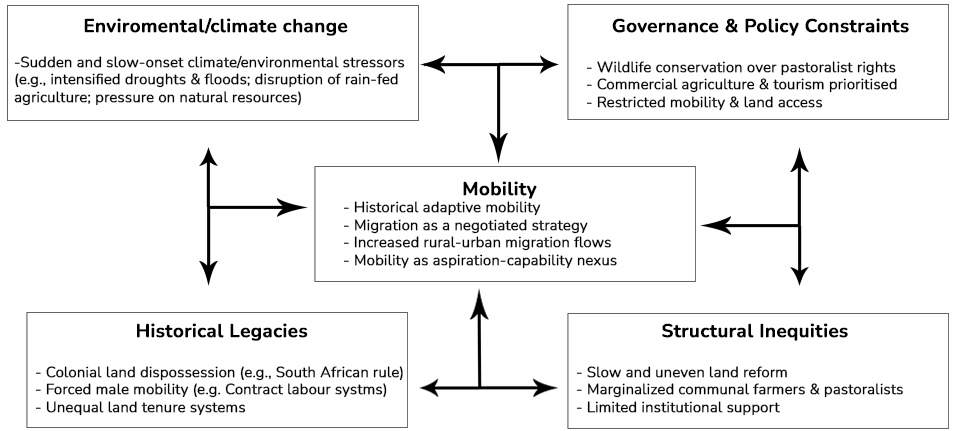
These vulnerabilities, rooted in historical processes of colonial land dispossession, apartheid-era spatial segregation, and post-independence land reform failures, have resulted in highly unequal access to land and productive resources, particularly among indigenous and rural populations. Moreover, contemporary governance systems, marked by fragmented institutional support, insufficient investment in rural infrastructure, and top-down policy approaches, further limit local adaptive capacity and amplify the impact of climatic variability. In this context, mobility emerges not merely as an emergency reaction but as a strategically negotiated adaptation, often drawing on longstanding cultural practices such as pastoralist transhumance, cyclical labour migration, and multi-sited livelihoods. Such practices reflect not only resilience and innovation but also agency and intergenerational knowledge, rather than passive victimhood.
The framework proposed critiques dominant international narratives that isolate climate as a discrete cause of migration, illustrating instead how systemic marginalisation and unequal development trajectories shape both the capacity to adapt and the decision to move. The study advocates for a justice-oriented, historically grounded, and context-sensitive approach to understanding climate-related mobility. By integrating local knowledge systems, addressing structural inequalities, and recognising the agency of affected communities, scholars and policymakers alike can move beyond crisis-driven, humanitarian framings that often obscure the deeper systemic drivers of vulnerability and displacement. Such an approach not only enriches our understanding of mobility in climate-vulnerable settings like Namibia but also challenges prevailing global policy paradigms that universalise the figure of the climate migrant without adequately accounting for localised complexities and historical legacies. The deconstruction of the environmental refugee myth and the rejection of reductionist crisis narratives are essential steps toward a decolonial approach to climate-migration policy. Such a framework recognises migration not as a symptom of failure, but as a legitimate and often necessary form of adaptation within broader systems of historical, political, and ecological transformation.
Within this reframing, as an alternative to the reductionist notion of the climate refugee, the concept of the Adaptive Migrant is proposed as an active and strategic agent who employs mobility as a deliberate adaptation strategy. Ultimately, climate-induced migration is best understood as a deeply social and political process, shaped by an interplay of environmental pressures, structural inequalities, and adaptive strategies. Future research and policy must move beyond reductionist, climate-centric models and instead develop integrated frameworks that recognise the multiplicity of factors shaping human mobility in the context of environmental change. Only by addressing the historical roots of vulnerability and amplifying local voices can climate adaptation policies and migration governance become truly effective, equitable, and sustainable.
Acknowledgements
The study benefited from the PRIN 2022 project JUSTAINABILITY - Just sustainability. Rhizomatic social innovations, transformative knowledge, and prefigurative practices for a just transition - 2022HKE2CY.
References
Abbot, M. L., & McKinney, J. (2013). Understanding and applying research design. John Wiley & Sons, Inc.
Abhinav, A., Arjun, K., & Simi, M. (2020). Interlinkages between urbanization and climate change: Identifying and understanding the challenges and the prospects. Journal of Regional and City Planning, 31(3), 285-300. https://doi.org/10.5614/jpwk.2020.31.3.4
Adams, H. (2016). Why populations persist: mobility, place attachment and climate change. Population Environment, 37, 429-448. https://doi.org/10.1007/s11111-015-0246-3
Adger, W. N. (2000). Social and ecological resilience: are they related? Progress in Human Geography, 24(3), 347-364. https://doi.org/10.1191/030913200701540465
Afifi, T., Milan, A., Etzold, B., Schraven, B., Rademacher-Schulz, C., Sakdapolrak, P., Reif, A., van der Geest, K., & Warner, K. (2016). Human mobility in response to rainfall variability: opportunities for migration as a successful adaptation strategy in eight case studies. Migration and Development, 5(2), 254-274. https://doi.org/10.1080/21632324.2015.1022974
Arnall, A. (2018). Resettlement as climate change adaptation: what can be learned from state-led relocation in rural Africa and Asia? Climate and Development, 11(3), 253-263. https://doi.org/10.1080/17565529.2018.1442799
Awil, M., Alpha, K., & Sönke, K. (2024, April 4). Climate change, development, and migration: an African Diaspora perspective. Germanwatch. https://www.germanwatch.org/sites/default/files/publication/9112.pdf
Barnett, J., & Adger, W. N. (2007). Climate change, human security and violent conflict. Political Geography, 26(6), 639-655. https://doi.org/10.1016/j.polgeo.2007.03.003
Bates, D. C. (2002). Environmental refugees? Classifying human migrations caused by environmental change. Population and Environment, 23(5), 465-477. http://www.jstor.org/stable/27503806
Benjaminsen, T. A., & Ba, B. (2009). Farmer–herder conflicts, pastoral marginalisation and corruption: A case study from the inland Niger delta of Mali. Geographical Journal, 175(1), 71-81. https://doi.org/10.1111/j.1475-4959.2008.00312.x
Bettin, G., Jallow, A., & Zazzaro, A. (2025). Responding to natural disasters: What do monthly remittance data tell us? Journal of Development Economics, 174, 103413. https://doi.org/10.1016/j.jdeveco.2024.103413
Bettini, G. (2013). Climate barbarians at the gate? A critique of apocalyptic narratives on “climate refugees”. Geoforum, 45, 63-72. https://doi.org/10.1016/j.geoforum.2012.09.009
Black, R. (2001). Environmental Refugees: Myth or Reality (Working Paper no. 34). United Nations Refugee Agency.
Black, R., Adger, W. N., Arnell, N. W., Dercon, S., Geddes, A., & Thomas, D. (2011a). The effect of environmental change on human migration. Global Environmental Change, 21(1), 3-11. https://doi.org/10.1016/j.gloenvcha.2011.10.001
Black, R., Bennett, S. R. G., Thomas, S. M., & Beddington, J. R. (2011b). Migration as adaptation. Nature, 478, 447-449. https://doi.org/10.1038/478477a
Boas, I. (2014). Climate migration and security: Securitisation as a strategy in climate change politics. Routledge.
Boas, I., Farbotko, C., Adams, H., Sterly, H., Bush, S., van der Geest, K., & Baldwin, A. (2019). Climate migration myths. Nature Climate Change, 9(11), 901-903. https://doi.org/10.1038/s41558-019-0633-3
Bohle, H. G., Downing, T. E., & Watts, M. J. (1994). Climate change and social vulnerability: Toward a sociology and geography of food insecurity. Global Environmental Change, 4(1), 37-48. https://doi.org/10.1016/0959-3780(94)90020-5
Bryant, A., & Charmaz, C. (2020). The SAGE Handbook of Current Developments in Grounded Theory. SAGE Publications Ltd. https://doi.org/10.4135/9781526485656
Brzoska, M., & Fröhlich, C. (2016). Climate change, migration and violent conflict: vulnerabilities, pathways and adaptation strategies. Migration and Development, 5(2), 190-210. https://doi.org/10.1080/21632324.2015.1022973
Call, M. A., Gray, C. M. Y., & Emch, M. (2017). Disruption, not displacement: Environmental Variability and temporary migration in Bangladesh. Global Environmental Changes, 46, 157-165. https://doi.org/10.1016/j.gloenvcha.2017.08.008
Carling, J. (2002). Migration in the age of involuntary immobility: Theoretical reflections and Cape Verdean experiences. Journal of Ethnic and Migration Studies, 28(1), 5-42. https://doi.org/10.1080/13691830120103912
Carling, J., & Collins, L. (2018). Aspiration, desire and drivers of migration. Journal of Ethnic and Migration Studies, 44(6), 909-926. https://doi.org/10.1080/1369183X.2017.1384134
Caruso, I., & Venditto, B. (2011). Le migrazioni ambientali nel Mediterraneo: il caso studio dei paesi del Medio Oriente e del Nord Africa. In C. G. Bruno, I. Caruso, M. Sanna & I. Vellecco (eds.), Percorsi Migranti (pp. 115-130). McGrow-Hill.
Caruso, I., & Venditto, B. (2012). Il futuro del Mediterraneo. Studio preliminare sui rifugiati ambientali. In M. A. Valleri, R. Pace & S. Girone (eds.), Il Mediterraneo: uno studio e una passione. Scritti in onore di Luigi Di Comite (pp. 251-269). Cacucci Ed.
Christian Aid. (n. d.). The climate of poverty: Facts, fears and hope. Christian Aid. https://www.friendsoftheearth.ie/assets/files/pdf/christian_aid_climate_change_brief.pdf
Christian Aid. (2007, May 14). Human tide: The real migration crisis. Christian Aid. https://reliefweb.int/report/colombia/human-tide-real-migration-crisis-christian-aid-report
de Haas, H. (2021). A theory of migration: The aspirations–capabilities framework. Comparative Migration Studies, 9(1), 1-35. https://doi.org/10.1186/s40878-020-00210-4
Diallo, Y. (2001). Processes and types of pastoral migration in northern Côte D’ivoire. In R. Dijk, D. Foeken & M. Bruijn (eds.), Mobile Africa: Changing Patterns of Movement in Africa and Beyond (pp. 153-168). Brill. https://brill.com/edcollbook/title/7568?srsltid=AfmBOoqQVcb31VP2gZQEosckLeDrn0M2TDt8leSK3zFjiSfTOCcY-Tao
Du Pisani, A. (2000). State and society under South African rule. In C. Keulder (ed.), State and society in Namibia (pp. 24-56). Gamsberg Macmillan.
El-Hinnawi, E. (1985). Environmental Refugees (Working Paper no. 34). United Nations Environment Programme. https://digitallibrary.un.org/record/121267/files/UNEP%2802%29_E52-E.pdf
Entwisle, B., Verdery, A., & Williams, N. (2020). Climate change and migration: New insights from a dynamic model of outmigration and return migration. American Journal of Sociology, 25(6), 1469-1512. https://www.journals.uchicago.edu/doi/10.1086/709463
Farbotko, C. (2023, February 2). Conceptualising resistance to climate mobility: Re-emplacement and anti-displacement mobilities. Researching Internal Displacement. https://researchinginternaldisplacement.org/short_pieces/conceptualising-resistance-to-climate-mobility-re-emplacement-and-anti-displacement-mobilities/
Farmer, P. (2004). Pathologies of power: Health, human rights, and the new war on the poor. University of California Press. http://www.jstor.org/stable/10.1525/j.ctt1pnznf
Frayne, B., & Pendleton, W. (2002). Mobile Namibia: Migration Trends and Attitudes (Migration Policy Series no. 27). Southern African Migration Project. https://samponline.org/wp-content/uploads/2016/10/Acrobat27.pdf
Giddens, A. (1991). Modernity and self-Identity. Self and society in the late modern age. Polity.
Giddens, A. (1984). The constitution of society: Outline of the theory of structuration. University of California Press.
Greiner, C. (2013). Guns, land, and votes: Cattle rustling and the politics of boundary (re)making in Northern Kenya. African Affairs, 112(447), 216-237. https://doi.org/10.1093/afraf/adt003
Hartmann, B. (2010). Rethinking climate refugees and climate conflict: Rhetoric, reality and the politics of policy discourse. Journal of International Development, 22(2), 233-246. https://doi.org/10.1002/jid.1676
Hausfather, Z. (2017). Why scientists think 100% of global warming is due to humans. Carbon Brief. https://www.carbonbrief.org/analysis-why-scientists-think-100-of-global-warming-is-due-to-humans/
Henley, J. (2020, September 9). Climate crisis could displace 1.2bn people by 2050, report warns. The Guardian. https://www.theguardian.com/environment/2020/sep/09/climate-crisis-could-displace-12bn-people-by2050-report-warns
Hishongwa, N. S. (1992). The contract labour system and its effects on family and social life in Namibia: A historical perspective. Macmillan.
Høeg, E., & Tulloch, C. D. (2018). Sinking strangers: Media representations of climate refugees on the BBC and Al Jazeera. Journal of Communication Inquiry, 43(3), 225-248. https://doi.org/10.1177/0196859918809486
International Association for the Study of Forced Migration. (n. d.). Mission of the IASFM. https://www.efms.uni-bamberg.de/iasfm/mission.htm
International Displacement Monitoring Centre. (2024). Global report on internal displacement. https://www.internal-displacement.org/global-report/grid2023/
International Organization for Migration. (2007). Discussion note: migration and the environment. https://environmentalmigration.iom.int/sites/g/files/tmzbdl1411/files/MC_INF_288.pdf
Jacobson, J. L. (1988). Environmental refugees: A Yardstick of habitability. Bulletin of Science, Technology & Society, 8(3), 257-258. https://doi.org/10.1177/027046768800800304
Kaufmann, V., Bergman, M. M., & Joye, D. (2004). Motility: mobility as capital. International Journal of Urban and Regional Research, 28(4), 745-756. https://doi.org/10.1111/j.0309-1317.2004.00549.x
Latham, K. (2024). Social mobility and opportunity: What the public thinks (Research brief). The Sutton Trust. https://www.suttontrust.com/wp-content/uploads/2024/05/Social-mobility-and-opportunity-What-the-public-thinks.pdf
Legal Assistance Centre for the Delegation of the European Union to Namibia. (2017). Namibia gender analysis 2017. https://www.lac.org.na/projects/grap/Pdf/Namibia_Gender_Analysis_2017.pdf
Lustgarten, A. (2020a, July 23). The great climate migration. The New York Times Magazine. https://www.nytimes.com/interactive/2020/07/23/magazine/climate-migration.html
Lustgarten, A. (2020b, September 15). How climate migration will reshape America. The New York Times Magazine. https://www.nytimes.com/interactive/2020/09/15/magazine/climate-crisis-migration-america.html
McAdam, J. (2012). Climate change, forced migration, and international law. Oxford University Press. https://doi.org/10.1093/acprof:oso/9780199587087.001.0001
McLeman, R., & Smit, B. (2006). Migration as an adaptation to climate change. Climatic Change, 76, 31-53. https://doi.org/10.1007/s10584-005-9000-7
Melber, H. (2014). Understanding Namibia: The trials of independence. Hurst.
Mendelsohn, J., Jarvis, A., Roberts, C., & Robertson, T. (2006). Atlas of Namibia: A portrait of the land and its people. Sunbird Publishers.
Methmann, C., & Oels, A. (2015). From ‘fearing’ to ‘empowering’ climate refugees: Governing climate-induced migration in the name of resilience. Security Dialogue, 46(1), 51-68. https://doi.org/10.1177/0967010614552548
Mwetulundila, P. N. (2021). Gender perspectives in Namibia’s communal Land: Exploring women’s hindrances to equitable land ownership. Journal of Asian and African Studies, 57(3), 481-496. https://doi.org/10.1177/00219096211020486
Myers, N. (2002). Environmental refugees: A growing phenomenon of the 21st Century. Philosophical Transactions of the Royal Society B, 357, 609-613. https://pmc.ncbi.nlm.nih.gov/articles/PMC1692964/
Naeem, M., Ozuem, W., Howell, K., & Ranfagni, S. (2023). A step-by-step process of thematic analysis to develop a conceptual model in qualitative research. International Journal of Qualitative Methods, 22. https://doi.org/10.1177/16094069231205789
Namibia Statistics Agency. (2024). Namibia 2023: Population and housing census. https://nsa.org.na/census/wp-content/uploads/2024/10/2023-Population-and-Housing-Census-Main-Report-28-Oct-2024.pdf
Namwater. (n. d.). Our Services. https://www.namwater.com.na/index.php/services/56-hydrological%20services?showall=1#:~:text=four%20Northern%20Regions.,EVAPORATION,through%20evaporation%20within%20one%20season
National Aeronautics and Space Administration. (2025). Global climate change: Facts, 2025. https://climate.nasa.gov/vital-signs/global-temperature/
National Research Council. (2020). Climate change: evidence and causes: Update 2020. The National Academies Press. https://nap.nationalacademies.org/catalog/25733/climate-change-evidence-and-causes-update-2020
Newsham, A., & Thomas, D. S. G. (2009). Agricultural adaptation, local knowledge and livelihoods diversification in North-Central Namibia (Working Paper no. 140). Tyndall Centre for Climate Change Research. https://tyndall.ac.uk/publications/agricultural-adaptation-local-knowledge-and-livelihoods-diversification-north-central-namibia/
Olwage, E. (2024). The politics of authority, belonging and mobility in disputing land in southern Kaoko. In S. Sullivan, U. Dieckmann & S. Lendelvo (eds.), Etosha Pan to the Skeleton cost. Conservation histories, policies and practices in North-west Namibia (pp. 191-217). Open Book Publisher. https://doi.org/10.11647/OBP.0402
Palmer, R., & Parson, N. (1983). The roots of rural poverty in central and southern Africa. Heinemann.
Paprocki, K. (2018). All that is solid melts into the bay: Anticipatory ruination and climate change adaptation. Antipode, 51(1), 295-315. https://doi.org/10.1111/anti.12421
Pérez-Segura, V., Caro-Carretero, R., & Rua, A. (2025). The elusive climate migrant: symbolic geographies in migration studies. Comparative Migration Studies, 13(64), 1-18. https://doi.org/10.1186/s40878-025-00489-1
Puig-Cepero, O. (2025). The central Sahel: Climate change, migration and conflict. Revista de Estudios Globales, Análisis Histórico y Cambio Social, 4(8), 65-86. https://doi.org/10.6018/reg.651821
Ranieri, L. (2022). Drought, desertification and displacement: Re-politicising the climate-conflict nexus in the Sahel (IAI Papers no. 4). Istituto Affari Internazionali. https://www.iai.it/sites/default/files/iaip2204.pdf
Reuveny, R. (2005). Environmental change, migration and conflict: Theoretical analysis and empirical explorations [Paper]. Human Security and Climate Change, International Workshop, Asker. https://climateaction.re.kr/?module=file&act=procFileDownload&file_srl=16376&sid=1070a088fa3515b4d835bb1445cf39e8
Reuveny, R. (2007). Climate change-induced migration and violent conflict. Political Geography, 26(6), 656-673. https://doi.org/10.1016/j.polgeo.2007.05.001
Ribot, J. (2011). Vulnerability before adaptation: Toward transformative climate action. Global Environmental Change, 21(4), 1160-1162. https://doi.org/10.1016/j.gloenvcha.2011.07.008
Rutten, M., & Verstappen, S. (2014). Middling migration: Contradictory mobility experiences of Indian youth in London. Journal of Ethnic and Migration Studies, 40(8), 1217-1235. https://doi.org/10.1080/1369183X.2013.830884
Scoones, I. (2023). Pastoralism, uncertainty and development. Practical Action Publisher.
Schewel, K. (2019). Understanding immobility: Moving beyond the mobility bias in migration studies. International Migration Review, 54(2), 328-355. https://doi.org/10.1177/0197918319831952
Sen, A. (1999). Development as Freedom. Oxford University Press.
Sheller, M. (2018). Mobility justice: The politics of movement in an age of extremes. Verso Books. https://doi.org/10.1080/2325548X.2020.1760059
Shikangalah, R. N. (2020). The 2019 drought in Namibia: An overview. Journal of Namibian Studies, 27, 37-58.
Smalley, R., & Corbera, E. (2012). Large-scale land deals from the inside out: Findings from Kenya's Tana Delta. Journal of Peasant Studies, 39(3-4), 1039-1075. https://doi.org/10.1080/03066150.2012.686491
Suliman, S., Farbotko, C., Ransan-Cooper, H., McNamara, K. E., Thornton, F., McMichael, C., & Kitara, T. (2019). Indigenous (im)mobilities in the Anthropocene. Mobilities, 14(2), 1-21. https://doi.org/10.1080/17450101.2019.1601828
Thiede, B. C., & Gray, C. L. (2017). Erratum to: Heterogeneous climate effects on human migration in Indonesia. Population and Environment, 39, 173-95. https://doi.org/10.1007/s11111-017-0282-2
Trilling, D. (2020, August 28). Flag, faith and fear for the planet - how the far right is exploiting climate change for its own ends. Prospect Magazine. https://www.prospectmagazine.co.uk/essays/40530/flag-faith-and-fear-for-the-planethow-the-far-right-is-exploiting-climate-change-for-its-own-ends
Trolldalen, J. M., Birkeland, N., Borgen, J., & Scott, P. T. (1992). Environmental refugees: A discussion paper. World Foundation for Environment and Development: Norwegian Refugee Council. https://search.worldcat.org/nl/title/Environmental-refugees-:-a-discussion-paper/oclc/55520754
United Nations High Commissioner for Refugees. (2024). No escape: On the frontlines of climate change, conflict and forced displacement. https://www.unhcr.org/sites/default/files/styles/edge2edge_h650/public/RF1278006.webp?h=af00ab36&itok=OGKz1lP7&t=1731325255
van Rensburg, P., & Tortajada, C. (2021). An assessment of the 2015-2017 drought in Windhoek. Frontiers in Climate, 3, 602962. https://doi.org/10.3389/fclim.2021.602962
Venditto, B., Kamwanyah, N. J., & Nekare, C. H. (2022). Climate change, migration and urbanisation in contemporary Namibia (Working Paper no. 14). Società Italiana di Economia dello Sviluppo. https://www.sitesideas.org/wp-content/uploads/2022/10/Sites_wp14.pdf
Venditto, B. (2019). The construction of the self: Narrative of rural migration in contemporary Namibia. Africa: Rivista semestrale di studi e ricerche, 1(2), 97-118. https://www.jstor.org/stable/48684736
Wallace, M., & Kinahan, J. (2011). A history of Namibia. CTP Book Printer.
Werner, W., & Odendaal, W. (2010). Livelihoods after land reform: Namibia country report. Land, Environment and Development Project Legal Assistance Centre. http://www.lac.org.na/projects/lead/Pdf/livelihoods.pdf
Winterfeldt, V. (2002). Labour migration in Namibia. Gender aspects. In V. Winterfeldt, T. Fox & P. Mufune (eds.), Namibia, Society, Sociology (pp. 39-74). University of Namibia Press.
World Bank. (n. d.). World Bank country and lending groups. https://datahelpdesk.worldbank.org/ knowledgebase/articles/906519-world-bank-country-and-lending-groups
Worldmeter. (n. d.). World population: Namibia. https://www.worldometers.info/world-population/namibia-population/
Yumagulova, L., Parsons, M., Yellow Old Woman-Munro, D., Dicken, E., Lambert, S., Vergustina, N., Scott, J. C., Michell, P., & Black, W. (2023). Indigenous perspectives on climate mobility justice and displacement-mobility-immobility continuum. Climate and Development, 1-18. https://doi.org/10.1080/17565529.2023.2227158
Zickgraf, C. (2018). Keeping people in place: Political factors of (im)mobility and climate change. Social Science, 8(8), 228. https://doi.org/10.3390/socsci8080228
Appendix 1
This appendix presents the three primary datasets that form the empirical foundation for this article, developed and analyzed between 2017 and 2023.
Set 1: Data extracted from a larger dataset originally compiled for the PhD thesis “Human mobility and Namibian family transformation: an analysis of socio-economic development and family-migrant connections in contemporary Namibia.”
Source: Venditto, B. (2018). Human mobility and Namibian family transformation: an analysis of socio-economic development and family-migrant connections in contemporary Namibia (Doctoral thesis). University of Namibia.
Set 2: Data utilized for the article “Climate change, migration and urbanisation in contemporary Namibia.”
Source: Venditto, B., Kamwanyah, N. J., & Nekare, C. H. (2022). Climate change, migration and urbanisation in contemporary Namibia (Working Paper no. 14). Società Italiana di Economia dello Sviluppo. https://www.sitesideas.org/wp-content/uploads/2022/10/Sites_wp14.pdf
Set 3: Data employed for the article “Trapped in Poverty and Informality: The Effects of Climate Change-Induced Migration on Women in Urban Settlements in Windhoek.”
Source: Venditto, B., Nekare, C., & Kamwanyah, N. J. (2023). Trapped in poverty and informality: The effects of climate change-induced migration on women in urban settlements in Windhoek. Namibian Journal of Social Justice, 3, 136-167). https://namsocialjustice.org/docs/article-editorial/s1741345466.pdf
Set 1
| R | Gender | Age | Type of work in urban area | Region |
|---|---|---|---|---|
| 1 | Male | 30 | Formal | Omusati |
| 2 | Male | 35 | Formal/but temporary | Oshikoto |
| 3 | Female | 22 | Formal/but temporary | Omusati |
| 4 | Male | 34 | Formal/but temporary | Erongo |
| 5 | Male | 31 | Formal/but temporary | Oshana |
| 6 | Female | 33 | Formal/but temporary | Omusati |
Set 2
| R | Gender | Age | Type of work in urban area | Region |
|---|---|---|---|---|
| 7 | Male | 49 | Formal | Kavango East |
| 8 | Female | 38 | Informal | Kavango East |
| 9 | Female | 25 | Informal | Kavango West |
| 10 | Female | 53 | Informal | Kavango West |
| 11 | Female | 24 | Informal | Kavango West |
| 11 | Male | 37 | Informal | Kavango West |
| 13 | Male | 27 | Formal | Kavango West |
| 14 | Female | 23 | Informal | Oshikoto |
| 15 | Male | 26 | Formal | Ohangwena |
| 16 | Female | 35 | Informal | Zambezi |
| 17 | Female | 29 | Informal | Omusati |
| 18 | Male | 28 | Informal | Oshana |
| 19 | Female | 30 | Informal | Oshana |
Set 3
| R | Age | Level of Education | Region of origin |
|---|---|---|---|
| 20 | 41 | G10 (fail) | Kunene |
| 21 | 31 | G10 | Ohangwena |
| 22 | 27 | G10 (fail) | Kavango West |
| 23 | 28 | G9 | Kavango West |
| 24 | 25 | G10 | Kavango West |
| 25 | 35 | G12 | Kavango West |
| 26 | 43 | G12 | Omusati |
| 27 | 48 | G3 | Kavango West |
| 28 | 46 | G4 | Kavango West |
| 29 | 38 | G9 | Kavango East |
| 30 | 30 | G12 | Oshikoto |
| 31 | 40 | G8 | Ohangwena |
| 32 | 34 | G10 | Oshana |
| R | Age | Level of Education | Region of origin |
|---|---|---|---|
| 33 | 82 | G3 | Omusati |
| 34 | 81 | G6 | Omusati |
| 35 | 37 | G10 | Ohangwena |
| 36 | 88 | None | Ohangwena |
| 37 | 70 | G1 | Kavango East |
| 38 | 65 | None | Kavango East |
| 39 | 55 | G10 | Kavango West |
| 40 | 43 | G10 | Kavango West |