Movilidades interconectadas y extractivismo minero en la provincia del Napo (Ecuador). Una contribución desde el nuevo paradigma de la movilidad a la ecología política


Various studies show that territories dominated by extractive economies have a particular relationship with population movements. However, this is often seen as a side effect, whether in terms of the expulsion of inhabitants or the attraction of workers. Drawing on the dialogue between political ecology and the New Mobility Paradigm, I propose a new perspective in which mobility is not presented as a simple consequence of extractivism. Through ethnographic research conducted in the province of Napo (Ecuadorian Amazon), based on observations in four mining areas, 13 semi-structured interviews, and 11 informal interviews with workers, environmental activists, local authorities, and community leaders, I argue that mobility constitutes and shapes extractivism. Analysing this phenomenon allows for a better understanding of the complex interconnections that are taking place between Napo, other Ecuadorian provinces, and countries in the region, as well as the profound transformation that their territories are undergoing in both physical and social terms.
Diversas investigaciones muestran que los territorios dominados por economías extractivas mantienen una relación particular con los movimientos de población. Sin embargo, estos suelen mencionarse como un efecto secundario, ya sea en términos de expulsión de habitantes o de atracción de trabajadores. Desde el diálogo entre la ecología política y el nuevo paradigma de la movilidad propongo una nueva mirada en la que la movilidad no se presenta como una simple consecuencia del extractivismo. Mediante la realización de una etnografía en la provincia del Napo (Amazonía ecuatoriana), basada en observaciones en cuatro zonas mineras, 13 entrevistas semiestructuradas y 11 entrevistas informales con trabajadores, activistas medioambientales, autoridades locales y líderes comunitarios, argumento que la movilidad constituye y da forma al extractivismo. Esta perspectiva permite comprender mejor las interconexiones complejas que se están produciendo entre el Napo, otras provincias ecuatorianas y países de la región, así como la profunda transformación de sus territorios en términos físicos y sociales.

Extractive economies; mining; mobility; political ecology; Ecuadorian Amazon
Economía extractiva; minería; movilidades; ecología política; Amazonía ecuatoriana

1. Introduction
On February 12, 2022, after more than a year of complaints filed by various environmental organisations and the FOIN (Federación de Organizaciones Indígenas del Napo), a major military operation was carried out against illegal mining in the area known as Yutzupino, located just ten minutes by car from Tena, the capital of the province of Napo (Ecuador). The dismantling of the mining area and the seizure of 148 bulldozers (out of more than 340 operating in the area) brought to light for the first time at a national level the devastation caused by small-scale gold mining in this Amazonian province of Ecuador.1
The affected area is part of a zone of incalculable ecological value: the confluence of two large rivers, the Jatunyaku and the Anzu, which results in one of the upper Amazon basin’s main influxes, the Napo River. The images disseminated in the media and investigative journalism portals (Mongabay, 2022; Labarraespaciadora, 2023) are shocking due to the violence embodied in the extractive activity: a landscape completely devoid of vegetation cover, riddled with craters of murky water and piles of ground and stones in constant risk of collapse. Equally striking is the number of people involved in the extraction (between 2,000 and 4,000 at its peak, between October 2021 and February 2022) as well as the conditions in which the activity takes place: overcrowding inside the craters and around the machinery, a total lack of safety, and piecework day and night.
The literature on mining extractivism in Ecuador, particularly in the Amazon region (Melo et al., 2013; van Teijlingen et al., 2017; Lalander et al., 2020; Bayón et al., 2020; Lyall, 2021; Mestanza Ramón et al., 2022; Medina Bueno et al., 2023; Cañar & Loor, 2023; Lyall & Ruales, 2025), addresses the issue from three main perspectives. The first focuses on Ecuador’s historical process of dependent integration into the global capitalist economy as a chronic exporter of raw materials. The second focuses on the social and environmental impacts of extractivism in contexts of high ecosystem and social fragility. The third examines the conflicts caused by these activities, as well as the resistance that has emerged from the affected territories.
However, this set of approaches omits a key issue: the impossibility of the extractive economic model functioning without considering its mobile nature. The case of Yutzupino illustrates this symbiotic relationship—the idea of mining sites as mobile spaces—because for it to occur, there had to be constant movement of machinery, materials, minerals, capital, and, crucially, populations. The specific dynamics of movement that accompany the latter and the effects they produce on the territory become the focus of this research.
To this end, this work is theoretically anchored in “The New Mobilities Paradigm” (Sheller & Urry, 2006; Cresswell, 2006; Urry, 2007) and, from there, it seeks to contribute to the field of Latin American political ecology. The intention is to fuel the debates on the power relations between nature and society that manifest themselves through the extractive economy, incorporating mobility as a constitutive factor of extractivism. This leads to a more complex understanding of the ecological conflict and the ways in which it manifests itself and expands.
Using this analytical framework, I conducted ethnographic research between April and May 2025 in four areas of the province of Napo. The starting point was the community of Yutzupino, as this case allowed me to investigate the temporal and spatial expansion of small-scale gold mining—both legal and illegal—throughout the province.
Through this fieldwork I argue that the extractive economic model is produced by and produces population movements, causing the two phenomena to merge and multiply predatory and accumulation processes in work, daily life, and the territory. From this more holistic perspective, I point out, firstly, that the mobilities linked to the mining activity in Napo cannot be understood from a cause-and-effect perspective, reducing them to a unidirectional vision: expulsion/attraction, but rather they occur simultaneously, even generating circularities. Secondly, these mobilities involve a diversity of populations participating in the activity in very unequal ways—according to social class, ethnicity, gender or nationality—which complicates the ways in which socio-ecological conflict manifests itself. Finally, these mobilities enable the connection of territories, in this case, the province of Napo, with other Ecuadorian provinces and several Latin American countries, contributing to the production of vast extractive regions where workers, capital, machinery, and minerals circulate incessantly.
2. Theory: Contributions of the Critical Paradigm of Mobilities to Political Ecology
Studies on extractivism in Latin America have undergone significant development in just two decades, coinciding with the renewed developmentalist momentum that has swept the region since the beginning of the 21st century (Gudynas, 2013, 2015; Raftopoulos, 2017; Svampa, 2019). This is a dynamic and interdisciplinary field of research in which various thematic lines and analytical frameworks can be distinguished. On the one hand, the studies focusing on the environmental, economic, and social impacts of extractivism are common, in a similar way to the conflicts triggered by this model of accumulation, and the multiple forms of resistance to dispossession, pollution, and the loss of cultural heritage, many of them led by peasant, indigenous, and Afro-descendant populations (Acosta, 2011; Composto, 2012; Veltmeyer, 2016; Villarreal Villamar et al., 2018).
On the other hand, critical geography and political economy stand out as analytical fields, centred on the idea of accumulation by dispossession (Harvey, 2004). In addition to the aforementioned fields, the Latin American political ecology plays a significant role. This focuses on the power practices involved in processes of knowing and intervening in nature, as well as the conflicts and resistances emerging from the hegemonic development model that has historically shaped the region (Leff, 2003; Martínez Alier, 2008; Gudynas, 2013; Alimonda, 2015, Moreano et al., 2017).
However, a more detailed review of this latter literature reveals some gaps. Namely, I emphasise that a significant number of studies employing the political ecology framework in Latin America to analyse extractivism—specifically mining—tend to overlook its close relationship with mobility (Delgado Ramos, 2013; Martínez Alier 2015; Romero and Gutiérrez, 2017). This does not imply denying the relevance of mobilities in understanding extractive dynamics, but rather that it is rarely positioned as a central analytical concern (Bayón et al., 2021; Uribe Sierra & Mansilla Quiñones, 2022).
In the few studies where it does appear as the focus of debate, it is usually addressed as an effect of the implementation of the extractive model and the resulting socio-territorial conflicts. In other words, the movement of people is understood as a subordinate or incidental phenomenon, rather than as a constitutive element of extractivism, which in turn generates much deeper effects on the physical and social transformation of the territory.
The most evident manifestation of this tendency is that studies on the topic typically portray population movements in dichotomous terms. On one hand, there are processes of expulsion—forced displacements of peasant, Indigenous, and Afro-descendant communities resulting from dispossession—(González, 2010; Figueroa, 2017; Hernández, 2018; Uribe Sierra & Mansilla Quiñones, 2022); and on the other hand, there are processes of attraction linked to labour migration (Saldomando, 2015; Stefoni et al., 2017; Stefoni, Stang, & Rojas, 2022). These dynamics are usually analysed in isolation, even though they occur simultaneously. Indeed, both can manifest within the same population or result in situations of immobility.
To address these limitations, I propose drawing on the New Mobilities Paradigm (Sheller & Urry, 2006) to enrich the Latin American political ecology’s approaches to the power relations and socio-territorial disputes underlying capitalist intervention in nature. From this perspective, I contend that an analysis of extractivism cannot overlook one of the key elements explaining its internal mechanisms of expansion, its radical transformations in the territory, and the types of disputes it generates: mobility.
The New Mobilities Paradigm places mobility at the centre of social life. Mobility ceases to describe merely spatial displacement and instead becomes understood as a practice that produces and transforms space. Moreover, since capitalist accumulation sets the pace of mobility, it reflects the power relations and asymmetries that shape our societies regarding who can move and who cannot, as well as how and through which routes movement takes place (Bayón et al., 2021, p. 108; Cresswell, 2006, 2010).
From this perspective, I draw on Sheller’s (2018) proposal regarding the “constitutive role of movement” in social life, and I argue that mobility is not a consequence or collateral effect of mining extractivism, but rather a structural component of it (Himley et al., 2024). This recognition makes it possible to understand that mobility not only shapes extractive localities and regions but also underpins many of the conflictive and unequal dynamics that characterise this economic model.
Recognizing that extractivism depends on both mobility and immobility for its functioning, I also seek to move beyond the specific model of conflict present in political ecology, where actors are usually represented through dichotomous categories: internal/external; favourable/opposed, destroyers/protectors of nature (Moreano et al., 2017). From this perspective, the conflict that extractivism faces takes on a polymorphic character, as power relations unfold in multiple layers and among diverse populations that coexist in the territories, with divergent and not always clearly defined interests.
This complexity is also rooted in the history of the territories and the economic, political, and social dynamics that precede mining extractivism, as well as in the dense networks of relationships that connect the local with other national and international spaces. In this way, extractive regions are formed, defined by their spatial discontinuity and by the mobility of thousands of people who find a source of economic livelihood or a form of enrichment in this activity, while at the same time land is being dispossessed and other populations are being forcibly displaced. These regions can be understood, according to Tarrius (1993), as “circulatory territories” in which expulsions and attractions feed back into and articulate with each other, making movement an essential component in the reproduction of the economic model, and at the same time a main vector in the configuration of conflicts and dynamics of resistance.
3. The Challenges of Conducting Ethnographic Research in Unsafe and Violent Territories
The methodological development of this research cannot be understood without considering the context of violence and insecurity in which I carried it out. Since the COVID-19 pandemic, the mining boom has multiplied the number of places affected by extractivism in Ecuador and other neighbouring countries. Furthermore, its development has been cloaked in a veil of illegality, protected by widespread institutional corruption and the growing presence of armed actors seeking to control it. This situation has made ethnographic research increasingly difficult and security a determining factor in the fieldwork.
The issue of safety must also be examined from a critical perspective that considers how colonialism, racism, and patriarchy subtly permeate ethnographic practice, affecting both research subjects and researchers (Berry et al., 2017; Hanson & Richards, 2019). In the specific context of this research, marked by very violent daily interactions and hidden, remote and masculinised workspaces, my position as a middle-aged European woman played an important role in determining which places I could access, who I could talk to, and who I could be accompanied by. This led me, for example, to conduct the fieldwork together with a research assistant, whose presence was key in terms of safety and in consolidating contacts.
The complexity of the terrain also takes shape in the tension and instability that the province of Napo is experiencing at the time of the fieldwork, manifesting itself in three situations. Firstly, the inability to access the extraction sites—the “mining fronts”—due to explicit or veiled threats from armed actors whose identity could not always be clearly determined beforehand. Secondly, the mistrust of many indigenous communities which, once they accept or are forced to allow mining into their territories, restrict access to outsiders. Finally, on May 9, 2025, an ambush took place on the Punino River—the border between the provinces of Napo and Orellana—in which 11 soldiers were killed during an operation against illegal mining (Mongabay, 2025). According to some informants, the attack was carried out by residents, mine workers, and members of the armed group “Comandos de la Frontera,” a dissident faction of the Revolutionary Armed Forces of Colombia (FARC) active in the northern Ecuadorian Amazon. This event led to the militarisation of the province and an increase in mistrust, forcing the premature closure of the fieldwork.
All the above forced us to constantly adapt the research strategies to anticipate potential risk. For example, during most visits to mining sites, ethnography was conducted covertly, using tourism as a protection. At the same time, the palpable tension and the constant insecurity meant that we had to accept that the data collection would have to be carried out through local actors but not all directly involved in mining activity. For example, we could only talk to five people who had worked directly in mining: three mining workers, a former security guard at a mining company, and a taxi driver linked to a mining entrepreneur. The rest of the people we were able to access had very diverse profiles: researchers, local authorities, community leaders, foundation workers, NGOs and religious organisations, police officers, and tour guides.
Following this premise, we conducted 13 semi-structured interviews and 11 more informal and shorter interviews. The latter were carried out without prior scheduling—they arose unexpectedly—or because the interviewees did not want to be recorded, so we could only take notes. Below is a more detailed list of the interlocutors.
| Formal interviews (13) | Informal interviews (11) |
|---|---|
Mining workers: 1 Colombian man 1 local Kichwa man 1 Venezuelan woman | Mining security guards: 1 former security guard for the Chinese company TerraEarth Resources S.A. |
Researchers: 1 researcher of the group Geografía Crítica del Ecuador 1 master's student at the Facultad Latinoamericana de Ciencias Sociales (FLACSO-Ecuador) | Researchers: 1 teacher-researcher at the FLACSO-Ecuador 1 teacher-researcher at the Universidad Regional Amazonica Ikiam |
Environmental groups and conservation foundations: 1 member of Napo Ama la Vida organisation 2 members of Yacuwarmi Foundation | Indigenous organisations: 1 member of the Coordinadora de las Organizaciones Indígenas de la Cuenca Amazónica (COICA) |
Religious organisations: 1 member of Caritas-Ecuador | Religious: Parish priest of the Josefinos church, Tena |
Community leaders: Governing Council of the Pueblo Kiwcha Rucullacta, Archidona Shandia community leader, canton Tena | Taxi drivers: 1 Archidona 1 Tena 1 Carlos Julio Arosemena Tola |
Police officers: 1 officer of the Archidona Criminal Investigation Department | Police officers: 1 officer of the Tena Migration Department |
Political authorities: Former governor of the province of Napo | Tour guides: 1 tour guide, Canton of Tena 1 boat driver, Puerto Misahuallí |
These two types of interviews allowed me to obtain information on specific issues about both the context and the results of the research. On the one hand, the operation of mining in Napo: the diversity of activities and businesses; the relationship between legal and illegal mining; channels for the circulation of goods, capital, and minerals; the dynamics of mining activity expansion. On the other hand, the changes and consequences of the activity in the province and local communities: social, economic, and cultural transformations; changes in population composition; socio-environmental conflicts. Finally, the human mobility related to the mining extractivism: complexity of population movements; circuits of mining workers and entrepreneurs; forced movements of local populations; the role of mobility in the development and expansion of mining extractivism in the province.
A second methodological strategy was to conduct ethnographic research in several locations where intense gold mining extraction processes are taking place. The observations and notes made in the field diary served also to enrich both the context and the results, complementing the information obtained in the interviews. Through them, we corroborated the physical transformations of the landscape, but also of the communities and parishes visited in terms of population composition, social relationships, type of housing, access roads, new businesses and facilities, and constant traffic of vehicles, dump lorries, fuel lorries, and backhoes.
Apart from enriching the analysis, the ethnography carried out in various locations became a security strategy, since mobility itself, including temporary returns to Quito, helped to dispel any possible suspicions about our presence. Thus, Tena served as our base of operations, and from there we travelled to communities in seven parishes (four urban and three rural): Carlos Julio Arosemena Tola, Puerto Napo, Puerto Misahuallí, Archidona, Talag, Gonzalo Díaz de Pineda, and Pano, belonging to four of the five cantons of the province: Tena, Archidona, Carlos Julio Arosemena Tola, and El Chaco.
4. Research Findings
4.1. The Mining Extractivism Expansion in Napo
The accelerated phase of gold extraction that began in 2020 in the province of Napo has historical roots and responds to broader and more complex local, national and international dynamics. The arrival of foreign companies that were interested in developing mining activities dates to the early 2000s in the canton of Carlos Julio Arosemena Tola. Among the first to establish themselves were the Canadian companies Hampton Court Resources Ecuador S.A. and Merendon de Ecuador S.A. Their incursions took place after opaque processes involving the sale of an old hacienda and included several attempts to evict three indigenous communities: Tzawata, Ila and Chukapi. The extractive activities, carried out without permits or supervision, were presented as tourism development projects, concealing their true nature (Noroña, 2020).
This case, still ongoing, represents one of the most significant mining conflicts the province has ever experienced. Although it was considered an isolated incident for years, analysis of the case provides insight into what happened later in Yutzupino, establishing some of the characteristics of mining in Napo: the coexistence of legal and illegal activities, the lack of controls, institutional corruption, the non-technical nature of extraction, and the failure to fulfil responsibilities in terms of environmental restoration and remediation.2
Another key element in understanding the territorial expansion of mining in the province is the secretive nature of the process during much of the 2010s. Although concessions were granted on a massive scale at that time3—with particular concern surrounding the 10,400 hectares obtained by TerraEarth (Lyall & Ruales, 2024)—the control mechanisms embedded in the regulations delayed the start of mining activities. In addition, the activity was camouflaged among many other economic dynamics, particularly tourism, megaprojects such as the construction of the Ikiam Amazon Regional University, and sustainable agriculture.
However, two factors favour the mining boom from 2020 onwards: the government’s announcement that this activity will continue during the COVID-19 pandemic—as it is considered a strategic sector—and the impossibility for many concession owners to obtain the necessary environmental permits for exploitation. The latter led to the proliferation of illegal operations between 2020 and 2022. The collective of research and militant action Geografía Crítica del Ecuador and the Monitoring of the Andean Amazon Project (MAAP) programme of the Amazon Conservation document in several reports4 how the growth of illegal mining took place under the cover of legal concessions that had not yet received the necessary permits to operate.
Several interviewees in this research also insisted that the lack of control on the ground—associated with corrupt practices by officials from the Ministry of Environment, Water and Ecological Transition (MAATE), the Ministry of Energy and Mines, the Mining Regulation and Control Agency (ARCOM), and the state security forces—facilitated agreements between concessionaires and illegal mining actors. The agreements consisted of the payment of significant sums for the monthly lease of several hectares within the concessions5 and the transfer of a percentage of the gold extracted to their owners. One of the members of the Yacu Warmi conservation foundation pointed out in this regard:
Legal and illegal mining are interdependent. The concession owner buys the gold extracted by illegal miners. Legal miners should report the illegal miners who are extracting gold on their concessions, but because of this interdependence, they never do so. If the authorities do not discover them, this relationship works well. Only when they are discovered does the legal mining company report them, claiming that it was unaware that they were operating on its territory. (Tena, 1 May 2025)
Consequently, the fact that environmental licences were not granted did not prevent extractive activities from finding ways to continue and expand, aided by an increasingly complex corruption network. Without the will to investigate the connection between legal and illegal mining, sporadic police and military operations have had little impact, as they focus on seizing or destroying machinery that is quickly replaced within a few days due to the high profits generated by gold.6
The Yutzupino case follows the logic described above. In 2019, TerraEarth Resources S.A. proposed to exploit four of its six concessions—Talag, El Icho, Confluencia, and Anzu Norte—under a single environmental licence in what it calls the Tena Mining Project. Although MAATE did not approve the environmental plan, exploitation of the Confluencia and Anzu Norte blocks began without authorisation. On 3 October 2021, the first machines were spotted working illegally. Several environmental organisations, FOIN, tour operators, and the Public Defender’s Office filed a protective action, but it took the authorities 114 days to carry out the military operation. By then, a significant number of machines and workers had already accumulated, and the affected area exceeded 70 hectares.
Although there are considerable examples of resistance from local populations in the province (see the cases of the Serena and Shandia communities), most communities succumbed to pressure exerted by mining companies. Both mining companies and their workers penetrated the territories in exchange for improvements in infrastructure, work for men and women in the communities, leases on houses and land, and the possibility of carrying out platoneo (manual collection of gold residues) within the excavations. Entry was relatively easy due to the collapse of agriculture and tourism caused by the pandemic, but in general terms it generated major conflicts in the communities (Lyall & Ruales, 2024), which ended with the intimidation and forced expulsion of those who did not agree with mining.
The dynamics described are repeated in practically all concessions in the Napo region. Observations in the field confirm the unchecked expansion of illegal mining since 2022. According to reports by the organisation Napo Resiste, in just five years, 1,700 hectares of land have been destroyed, 400 of them between 2023 and 2024.
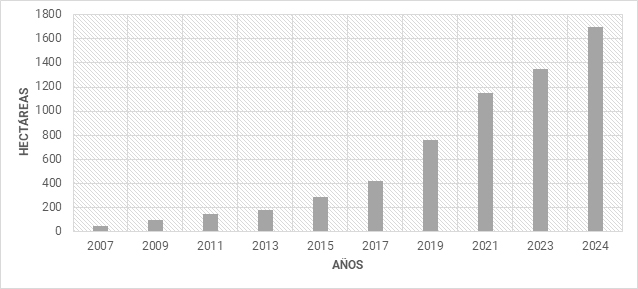
Source: MapBiomas Ecuador – EcoCiencia. https://www.maapprogram.org/es/mineria-ecuador-napo/
In fact, the main consequence of the early 2022 military operation in Yutzupino was the reconfiguration of mining in the territory through its dispersion. As can be seen on the following map, which outlines the province of Napo in red, there are currently three main hubs of activity with multiple extraction fronts: Carlos Julio Arosemena Tola and the Jatunyaku basin in the south-west of the province; Puerto Misahuallí-Ahuano-Chontapunta in the south-east; and the Punino River in the north-east. Illegal activity takes place in most legal concessions, but it also occurs in non-concessioned territories, due to coercive practices against communities or the purchase of land from settler populations.7
This territorial expansion is complemented by a new phenomenon: groups linked to organised crime engaging in this activity. Particularly, the presence of the FARC dissident group “Comandos de la frontera” has been documented in the north and south-east of the province, as well as that of “Los Lobos,” an organisation linked to drug trafficking based on the Ecuadorian coast, in several mining fronts in the south-west.
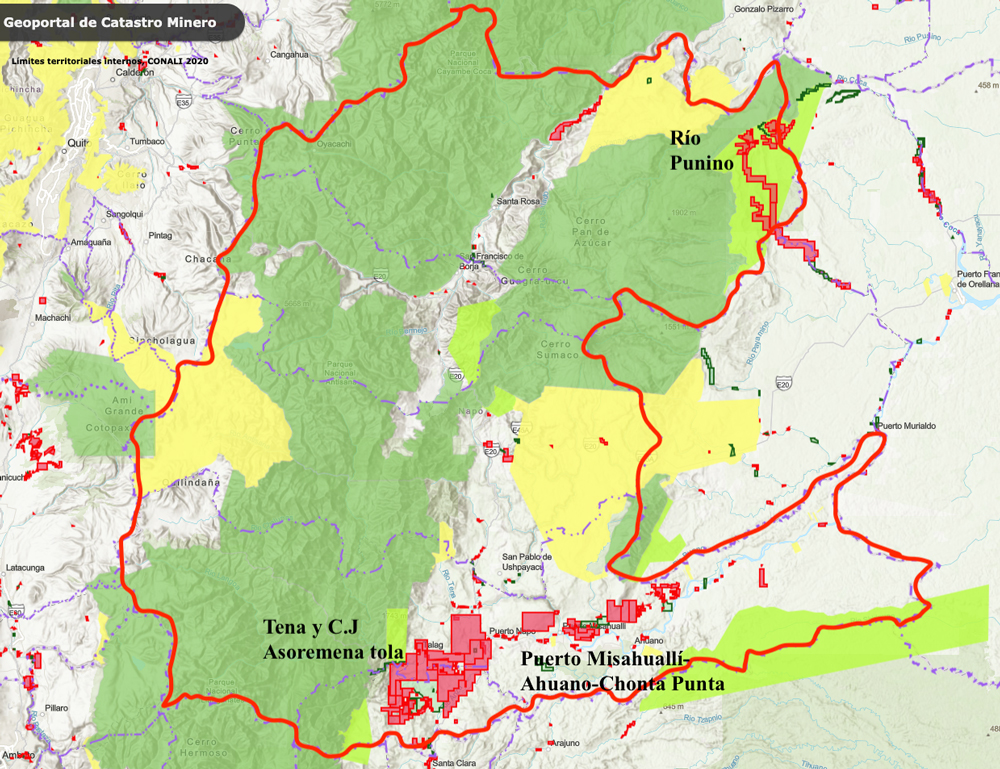
Source: intervention of the author in the Catastro Minero del Ecuador
4.2. Napo, A Scenario of Multidirectional, Simultaneous, and Interconnected Movements Around the Extractive Mining Economy
When inquiring about the context of mobility and migration in the province, the responses reveal a complex scenario. Specifically, I identified four dynamics, although they are all interdependent. First, internal migrations that have occurred since the early 20th century from Ecuadorian provinces such as Loja, Azuay, Bolívar, Tungurahua, Cotopaxi, and Pichincha. These migrations have multiple causes: the search for work and land, climatic events such as droughts in the southern region, or natural disasters such as the eruptions of the Tungurahua volcano. These dynamics have transformed the population composition of the province, as evidenced by the censuses. In the most recent census (2022), 39.68% of the population in Napo stated that it was born in another province of the country.
Secondly, inter-territorial mobility dynamics (rural-rural, rural-urban) can be observed, characteristic both of the lifestyles of indigenous populations (Muratorio, 1998) and of broader processes of colonisation, urbanisation, and touristification of the territory (Durán et al., 2025). Many of these movements are in response to the search for employment, education, or marriage to foreigners (Uzendoski et al., 2024). Thus, there are temporary or permanent movements to urban areas of the province, other Ecuadorian provinces, or even abroad. In an interview conducted in the canton of Archidona on 22 April 2025, one of the representatives of the Governing Council of the Kichwa Rucullacta People8 pointed out that the lack of job opportunities for young Kichwa people had led to significant migration to the flower industry, especially in the mountainous province of Cayambe.
Thirdly, there is evidence of international migration, marked by significant differences in social class and nationality. The 2022 census reports only 1,814 foreigners living in Napo (1.37% of the population), although it is clearly underreporting. According to the research director at the University of Ikiam (Tena, 26 April 2025), over the last 15 years a small group of Europeans and Americans linked to sustainable economic activities, such as agroecological businesses and tourism, have settled in the area. Many of them, mainly German and American men, have married local women. In terms of regional migration, there has been a notable presence of Colombians, Venezuelans, and Cubans since the late 1990s. Their arrival coincides with regional migration dynamics and explains, for example, the high presence of Venezuelan and Cuban professionals in sectors such as health and education since the early 2010s.
The presence of Colombian refugees has also been visible since the early 2000s, settling into very precarious and poorly paid jobs in catering, cleaning, and agriculture. Finally, between 2021 and 2023, a new migratory flow became evident, with the arrival of non-professional Venezuelan migrants. The president of Casa Wasi Pani and a worker from Caritas Ecuador confirmed the presence of around 80 families in Tena during the peak of this migration. Likewise, hundreds of people were recorded passing through the province on their way to Peru and Colombia. The few who settled permanently engaged in activities such as barbering, restaurant work, or street vending.
Fourth, the transformation of the Amazon region since the 1990s into a strategic area for the expansion of mining extractivism also contribute to explain its rapid population growth (Uzendoski et al., 2024).9 It is interesting to observe how the three dynamics mentioned above converge around the extractive economy in Napo. In other words, local, national and international population movements are accelerating, spurred on by the transformations that mining is bringing about in the province and the opportunities that are emerging in a sector with many gaps in control.
In this regard, the Napo region is experiencing complex movements of expulsion and attraction in the same places and simultaneously. While there are numerous populations arriving from other provinces of Ecuador, including workers and entrepreneurs of African-descent, indigenous peoples, and white mixed-race, as well as mining workers and entrepreneurs from other countries—particularly Colombians and Venezuelans—who seek to do business or make a living from mining, there are also forced displacements of indigenous populations that are barely visible.
This is the case of dozens of families who, since 2023, have had to flee from the banks of the Punino River and the parish of Chontapunta to the province of Orellana because of direct physical threats from armed groups (Plan V, 2025b). As the president of the environmental organisation Napo Ama la Vida (Tena, 28 April 2025) pointed out, there are also constant cases of families or individuals being expelled to urban centres or other communities due to threats or physical attacks by other community members when they refuse to sell land or allow mining by people from outside the territory.
On the other hand, as a researcher from the Latin American Faculty of Social Sciences in Quito (16 April 2025) indicated, there have been several attempts to expel the communities of Tzawata and Ila, endorsed by the State, which have so far failed to materialise due to the coordinated resistance of the communities.
Finally, there is also concern about the possibility of future forced displacement due to the environmental liabilities left behind by mining. The scarcity and contamination of land and water are creating new scenarios of rural-rural and rural-urban mobility for local indigenous populations. Therefore, expulsion may materialise after a period of differentiated inclusion in activities. As the president of the organisation Napo Ama la Vida pointed out:
This is already happening. Some people are migrating to Tena or to neighbouring communities, others to other provinces, and this also causes a setback because the Kichwa people are generally very attached to the land, and there are organisations of displaced people who want to start entering national parks to invade land (Tena, 28 April 2025).
As I indicated above, movements of attraction and expulsion often occur simultaneously, but when the same population experiences both, this generates situations that challenge the idea of this dichotomy. Thus, I found local populations that had experienced forced displacement linked to extractivism and who subsequently became involved in this economic activity, either in other territories or by returning to their communities. This is a kind of circularity promoted by the process of exclusion that initially stems from non-acceptance to mining activity, and subsequently from the need for survival in a context where there are few opportunities for local indigenous populations to sustain themselves.
A former Kichwa mining worker (Shandia, 1 May 2025) confirmed that mining activity causes constant movements of indigenous populations in and out of the territory, because in contexts of need, the relationship with mining becomes very ambivalent. In his case, he moved to Tena and worked for FOIN, covertly monitoring the expansion of mining and participating in the anti-mining resistance. However, when he lost his job with the indigenous organisation, he had no choice but to return to his community, where, with no other option, he began working as a machine operator for a mining entrepreneur.
4.3. Who Does What in the Extractive Economy. Unequal Participation Depending on Social Class, Gender, Ethnicity, and Geographical Origin
A key issue in this research was understanding who does what in gold mining in Napo and the way this is related to mobility processes. This question arises from the constant reference made in academic literature, the media, and investigative journalism to one category: illegal miners. I consider this category simplistic and homogenising, as it not only disguises the complexity of the services and jobs linked to this economy, but also actively contributes to concealing the exploitation of many of the workers involved in it, making it even more attractive and profitable for capital. Extractivism needs workers to function, but above all, it needs precarious workers, and this is where mobility plays a fundamental role.
The first thing I noticed in Tena and the communities I visited is that, for the local population, miners were not the visible workers operating on the front lines, but rather the entrepreneurs who had the capital, machinery, and labour necessary to exploit the deposits, both legally and illegally. Thus, there is a clear division between three actors: the concession owners and mining entrepreneurs, who are rarely present in the territory, and the mining workers who make the activity visible.
The armed groups are the fourth actor. Although they are not the focus of this study, their presence has led to significant changes in the internal dynamics of extraction. However, contrary to what official discourse suggests, these groups do not control the entire territory. In fact, much of the violence that occurs on site is due to disputes with illegal mining companies, who arm their own workers to defend their fronts from possible incursions.10
Besides the role of those who hold capital, the focus here is on the workers who make up the extractive economy. Among these workers, there is considerable diversity depending on the roles they perform:
Watchmen: bell ringers, responsible for alerting others to the arrival of outsiders or security forces; and guards, who physically protect the mining sites. All of them are usually local people.
Extraction operators: they are part of crews that operate machinery. This work, predominantly male, is also influenced by ethnic and geographical markers. Within this group are the bulldozer operators, who are divided into: pointers (punteros), who operate at the bottom, opening the excavation; backpackers (mochileros), who collect the material and transport it to the more superficial area; collectors (recolectores), who deposit the material in the classifier or zeta, where the gold is separated from the rest of the materials. At the sorting plant, there is another operator called a chorero, and further down, another who controls the pumping of water, the loading of fuel, and that the machinery works properly. The operators are usually from outside the community, national or international migrants who live almost permanently within the communities.
Dump lorry drivers: they transport the soil. They are usually local people or people from other provinces in the country.
Cooks: this work is generally carried out by local women and is a tangible example of the deep gender division that exists in the mining extractivism.11
Participation in these activities is uneven and is influenced by factors such as social class, ethnicity, gender, and geographical origin. However, it is previous experience in certain jobs that ultimately determines participation. Several incidental conversations in Tena between concession owners and mining entrepreneurs provided clues to understanding the hierarchical structure and profitability criteria that guide mining work. From what can be gathered, the success of the operation depends largely on the expertise of the foremen. Local workers are almost always excluded from operating bulldozers,12 which means they are appointed to less valued jobs (security, sorting and water pumping). This also happens to workers of Venezuelan origin, who are considered “lazy” or “unreliable” due to xenophobic stereotypes and because their high mobility fuels the idea that they are unstable workers.
The most highly valued operators come from regions with a long tradition of mining, such as the Colombian Pacific coast, the province of Esmeraldas in Ecuador, and the southern Amazonian provinces (Morona Santiago and Zamora Chinchipe). In this regard, it is quite common to hear that the machinery is “in the hands of Afro-descendants13 and Colombians,” highlighting their ability to work in extreme conditions. Their value lies precisely in the naturalisation of colonial and racial structures of domination.
In general, mining wages are more competitive, offering higher and faster earnings than, for example, agricultural activities. Income varies between $300-$400 per month for bell ringers and cooks; $500-$600 for security guards, water pump operators, and sorters; and $800-$1,200 for bulldozer operators, with the foreman being the highest paid. However, when compared to the millions of dollars generated annually by illegally mined gold and the dangerous conditions in which the work is carried out, these wages are paltry and clearly serve the dynamics of extractive capital accumulation.
The Kichwa former mining worker confirmed in the interview that the worst paid were Venezuelans and Colombians. Although the latter are in machine-operating positions, which pay more than the rest, their pay is always less than agreed since many of them are in an irregular situation. This fact generates a lot of conflict among workers.
They are not paid the same as we are. Venezuelans and Colombians are paid around 10 to 15 dollars maximum for the job I do, water pump operator. So, they start to wonder: “how much do they pay us here?” We (Ecuadorians) earn between 20 and 25 dollars a day, and they are earning less. So, they know that and start fighting with us and telling the boss this and that. (Shandia, 1 May 2025)
The interviewees confirm that this is piecework, organised in 12-hour shifts for 26 consecutive days. Not everyone manages to keep up the pace or make this activity their main source of income. This also requires certain forms of compensation. This has given rise to two phenomena. On the one hand, there are informal agreements between workers to collect the gold that gets trapped in the machinery without reporting it to the employer. On the other hand, some workers end up moving into entrepreneurship. With the money they have saved, some of them form partnerships, investing in their own machinery and starting their own businesses. However, this transition also leads to new inequalities. Not all mining entrepreneurs start from the same conditions with regard to capital, and the risks associated with investing in the activity do not affect them equally. For example, the seizure of machinery during police or military operations can be devastating for small entrepreneurs and merely a setback for those who operate with greater financial backing.
Consequently, the “win-win” situation often associated with mining turns out to be an illusion at every link in the chain. This idea is part of the capitalist narrative in which failure is assumed silently and individually. At the same time, relative improvements in living conditions trap populations in presentism or a profound misunderstanding of their functional role within the economic model: residual beneficiaries of accumulation who sustain the accumulation of others.
In addition to the work described in the mining fronts, the extractive economy is expanding into at least two additional layers of activities (regular, irregular, legal and illegal) that attract many people from outside Napo interested in setting up service businesses or converting existing ones. This has led to a profound reorganisation of the local economy, displacing tourism and agriculture as drivers of wealth creation.
My observations in the urban parishes of Tena, Carlos Julio Arosemena Tola, Puerto Napo, and Puerto Misahuallí confirmed the boom in a first layer of businesses directly linked to mining: machinery sale, mechanical workshops, dredge assembly, hardware stores, petrol stations, machinery operation courses, gold trading, and transport of workers and materials. Furthermore, a second layer of associated businesses is emerging: housing rentals, food and beverage sales, barbershops, construction, clothing and footwear stores, and motorcycle sales. Added to these activities are other classified as illegal, such as sex work and the unauthorised transport and trade of fuel.
In all these businesses, there is a clear distinction between self-employed small entrepreneurs and the ones who employ a few workers. Factors such as social class, gender, ethnicity, national origin and legal status in Ecuador (regular or irregular) determine the type of involvement in these businesses, as well as the real chances of success or failure.
Within this complex network, what becomes evident is that the economic dynamism generated by mining produces mobility and, simultaneously, mining and the entire economy surrounding it reproduce themselves in a specific way in the territory due to the type of workers they require. In this sense, mobility not only explains the increase in workers from within and outside the country in Napo, but also the massive presence of a type of worker who is functional to extractive capital: a mobile worker, affected by multiple social inequalities, who is differentially inserted into the multiplicity of activities and businesses that the economic model makes possible.
4.4. Mobility as a Producer of Socio-Territorial Transformations and Extractive Regions
Following the military operation in early 2022 in Yutzupino, mining in Napo not only continued, but expanded into deeper areas of the jungle in search of new and more secluded locations to avoid possible controls. The logic of exploitation changed from concentration to dispersion, and negotiations or coercion of communities multiplied. Whether they resisted or accepted the arrival of mining activity, the internal dynamics of movement through the territory were significantly transformed, generating important changes in daily life marked by suspicion and intra- and inter-community conflicts.
Wherever mining takes place, regulations are put in place governing who can enter the territory (Dessertine et al., 2024), thereby also transforming the meaning of the activity of platoneo.14 A worker of the Coordinating Body of Indigenous Organisations of the Amazon Basin (COICA) (Tena, 22 April 2025), told me that the new context had radically transformed the traditional meaning of gold prospecting, which now had an economic and enrichment significance far removed from the communities’ worldview of nature and the relationship of indigenous populations with it.
Despite these changes, there is an attempt to regain control over the activity and prevent it from being carried out by outsiders, as happened in Yutzupino. This case coincided with the rise of Venezuelan migration to Ecuador, which led many people with no previous ties to mining—including Colombians and internal Ecuadorian migrants—to enter the community’s territory to pan for gold without any kind of control. A Colombian mining worker, recounted his experience as follows:
I: How did you find out about Yutzupino? Did you hear about it or how did it happen?
Mining worker: Of course, I heard about it. I had some friends who told me to come here, right?
I: Colombian friends?
MW: Colombians and Ecuadorians.
I: Didn’t you have to talk to someone to get into Yutzupino?
MW: No, I just went in. Without saying anything to anyone.
I: But did you have to pay to get in or not?
MW: There was a queue, you just had to pay a few dollars. We went in and nothing happened. We were just hanging out there. In the afternoon and at night there were even a thousand guys there hanging out. Lots of people, day and night (El Bombon, 18 May 2025).
The change in dynamics led to seemingly invisible but highly coercive control over the movements of people within the territory. However, this does not mean that mining workers are prevented from being present. The settlement of external workers is “accepted” if they are clearly linked to one or more entrepreneurs with whom the community negotiates, and if unions with indigenous women are formed.15 Therefore, control is exercised over who is who and what they do within the territory. In this regard, the former Kichwa mining worker stated:
The only people who can manually collect gold debris must be from the area, from the community, acquaintances, or neighbours. But the people who work on the machines are from outside the area. They are from the coast. Others are from Morona, from Zamora. From over there. But they come in through contacts with the miners and because the community accepts them. (Shandia, 1 May 2025)
In the arrivals and departures of workers and the substantial changes they bring about in the ways of life and in the morphology of the territory (transformations in the landscape, growth of communities, disappearance of crops, changes in housing construction), I observed other dynamics in which mobility shapes extractivism. In the face of these changes, which are visible locally, the permanent movements of populations around mining and its voracious search for new areas of exploitation are generating a larger-scale landscape that connects national and international spaces, creating a particular circuit of floating populations (businesspeople, investors and, above all, workers).
A taxi driver linked to the mining industry (Tena, 21 April 2025) told me that miners usually have their own equipment, which they move from one place to another as opportunities arise. In other cases, miners invest in different locations and form new working groups based on local recommendations and contacts. This is possible because there is a floating national and international population that constantly moves to areas where they have acquaintances or where new mining fronts are opening. This was confirmed by a Venezuelan migrant, whom I contacted by telephone with the assistance of another researcher. She worked with her husband in two mining enclaves in the Ecuadorian Sierra region: La Merced de Buenos Aires (Imbabura province) and Camilo Ponce Enriquez (Azuay province) (online interview, 12 June 2025). In these mining areas, she met several workers with prior experience in the Amazon region, including various locations in the province of Napo. Another example was provided by the Colombian mining worker interviewed, as he himself was part of this population of itinerant international workers:
I: After Yutzupino, are you going to Punino?
MW: No, I came here (El Chaco, Napo). From here I went down to the Chontayacu River (near Chontapunta, Napo) and to Cabeno (Sucumbíos province.) And after Cabeno I went to Punino (north of Napo). After Punino, I went to where the Cofanes live (Sucumbíos). From the Cofanes, I went to La Merced de Buenos Aires (province of Imbabura). From Buenos Aires, I went to Chical (province of Carchi). And right now, they were inviting me to a place called Cayambí, near Colombia. Over there (El Bombon, 18 May 2025).
The testimonies confirm that, since 2020, the province of Napo has been integrated into a vast extractive region characterised by an increasingly dense and complex network of interconnected territories at the national level—including the provinces of Esmeraldas, Imbabura, Zamora Chinchipe, Morona Santiago, Azuay, and Cotopaxi, represented on Illustration 2 by purple circles—and internationally—Colombia, Brazil, Peru and Venezuela—where people, machinery, materials, and gold circulate constantly. The latter, as reflected by the red arrows on the map, is transported to Colombia, Peru, and Brazil by land and river routes, and to other international destinations by sea.
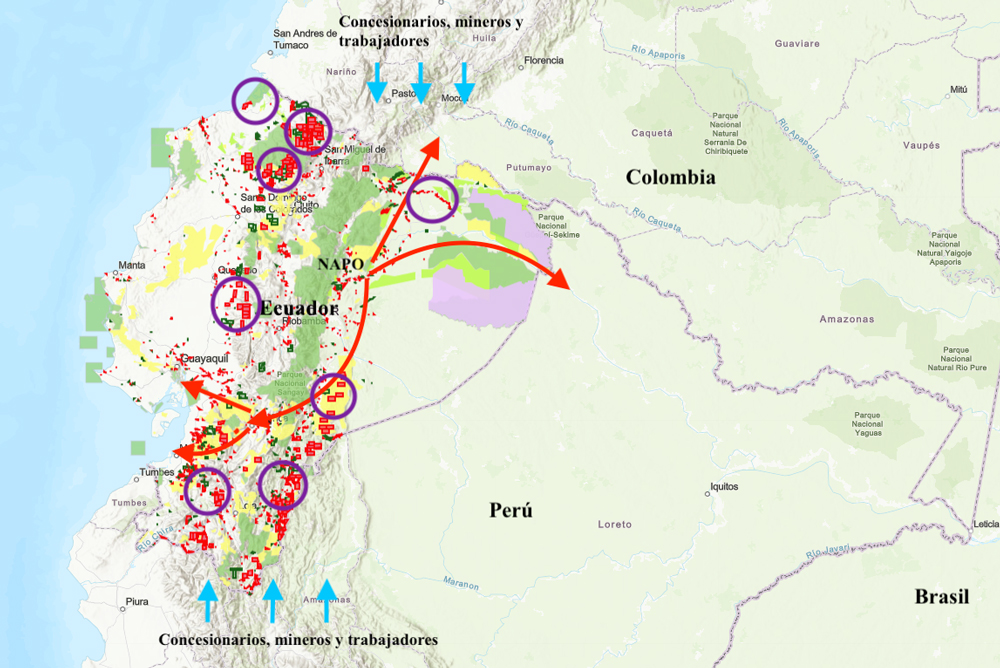
Source: intervention of the author in the Catastro Minero del Ecuador
It can therefore be established that the production and reproduction of the extractive economic model take place though the configuration of a network of spaces interconnected by mobility that extend both above and below the national scale. These become “circulatory territories” in which economic activities and population flow multiply, producing significant socio-territorial transformations and conflicts.
5. Conclusions
This research highlights the fundamental role of mobility in shaping mining extractivism. Considering the residual position that it occupies in some studies, or its consideration as a direct effect of the extractivism, I argue that mobility is an element that constitutes and gives form to it. From this point of view, I propose that extractivism—which has been extensively studied from political ecology—can be enriched and further elaborated through another field of interpretation of social reality, the New Mobilities Paradigm.
I follow Sheller’s (2018) idea of the “constitutive role of movement” in social life and, from there, I understand extractivism as an articulated system of intensive actions of extraction, exploitation, and mobility within socio-ecological spaces where capital can maximise its processes of accumulation. In this sense, I propose that extractivism cannot be understood or exist without mobility. Not only because its nature is mobile—to survive as a model it needs constant territorial expansion—but also because it feeds on the equally mobile character of multiple factors that participate in its functioning including, decisively, the human factor.
Through the gold-mining boom in Ecuador’s Napo province, I show how mobility is much more than a collateral effect of mining activity and the complex economy that forms around it. By questioning the expulsion/attraction logic, I break with the idea of mobility as effect or consequence. What emerges from the research are much more entangled and simultaneous dynamics that give life to the forms in which extractivism manifests in each territory.
In this research I identify three levels at which mobility can give shape to extractivism. First, through the actors who participate in and enable its functioning. Within the extractive model, different processes combine to multiply accumulation, among them labour exploitation. In this sense, mining in Napo relies on the existence of a significant mass of precarious mobile workers—of local, national, and foreign origin—who are also characterised by being racialised, in irregular situations, or coming from other irregular or illegal economies. They materialise and give form, through their bodies, to the social imaginaries and symbolic orders that traverse the artificial separation between legal and illegal mining in Napo, while remaining fully functional to extractive capital.
Second, mobility produces major transformations in territories. These modifications are not only biophysical, resulting from the destruction of vegetation cover and of water and food sources, but also social, defined by the daily coexistence of populations of multiple origins that enter and leave the territory, creating new identities, ways of life, and understandings of social relations, always marked by high degrees of inequality and violence.
Finally, mobility co-produces new extractive spaces that challenge traditional geographical divisions. This is evident in the connections it produces—particularly through the circulation of capital and people—between local, regional, national, and international scales. These new spaces, which are extremely dynamic and unequal, and are a product of the current accumulation regime, cannot survive without mobility constantly feeding their expansive dynamics.
Acknowledgements
This work is part of the project [ID001]: Regímenes de movilidad e inmovilidad, experiencia migrante y desigualdades sociales en el Ecuador, financed with Research Development Funds from the Latin American Faculty of Social Sciences, Ecuador.
References
Acosta, A. (2011). Extractivismo y neoextractivismo: dos caras de la misma maldición. Más allá del desarrollo. Fundación Rosa Luxemburg, Abya Yala.
Alimonda, H. (2015). Notas sobre la ecología política latinoamericana: Arraigo, herencias, diálogos. Ecología Política, (51), 36-42.
Bayón, M., Durán, G., Bonilla, A., Ávila, M., & Araujo, M. (2020). Urbanización en la Amazonía Sur: entre el desplazamiento y las regalías mineras. FLACSO Ecuador.
Bayón, M., van Teijlingen, K., Velasco, S., & Moreano, M. (2021). Cuando los sujetos se mueven de su lugar: una interrogación al extractivismo y la movilidad en la ecología política latinoamericana. Revista de Geografía Norte Grande, (80), 103-127. https://doi.org/10.4067/S0718-34022021000300103
Berry, M. J., Chávez Argüelles, C., Cordis, S., Ihmoud, S., & Velásquez Estrada, E. (2017). Toward a Fugitive Anthropology: Gender, Race, and Violence in the Field. Cultural Anthropology, 32(4), 537-565. https://doi.org/10.14506/ca32.4.05
Cañar, J., & Loor, I. (2023). The socio-environmental aftermath of gold mining in the Amazon: The case of Yutzupino in Napo, Ecuador. Sustainability in Debate - Brasília, 14(3), 219-233. https://doi.org/10.18472/SustDeb.v14n3.2023.49965
Cresswell, T. (2006). On the move: Mobility in the modern Western world. Taylor & Francis.
Cresswell, T. (2010). Towards a Politics of Mobility. Environment and Planning D: Society and Space, 28(1), 17-31. https://doi.org/10.1068/d11407
Composto, C. (2012). Acumulación por despojo y neoextractivismo en América Latina. Una reflexión crítica acerca del estado y los movimientos socio-ambientales en el nuevo siglo. Astrolabio, (12), 323-352. https://doi.org/10.55441/1668.7515.n8.767
Delgado Ramos, G. C. (2013). Ecología política del extractivismo en América Latina: Casos de resistencia y justicia socioambiental. CLACSO.
Dessertine, A., Petit-Roulet, R., Champy, M., & Kalil Doumbouya, I. (2024). The governance of ASGM in Guinea and Côte d’Ivoire: (im)mobility, territory, and technological change. In G. Castillo Guzmán, M. Himley & D. Brereton (eds.), Mining, mobility, and social change in the Global South. Regional perspectives (pp. 123-142). Routledge. https://doi.org/10.4324/9781003313236-9
Durán, G., Bayón Jiménez, M., Pérez Tarqui, A., Toscano, D., Serrano, C., Barros, K., Castañeda, D., & Sánchez, Y. (2025). Urbanización residual de la Amazonía: Una geografía descriptiva de la red de ciudades amazónicas del Ecuador. FLACSO Ecuador.
Figueroa, I. (2017). Desplazamientos en virtud del desarrollo: Un estudio de caso del proyecto minero Mirador en Zamora Chinchipe, Ecuador. Opinión Jurídica, 17(33), 173-198. https://doi.org/10.22395/ojum.v17n33a7
González, L. (2010). Desalojos forzados, reasentamientos involuntarios y derechos de las comunidades. In L. González, Y. Orsini, C. González & S. Indermühle (comps.), Minería y comunidades (pp. 2-21). Indepaz.
Gudynas, E. (2013). Extracciones, extractivismos y extrahecciones: Un marco conceptual sobre la apropiación de recursos naturales. Observatorio del desarrollo, 18(18), 1-17.
Gudynas, E. (2015). Extractivismo: Ecología, economía y política de un modo de entender el desarrollo y la naturaleza. Centro de Documentación e Información Bolivia (CEDIB).
Harvey, D. (2004). The “new” imperialism: Accumulation by dispossession. In L. Panitch & C. Leys (eds.), The new imperial challenge (pp. 63-87). Monthly Review Press.
Hanson, R., & Richards, P. (2019). Harassed: Gender, bodies, and ethnographic research. University of California Press. https://doi.org/10.2307/j.ctvfxvcd1
Hernández, E. (2018). Minería y desplazamiento: el caso de la multinacional Cerrejón en Hatonuevo, La Guajira, Colombia (2000-2010), “Nuestra tierra es nuestra vida” . Ciencia Política, 13(26), 97-125. https://doi.org/10.15446/cp.v13n26.68300
Himley, M., Brereton, D., & Castillo Guzmán, G. (2024). An introduction to the mining, mobility and social change. In G. Castillo Guzmán, M. Himley & D. Brereton (eds.), Mining, mobility, and social change in the Global South. Regional perspectives (pp. 1-20). Routledge. https://doi.org/10.4324/9781003313236-1
Labarraespaciadora. (2023, July 23). Yutzupino, el dorado en disputa. https://www.labarraespaciadora.com/medio-ambiente/yutzupino-el-dorado-en-disputa-disponible/
Lalander, R., Eguiguren Riofrío, M. B., Vera, A. K., Reyes, M., Espinosa, G., & Lembke, M. (2020). Una ecología política de minería indígena responsable: Dilemas, disputas y desafíos en la comunidad Shuar de Congüime de la Amazonía ecuatoriana. Revista Chilena de Derecho y Ciencia Política, 11(1), 66-101. https://doi.org/10.7770/RCHDCP-V11N1-ART2110
Leff, E. (2003). La Ecología política en América Latina: un Campo en construcción. Sociedade e Estado, 18(1-2), 17-40.
Lyall, A. (2021). Resistencia en retrospectiva: la multitemporalidad del extractivismo en la Amazonía. Íconos. Revista de Ciencias Sociales, (69), 17-34. https://doi.org/10.17141/iconos.69.2021.4496
Lyall, A., & Ruales, G. (2025). Land Grab Double Binds: Peasant Farmers and/in the Ecuadorian Mining Boom. Journal of Agrarian Change, (25), 1-11. https://doi.org/10.1111/joac.12612
Medina-Bueno, F., Simbaña-Tasiguano, M., Aguinaga-Barragán, A., & Salgado-Revelo, A. (2023). Análisis del impacto de la pequeña minería en una comunidad amazónica ecuatoriana, dentro del contexto geológico, ambiental y socioeconómico. Boletín de Ciencias de la Tierra, 54, 48-63. https://doi.org/10.15446/rbct.n54.109598
Martínez Alier, J. (2008). Conflictos ecológicos y justicia ambiental. Papeles de Relaciones Ecosociales y Cambio Global, (103), 11-28.
Martínez Alier, J. (2015). Ecología política del extractivismo y justicia socio-ambiental. Interdisciplina, 3(7), 57-73. https://doi.org/10.22201/ceiich.24485705e.2015.7.52384
Melo, C., Mena, C., Arsel, M., & Pellegrini, L. (2013). The State is Dead, Long Live the State: Re-inserting the State in the Gold-mining Industry in Zamora-Chinchipe, Ecuador. CoCooN NEBE Working Paper (International Institute of Social Studies), 1-37. https://doi.org/10.13140/RG.2.1.3891.7603
Mestanza-Ramón, C., Mora-Silva, D., D’Orio, G., Tapia-Segarra, E., Gaibor, I. D., Esparza Parra, J. F., Chávez Velásquez, C. R., & Straface, S. (2022). Artisanal and small-scale gold mining (ASGM): Management and socioenvironmental impacts in the Northern Amazon of Ecuador. Sustainability, 14(11), 6854. https://doi.org/10.3390/su14116854
Mongabay. (2022, February 17). Ecuador: la minería ilegal está acabando con dos ríos de la provincia de Napo. https://es.mongabay.com/2022/02/ecuador-la-mineria-ilegal-esta-acabando-con-dos-rios-de-napo/
Mongabay. (2025, May 21). Detrás de masacre en Punino: asesinato de 11 militares revela expansión e impacto ambiental de la minería ilegal en la Amazonía ecuatoriana. https://es.mongabay.com/2025/05/masacre-punino-asesinato-militares-mineria-ilegal-ecuador/
Moreano, M., Molina, F., & Bryant, R. (2017). Hacia una ecología política global: Aportes desde el Sur. In H. Alimonda, C. Toro Pérez & F. Martin (eds.), Ecología política latinoamericana. Pensamiento crítico, diferencia latinoamericana y rearticulación epistémica (pp. 197-212). CLACSO & Universidad Autónoma Metropolitana de Buenos Aires.
Muratorio, B. (1998). Rucuyaya Alonso y la historia social y económica del Alto Napo. Abya-Yala.
Noroña, M. B. (2020). Luchas en red o luchas colectivas en la Amazonía del Ecuador: El caso de Tzawata / Networked and Collective Struggles in the Ecuadorian Amazon: The Case of Tzawata. Journal of Latin American Geography, 19(2), 191-217. https://doi.org/10.1353/lag.2020.0044
Plan V. (2025a, February 16). Napo: lo que el oro separa, el agua junta. https://planv.com.ec/historias/planverde/lo-que-el-oro-separa-el-agua-junta
Plan V. (2025b, May 6). El silencio de los desplazados por la minería ilegal en Ecuador. https://planv.com.ec/historias/derechoshumanos/el-silencio-de-los-desplazados-por-la-mineria-ilegal-en-ecuador/
Raftopoulos, M. (2017). Contemporary debates on social-environmental conflicts, extractivism and human rights in Latin America. The International Journal of Human Rights, 21(4), 387-404. https://doi.org/10.1080/13642987.2017.1301035
Romero, H., Videla, A., & Gutiérrez, F. (2017). Explorando conflictos entre comunidades indígenas y la industria minera en Chile: Las transformaciones socioambientales de la región de Tarapacá y el caso de Lagunillas. Estudios Atacameños. Arqueología y Antropología Surandinas, (55), 231-250. https://doi.org/10.4067/S0718-10432017005000019
Saldomando, A. (2015). Inmigración y minería en Chile. OIT.
Sheller, M. (2018). Theorizing mobility justice. Tempo Social. Revista de Sociologia da USP, 30(2), 17-34. https://doi.org/10.11606/0103-2070.ts.2018.142763
Sheller, M., & Urry, J. (2006). The new mobilities paradigm. Environment and Planning A: Economy and Space, 38(2), 207-226. https://doi.org/10.1068/a37268
Stefoni, C., Cienfuegos, I., Araneda, M., Stang, F., & Valenzuela, F. E. (2017). Por una región minera diversificada y fraterna con los migrantes. Diagnóstico participativo y propuestas de política migratoria y de empleo para las ciudades de Antofagasta y Calama. Ariadna.
Stefoni, C., Stang, F., & Rojas, P. (2022). Extractive Economy and Mobilities. The Case of Large Copper Mining in the Antofagasta Region. In G. Herrera & C. Gómez (eds.), Migration in South America. IMISCOE Research Series. https://doi.org/10.1007/978-3-031-11061-0_2
Svampa, M. (2019). Las fronteras del neoextractivismo en América Latina: Conflictos socioambientales, giro ecoterritorial y nuevas dependencias. CALAS.
Tarrius, A. (1993). Territoires circulatoires et espaces urbains: Différentiation des groupes migrants. Les Annales de la recherche urbaine, (59-60), 51-60. https://doi.org/10.3406/aru.1993.1727
Urry, J. (2007). Mobilities. Polity Press.
Uribe-Sierra, S. E., & Mansilla-Quiñones, P. (2022). Estudos do despovoamento rural no Chile: abordagens para um quadro analítico da ecologia política latinoamericana. Revista Brasileira de Estudos de População, 39, 1-23. https://doi.org/10.20947/S0102-3098a0208
Uzendoski, M. A., Bayón Jiménez, M., & Durán Saavedra, G. (2024). Residual urbanization and the social relations of collective struggle in an Amazonian Kichwa commune from Ecuador. Journal of Global South Studies, 41(2), 279-306. https://doi.org/10.1353/gss.2024.a948725
van Teijlingen, K., Leifsen, E., Fernández-Salvador, C., & Sánchez Vázquez, L. (eds.) (2017). La Amazonía minada: Minería a gran escala y conflictos en el Sur del Ecuador. Editorial USFQ & Ediciones Abya-Yala.
Veltmeyer, H. (2016). Extractive capital, the state and the resistance in Latin America. Sociology and Anthropology, 4(8), 774-784. https://doi.org/10.13189/sa.2016.040812
Villarreal Villamar, M. C., & Echart Muñoz, E. (2018). Resistencias y alternativas al desarrollo en América Latina y el Caribe: luchas sociales contra el extractivismo. Revista Relaciones Internacionales, 39, 141-163. https://doi.org/10.15366/relacionesinternacionales2018.39.008