La especificidad de la mujer mexicana en las cadenas globales de cuidados



This article examines Global Care Chains between Mexico and the United States analysing paid care labour insertion at destination and its association with household migration exposure at origin. Using microdata from the 2024 Current Population Survey (US) and the 2024 National Survey of Occupation and Employment, first quarter (Mexico), multinomial logit models were estimated for the employed population aged 15 and older. Results reveal occupational segmentation by origin: Mexican-born women show a higher probability of entering paid domestic work (10.6 percentage points) than native-born women, while higher educational shifts participation towards professionalised care sectors. In Mexico, remittance receipt—a proxy for migration exposure—is associated with a lower probability of paid domestic care (-1.14 percentage points) and other paid care occupations (-1.41 percentage points). Findings suggest cross-border care circuits may be structured along gender, origin, and education lines, though reflecting statistical associations rather than confirmed causal mechanisms.
Este artículo examina las cadenas globales de cuidado entre México y Estados Unidos, analizando la inserción laboral en el trabajo de cuidados remunerado en el destino y su asociación con la exposición migratoria de los hogares en el origen. Con base en microdatos de la Current Population Survey (CPS) de 2024 (Estados Unidos) y de la Encuesta Nacional de Ocupación y Empleo (ENOE) de 2024, primer trimestre (México), se estimaron modelos logit multinomiales para la población ocupada de 15 años y más. Los resultados revelan una segmentación ocupacional según el origen: las mujeres nacidas en México presentan una mayor probabilidad de insertarse en el trabajo doméstico remunerado (10,6 puntos porcentuales) que las mujeres nativas, mientras que un mayor nivel educativo desplaza la participación hacia sectores de cuidado profesionalizados. En México, la recepción de remesas, utilizada como indicador aproximado de la exposición migratoria, se asocia con una menor probabilidad de ejercer el trabajo de cuidados domésticos remunerado (−1,14 puntos porcentuales) y otras ocupaciones de cuidado remuneradas (−1,41 puntos porcentuales). Los hallazgos sugieren que los circuitos transfronterizos de cuidado podrían estar estructurados según el género, el origen y la educación, aunque reflejan asociaciones estadísticas y no mecanismos causales confirmados.

Global Care Chains; migration; intersectionality; transnational labour networks
Cadenas globales de cuidado; migración; interseccionalidad; redes laborales transnacionales

1. Introduction
The feminisation of migration constitutes one of the most significant phenomena shaping contemporary dynamics of human mobility: women account for approximately 48% of the international migrant population, reflecting structural patterns that intertwine gender, labour, and global inequality (Organización Internacional para las Migraciones [OIM], n.d.). A substantial share of these flows is absorbed into the care sector of the Global North, where middle- and upper-class women outsource reproductive tasks as a strategy to sustain their participation in the labour market. This process fuels the configuration of Global Care Chains (GCC), that is, transnational circuits of reproductive labour transfer that interlink families, regions, and economies on a worldwide scale (Pérez Orozco, 2010).
The COVID-19 pandemic heightened the visibility of this unequal architecture of care, particularly in countries such as the United States, whose health and care systems structurally depend on a highly vulnerable migrant workforce that comprises nearly 88% of personnel in certain segments of the sector (Osterman, 2023). The health crisis demonstrated forcefully that any analysis of care is inseparable from migration processes and from the global configurations of reproductive labour (Pérez Orozco, 2014). This scenario is associated with two major demographic and economic transformations: the growing labour force participation of professional women in the Global North and the accelerated ageing of the population—both factors that amplify the structural demand for care (Burnham & Theodore, 2012).
Within this framework, the mobility of women workers from the Global South, particularly from Mexico to the United States, aligns with the international division of reproductive labour and shapes distinct circuits of labour mobility. Added to this is a less-examined phenomenon: the transmigration of women residing in Mexico who cross the border on a daily or temporary basis to perform paid care work, attracted by wages significantly higher than those available in their communities of origin. This flow constitutes specific forms of cross-border care labour that reconfigure the relationships among mobility, gender, and social reproduction (López-Estrada, 2020).
Moreover, Global Care Chains deepen new paradoxes in the contemporary organisation of care services. On the one hand, they highlight the essential nature of the work performed by migrant women, while simultaneously revealing the structural vulnerability of those who carry it out: although indispensable, they remain subject to migration regimes that consider them deportable (Parreñas et al., 2022). On the other hand, GCCs illustrate how the international segmentation of reproductive labour produces patterns of differentiated risk. A critical example is the occupational and geographical segregation that concentrated Filipino nurses in high-exposure contexts during the COVID-19 pandemic in the United States, resulting in disproportionate mortality rates (Nazareno et al., 2021).
Recent scholarship demonstrates a clear divergence between research agendas in the Global North and the Global South (Rivera-Lozada et al., 2026). In the Global North, analytical attention has centred on understanding the importation of care, emphasising how states and households outsource reproductive needs to migrant women workers (Osterman, 2023; Francisco-Menchavez, 2018; Burnham & Theodore, 2012). In contrast, research conducted in the Global South has examined issues such as care drain and remittances (Cervantes González & Ortega, 2024); the experiences of cross-border caregivers (López-Estrada, 2020); affective ties in families separated by migration (Ariza, 2020); transborder motherhood (Castillo Cervantes, 2025); the framing of care as a human right (Suprema Corte de Justicia de la Nación, 2025), among other emerging contributions.
In this context, the Mexican case acquires particular relevance. Recent evidence points to a marked feminisation of remittance reception: 61.8% of remittance recipients are women, reflecting the persistent physical and emotional burden of care assumed by those who remain in the country of origin (Cervantes González & Ortega, 2024). Likewise, Mexican women make up 47.4% of Mexican migrants in the United States, while 20.7% of Mexican immigrant women work in educational and health services (Li Ng, 2024). These patterns demonstrate how women’s labour mobility is shaped by the structural demand for care in the Global North and by the international division of reproductive labour.
This article aims to analyse the Global Care Chains within the Mexican diaspora by examining the interdependence between origin (Mexico) and destination (United States) contexts in 2024, drawing on contemporary theory on the feminisation of care and Global Care Chains, as well as on the analysis of migration dynamics that characterise the Mexican case.
This article addresses the following research question: How does the transnational division of reproductive labour shape the occupational insertion of Mexican women in paid care sectors in the United States, and how is household migration exposure associated with paid care participation in Mexico? We argue that while the Global Care Chain operates as an overarching structural framework connecting reproductive labour across borders, its empirical manifestation within labour markets is fundamentally mediated by gender, country of birth, and educational attainment. Rather than assuming direct causal linkages between individuals across surveys, this comparative study analyses the distinct occupational patterns of paid care in destination and origin contexts, delineating the boundaries between formal labour market participation and intra-family reproductive dynamics.
Following this introduction, which outlines the central problem related to GCC and the specificities of the Mexican context, the text is organised as follows. Section 2 develops the theoretical-analytical framework based on gender, the feminisation of care, and Global Care Chains. Section 3 presents the methodological approach used to capture the Mexico-United States care chain. Section 4 reports the main findings, including descriptive results on sample size, a graphical characterisation of the dependent variable, and the principal independent variables, followed by the estimation results. Section 5 discusses these findings in light of the literature. Finally, Section 6 synthesises the study’s conclusions and analytical projections.
2. Theoretical Framework
2.1. Gender
Gender is a political analytical category that cuts across the social, economic, and symbolic dimensions of collective life (Scott-Jones & Clark, 1986). Rather than a mere sexual difference, it constitutes relations of power that produce and legitimise hierarchies, structuring everyday practices, institutions, and global economic configurations (Connell, 2021). Far from expressing a natural distinction, gender establishes a binary and hierarchical logic between masculine and feminine, public and private, which sustains the sexual division of labour and reproduces material and symbolic inequality (Fraser, 1994, 2007).
In the context of international migration, gender emerges as a structure of power that organises human mobility and defines the hierarchies that sustain labour at the global scale (Connell, 2021; Yeates & Holden, 2022). Decisions to migrate, the pathways followed, and the possibilities for economic incorporation are not neutral, as they are shaped by social constructions of gender, legal regimes, and imaginaries that assign differentiated roles to women and men (Fraser, 2022). In this regard, gender operates as a transnational logic of inequality that determines who can move, under what conditions, and with what degree of social recognition, producing differentiated positions of vulnerability or privilege within a global order that remains patriarchal and colonial (Pérez Orozco, 2014; Gutiérrez-Rodríguez & Reddock, 2021).
From this perspective, gender analysis enables migration to be understood as a social, political, and symbolic process rather than as an exclusively economic or territorial phenomenon (Fraser, 2022). Incorporating this perspective allows for examining migration as part of a global power structure in which gender relations shape the distribution of work, resources, and opportunities (Anastasiadou et al., 2025). Understanding globalisation through this lens implies recognising that its logic mobilises people and capital, reproduces historical inequalities, and maintains the hierarchies that underpin the contemporary world system (Pérez Orozco, 2014; Connell, 2021).
Within this framework, the sexual division of labour connects gender relations with the unequal organisation of care. It shows how reproductive responsibilities are unevenly distributed and how these inequalities extend into paid care work and, in migratory contexts, into the transnational organisation of reproductive labour. Therefore, gender, the feminisation of care, and Global Care Chains are approached here as interconnected analytical dimensions rather than as separate conceptual categories.
2.2. Feminisation of Care
Care work and domestic work are closely related, but they are not equivalent. In this article, care work is understood as a broader category encompassing activities involved in sustaining everyday life and responding to people’s needs, while domestic work refers more specifically to activities performed within or for households. Domestic work may be paid when it is performed as a remunerated occupation, or unpaid when it is carried out within households without remuneration. This distinction is particularly relevant to the analysis developed here, since the empirical models examine paid occupations, whereas unpaid domestic and care work forms part of the broader organisation of care discussed theoretically but is not directly observed in the occupational data.
The sexual division of labour accounts for the feminisation of care by showing how women continue to assume, in a systematic and structural manner, the majority of activities involved in sustaining life, such as health care, education, domestic administrative management, food preparation, and the care of children and dependent persons (Meneses-Medina, 2023a, 2023b). This persistent overload drives women’s massive incorporation into precarious labour markets, particularly those associated with care work, where the devaluation of reproductive labour adopts new forms of exploitation and dependency (Pérez Orozco, 2014; Rosero-Ceballos & Meneses-Medina, 2022; Meneses-Medina, 2023a). Even in households where women hold tertiary education or possess an educational advantage over their partners, recent evidence shows that gaps in domestic and care work narrow but do not disappear, demonstrating the limits of formal education in transforming the sexual division of labour (García-Román, 2023; Hook & Nazio, 2025; Raz-Yurovich & Okun, 2024). This reveals that the global economic system continues to rely on a structure of inequality that assigns women the responsibility of sustaining life without granting them political recognition or economic value (Federici, 2020; Fraser, 2022). In this regard, the feminisation of care stands as a key category for understanding contemporary transformations in reproductive labour and its integration into the market, while maintaining the gender and class hierarchies described by Connell (2021) and Yeates and Holden (2022) that support the reproduction of the world economy.
Taken together, these processes demonstrate the structural persistence of the feminisation of care and situate within a broader framework the capitalist reconfiguration in which reproductive labour acquires new meanings and forms of exploitation. Thus, the expansion of capitalist logic redefines the meaning of care by subordinating it to the principles of productivity, profitability, and efficiency (Fraser, 2022; Pérez Orozco, 2014). In this process, women’s bodies, time, and emotions become fundamental pillars of social reproduction, forming a complex web in which the demands of capital blur the boundaries between life and work (Federici, 2020). The intensification of care is manifested not only in the material overload of labour but also in the transformation of subjectivities, where the mandate to care acquires heightened emotional and moral centrality, reinforced in times of crisis such as the context experienced during the COVID-19 pandemic (Meneses-Medina, 2023a). Thus, far from being a relational or domestic practice, care functions as a mechanism of social regulation that guarantees the continuity of life under the logic of capital (Pérez Orozco, 2014; Federici, 2020).
From a critical perspective, the feminisation of care does not necessarily imply a transformation in the unequal social organisation and valuation of care and domestic work. Rather, it reflects a rearticulation between patriarchy and capitalism through which gendered relations of subordination are reproduced and transnationalised (Gutiérrez-Rodríguez & Reddock, 2021; Fraser, 2022). In contemporary economic systems, life becomes a field of dispute between accumulation and sustainability, placing care at the heart of the capital–life conflict (Pérez Orozco, 2014; Federici, 2020). Understanding the feminisation of care thus entails recognising that transformations in reproductive labour redefine social hierarchies and the organisation of power, as well as migratory dynamics, time regimes, and the ways in which the value of life is distributed in global capitalism (Federici, 2020; Fraser, 2022).
2.3. Global Care Chains
The gendered organisation and feminisation of care acquire a transnational dimension as reproductive and affective labour circulates across households, labour markets, and national borders, connecting women situated differently within global structures of inequality. These relations can be examined through the notion of Global Care Chains. Hochschild (2000) introduced this concept to describe how globalisation redistributes care from the South to the North, generating an invisible transfer of time, energy, and emotional labour. She later expanded this analysis by arguing that the emotional value produced within these circuits constitutes a form of surplus within the global care economy (Hochschild, 2014). Yeates (2004) also examined this issue by situating Global Care Chains within an international political economy, where women’s migration reproduces the sexual and transnational division of domestic work. Following this logic, she demonstrated that care chains constitute an essential infrastructure of globalisation by linking the reproduction of life to capital accumulation (Yeates, 2012, 2013).
Parreñas (2001) deepened the analysis by showing that Global Care Chains function as transnational regimes of dependence and affectivity, where care relations are organised around hierarchies of gender, class, and origin. Her work documents how migrant women take on feminised and devalued jobs in core economies while delegating the care of their own households to other women, thereby generating an unequal structure that reproduces the international division of reproductive labour. In her more recent contributions, Parreñas (2021) expands this perspective by emphasising that these relations are mediated by emotional bonds that combine empathy, discipline, and affective exploitation, revealing the subjective dimension of global inequality. From a decolonial perspective, Gutiérrez-Rodríguez (2010) complements this interpretation by showing that care chains are sustained through the racialisation and colonial legacies embedded in domestic and affective labour, confirming that the global care economy continues to rely on historical hierarchies of domination.
For feminist political economy, Global Care Chains constitute a core component of the capital-life conflict, in which social reproduction becomes a pillar of accumulation (Pérez Orozco, 2014). In this sense, care, beyond being commodified, is organised through a transnational logic that perpetuates the international division of labour and structural inequalities (Yeates & Holden, 2022). These dynamics confirm that sustaining life in the Global North depends on the material and emotional depletion of women in the Global South, whose migratory trajectories embody the tensions between sustainability and exploitation. Thus, Global Care Chains reveal that economic globalisation and social reproduction are part of the same web of power and inequality (Hochschild, 2000; Parreñas, 2021; Pérez Orozco, 2014).
Although the GCC framework was developed primarily to examine transnational migration and the redistribution of care across countries, the territorial variables included in this study should not be interpreted as identifying distinct Global Care Chain mechanisms. In particular, border location is treated as a regional characteristic within the Mexican model rather than as direct evidence of a specific cross-border care chain.
3. Methodology
The methodology employed in this study is quantitative and correlational in nature. Two primary data sources are used to capture the Global Care Chain between the United States and Mexico. On the one hand, the study focuses on the employed population in the United States as the main destination for Mexican immigrants (Passel & Krogstad, 2024), drawing on the 2024 microdata from the Current Population Survey (CPS) (Flood et al., 2020). On the other hand, the study considers the employed population in Mexico as the main country of origin for immigrants living in the US, using microdata generated by the National Survey of Occupation and Employment (ENOE) for the first quarter of 2024. These surveys were selected because they are the primary instruments for capturing labour market information in each country, and the paid care occupations under analysis are included within their occupational classifications. All processed data are publicly available (Rosero-Ceballos et al., 2025).
The analysis is restricted to the employed population aged 15 years and older in both countries. For the United States, the final sample comprised 636,188 observations (N) (156,646,689 weighted, using CPS expansion factors, see Table 2); for Mexico, the final sample comprised 194,252 observations (N) (59,516,246 weighted, using ENOE expansion factors, see Table 2). Individuals under 15 years of age were excluded, consistent with the minimum working age used by both surveys.
To analyse the Global Care Chains, the study estimates Multinomial Logit (MNL) models for both the United States and Mexico, based on utility maximisation theory (Greene & Hensher, 2010). In both cases, the model assumes that individuals obtain a certain level of utility from engaging in a given occupation, whether care-related or otherwise. For the MNL model of occupational choice, the utility U of individual i when choosing occupation j is described as follows:

Where Xij is a vector of occupational alternatives j, β is a vector of utility weights (homogeneous across individuals), and εij is a stochastic term that captures unobserved heterogeneity in utilities (Zou et al., 2026). The occupational vector Xij for the occupations j=1,…,3 includes individual-specific characteristics that reflect persistence in the unobserved attribute associated with each choice j.
The index j represents the different choice possibilities. For both the United States and Mexico, three types of occupations can be selected: i) occupations not related to care work (reference category), ii) occupations in domestic care work, which do not require a professional degree, such as domestic workers, food preparation, childcare, among others; and iii) occupations in other types of care work, which are professional and require a degree, such as health, education, and administrative roles.
As in binary response models, the objective is to determine how changes, ceteris paribus, in elements of X affect response probabilities. Therefore, marginal effects are estimated for each response of Y (Wooldridge, 2001). The marginal effects reported correspond to average marginal effects (AME) for the model’s main results, and to predicted probabilities evaluated at representative sociodemographic profiles for the complementary subgroup analysis. In both cases, standard errors were calculated using the delta method. The probability of choosing a given occupation is denoted by:

Where Xij corresponds to a vector of independent variables and, β is a vector of coefficients specific to the occupational choice j. The independent variables are described as follows:
| Variable | MNL US | MNL Mexico |
|---|---|---|
| Women | Dichotomous variable indicating the individual's sex at birth, with men serving as the reference category. | Dichotomous variable representing the individual's sex at birth, with men as the reference category. |
| Age and Age Squared | Quantitative variables representing each individual's age and age squared, respectively. | Quantitative variables representing each individual's age and the square of age, respectively. |
| Nchild | Quantitative variable representing the number of children in each household. The variable number of children in the household (Nchild) was taken from the CPS-IPUMS database, where it measures the number of the respondent's own children living in the household. It was included without recoding, as a continuous quantitative variable. This specification was compared against an alternative categorical version using the Akaike (AIC) and Bayesian (BIC) information criteria; since both penalised the inclusion of additional parameters, Nchild was kept as a continuous variable. | Quantitative variable representing the number of children in each household. The variable number of children was constructed from the ENOE relationship variable, identifying household members classified as sons or daughters of the household head. The count was carried out at the household level and assigned uniformly to all members of that household. This variable should be interpreted as the number of children of the household head present in each individual's household of residence. |
| Origin | Categorical variable divided into three groups: natives (reference category), Mexicans, and other immigrants. Mexican migrant status was defined based on country of birth, since the study's focus is on migration status rather than self-reported ethnicity. Place of birth allows for a more precise identification of the population born in Mexico who migrated to the United States. | NA |
| Proxy_migrant | NA | Dichotomous variable that takes the value 1 for individuals who receive remittances from abroad (used as a proxy for the household migration exposure). The reference category corresponds to those who do not receive remittances. This variable is constructed based on remittances received by the household. It is an approximation, not a direct identification, of migration exposure, with low prevalence in the sample (0.9%; N = 1,682) that limits the precision of the marginal effects in some categories, particularly "other care," with only 17 unweighted observations among recipients—so its results should be interpreted with caution. |
| Education | Categorical variable divided into five categories: no formal education (reference category); incomplete schooling; completed high school; professional degree; and graduate studies. | Categorical variable divided into five categories: no formal education (reference category); incomplete schooling; completed high school; professional degree; and graduate studies. |
| Marital Status | Categorical variable divided into three categories: married (reference category); widowed, separated, or divorced; and single. | Categorical variable divided into three categories: married (reference category); widowed, separated, or divorced; and single. |
| Regions | Categorical variable divided into four categories representing the regions of the United States: Northeast (reference category); Midwest; South; and West. | Categorical variable divided into three groups: Group 1: takes the value 1 for observations located in Guanajuato, Jalisco, and Michoacán, identified as the main remittance-receiving states (Consejo Nacional de Población [CONAPO], 2017). Group 2: takes the value 1 for observations located in the border states—Baja California, Sonora, Chihuahua, Coahuila, Nuevo León, and Tamaulipas. Group 3: the remaining states, which serve as the reference category. |
The estimates incorporate the sample weights of the CPS and ENOE, along with heteroskedasticity-robust standard errors. Missing values in the occupation variable, corresponding to unclassified cases, were excluded from the analysis in both countries. Given that marginal effects derived from multinomial models with differing numbers of outcome categories are not directly comparable in magnitude, the comparative strategy focuses on i) the direction and significance of covariate effects across countries, and ii) predicted probabilities for comparable sociodemographic profiles constructed from equivalent covariates (migration exposure, education, age), rather than on absolute AME magnitudes.
4. Results
This section presents selected descriptive results from the data, including sample size, graphical descriptions of the dependent variable, and the main independent variables. Specifically, it analyses the relationship between care work and individuals’ place of origin in the United States, and for Mexico, the relationship with the migration proxy variable. It then presents the results of the econometric estimations.
Table 2 shows the classification of paid care work and other occupations disaggregated by sex, based on information from the CPS for the United States and the ENOE for Mexico. In the US case, 36.5% of the employed population works in care-related activities, of whom 66.7% are women. Women are employed primarily in domestic care occupations, such as childcare, domestic work, and food preparation, as well as in professionalised care occupations (health, education, and administrative). In contrast, only 33.3% of men participate in this type of work.
For Mexico, the data indicate that only 12.4% of the employed population is engaged in care-related activities, a considerably smaller share than in the United States. The distribution by sex shows a similar trend: 68.1% of workers in care-related occupations are women, while 31.9% are men. By contrast, in other types of occupations, 36.7% of workers are women and 63.3% are men.
| United States (CPS) | Mexico (ENOE) | ||||
|---|---|---|---|---|---|
| Sex | Values | Paid Care | No Care | Paid Care | No Care |
| Male | N | 77,823 | 253,715 | 7,901 | 105,343 |
| n | 19,125,657 | 62,351,800 | 2,360,153 | 32,982,992 | |
| % (n) | 33.2% | 62.9% | 31.9% | 63.3% | |
| Female | N | 156,399 | 148,251 | 16,695 | 64,313 |
| n | 38,475,324 | 36,693,907 | 5,034,637 | 19,138,464 | |
| % (n) | 66.8% | 37.1% | 68.1% | 36.7% | |
| Total | N | 234,222 | 401,966 | 25,596 | 169,656 |
| n | 57,600,982 | 99,045,707 | 7,394,790 | 52,121,456 | |
| % (n) | 36.5% | 63.5% | 12.4% | 87.6% | |
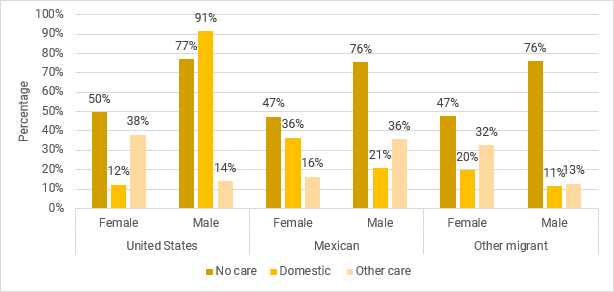
Figure 1 displays the type of occupation by sex and place of origin in the United States. The figure shows that non-care-related occupations have a higher participation rate among men than among women. In contrast, care-related jobs exhibit a differentiated distribution by sex: women overwhelmingly perform this type of work regardless of their place of origin.
Source: Authors’ elaboration.
Regarding place of origin, significant differences are observed in the distribution of care work. Among native-born women, 38% work in professional care occupations that require a degree such as those linked to the health, education, and administrative sectors, followed by 12.3% who work in domestic care. In contrast, 36.4% of Mexican women in the United States are engaged in domestic work related to childcare, domestic employment, food preparation, cleaning tasks, among others. 16% work in professional care. Among other migrant women, including Latin Americans and those from other regions, the highest share is also concentrated in professional care, at 32%, while 20% of women work in domestic care.
Source: Authors’ elaboration.
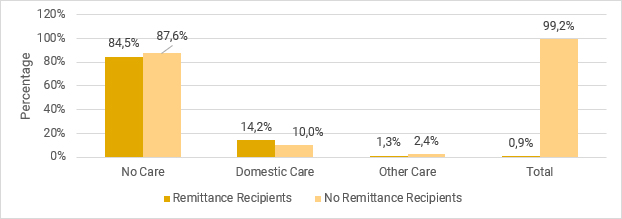
When examining the Mexican labour market, and for the purpose of analysing the functioning of Global Care Chains, a proxy variable is estimated to identify household migration exposure and to assess how this condition may reshape care arrangements in the place of origin through the receipt of remittances. Figure 2 shows the type of occupation performed, distinguishing between households that receive remittances and those that do not. According to the ENOE, approximately 1% of the Mexican employed population resides in households receiving remittances, used here as a proxy to identify household migration exposure. The data also indicate that 84.5% of individuals with household migration exposure (remittance recipients) are concentrated in non-care-related occupations, while 14.2% are engaged in domestic care work and 1.3% in other care activities.
Based on the estimation of the multinomial logistic model and its marginal effects, it is possible to analyse the impact of the independent variables on the probability of individuals engaging in care-related work, both in the United States and in Mexico. All marginal effects are expressed in percentage points; accordingly, the coefficients reported in the following tables are multiplied by 100 for ease of interpretation. Table 3 presents the marginal effects of the estimation for the US case: being a woman increases the probability of participating in paid care work relative to men. This effect is particularly strong in other care as health care or education care, where women exhibit a 21.2 percentage points higher probability of entering these occupations. Although the effect remains positive, the magnitude is smaller for domestic care work with marginal probabilities of 5.8 percentage points.
(1) No care | (2) Domestic care | (3) Other care | |
|---|---|---|---|
| Women | -0.2713*** (0.0012) | 0.0587*** (0.0008) | 0.2127*** (0.0010) |
| Other migrants | -0.0183*** (0.0017) | 0.0651*** (0.0014) | -0.0468*** (0.0014) |
| Mexican | -0.0230*** (0.0032) | 0.1060*** (0.0024) | -0.0829*** (0.0028) |
| Int. gender-native | -0.2683*** (0.0012) | 0.0469*** (0.0008) | 0.2213*** (0.0011) |
| Int. gender- other migrants | -0.2696*** (0.0032) | 0.0995*** (0.0026) | 0.1700*** (0.0026) |
| Int. gender-Mexican | -0.3291*** (0.0059) | 0.1389*** (0.0045) | 0.1902*** (0.0053) |
| Age | 0.0029*** (0.0003) | -0.0060*** (0.0002) | 0.0031*** (0.0002) |
| Age Squared | -0.0000*** (0.0000) | 0.0001*** (0.0000) | -0.0000*** (0.0000) |
| Nchild | -0.0131*** (0.0006) | -0.0003 (0.0004) | 0.0134*** (0.0005) |
| Incomplete_school | 0.0266* (0.0157) | -0.0349** (0.0141) | 0.0083 (0.0108) |
| High_school | 0.0519*** (0.0156) | -0.1295*** (0.0140) | 0.0776*** (0.0107) |
| Associate_degree | 0.0021 (0.0157) | -0.1764*** (0.0141) | 0.1743*** (0.0108) |
| Bachelor | 0.0281* (0.0156) | -0.2306*** (0.0140) | 0.2025*** (0.0107) |
| Postgraduate | -0.1021*** (0.0156) | -0.2652*** (0.0140) | 0.3673*** (0.0108) |
| Separated/divorced | -0.0148*** (0.0018) | 0.0180*** (0.0012) | -0.0032** (0.0015) |
| Never married/single | -0.0219*** (0.0017) | 0.0389*** (0.0011) | -0.0170*** (0.0014) |
| Midwest | 0.0256*** (0.0019) | -0.0101*** (0.0013) | -0.0155*** (0.0017) |
| South | 0.0253*** (0.0017) | -0.0052*** (0.0012) | -0.0202*** (0.0015) |
| West | 0.0157*** (0.0018) | -0.0062*** (0.0013) | -0.0095*** (0.0016) |
Observations McFadden's Pseudo-R² Wald-Chi² Prob > chi² | 636,188 0.1252 120,781.68 0.0000 |
Regarding the Origin variable, Mexican and other migrants show distinct patterns of labour insertion compared to native-born women. Mexican women are 10.6 percentage points more likely to work in domestic care, and other migrants 6.5 percentage points more likely, while both groups show lower probabilities in other care work (8.2 percentage points for Mexicans, 4.6 for the other migrants). Additionally, the interaction between gender and origin reveals a clear pattern of occupational segmentation among employed women. The marginal effect of being a woman on domestic care increases with migration status (4.69 percentage points for native-born women, 9.95 percentage points for other migrant groups, and 13.89 percentage points for Mexican women), whereas its effect on professionalised care is lower for both migrant groups than for native-born women (22.13 percentage points for native-born women, compared with 17.00 for other migrants and 19.02 for Mexican women).
Age has a small negative effect on domestic care (under 1 percentage point per year), with a non-linear pattern confirmed by the quadratic term. Each additional child increases the probability of working in professional care by 1.3 percentage points but has no significant effect on domestic care. Education shows opposite effects across care types: higher schooling reduces the probability of domestic care from 3.4 percentage points for incomplete education to 26.5 percentage points for postgraduate education, while increasing the probability of professional care (up to 36.7 percentage points for graduate degrees). Single individuals are more likely to work in domestic care (3.8 percentage points) and less likely in other care work (1.7 percentage points). Regionally, residents of the Midwest, South, and West show lower probabilities of domestic care compared to the Northeast.
(1) No care | (2) Domestic care | (3) Other care | |
|---|---|---|---|
| Women | -0.1372*** (0.0016) | 0.1288*** (0.0015) | 0.0083*** (0.0007) |
| Proxy_migrant | 0.0255*** (0.0082) | -0.0114* (0.0062) | -0.0141** (0.0057) |
| Age | -0.0054*** (0.0003) | 0.0031*** (0.0002) | 0.0023*** (0.0002) |
| Age Squared | 0.0001*** (0.0000) | -0.0000*** (0.0000) | -0.0000*** (0.0000) |
| Nchild | 0.0038*** (0.0006) | -0.0029*** (0.0005) | -0.0009*** (0.0003) |
| Incomplete_school | 0.0072 (0.0056) | -0.0103* (0.0056) | 0.0031*** (0.0004) |
| High_school | 0.0588*** (0.0058) | -0.0777*** (0.0057) | 0.0189*** (0.0008) |
| Bachelor | 0.0404*** (0.0067) | -0.0961*** (0.0062) | 0.0558*** (0.0028) |
| Postgraduate | 0.0901*** (0.0057) | -0.1450*** (0.0056) | 0.0549*** (0.0011) |
| Separated/divorced | -0.0215*** (0.0022) | 0.0214*** (0.0020) | 0.0001 (0.0011) |
| Never married/single | -0.0218*** (0.0019) | 0.0147*** (0.0018) | 0.0071*** (0.0009) |
| Remittance_states | 0.0167*** (0.0025) | -0.0196*** (0.0022) | 0.0029** (0.0012) |
| Border_States | 0.0212*** (0.0019) | -0.0195*** (0.0017) | -0.0017** (0.0009) |
Observations McFadden’s Pseudo-R² Wald-Chi² Prob > chi2 | 194,252 0.1283 15,895.98 0.0000 |
The multinomial logit results for Mexico show that women are more likely than men to work in domestic care (12.8 percentage points) and slightly more likely to work in other care occupations (0.83 percentage points). Age has a positive relationship with both types of care work (0.30 percentage points for domestic care, and 0.23 percentage points for other care per year), with the expected nonlinear pattern confirmed by the squared term. Each additional child slightly decreases the probability of domestic care (0.29 percentage points) and other care work (0.09 percentage points), respectively.
Household migration exposure (Proxy migrant) reduces participation in both domestic care (1.1 percentage points) and other care work (1.4 percentage points), respectively. Higher education reduces the probability of domestic care, while increasing participation in other care work (5.4 percentage points for postgraduate education). Being single, separated, widowed or divorced increases the probability of domestic care by 1.4 percentage points and 2.1 percentage points, respectively, compared with married women. In states that are major remittance recipients, domestic care probability is 1.9 percentage points lower and other care work is 0.2 percentage points higher. A similar pattern appears in border states, with a 1.9 percentage points lower probability of domestic care and 0.1 percentage points lower probability of other care work.
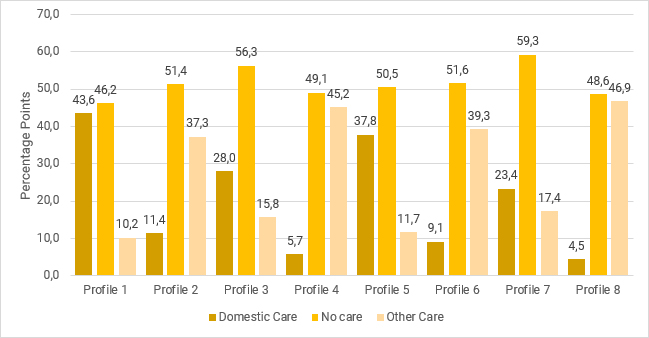
In addition to average marginal effects (AME), which show the direction and magnitude of each covariate’s individual effect, adjusted predicted probabilities were estimated for eight representative sociodemographic profiles. These profiles for each country were constructed by crossing the three dimensions: migration status (Mexican/native-born for the US; and remittance recipient/non-recipient for Mexico), educational level (low/high), and age (30/45 years), while holding sex (woman), marital status (married), number of children (2), and region (South for the US and the border states for Mexico) constant.
For the United States, then, Profile 1 corresponds to a Mexican woman with incomplete schooling and age 30; Profile 2, to a Mexican woman with a college education and age 30; Profile 3, to a native-born woman with incomplete schooling and age 30; and Profile 4 to a native-born woman with a college education and age 30. Profiles 5 through 8 replicate these same combinations of origin and education, but for women aged 45: Profile 5 corresponds to a Mexican woman with incomplete schooling; Profile 6 to Mexican woman with a college education; Profile 7 to a native-born woman with incomplete schooling; and Profile 8, to a native-born woman with a college education.
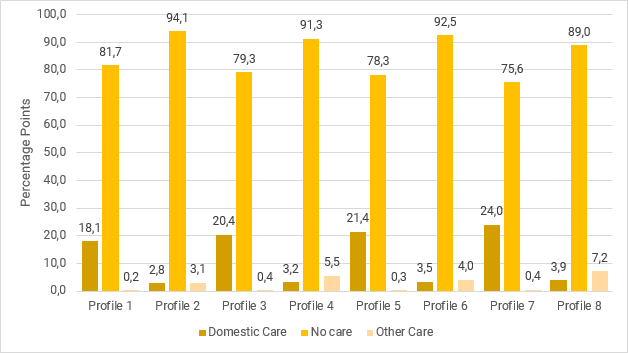
For Mexico, the eight profiles are constructed equivalently to those for the United States, replacing individual migration status (Mexican/native-born) with household migration exposure: remittance-recipient household instead of Mexican; and non-recipient household instead of native-born. The other dimensions (education, age) and constant covariates (sex, marital status, number of children) remain identical; the reference region corresponds to the border states.
Source: Authors’ elaboration.
The results show that migration status is consistently associated with a higher probability of working in domestic care, although this association weakens substantially with educational level. Among women with low education, the gap between Mexican and native-born American women in the probability of working in domestic care is 16 percentage points at age 30 (44 percentage points compared to 28 percentage points), and 15 percentage points at age 45 (38 percentage points compared to 23 percentage points). This gap narrows to 5 percentage points among women with high education, both at age 30 (11 percentage points versus 6 percentage points) and age 45 (9 percentage points versus 5 percentage points), suggesting that education acts as a compensatory factor for the disadvantage associated with migration status.
Educational level is one of the most important determinants among the three analysed: moving from low to high education at age 30 reduces the probability of domestic care by 33 percentage points among Mexican women and 22 percentage points among native-born women, shifting this probability mainly towards other care occupations, such as health, education, and administrative work, which increase from 10 percentage points to 37 percentage points among Mexican women and from 16 percentage points to 45 percentage points among native-born women. Finally, age shows a smaller effect, associated with a gradual decline in the probability of domestic care between ages 30 and 45 for both the Mexican and US cases.
Source: Authors’ elaboration.
The results for Mexico show that migration status (approximated through household remittance receipt) is not associated with a higher probability of domestic care. Among observations with low education, those residing in remittance-recipient households show a similar or even lower probability of domestic care than non-recipients, both at age 30 (18 percentage points compared to 20 percentage points) and age 45 (21 percentage points compared to 24 percentage points). Among observations with high education, this difference practically disappears (3 percentage points in both groups at age 30 and 3 percentage points versus 4 percentage points at age 45).
Educational level is the most important determinant, moving from low to high education reduces the probability of domestic care by 15 percentage points among observations in remittance-recipient households and by 17 percentage points among observations in non-recipient households (at age 30), shifting this probability mainly towards the no-care category. Finally, age shows a mild effect: the probability of domestic care increases slightly between ages 30 and 45 in most groups.
5. Discussion
The results show that gender continues to shape how women and men enter paid care work (Scott-Jones & Clark, 1986; Connell, 2021). In the United States, this pattern also varies by origin. The effect of being a woman on the probability of working in domestic care is 4.69 percentage points among the native-born population, 13.89 percentage points among the Mexican population, and 9.95 percentage points among other migrant groups. In Mexico, women are 12.88 percentage points more likely than men to work in domestic care. These differences show that the sexual division of labour remains present in the occupational organisation of care, although it takes different forms depending on the national and migration context. Furthermore, the comparison of predicted profiles across both countries reinforces this divergence. In the United States, being Mexican is associated with a substantially higher probability of domestic care relative to native-born women, with gaps of 15-16 percentage points among women with low education, narrowing to 4-5 percentage points among women with high education. In Mexico, by contrast, household migration exposure (proxied via remittance) does not follow the same pattern: differences between remittance-receiving and non-receiving households are minimal (2-4 percentage points) and, contrary to the US case, receiving households show a slightly lower probability of domestic care. This is consistent with the feminisation of care described by Meneses-Medina (2023a, 2023b) and with the structural devaluation of reproductive labour discussed by Fraser (1994, 2007, 2022) and Pérez Orozco (2014). Since the analysis is limited to the employed population, these findings refer specifically to occupational segregation in paid work and should not be interpreted as evidence of how paid and unpaid care responsibilities are distributed more broadly.
Education introduces another important difference in how women are positioned within paid care work. In the United States, higher levels of education are associated with a lower probability of working in domestic care and a higher probability of entering professionalised care occupations. Among individuals with postgraduate education, the probability of domestic care falls by 26.52 percentage points, while the probability of other care work increases by 36.73 percentage points. The predicted profiles show this pattern more clearly among women: moving from low to high education at age 30 reduces the probability of domestic care by approximately 33 percentage points among Mexican women and 22 percentage points among native-born women, with much of this change moving towards professionalised care occupations.
In both countries, education is the determinant of the largest magnitude: moving from low to high education reduces the probability of domestic care by 15-17 percentage points in Mexico, a smaller but still substantial effect compared to the US case. Age, meanwhile, shows opposite directions across contexts—domestic care probability declines slightly between ages 30 and 45 in the US, but increases over the same span in Mexico, pointing to distinct occupational trajectories in each labour market. Education therefore changes women’s position within paid care work, but it does not remove the gendered patterns that organise this labour. Rather, it shows that women occupy different segments of the care economy depending on their educational and migration trajectories.
These findings are consistent with recent studies showing that, even among women with higher education or an educational advantage over their partners, inequalities in the distribution of care work narrow but do not disappear (García-Román, 2023; Hook & Nazio, 2025; Raz-Yurovich & Okun, 2024). The present study examines paid occupational incorporation rather than the distribution of unpaid care within households, so these two dimensions should not be treated as equivalent. Still, considered together, they show why education alone cannot explain changes in the sexual division of labour. Education expands opportunities and changes labour trajectories, but these processes continue to take place within broader gendered relations that shape how care is organised and valued (Federici, 2020; Fraser, 2022).
From the perspective of feminist economics and Global Care Chains, these findings can be understood as part of a broader transnational organisation of reproductive labour. Women remain highly concentrated in paid care work, but their position within this labour is not the same. In the United States, the differences between Mexican, native-born, and other migrant women show that gender intersects with migration and origin in shaping access to different segments of the care economy. These patterns are consistent with the transnational organisation of reproductive and affective labour described by Hochschild (2000, 2014), Yeates (2004, 2012, 2013), and Parreñas (2001, 2021). At the same time, the models used here do not directly observe how unpaid care is redistributed between households or whether domestic tasks are outsourced as a result of migration. From the capital-life conflict proposed by Pérez Orozco (2014), the findings can instead be read as showing how the organisation of paid care remains connected to broader inequalities in the organisation of social reproduction. This interpretation also connects with the labour segmentation, racialisation, and global inequalities discussed by Gutiérrez-Rodríguez (2010), Gutiérrez-Rodríguez and Reddock (2021), and Connell (2021).
The findings of this study provide empirical evidence regarding the occupational segmentation of care labour by country of birth and gender. Specifically, Mexican-born women in the United States exhibit a substantial concentration in paid domestic and basic care tasks (36.4%), contrasting with higher participation rates of native-born women and other migrant groups in professionalised health and education occupations. Rather than confirming an intrinsic ethnic attribute, this occupational positioning reflects structural mechanisms of labour segmentation and migration regimes that historically channel Mexican migrant women into devalued reproductive sectors (Glenn, 1992; Romero, 2002).
Furthermore, the finding that residing in Mexican border states is associated with a lower probability of employed women entering paid domestic care work (-1.95 percentage points) introduces a relevant territorial nuance within the national labour structure. This regional control should not be interpreted as an absence of domestic care dynamics along the border, nor does it contradict evidence showing the vitality of cross-border care. As Orraca Romano (2015) demonstrates, while the overall share of transmigrant workers in border hubs such as Tijuana has experienced relative declines, female transmigrant participation in elemental and domestic service occupations remains notable. However, as López-Estrada (2020) points out, care workers’ trajectories in border cities often intertwine with local commercial and personal service activities on the Mexican side rather than being exclusively absorbed into cross-border domestic service. Within our national-level model, the border dummy captures the broader occupational diversification and specific economic structure of northern Mexico relative to the rest of the country, rather than directly measuring individual cross-border commuting flows or localised care chains.
Finally, the negative association between household migration exposure (proxied via remittance receipt) and participation in paid care occupations in Mexico (-1.14 percentage points in domestic care and -1.41 percentage points in other care) requires cautious interpretation. Because our empirical model is restricted to the employed population and observes only formal occupational categories, these results cannot be interpreted as direct evidence of care commodification or commercial outsourcing. Remittance-receiving households may reorganise social reproduction through multiple unobserved channels, including the redistribution of unpaid care chores among female relatives, changes in overall labour force participation, or altered reservation wages (Parreñas, 2001; García & de Oliveira, 2007). Consequently, while remittances alleviate financial constraints, their role in substituting domestic labour remains an interpretative hypothesis rather than an empirically observed mechanism.
6. Conclusions
Care continues to function as a central axis of inequality in the twenty-first century, not as a static legacy of the past, but as a dimension that is continually reconfigured in response to economic, demographic, and transnational transformations. The findings show that women remain disproportionately concentrated in paid care occupations, while education and migration shape their position within different segments of this labour. Higher education is associated with movement away from domestic care and towards professionalised care occupations, but these changes take place within an occupational structure that remains strongly gendered. Since the analysis is restricted to the employed population, these findings should be understood as evidence of occupational segregation in paid care work rather than as evidence of who performs care more broadly. Examining the latter would require considering unpaid care work and labour force participation decisions, which are not captured by the models used here.
The findings from the United States and Mexico also show that the organisation of paid care work takes different forms across national and migration contexts. Although the two analyses do not identify a direct empirical link between workers in the United States and households in Mexico, considering them together makes it possible to examine how gender, education, migration, and origin are associated with different positions within paid care work. From a Global Care Chains perspective, these patterns can be read in relation to broader transnational inequalities in the organisation of reproductive labour, without assuming that the models directly capture the mechanisms through which care is transferred or redistributed across households and countries. These differences also suggest that policies addressing inequalities in care work need to consider the specific labour and migration contexts in which they are produced.
The incorporation of Mexican women into the US labour market is marked by occupational segregation within paid care. The empirical evidence shows that country of birth and gender interact to increase the concentration of Mexican-born women in paid domestic work relative to native-born peers, while access to professionalised health and education niches remains mediated by educational level. These patterns illustrate how international demand for reproductive labour reproduces historical inequalities without assuming that all migrant women occupy homogeneous positions across the care sector.
In the country of origin, household migration exposure correlates with lower probabilities of employed individuals working in paid care occupations. However, because occupational surveys do not capture unpaid domestic tasks or the direct allocation of remittance expenditures, this relationship should not be conflated with the market outsourcing of care. Instead, it underscores the need for future research combining time-use surveys and qualitative methods to trace how transnational financial flows interact with intra-household, unpaid care arrangements across borders. Future studies would also benefit from incorporating the degree of urbanisation of the locality (urban/rural), which may be associated with both remittance receipt and local occupational structure, and which could not be examined within the scope of this study.
Data Access Statement
The data that support the findings of this study are publicly available in the Zenodo repository and can be accessed at:
Rosero-Ceballos, E. L., Meneses-Medina, P. A., & Rivera-Lozada, I. C. (2025). Data-Global care chain of Mexican women [Data set]. Zenodo. https://doi.org/10.5281/zenodo.17823429
Acknowledgments
The authors thank Andrea Youlitzi Villanueva del Prado, Director of Economic Analysis at the National Minimum Wage Commission (CONASAMI), Mexico, for technical support in merging the databases used in this study.
References
Anastasiadou, A., Zagheni, E., & de Valk, H. A. G. (2025). Including the gender dimension of migration is essential to avoid systematic bias in migration predictions. Proceedings of the National Academy of Sciences of the United States of America, 122(28), e2500874122. https://doi.org/10.1073/pnas.2500874122
Ariza, M. (coord.) (2020). Las emociones en la vida social: Miradas sociológicas. Universidad Nacional Autónoma de México, Instituto de Investigaciones Sociales.
Burnham, L., & Theodore, N. (2012). Home economics: The invisible and unregulated world of domestic work. National Domestic Workers Alliance.
Castillo Cervantes, M. de J. (2025, October 14). La maternidad transnacional entre mujeres migrantes en tránsito por el sur y centro de México. Contexto UDLAP. https://contexto.udlap.mx/la-maternidad-transnacional-entre-mujeres-migrantes-en-transito-por-el-sur-y-centro-de-mexico/
Cervantes González, J. A., & Ortega, J. A. (2024, May). La emigración mexicana femenina, el ingreso por remesas y la inclusión financiera (Notas de Remesas). Centro de Estudios Monetarios Latinoamericanos. https://www.cemla.org/foroderemesas/notas/2024-01-notas-de-remesas.pdf
Connell, R. (2021). Gender: In world perspective (4th ed.). Polity Press.
Consejo Nacional de Población (CONAPO). (2017). Mexicanos residentes en Estados Unidos. Boletín de Migración Internacional. https://www.gob.mx/conapo/articulos/boletin-mexicanos-residentes-en-estados-unidos-104234
Federici, S. (2020). Beyond the periphery of the skin: Rethinking, remaking, and reclaiming the body in contemporary capitalism. PM Press.
Flood, S., King, M., Rodgers, R., Ruggles, S., & Warren, J. R. (2020). Integrated Public Use Microdata Series, Current Population Survey (Version 7.0) [Data set]. IPUMS. https://doi.org/10.18128/D030.V7.0
Francisco-Menchavez, V. (2018). The labor of care: Filipina migrants and transnational families in the digital age. University of Illinois Press. https://doi.org/10.5622/illinois/9780252041723.001.0001
Fraser, N. (1994). After the family wage: Gender equity and the welfare state. Political Theory, 22(4), 591-618. https://doi.org/10.1177/0090591794022004003
Fraser, N. (2007). Feminist politics in the age of recognition: A two-dimensional approach to gender justice. Studies in Social Justice, 1(1), 23-35. https://doi.org/10.26522/ssj.v1i1.979
Fraser, N. (2022). Cannibal capitalism: How our system is devouring democracy, care, and the planet. Verso.
García, B., & de Oliveira, O. (2007). Trabajo extradoméstico y relaciones de género: Una nueva mirada. In M. A. Gutiérrez (comp.), Género, familias y trabajo: Rupturas y continuidades. Desafíos para la investigación política (pp. 49-87). Consejo Latinoamericano de Ciencias Sociales.
García-Román, J. (2023). Does women’s educational advantage mean a more egalitarian distribution of gender roles? Evidence from dual-earner couples in Spain. Journal of Family Studies, 29(1), 285-305. https://doi.org/10.1080/13229400.2021.1915852
Glenn, E. N. (1992). From servitude to service work: Historical continuities in the racial division of paid reproductive labor. Signs: Journal of Women in Culture and Society, 18(1), 1-43. https://doi.org/10.1086/494777
Greene, W. H., & Hensher, D. A. (2010). Does scale heterogeneity across individuals matter? An empirical assessment of alternative logit models. Transportation, 37(3), 413-428. https://doi.org/10.1007/s11116-010-9259-z
Gutiérrez-Rodríguez, E. (2010). Migration, domestic work and affect: A decolonial approach on value and the feminization of labor. Routledge.
Gutiérrez-Rodríguez, E., & Reddock, R. (eds.). (2021). Decolonial perspectives on entangled inequalities: Europe and the Caribbean. Anthem Press. https://doi.org/10.2307/j.ctv22d4tmb
Hochschild, A. R. (2000). Global care chains and emotional surplus value. In W. Hutton & A. Giddens (eds.), On the edge: Living with global capitalism (pp. 130-146). Jonathan Cape.
Hochschild, A. R. (2014). Global care chains and emotional surplus value. In A. Elliott (ed.), Routledge handbook of emotions and sociology (pp. 127-140). Routledge.
Hook, J., & Nazio, T. (2025). Women’s educational advantage and the gendered division of housework: Couples in France, Germany, Italy and the UK. Journal of Family Research, 37, 81-97. https://doi.org/10.20377/jfr-1168
Li Ng, J. J. (2024). México | Perfil de las y los migrantes mexicanos en Estados Unidos. BBVA Research. https://www.bbvaresearch.com/publicaciones/mexico-perfil-de-las-y-los-migrantes-mexicanos-en-estados-unidos/
López-Estrada, S. (2020). Cuidado a través de la frontera: Trayectorias transfronterizas de cuidados en la región Tijuana-San Diego. Estudios Fronterizos, 21, e044. https://doi.org/10.21670/ref.2002044
Meneses-Medina, P. A. (2023a). Aproximaciones al trabajo de cuidados de las mujeres durante la pandemia del COVID-19. Hallazgos, 20(40), 299-331. https://doi.org/10.15332/2422409x.9265
Meneses-Medina, P. A. (2023b). Reflexiones sobre el papel de las mujeres rurales colombianas en el trabajo. Revista Punto Género, 20, 361-383. https://doi.org/10.5354/2735-7473.2023.73473
Nazareno, J., Yoshioka, E., Adia, A. C., Restar, A., Operario, D., & Choy, C. C. (2021). From imperialism to inpatient care: Work differences of Filipino and White registered nurses in the United States and implications for COVID-19 through an intersectional lens. Gender, Work & Organization, 28(4), 1426-1446. https://doi.org/10.1111/gwao.12657
Organización Internacional para las Migraciones. (n. d.). Género y migración. https://www.migrationdataportal.org/es/themes/genero-y-migracion
Orraca Romano, P. P. (2015). Inmigrantes y trabajadores transfronterizos en la región fronteriza Estados Unidos-México. Frontera Norte, 27(53), 5-34. https://doi.org/10.17428/rfn.v27i53.97
Osterman, P. (2023). The care crisis: How the US care system is failing its elderly and the workers who support them. Russell Sage Foundation.
Parreñas, R. S. (2001). Servants of globalization: Women, migration, and domestic work. Stanford University Press.
Parreñas, R. S. (2021). Unfree: Migrant domestic work in Arab states. Stanford University Press.
Parreñas, R. S., Sabio, G. S., & Pandey, K. (2022). Global care chains. In A. Triandafyllidou (ed.), Routledge handbook of Immigration and Refugee studies (2nd ed., pp. 172-183). Routledge. https://doi.org/10.4324/9781003194316-21
Passel, J., & Krogstad, J. (2024, July 22). What we know about unauthorized immigrants living in the U.S. Pew Research Center. https://www.pewresearch.org/short-reads/2024/07/22/what-we-know-about-unauthorized-immigrants-living-in-the-us/
Pérez Orozco, A. (2010). Cadenas globales de cuidado: ¿Qué son, cómo funcionan y por qué importan? Instituto Internacional de Investigaciones y Capacitación de las Naciones Unidas para la Promoción de la Mujer (UN-INSTRAW).
Pérez Orozco, A. (2014). Subversión feminista de la economía: Aportes para un debate sobre el conflicto capital-vida. Traficantes de Sueños.
Raz-Yurovich, L., & Okun, B. (2024). Are highly educated partners really more gender egalitarian? A couple-level analysis of social class differentials in attitudes and behaviors. Demographic Research, 50, 1005-1038. https://doi.org/10.4054/DemRes.2024.50.34
Rivera-Lozada, I. C., Ordonez-Claros, J. M., & Meneses-Medina, P. A. (2026). Global Care Chains and the links of caring: A systematic review. Social Sciences & Humanities Open, 13, 102997. https://doi.org/10.1016/j.ssaho.2026.102997
Romero, M. (2002). Maid in the U.S.A (10th anniversary ed.). Routledge.
Rosero-Ceballos, E. L., & Meneses-Medina, P. A. (2022). Wage discrimination by gender of South American immigrants in the US labour market. Cuadernos de Administración, 38(73), e2611643. https://doi.org/10.25100/cdea.v38i73.11643
Rosero-Ceballos, E. L., Meneses-Medina, P. A., & Rivera-Lozada, I. C. (2025). Data-Global care chain of Mexican women [Data set]. Zenodo. https://doi.org/10.5281/zenodo.17823429
Scott-Jones, D., & Clark, M. L. (1986). The school experiences of Black girls: The interaction of gender, race, and socioeconomic status. Phi Delta Kappan, 67(7), 520-526.
Suprema Corte de Justicia de la Nación. (2025). El derecho humano a los cuidados: Una agenda en construcción. https://www.scjn.gob.mx/derechos-humanos/sites/default/files/Publicaciones/archivos/2025-06/DH-cuidados-agenda-en-construccion.pdf
Wooldridge, J. M. (2001). Econometric analysis of cross section and panel data. The MIT Press.
Yeates, N. (2004). Global care chains: Critical reflections and lines of enquiry. International Feminist Journal of Politics, 6(3), 369-391. https://doi.org/10.1080/1461674042000235573
Yeates, N. (2012). Global care chains: A state-of-the-art review and future directions in care transnationalization research. Global Networks, 12(2), 135-154. https://doi.org/10.1111/j.1471-0374.2012.00344.x
Yeates, N. (2013). Global care chains. In W. A. Dunaway (ed.), Gendered commodity chains (pp. 175-189). Stanford University Press. https://doi.org/10.1515/9780804788960-016
Yeates, N., & Holden, C. (eds.). (2022). Understanding global social policy 660 (3rd ed.). Policy Press. https://doi.org/10.56687/9781447358060
Zou, Y., Wong, M., van der Berg, P. E. W., & Kemperman, A. D. A. M. (2026). Older adults’ out-of-home activity location choice and associations with loneliness: A latent class multinomial logit approach. Cities, 168, 106485. https://doi.org/10.1016/j.cities.2025.106485