Racializando la frontera sur española. Poder neocolonial, linaje patriarcal, y la nueva pureza de sangre



Melilla is a crucial laboratory of Spanish neocolonial rule. In this paper, we deploy our extensive ethnography in the North African Spanish enclave to argue that analyses of racialization in Spain must (1) be critically situated in the particular genealogies of Hispanic coloniality (as opposed to uncritically incorporating Anglo-Atlantic frames) and (2) foreground their inextricability from the broader formations of global apartheid and imperialism. We zoom in on the phenomena of “mestizaje” in the enclave, examining the neocolonial state intervention in marriage, the gendered and classed racialization of lineage, and the related, irreducibly heterogeneous patterns of belonging and subjection. We then point to the importance of the elimination of the interstice—the suppression of “the Other within”—to the coherence and stability of racial categories and multiculturalist governance. Contemporary racialization in Spain, then, appears as co-constituted by the border regime, patriarchal kinship, and liberal governmentality.
Melilla es un laboratorio crucial del poder neocolonial español. En este artículo, utilizamos nuestra etnografía de larga duración en el enclave español del norte de África para argumentar que el análisis de la racialización en España debe (1) situarse críticamente en las genealogías particulares de la colonialidad hispana (en contraposición a la incorporación acrítica de marcos anglo-atlánticos) y (2) poner de relieve su carácter indisociable del sistema planetario de apartheid global e imperialismo. Nos centramos en el fenómeno del «mestizaje» en el enclave, examinando la intervención neocolonial del Estado en el matrimonio, la racialización del linaje basada en el género y la clase, y los patrones irreductiblemente heterogéneos de pertenencia y sujeción. A continuación, señalamos la importancia de la eliminación del intersticio —la supresión del “otro dentro de mí”— para la coherencia y estabilidad de la gobernanza multiculturalista y sus categorías etno-raciales. La racialización contemporánea en España es pues co-constituida por el régimen fronterizo, el parentesco patriarcal y la gubernamentalidad liberal.

Melilla; Spain; Hispanic/Spanish coloniality; racialization; limpieza de sangre; cross-border marriage; kinship; normativity; queer of color critique; mestizaje; miscegenation; interethnic relations; interracial relations; border regimes; racial capitalism; imperialism; decoloniality; feminism; patriarchy
Melilla; España; colonialidad hispana/española; racializacion; limpieza de sangre; matrimonio transfronterizo/mixto; parentesco; linaje; normatividad; queer of color critique; mestizaje; mezcla; relaciones interétnicas e interraciales; regímenes fronterizos; capitalismo racial; imperialismo; decolonialidad; feminismo; patriarcado

1. Introduction
Melilla is a critical place to explore how border regimes activate racialization. One of two Spanish enclaves in North Africa, Melilla’s fence has become one of the emblems of Spain’s border spectacle and a broader symbol of Fortress Europe (De Genova, 2013, 2016; Ferrer-Gallardo & Gabrielli, 2024). Endless media coverage of Black African men jumping the border fence between Morocco and the enclave appears constantly in narratives about immigration and borders. Black bodies have become the icon of the dramatic consequences of the border’s rejection of racialized bodies (Gazzotti, 2023; Sharpe, 2016). However, this media focus is key to constructing the dominant framing of how the state, through highly developed security-based governance of its borders, orders the assumed chaos of people’s global movements. In this Eurocentric narrative, foreign Black bodies become the icon of “racial” otherness, coming from abroad and managed at the border.
The contemporary construction of the racial other, thus, is intimately connected to the border regime. Or, that is, to the military, political, and legal ordering of the divide between global North and South, between Spain and Morocco, between so-called secular liberal democracy and religious authoritarian rule, between “developed” and “developing,” between “modernity” and its Others. The border regime deploys both material and symbolic devices to legitimize the racialization and criminalization of the mobility strategies of the wretched of the earth (Fanon, 1961). The construction of a radical “Other” that treacherously employs all available means to flee poverty, conflict, neocolonial extractivism, or climate breakdown is well established in Europe, Spain, and, of course, Melilla.
However, the fence hides more than it reveals. Ethnographic research in Melilla uncovers that beyond it lie highly invisibilized processes of constant, relentless, and profound racialization and gendering. Foregrounding these is critical to developing a decolonial analysis of border regimes and the fundamental role of racism in their contemporary operation. This is not self-evident, however. Liberal regimes conceptualize racism as external to their self-proclaimed egalitarianism, as aberrant and illegal behavior and/or ideology that can be “fixed” through legal and educational devices. Nevertheless, as we will show, liberalism is embedded in coloniality and is central to its contemporary work. Both multiculturalist rhetoric and governance and liberal equal rights discourse, or bourgeois law, neglect the colonial roots of racialization and the inherited classificatory orders that have structured inequalities historically while at the same time conjuring up a realm of perfectly equivalent racial differences before the law and the state (Collier, Maurer & Suarez-Navaz, 1995; Suarez-Navaz, 2004).
Our work is based on long-term ethnographic research in Melilla. From 2016 to 2022, we worked in a variety of sites in the enclave, from the CETI (Center of Temporary Stay for Immigrants) to official and informal NGO and activist organizations dealing with immigration, local poverty, and exclusion in daily life in the highly segregated neighborhoods (Suarez-Navaz & Suarez, 2024). The city is pierced by an oppositional dynamic between “Christians” and “Muslims,” often called “Moors,” which coexists with a hegemonic discourse of harmonious multicultural “convivencia” (coexistence) that includes them and “Hebrews,” “Hindis” and “Gypsies.”1 These latter groups are added, as a Melillan told us, to “hide the tension between ‘Moors’ and ‘Christians’” and their longue durée, which defines the city. In other words, away from the media, Melilla’s everyday texture is not defined by the anti-Black spectacularization of the fence and border-crossing but rather by a fragile equilibrium that combines and reanimates geo-specific historical antagonisms with the delicate exercise of neocolonial rule.
Early in our research, we collaborated in a summer workshop with children in one of Melilla’s “Muslim” districts. During introductions, we found that a few were named after their Muslim and Christian ancestors, like Fatima María or Abdul José. The small crowd instantly reacted: “Fatima Maria is a mestiza, is a mestiza…” they sang mockingly to the shy girl. This serendipitous moment led us to important questions about using “mestiza” and Melilla’s ethnoracial order. How can we understand the pragmatics of a category coined during American colonization in an environment closer to the ethnoreligious classification of medieval Iberia? What processes of racialization make sense of this problematic border-crossing in the eyes of Melilla’s children? How does ethno-stratification work in this complex transborder space? How do longer-term structures around “purity of blood”, lineage, and its patriarchal basis manifest in the governance of the border, the borderland, and its gendered inequalities? How is this neocolonial, patriarchal, and class-based mode of production legitimized in the new liberal democracies, if at all?
This article advances a decolonial analysis of Spain’s liberal border regime and its forms of racialization. Instead of assuming universal forms of exclusion based on “race” and “sex”, we examine the specificity of Hispanic coloniality and patriarchy. “Race” should be understood as rooted in and co-constitutive of the patriarchal control of lineage, as our analysis of interreligious sex in Melilla will show. The border regime thus reinscribes old semiotics of Hispanic classification into today’s global apartheid and neocolonial structures. We underscore the coloniality inscribed in the new Spanish democratic system, showing how Melilla’s ethno-stratification and intense segregation coexist with the new rhetoric of multiculturalism and “convivencia,” rooted in pre-liberal political imagery.
We will first explain the complexities of Spanish or Hispanic coloniality around the idea of “race” and longue durée processes of racialization, trying to unsettle Anglo-Saxon influence in academic analyses of race and racism in Spain (Martínez, 2008). We explore Spanish exceptionalism, an ideology that parades “mestizaje” as a sign of the overcoming of racism and thus claims superiority to other European racial regimes. Throughout the paper, we argue that while the importance of “race” should not be minimized in the Spanish case, racialization processes in Spain require finer and more geo-culturally specific analytics—both necessary to avoid Anglo-centric and presentist impositions of “race” upon its longstanding colonial structures. The second section shows the extent to which Melilla is part of a global apartheid system and how contemporary border regimes are key to new racialized political economies of accumulation and dispossession (Walia, 2010, 2013), arguing that this needs to be foregrounded in analyses of racialization.
The third and fourth sections delve into the phenomena of “mestizaje”, as it is locally called. We emphasize the need to avoid the temptation to think of it as a sociological category because it is not: the heterogeneity of experiences is radical and severely shaped by gender, class, and ethno-racial or ethnoreligious adscriptions (Laplantine & Nouss, 2007). We show this through our ethnographic findings in Melilla. We will show how “mixed” is a contingent site that can yield different racializing pressures and explore the gendered racialization of lineage and the patriarchal division of women across etno-religious boundaries. In doing so, we emphasize the ongoing centrality of patriarchal mechanisms to the production of “race”, highlighting their continual interplay and enduring codetermination. The final section shows the racializing pressures aimed at “mestizo” subjectivity, an embodied experience of daily interpellation to “choose” identity, part of an “ethno-classifying panopticon” that effectively procures the suppression of the other within.
2. Hispanic Coloniality: rootling race, racialization and racism in Spain
This special issue urges us to understand everyday forms of racism and the underlying ideas of race and racialization. Doing this requires critically approaching the all-too-common Anglo-Saxon use of such analytical categories. Race is not, by any means, a universal positivist category. On the contrary, it builds on the historically specific, long-durée material and symbolic structures that shape social classification systems. Thus, the perplexity at and problematization of the absence of “race” both in social analysis and political discourse in Spanish society should not be falsely solved by reintroducing “race” as if it were a universal and timeless parameter. The historical social construct of “race” and specific racialization processes go, in the case of Spain and Latin America, back to the first modernity (Dussel, 2000; de la Cadena, 2005; Martinez, 2008). This long-durée analysis will nonetheless establish that racialization processes do not need the category of “race”—particularly in its biological or phenotypical inflection—to produce equivalent hierarchical and differential orders and classifications.
On the other hand, there is a problematic and often elusive treatment of Hispanic coloniality in Spain. The most conservative position, generally found in the traditional as well as the new right, is altogether to deny the characterization of Spanish history as colonialist. A more moderate ideological position recognizes Spanish colonial expansion in America (coded both as Iberoamérica and hispanoamérica) only to then praise “our” inclination to mix with locals, contrary to the deep-seated racism of the “one drop rule” in Anglo-Saxon colonial formations. This argument, which we analyze in detail later, is part of “Spanish exceptionalism” (Gabilondo, 2009). Finally, there is a third, more critical position that stresses the need for decolonization, using the category of “race” as if it were a universal phenomenon, falling into both Eurocentrism and presentism. This is a common error in sociological analyses that reduce “race” and “racialization” to a self-evident variable.2
Thus, we begin this article with a (necessarily) brief historical review of the symbolic and semiotic layers that dialectically inform contemporary processes of racialization in Spain. The need for a long-durée analysis that is not constrained to the Anglo-Saxon take on “race” arose from our empirical findings in Melilla, where people of mixed religious backgrounds call themselves “mestizas/os.” Knowing and being critical of the very racist use of this category in Spanish coloniality (Stolcke, 2008; Catelli, 2020), we only maintain its use in the article because a) it is an emic term used by local people, b) it indicates the contemporary resilience of a (neo)colonial category which is largely avoided in the academy, c) it shows the specificity of Spanish understandings of (ethno-racial-religious) cultural difference, and d) it highlights the relevance of bordering through everyday racism, while nevertheless becoming legitimized and reproduced in contemporary neoliberal-multiculturalist rhetoric.
Decolonizing our sociological approach to racialization in the Hispanic context unveils the founding importance of lineage and religion to the construction of racist and exclusionary classificatory orders. Lineage and religion channeled belonging, rights, and obligations before colonial expansion, and they were key in the peninsular multireligious social ordering into ethnoreligious “castes” with sovereign rights in the Iberian Peninsula (Castro, 1946; Martinez, 2008). These “castes” that coexisted for centuries in the Iberian Peninsula (not necessarily on equal conditions, as this was not a political criterion in the pre-Enlightenment era) maintain socioeconomic, political, and, of course, sexual ties. Patriarchal lineages surveil the mobility and sexual freedom of women, conveyors of recognized descendants (Niremberg, 2002). Interreligious sex is a threat to the patriarchal social order, but until the “Reconquista” entwines territory and religion as factors of war, Muslim or Jewish lineages are not conceived of as a political threat or as a transgression of the limpieza or pureza de sangre. Forced conversions are the beginning of the imposition of Christian genealogy, as though lineage—blood—could corrupt faith.
As much historical work on colonialism has shown, the “purity of blood” established in the Americas distinguished between, on the one hand, indigenous and peninsular communities and, on the other, those that were genealogically marked by other religious lineages, i.e., Jews, Muslims, heretics or enslaved Africans. This system did not involve a “racial” concept in a biological sense so phenotypically different “mestizos” could claim statuses generally reserved for “peninsular” (Rappaport, 2014; Stolcke, 2008). However, precisely due to the increase in multiethnic relations, the rights of the “mixed” population were gradually restricted. Thus, the colonial “caste” system racialized social hierarchies, reestablishing a “purity of blood” that sanctioned “mestizo” and “mixed” progeny in general. Our work in Melilla foregrounds the colonial underpinnings of the patriarchal surveillance of “purity of blood” in a context that racializes difference. This difference is not necessarily phenotypical, not even religious. The fundamental base is the ordering of patriarchal lineage.3
The colonial legacy of the Hispanic system of classification, its specific coloniality, adds another complexity to our socio-symbolic cartography of racialization and race under imperial eyes. Researchers like Gabilondo have shown the articulation between the ideas of “Latin race” or “Hispanic race” with the ideology of Spanish exceptionalism (2009). Spanish or Hispanic exceptionalism narrates itself as superior to the Anglo-Saxon insofar as it refers to multiracial and “mestizo” Hispanic lineage. This form of familial closeness extends into the 19th century to encompass the Muslim populations of North Africa, with whom the authorities of the Protectorate and Francoism feel “hermanados,” or united by fraternal ties (Mateo Dieste, 2018). In this case, the recognition of religious otherness does not signify heresy but a common recognition of the importance of religion in ethnoracial self-definition—again, in contrast to other liberal nations like the Europeans. This imagery, nonetheless, partakes in the supremacist ideology that legitimizes the colonization and/or “protection” of underdeveloped and interiorized nations, such as the “Moors” and other Africans.
Thus, we show that iterations of Hispanic “race”, with their characteristic fluidity, are capable of incorporating biologistic racism to the older racism based on limpieza de sangre and religious borders, both of them regulated through the patriarchal surveillance of the mobility and sexuality of women. The Hispano-Muslim brotherhood or friendship is based on an inter-patriarchal pact, the effects of which we show below. The most relevant insight of this analysis is understanding that “race” is always conjured through the sexism derived from the regulation of lineage. In a colonial context, in which socioeconomic and political interests are imposed to deny rights to colonized groups, “race” is not the only axis that determines inequality. Rather, “race” is produced through its interaction with gender and the patriarchal control of lineage. This is precisely the concern behind the rise of “intersectionality”, which, despite its partiality and liberal political and analytical tendencies, attempts to articulate race and gender in the analysis. However, this analytic ends up trapped in the liberal short-circuit if it does not incorporate an understanding of how the historical and cultural specificity of coloniality is etched onto social borders and inequalities.4
3. Border regime and global apartheid
Any approach to everyday forms of racialization in Melilla must begin by understanding not only its deeper cultural and historical substrate but also its neocolonial present. Melilla is a prime example of the system of global apartheid, the “loosely integrated effort by countries in the global north to protect themselves against the mobility of people from the global south” (Besteman, 2019, p. 26), which is central to the contemporary phase of racial capitalism (Robinson, 1983). To understand patterns of racialization, then, we need to understand their implication in racialized political economies of accumulation, (hyper)exploitation, and dispossession, as well as mobility patterns at a global level (Amin, 1974). In this section, we briefly explain Melilla’s recent history and its readaptation to this global regime of power, emphasizing how it undergoes a mutation in function from the launchpad of conquest to border vanguard, from conquering to bordering. In this period, articulated by Spain’s liberal democratic regime, Melilla became defined by what we call a multiculturalist border regime or its particular expression of neocolonial rule.
In 1985, seven years into the post-Francoist constitution, Spain’s accession to the European Union demanded the adoption of a new Alien Law to regulate its new role as “door to Europe”. In Melilla, the Alien Law explicitly excluded Muslims from Spanish citizenship, including the Amazigh majority, native to the land and resident in the city for generations. The overt coloniality of this move sparked fierce protests by Melilla’s Muslims, who mobilized for inclusion into Spanish and European citizenship. They were met by nearly unanimous counter-protests by the Euro-Christian group, who feared losing its monopoly over Spanishness and its entitlements (Belmonte, 2010).
Facing generalized civil disorder in the enclave, Madrid corrected its “mistake” and made an “exception” to the new law. Melilla’s Muslims were granted a path to obtain Spanish citizenship. Far from a move of benevolent liberalism, metropolitan politicians conceived and formulated this as a counterinsurgency policy imperative to maintain Spanish rule and reestablish order (Belmonte, 2010). The liberal “pacification” of Melilla, then, paved the way for the development of multiculturalist governance, which shortly followed Amazigh’s assimilation into citizenship. The “war” between “Moors” and “Christians”, as it is often coined in popular discourse, gave way to another productive historical analogy: “convivencia” (Spanish term for co-existence or co-habitation) between the different ethnoreligious groups. Evoking Iberia’s multireligious medieval period, “convivencia” would become increasingly central to the enclave’s vernacular formulation of multicultural rule.
This juncture fundamentally reconfigured Melilla, inaugurating its mutation from colonial to neocolonial rule (Suarez-Navaz & Suarez, 2024). It was the genesis of the multiculturalist border regime. Increasingly redundant in its past commercial and economic roles, the enclave begins a journey towards becoming a vanguard of Europe’s regime of separation from the global South. This sets in motion two politico-economic processes that have become central to the city’s architecture of rule. First, the enclave’s overt military domination and corrupt economy increasingly give way to the border-industrial complex (Bautista & PorCausa, 2022), perpetuating militarized rule and accumulation under seemingly civil imperatives and institutions. Secondly, the colonial regime’s pretense of the “betterment” of colonized peoples gives way to the non-profit industrial complex (Rodriguez, 2009), a growing humanitarian sector that becomes an effective, if decentralized, mode of governance.
Parallel to this, Melilla’s Muslims’ accession to European citizenship subtly reinstitutes colonial difference in now national rather than explicitly ethnoracial terms. In other words, the “legalization” of Melilla’s local Amazigh population also meant the “illegalization” of all other local Indigenous people, often linked to Melilla in social, economic, and familial terms. Indirectly, this move also meant the increasing and more general illegalization of the popular classes of the global South, which would become apparent in the decades to come. The explicit disentitlement of these groups as “foreigners” gives rise to renewed modes of racialized political economy and new forms of producing racialized sub-proletariats, or captive workforces, through what we have called accumulation by bordering (Suarez-Navaz & Suarez, 2024). Where before most of Melilla’s Muslims had only a “dog’s plate” as identification, which marked their explicit subjugation to Spanish citizens, now non-citizenship would come to fill that role. This, in turn, is at the root of the profound ethno-stratification that characterizes the city today despite its self-aggrandizing discourse as the flagship of European multicultural values.
In other words, liberal multiculturalist governance settles at the exact moment the border begins its elaboration as a new form of colonial rule. They are, in fact, co-constitutive, just as liberal civilizing discourse was co-constitutive of colonial conquest. We find this important to emphasize because it forces us to understand racialization in liberal polities—a function of multiculturalism’s categories—in articulation with the border and its global regime. In other words, the racialization of “citizens” has to be understood in the broader context of the wholesale and explicit disentitlement—racialization—of global south “non-citizens” on a planetary scale. Melilla’s borderland condition makes this apparent: global and internal apartheids converge.
This materializes in myriad forms of state racism in the enclave, which are essential to understanding the structural underpinnings of Melilla’s everyday forms of racialization. To begin with, Melilla’s police systematically—and illegally—preclude immigrants from registering their residency (“empadronamiento”), impeding their access to the civil rights liberal states are obliged to guarantee to residents (Barone, 2019). We then find the illegalization of the (highly feminized) cross-border Amazigh workforce, which has long been an essential part of the enclave’s economy but is prohibited from residing in it. Moreover, we find the state’s effective (if disavowed) ban on cross-border marriage, which we explain below.
Ethno-stratification in Melilla is pronounced: the average income of the Euro-Christian community nearly doubles that of Amazigh Muslims. In great part, this stems from the precarity imposed on non-citizens by the state, which reproduces conditions of impoverishment and marginalization. The socioeconomic divide, in turn, translates into a pronounced socio-spatial segregation. The border—part of global apartheid—produces internal apartheid. Melilla’s two poorest districts, which have 51% of their population under the poverty line, are 81% and 75% Amazigh Muslim. 80% of Melilla’s total Muslim population resides in them (Ananou, 2015). The reality for the majority of Muslims in the city, then, is confined to spaces of acute socio-spatial exclusion, where Melilla’s unemployment—consistently among the highest in Spain—is concentrated and most activities are criminalized (Suarez-Navaz and Suarez, 2022). Symbolically, one of these districts is informally called Cañada de la Muerte [“track of death”]. Segregation translates even into urban landscapes, which visually differentiate Melilla into Maghrebi and Euro-modernist architectures, into two neatly defined worlds (see Figure 1). Finally, school segregation is an increasingly undeniable reality: the socioeconomic gap between students of Catholic state-subsidized private schools—where most upper and middle classes choose to enroll their kids to avoid public, Muslim-majority schools—and those in public schools is the largest in Spain (López Belmonte, 2017, p. 23). Because of this, dropout rates among Amazigh students are much higher. Such a profound educational divide, in turn, compounds social divides, reproducing the lumpenized surplus status to which many are condemned. Such social exclusions join that of informal cross-border workers and undocumented Moroccan residents, which constitute a veritable cross-border underclass.
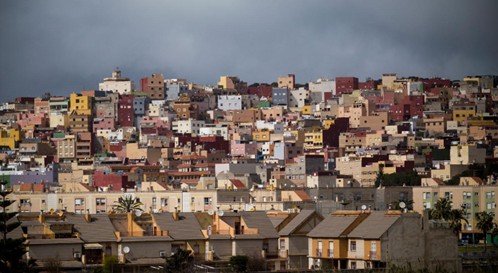
Fuente: Jairo Vargas (Público, 4 April 2015).
These material structures of neocolonial rule are justified and reproduced through the discursive construction of the “Moor” as an antagonist of the Spanish, European, and Christian nations. The border updates the foundational tropes of anti-Moor racism through the imaginaries of “invasion”—which is thoroughly gendered, as we analyze below—and the routine racism of political activity, epitomized by the centrality of “fear of the Moor” discourse. This discourse (yet again) other “Moors” as treacherous and as a threat to Spanishness, this time through their construed loyalty to the Moroccan state and its claim on the enclave. Indeed, in March 2024, several Muslim leaders of the “Muslim party” (CpM) were accused of buying votes, something that expert journalist Ignacio Cembrero calls “a common practice in Melilla”5. In an unprecedented move, they were put in pre-trial detention to avoid a perceived “risk of absconding,” which the judge’s writ explicitly said derived from their “Moroccan descent” and their possible Moroccan citizenship. They were released only after 71 days in prison, and while still awaiting a ruling, their targeting is unequivocally racialized. Such repressive discourse and action are complementary to the “gentler” multiculturalist incantations—not contradictory to them. Contemporary liberal discourse is a key vector for the racialization of the “non-modern” Other. Notably, the continued prevalence of integrationist discourse casts Muslims in general as in need of assimilating to Melilla’s, Spain’s, and Europe’s “way of life”—its secularism, liberalism, “gender equality,” etc., which are presumed to be lacking in Muslims.
All these discourses not only update historical antagonisms to Melilla’s new function as a border enclave but also give crucial cover to reproducing its material arrangement. To analyze everyday racialization in Melilla, then, it is necessary to understand it in the context of its racial capitalist configuration, its conservative and liberal racism, its neocolonial forms of disentitlement, and the patriarchal patterns through which these processes are organized. To this, we turn below.
4. The fiction of “mestizaje” as racial progress and the state racialization of kinship.
Melilla is undoubtedly a borderland. As we have shown, the system of rule and mode of production are neocolonial. Most sexual, affective, and marital relations are endogamous, geared towards the social reproduction of the socioeconomic statuses and patriarchal lineages that in Melilla are known as “Christians,” “Muslims,” “Jews,” “Hindus,” and “Gypsies”. It is true that factors like the establishment of a liberal rule of law, secularization, and the displacement of explicit racism as a tolerable discourse have contributed to the rise in exogamous relations and so-called “mestizo” progeny. While we do not explore this in this paper, these relations sometimes nurture experiences and upbringings steeped in biculturality and replete with transcultural practices (Suarez-Navaz & Suarez, 2022). Dominant discourse often narrates these cases in terms of a “progress” that “normalizes” phenomena derived from “romantic love” and people’s ability to “choose” in a liberal democracy. This rhetoric of progress, however, is rooted in an essentialist notion of ethnoracial “mixing,” which has been instrumentalized by Latin American criollo nationalisms since at least the narratives of the “cosmic race.”
This racializing, biologistic imaginary of culture attempts to make us think that “mixing” entails an overcoming of racism or that racism is unlikely in its context. But this is not the case. Instead, “mixing” is often an effect of racism (Bastide, 1970; Wade, 2003; Telles & Sue, 2009). “Mixed” sexual and affective relations and their “mestizo” progeny entail today, as they did in the past, a transgression of patriarchally controlled lineages, and nothing guarantees the biculturality and daily transcultural practices that sometimes arise. “Mestizo” lives or “mixed” progeny do not undo cultural borders. Rather, they inhabit them and walk their lines, often across highly segregated spaces (Suarez-Navaz & Suarez, 2024, p. 210).
That such multiculturalist ideological premises are reproduced by academic analysis stems from the creation of a single “mixed” social position from which a “mestizo” or “hybrid” condition derives. Contra this, we propose to delve into the embodiment of power relations—capitalist, nationalist, sexist, racist—in the families that cross genealogical borders. In this sense, “mestizo” is not a “condition” but a set of practices derived from the everyday exercise of upbringing and care work, which entails navigating daily ethnoreligious borders, qualms and mistrust from relatives and neighbors, fears and misunderstandings, racist attacks and the racialization of inherited ethnoreligious stigma.
Part of this liberal narrative responds to the fact that the multiculturalist border regime needs to normalize the possibility of “mestizaje” by “choice” to sustain its coherence and legitimacy as a non-racist system. However, a salient and understudied element of state racism—and a key vector of everyday racialization—happens in the realm of marriage. According to ethnographic information triangulated between expert actors such as lawyers, social workers, public servants at the Civil Registry, and activists, around three in four marriage applications from interethnic and cross-border couples are rejected. The process starts with arbitrary “interviews” from the Civil Registry to confirm the “veracity” of the union. In a legal context of supposed freedom of marriage, such “interviews” are stipulated by special national regulation to curtail “marriages of convenience” used by “aliens” to enter Spain and regularize their status (Andrikopoulos, 2021; Maskens, 2015; Roca, Anzil & Yzusqui, 2017, for related research). The racialized intervention of the state into kinship here is twofold. First, the police-like “interview” is used almost exclusively on marriages that involve someone from the global South, i.e., mainly racialized populations. Second, the measures also seem to be informally deployed between citizens of which one is not Euro-Christian.
This shows the neocolonial deployment of state power against any kinship perceived as a security threat. Conversations with several Civil Registry staff and marriage and family lawyers also showed that the application process, and particularly the “interview,” are sites of impunity where “true” marriages are dismissed as “false” by the state through dubious means. Even consummated unions with several children have been deemed “false” adducing rather preposterous evidence, such as not remembering the exact meal shared a week before. Thus, the liberal state is not just monitoring but attempting to curtail the marriages it sees as “suspicious”—those that don’t reproduce the European nation, the Christian lineage. Moreover, the calculation that all expert informants agreed on (three out of every four marriages rejected) does not include all those prevented by the sheer and Kafkaesque paperwork obstacles imposed by the state, which serve as an additional hurdle to formalizing cross-border marriages.
We thus find what amounts to a de facto prohibition of cross-border marriage. Global apartheid and the border regime, like other modes of racial-colonial rule before, depend on such gendered intervention into kinship. Think of past bans on interreligious and/or interracial marriage. This time, however, the intervention occurs concealed, as it is no longer tolerable to ban interethnic kinship in the nominally post-racial context of contemporary liberal society. The prohibition of cross-border marriages is a cunning measure designed to maintain the order of privileges of global apartheid. At the same time—as we develop in detail below—it provides state cover for the continued dispossession and extraction of the bodies and lives of colonized women. The state, then, supposedly colorblind, acts as a fundamental vector of racialization, racially demarcating access to state-sanctioned forms of kinship and affect, as well as the entitlements they produce.
5. Who’s your mum? Genealogies of dispossession
Despite the equal rights that the liberal regime seemingly guarantees to Melilla’s well-established multiethnic middle class, the enclave’s everyday context is permeated by the stigma of the “Moor.” Racism and racialization have deep historical roots and manifest in unequivocal, constant, and humiliating forms of discrimination. The new border regime has welded the foundational tropes of “Christian” Spanishness with new imaginaries of treason and threat that are projected routinely in the public sphere, from the criminalization of Amazigh politicians, be they in government or the opposition, to the refusal to make Tamazigh an official language in schools, which reproduces the inequality of a population for whom Spanish is not a first language.
In the media, however, the internal border that racializes Amazigh and/or Muslim people inside the enclave is almost entirely invisible. It hides behind the spectacle of the fence, the great border, and the sensationalized images of sub-Saharan African migrants and unaccompanied migrant minors whose stay in the city is temporary (De Genova, 2013). Years of fieldwork have shown us that the dispossession, suffering, and stigma most searing and silenced is that which befalls poor women from the Rif who reside in the city or on the Moroccan side of the border. Many come from rural milieux, where structural poverty, illiteracy, and patriarchal subjection prevail. Contrary to the hypervisibility of others, these women and their experiences are invisibilized in the folds of the racial-patriarchal capitalism that sustains the neocolonial borderland. In this section, we attempt to show how the experiences of these women, marked by border violence, both racial and sexual, are a crucial site of gendered racialization, one that runs deeper than phenotype, culture, or habitus and operates on the level of genealogy. A (gendered) taint, in short, to new forms of limpieza de sangre; a taint that is transmitted to their children in profound ways.
When we initially encountered the category “mestizo,” our first empirical samples led us to a multiethnic middle class that narrated their experiences as a result of modernization and progress, in short, as an overcoming of racism. However, the Hispanic coloniality that animates the term “mestizo” made us mistrust such modernizing narratives. To unravel them, we extended our research to the more invisibilized zones of dispossession, poverty, and intense racialization and racism. We started understanding the radical heterogeneity of “mestizo” experiences in a workshop with children in one of the city’s segregated barrios:
Miriam is ashamed of her last name (in fact, she never got to say it) because it is Muslim. Sara, her cousin, explains that her father is Muslim and her mother Christian, and that’s why she has a Muslim last name. Miriam proclaims hating her father, that he never goes see her, and that he always promises to give her gifts but doesn’t. Because of that, she’s Christian only. Ismael is also ashamed of his Muslim last name, though not for the same reasons. He says that it’s because “it sounds very silly.” He, however, is the son of a “mestizo” woman and a Moroccan man whom he barely sees, but he does feel Muslim. On the first day he introduced himself by saying: “I am Ismael and I am Muslim”. Even so, he was born in Malaga, defines himself as malagueño and his father as Moroccan; he does not identify with him at all. It is interesting to observe how the relationship with parents conditions children’s identification with the categories that divide Melilla. Sara, who is also “mestiza,” lives with both her parents, has a good relationship with both, and speaks of her last names without trouble.
As we can see, “mixed” is a contingent site that can yield many different racializing pressures. More than that, however, racialization here is predicated on one’s relation to lineage and, often, on the adherence to a certain normative kinship ideal and its expectations. However, kinship is, as we know, a thoroughly gendered affair (Rubin, 1975). A kindergarten teacher with many years of experience told us about the role sexist stigma around the mother played in such racializing contexts with her students:
They can have an Amazigh and a Hispanic last name or not, that is not what I see as most important. It’s a matter of social class, because it’s two worlds, two cultures. And kids always resent when it’s been a situation of “marrying to have a woman who serves me as housewife,” both when the father is Muslim and when he is Christian. It is not a relationship of equality; they have crossed the border to marry a “Morita” (a dismissive term for Muslim woman); she might have agreed to it because being Spanish is very valuable in this border context, and the Moroccan woman cannot choose not to marry anyway, so she does… The problem is with the children because they see her cornered, and that’s when there’s no violence, which also happens. Children see that the father has a life and friendships, but her mother is limited. That’s how sexism and racism are conveyed, no more, no less.
Here, children inherit the wound of the mother, sometimes to the point of deidentifying from her and her background. What is at stake here exceeds classification on mere ethnoreligious or racial terms. Rather, racialization is inflected by an evaluation of the “honor” or normativity of the child’s lineage. Here, the patriarchal division of women into respectable and public women—agreed upon cross-ethnically or interpatriarchally—comes into play. The former are those fit to establish a family and convey lineage; the latter are those patriarchally thought as available, fit for appropriation, and “using” sex for their own “benefit” (Pateman, 1988). The perceived belonging of the mother to the latter category deepens the “dishonor” associated with being racialized as “Moor” (Stoler, 1992). Children come to embody their mother’s humiliation, which has complex psychological effects and bears profoundly on their identity attachments and cultural belonging. This is the presence of “mestizaje” as suspected bastardy, a blemish in the patriarchal cleanliness of blood. Far, indeed, from the narratives of racial progress instrumentalized by multiculturalist governance.
That these women are thus stigmatized, however, is an effect of neocolonial rule. The border is for these women, both a sentence and a resource, a liberal instrument that intensifies their subjection. The border regime illegalizes their necessary crossing over to Melilla, where they are confined to deregulated labor markets like sex work, domestic work, or the recently banned “atypical commerce,” i.e., commodity smuggling. All of these sectors are highly feminized and precarious in very particular ways: being at the whim of the domestic employer under the perpetual informality (and attendant underpayment) of the “private” space; being arbitrarily criminalized or neglected by police and men who both repress and use their sexual services; or depending on the increasingly volatile border policies of both the Moroccan and Spanish states, with the constant possibility of criminalization, expulsion and/or restriction of business via border closure. These are, indeed, forms of racialization, or racialized vulnerabilities, which are heavily gendered and are produced by the combined operations of the state, capital, and patriarchy.
In such a context, both labor and desire become necessary components of strategies to survive a highly violent social field. The case of Yasmina here is illustrative. It corresponds to one of the foundational ideal types of “mestizaje,” that of bastardy and sexual subjection. She is an Amazigh woman raised in Morocco, but from her early childhood, she worked in Melilla as a “servant,” in her own words. “In every family I’ve worked with, I have experienced mistreatment and abuse ever since I started when I was eight years old. When you’re poor, they don’t treat you well, to be honest. It’s better not to speak about this, but when you’re poor, they don’t treat you like a human person, to be honest.” She told this experience to her son after she managed to marry a Christian Spanish soldier who had got her pregnant. He was rather quarrelsome when he drank and did not allow her to leave the house, nor had he registered their marriage in Spain so that she was undocumented in the eyes of the state. Cristina, the kid’s teacher, called the parents: “They are not going to come, none of them. My mother does not leave the house, and my father ignores me.” Yasmina lived in continuous distress, constantly threatened by her husband with reporting her and returning her to Morocco.
This type of captivity, tolerated and produced by both the Spanish state and the interpatriarchal pact over “respectable” and “appropriable” women, builds on the long colonial histories of sexist conquest of both land and women, updating it to a neocolonial phase. As we have noted above, marriage applications for “mixed” and cross-border couples are closely monitored by the liberal state. This is particularly the case when the marriage involves a poor Moroccan woman, which is denied en masse. Racialization is amplified here by the illegalization and sexualization of these women. The application is considered “suspicious” of fraudulent interests on the part of the woman, who is construed to be instrumentalizing her erotic capital and youth to “deceive” Spanish men with sex.6 But the opposite is true. Racialized women are sought after like trophies and/or loot by men who prefer them young and submissive to have a patriarchal marriage without resistance. As we have shown elsewhere, there is a striking statistical tendency of marriages between older Spanish men and rural Moroccan women, who are perceived to embody the desire for submission so desired by both Christian and Muslim Spanish citizens.7
Racialization also awakens the ambivalent desire for the forbidden woman, the “other” woman that is available for men with Spanish citizenship, be they Christian or Muslim. Racialization works on different premises in these cases: for the Muslim Spaniard, her otherness lies in her roots in a patriarchal structure from the Moroccan rural milieu, one that barely exists in Melilla; for the Christian Spaniard, the Muslim woman evokes racial imaginaries of boundless and ever-available sexuality. These processes of racialization and sexualization become a resource for Moroccan women, undocumented or not, and are sometimes the only capital they have in this cross-border social field. Marriage with Spanish citizens is part of a personal improvement strategy for them and their children to achieve both papers and a stable socioeconomic situation. This personal achievement based on their labor and erotic capital is nevertheless subject to everyday racism in Melilla, which negates its legitimacy by way of sexualizing the union: “a turn-on is no reason to get married”, the families of Christian men who formalized their “mixed” unions will say. Often, racialized women in interethnic marriages told us about how they have been repeatedly stigmatized as prostitutes. Their “use” of sex in ways presumed non-romantic—in a context where romantic love is the only normative kinship sanctioned by both state and liberal common sense—relegated them to an inferior category of woman and person.
This sexualization imposed on racialized women also applies to Moroccan men: both are suspected of sexual manipulation. Such “manipulation” is a function of the border regime, as the reason they “manipulate” is legal residency or citizenship. In other words, their sexual “deviance” from romantic love (and its attendant stigmatization) arises from the border as central racializing regime. Such are the ways through which contemporary sexual kinship normativity, are produced, showing how they continue to be rooted in “white supremacist ideologies which sought (and continue) to use the state and its regulation of sexuality, in particularly through the institution of heterosexual marriage, designate which individuals were truly ‘fit’ for full rights and privileges of citizenship” (Cohen, 1997, p. 453).
Even in “romantic” interethnic unions, however, the sexual-racial suspicion and stigma remain, carrying over to “mestizo” progeny as well. For example, Lucia recounts how her mother reminds her every time something is not going well in her “mixed” relationship: “I told you! Why did you marry him?... How is he going to understand you? No, no!” Marta, who did not even marry his son’s Amazigh father, insists that people do not forget and that at the slightest problem, they remind her of his blemish. Juan, a young man from the Cabrerizas neighborhood, son of a Christian soldier and a humble cross-border Muslim woman, recognizes that his girlfriend and his identity are Christian, which nevertheless protects him little: “My girl knew that I was ‘mestizo,’ she accepted it, but she used to say ‘a leopard never changes its spots’ [“la cabra siempre tira al monte,” referring to his Muslim blood]… There is always mistrust and small provocations.” In other words, even when “romantic,” interethnic and cross-border kinship continues to carry a blemish. This places it, like in prior regimes, in a precarious position with respect to state-backed kinship and sexual normativity.
In short, “racialization” processes are radically heterogeneous and highly depend on articulating resources that concretize each social position. We might conceptualize it as a cross-border social field with structural factors like social class, nationality, legal status, sex, age, etc. These variables configure the capitals put in motion in sexual-affective relations: economic (or its lack), social, legal, and sexual. This social field, as we have seen, is triply configured by colonial legacies, the inter-patriarchal division of women, and the racialized production of “romantic” normativity.
6. Severing “the other within”: racialization and bordering at the interstice
There are many other cases of “mestizos” where the ability to perform a particular class-cultural habitus (Christian middle-class) can “whiten” them enough to elude the more apparent racializing regimes of the prior section. These might be cases where violence is not so explicit, and the distribution of different social capitals and resources plays a minor role in the racializing process of the “mestizo.” In fact, this is the site from which liberal narratives of ethnic progress are constructed. Here, too, however, we find social pressures that are key to understanding everyday racialization in Melilla. These concern the identity experiences of such “mestizos”. When already adults, most of them describe themselves in terms of one of the monocultural identities legible to multiculturalist governance: “Muslim,” “Christian,” etc. This appears to be “natural” to Melilla’s order of classification. However, when delving deeper into their life experiences around identity and subjectivation, stories like Alejandro’s, who now identifies as Christian, come up:
That’s one of the things that caught my attention when I came back to Melilla because when I arrived to Madrid I “was nothing”, nobody asked you about your family or such things. But in Melilla… Look, it so happens that my intimate circle addresses me with a nickname, Momo. For Muslims, Momo is often a diminutive of Mohammed, and for Jews it is an abbreviation of Salomon. So, of course, when you are born in a neighborhood [as multicultural as] the Polígono, and go by Momo, the next thing is always to look at you and start asking [about your identity]. I went into such philosophical rabbit holes… [to explain,] because I did not consider myself anything. But they didn’t care what I thought; they wanted to know if my parents were Christians, Muslims, or Jews, and that was the only thing they were interested in. And I tried to explain to them that I was nothing. Because in the beginning, I refused to say “I am Christian” every time they asked me because I do not consider myself Christian. But, what happened? Ever since I became fed up, they ask me “What are you?” and I answer “Christian”. “And why is your name Momo?” “It’s a long story.”
His attempt at eluding identification within the stable categories of Melilla’s order is stifled by a constant social interpellation—“What are you?”—that demands he be legible and clearly situated in Melilla’s ethnoreligious order. The interpellation is personal, but as in the cases above, it is also keenly attentive to questions about parents, family, and lineage—ultimately, who had sex with whom and whose blood you carry. Informants often emphasize how this happens with particular intensity in Melilla, pointing to the specific vigor of such processes at the borderland. Here, Alejandro’s embodied ambiguity is persistently countered and worn down to the point of disappearing his difference into monocultural identification. His identity’s complexity ends up being reduced to “Christian”. A similar experience is that of Iris, the daughter of a Christian woman and a Muslim man:
In mestizaje in Melilla people define themselves. And I think that this is owed to Melilla’s characteristics. It is a tiny city, which works like a small town, everybody knows each other, people live always thinking of what people will say, de cara a la galería, typical of a town setting. Because of this, they feel like they’re surveilled and say: “No, I have to do that because it is what is socially accepted.” But I think, why do I have to do that? It happens to me all the time with my friends, and almost all my friends here are Christians. And all of them, all of them, since I have been here, and I have been here for ten years, ask me “What are you, Christian or Muslim?” And I respond, “I have told you I am not going to define myself; I repeat it to you again, I’m not going to define myself.” That is, I feel bad if I have to choose, because it seems that I have to betray one or the other. But that question is there, always, because here they do not understand that you can be mestiza and that you do not define yourself in any religion. They just don’t understand.
Unlike Alejandro, Iris refuses to give in, if to no avail. The constant interpellation persists and creates a form of “surveillance” of identity positions, as Iris describes it—what we have elsewhere called an “ethno-classifying panopticon” (Suarez-Navaz & Suarez, 2024, p. 270). Here we find interesting similarities with the insights of queer theory around the policing of sexual and gender practices, which enforce and attempt to impose identities that are both legible and controllable. In Melilla, the ubiquity and relentlessness of the questioning means, if perhaps indirectly, a form of social coercion that attempts to impose univocal belonging and often succeeds. This embodied identity experience entails a deeply felt pain that shapes their sensibility and orientation.
These brief ethnographic examples show that contemporary racialization practices hinge on the negation and attendant erasure of the interstice. In other words, racializing devices need the elimination of anything that troubles their internal coherence, their categorial solidity, or their appearance of socio(bio)logical truth. In the subjective experience of these “mestizos”, this elimination is directed to a part of their own self, which is to be severed for their public identity. In other words, it entails a form of self-mutilation, a suppression of the other within. In Melilla, such racialization is omnipresent: to become socially legible demands such a bordering of personhood. Indeed, most parents of these “mestizos” frame the upbringing of their children as necessarily leading to a “choice” of monocultural identity. “When she grows up, she’ll decide”, they say. In personal, familial, and social terms, the border is inscribed in the very subjectivity of Melilla’s people. The privileged site where racism is supposedly overcome is, in fact, a key theater of racialization.
At the same time, we should be wary of overestimating the reach of this bordering device. At times, the everydayness and familiarity of daily interaction relaxes ethno-classificatory pressures, allowing for role segregation and the continuity of transcultural experience. We know many “mestizos” whose seemingly stable monocultural identity does not preclude them from continuing to live in and partake of the transcultural spaces they were brought up in. We find, then, that their public-facing identity is most obsessively policed, just enough to secure the coherence of the border and its epistemology of power.
For some readers, the dynamic directed to certain “mestizos” might have quickly evoked the “Where are you (really) from?” repeatedly hurled at racialized people in the peninsula and other European societies. This perhaps simple connection shows that the severing of “the other within” is part and parcel of the racializing epistemologies of multiculturalist governance—it is a racializing act in itself. The attempted erasure of the interstice acts in concert with the negative racialization of other groups, entering a mutually reinforcing cycle.
The elimination of the interstice is the production of a border, just as the elimination of blurriness often amounts to the sharpening of lines (and colors!). We might then characterize these forms of everyday racialization at the interstice as the micropolitics of bordering and the border regime—the sites where it is quotidianly maintained, reproduced, and secured. The state’s involvement in kinship and the liberal-romantic common sense that underlies it might then come under a new light, as acting in concert to produce the border where its reproduction fails continually. A contemporary limpieza de sangre of sorts, if you will, that continues to animate in the present the longue durée of Spanish coloniality.
7. Conclusion
The time has come in Spain to properly incorporate the question of “race” in our sociological analyses, social movements, and public policy. However, as we have argued here, to do so uncritically would be to reproduce positivistic understandings of “race” as a self-evident concept with universal rather than geo-historically specific meaning. We must go beyond a superficial notion of race that takes the phenotypical appearance as the only indicator of racialization. Appearance is an indisputable key aspect of racialization, and it has been a fundamental basis of stigma, discrimination, and exclusion in Western modernity. But understanding processes of everyday racialization requires investigating the historical, epistemic, and geographic particularities of a territory’s coloniality, which in our case traces back to well before biology as a science inflected the category of “race.” At the same time, we also must be cautious against the Spanish reticence to review its colonial past and the imperialist underpinning of Hispanic exceptionalism, ideologically branded as singularly anti-racist. Between Anglo-Saxon and Hispanic claims of universality lies the political importance of uncovering complex and always historically grounded systems of intersectional racialization.
The case study of Melilla demonstrates how contemporary border regimes are constructed upon the Hispanic relevance of blood, lineage, and the gendered control of kinship. The fence is a neoliberal tool to keep poor racialized women in their subaltern place. One that is both shaped by neocolonial relations of power at the southern border of Europe in Africa and which is highly efficient in its function of racializing and sexualizing bodies it attempts to control. Racialization is not only a consequence of today’s Islamophobic racist discourses; rather, it adds layers of signification to a longue durée Hispanic coloniality based on sexual and economic extractivism.
Racialization ought to be understood as a function of broader systems of power and domination: global apartheid and racial-patriarchal capitalism, which continue to order the dispossession and subjection of the wretched of the earth (Fanon, 1961; Robinson, 1983; Walia, 2010). Otherwise, we run the risk of feeding into liberal analytics that does not question (and thus obscure) structural causes, presenting racialization as a fixable aberration of an otherwise egalitarian liberal order. Importantly, this means that we bind our inquiries of racialization to critical analyses of the border regime and political economy, pointing to how multiculturalist governance restructures rather than overcomes the racial order. When the border regime is produced by liberalism, liberal antiracism is, at best, an oxymoron and, at worst, a farce.
References
Al-Faham, H., Davis, A. M., & Rose Ernst, R. (2019). Intersectionality: From Theory to Practice. Annual Review of Law and Social Science, 15, 247-265. https://doi.org/10.1146/annurev-lawsocsci-101518-042942
Amin, S. (1974). Accumulation on a World Scale. A Critique of the Theory of Underdevelopment. Monthly Review Press.
Ananou, O. (2015). Melilla y Nador. Choque de civilizaciones y coexistencia de culturas en el Mediterráneo (Tesis de Doctorado). Universidad de Granada. http://hdl.handle.net/10481/42599
Andrikopoulos, A. (2021). Love, money and papers in the affective circuits of cross-border marriages: beyond the ‘sham/‘genuine’ dichotomy. Journal of Ethnic & Migration Studies, 47(2), 343-360. https://doi.org/10.1080/1369183X.2019.1625129
Barone, S. (2019). Locked in Mobility: Negotiating Legal Residence in a Border Setting. The Case of Moroccan Women in Melilla, Spain. Journal of Immigration, Asylum & Nationality Law, 33(2), 117-212.
Bastide, R. (1970). El prójimo y el extraño. El encuentro de las civilizaciones. Amorrortu.
Bautista, J., & PorCausa (2022). Fronteras SA: la industria del control migratorio. El Confidencial. https://www.elconfidencial.com/espana/2022-07-15/fronteras-industria-control-migratorio_3460287/
Belmonte, F. M. (2010). La ley de extranjería de 1985 y la transformación del espacio público en la ciudad de Melilla. Instituto de las Culturas.
Besteman, C. (2019). Militarized Global Apartheid. Current Anthropology, 60(S19), S26-S38. https://doi.org/10.1086/699280
Brah, A. (2004). Diferencia, diversidad y diferenciación. In B. Hooks, A. Brah, C. Sandoval & G. Anzaldúa (eds.), Otras inapropiables. Feminismos desde las fronteras (pp. 107-136). Traficantes de Sueños.
Castro, A. (1946). España en su historia. Cristianos, moros y judíos. Grijalbo.
Catelli, L. (2020). Arqueología del mestizaje. Colonialismo y racialización. Universidad de la Frontera.
Cohen, C. (1997). Punks, Bulldaggers, and Welfare Queens: The Radical Potential of Queer Politics? GLQ: A Journal of Lesbian and Gay Studies, 3(4), 437-465. https://doi.org/10.1215/10642684-3-4-437
Collier, J., Maurer, B., & Suarez Navaz, L. (1995). Sanctioned Identities: Legal Constructions of Modern Personhood. Identities. Global Studies in Culture and Power, 2(1-2), 1-27. https://doi.org/10.1080/1070289X.1997.9962524
De Genova, N. (2013). Spectacles of migrant “illegality”: the scene of exclusion, the obscene of inclusion. Ethnic and Racial Studies, 36(7), 1180-1198. https://doi.org/10.1080/01419870.2013.783710
De Genova, N. (2016). The “crisis” of the European border regime: Towards a Marxist theory of borders. International Socialism, (150).
De la Cadena, M. (2005). Are Mestizos Hybrids? The conceptual Politics of Andean Identities. Journal of Latin American Studies, 37, 259-284. https://doi.org/10.1017/S0022216X05009004
Dhamoon, R. (2015). A feminist approach to decolonizing anti-racism: Rethinking transnationalism, intersectionality, and settler colonialism. Feral feminisms, 4, 20-37.
Dussel, E. (2000). Europa, modernidad, y eurocentrismo. In E. Lander (ed.), La colonialidad del saber: eurocentrismo y ciencias sociales. Perspectivas latinoamericanas (pp. 24-33). CLACSO-UNESCO.
Escudero Zabala, L. (2021). El racismo negado: una etnografía sobre el silenciamiento y la sofisticación de las prácticas de discriminación racial en el contexto español (Tesis de Doctorado). Universidad Complutense de Madrid. https://hdl.handle.net/20.500.14352/3961
Fanon, F. (1961). Les damnés de la terre. François Maspero.
Ferrer-Gallardo, X., & Gabrielli, L. (2024). The fenced off cities of Ceuta and Melilla: Mediterranean nodes of migrant (im)mobility. In R. Zapata Barrero & I. Awad (eds.), Migrations in the Mediterranean (pp. 289-308). Springer. https://doi.org/10.1007/978-3-031-42264-5_17
Gabilondo, J. (2009). Genealogía de la "Raza Latina": Para una teoría Atlántica de las estructuras raciales hispanas. Revista Iberoamericana, LXXV(228), 795-818. https://doi.org/10.5195/reviberoamer.2009.6608
Gazzotti, L. (2023). As if there was a border: Bordering through excision in Melilla and the Canary Islands. Environment and Planning D: Society and Space, 41(3), 1-20. https://doi.org/10.1177/02637758231181401
González Güeto, J. H. (2021). ¿Cómo se siente la racialización? Un recorrido por los marcajes raciales de sectores populares en Cartagena (Colombia) y Madrid (España) (Tesis doctoral). FLACSO México, Ciudad de México. http://flacso.repositorioinstitucional.mx/jspui/handle/1026/380
Gutiérrez Rodríguez, E., & Tate, S. A. (2015). Creolizing Europe. Legacies and Transformations. Liverpool University Press. https://doi.org/10.2307/j.ctt1gn6d5h
Hellgren, Z., & Ábel Beremény, B. (2022). Racialized Citizenship in Superdiverse Europe. MDPI. https://doi.org/10.3390/books978-3-0365-3149-6
Hill Collins, P., & Bilge, S. (2020). Intersectionality. Polity.
Laplantine, F., & Nouss, A. (2007). Mestizajes. De Arcimboldo a zombi. Fondo de Cultura Economica.
López Belmonte, J. L. (2017). Aportaciones a la diversidad cultural y educación intercultural. SATE-STEs.
Martínez, M. E. (2008). Genealogical Fictions. Limpieza de Sangre, Religion and Gender in Colonial Mexico. Stanford University Press. https://doi.org/10.1515/9781503626591
Maskens, M. (2015). Bordering Intimacy. The Fight against Marriages of Convenience in Brussels. The Cambridge Journal of Anthropology, 33(2), 42-58. https://doi.org/10.3167/ca.2015.330205
Mateo Dieste, J. Ll. (2018). Moros vienen. Historia y política de un estereotipo. Instituto de las Culturas.
Méndez Gutiérrez, M. J. (2018). “The river told me”: Rethinking intersectionality from the world of Berta Cáceres. Capitalism Nature Socialism, 29(1), 7-24. https://doi.org/10.1080/10455752.2017.1421981
Niremberg, D. (2002). Conversion, Sex, and Segregation: Jews and Christians in Medieval Spain. American historical review, 107(4), 1065-1093. https://doi.org/10.1086/ahr/107.4.1065
Pateman, C. (1988). The Sexual Contract. Stanford University Press.
Rappaport, J. (2014). The Disappearing Mestizo. Configuring Difference in the Colonial New Kingdom of Granada. Duke University Press. https://doi.org/10.1215/9780822376859
Rivera Cusicanqui, S. (2010). Ch’ixinakax utxiwa Una reflexión sobre prácticas y discursos descolonizadores. Tinta Limón.
Robinson, C. J. (1983). Black Marxism: The Making of the Black Radical Tradition. Zed Press.
Roca, J., Anzil, V., & Yzusqui, R. (2017). Love and its borders: The monitoring and control of binational marriages in Spain. Anthropological Notebooks, 23(2), 21-37.
Rodriguez, D. (2009). The political logic of the non-profit industrial complex. In Incite! (ed.), The revolution will not be funded: Beyond the non-profit industrial complex (pp. 21-40). Duke University Press. https://doi.org/10.1215/9780822373001-002
Rodríguez-Reche, C., & Rodríguez-García, D. (2020). El estigma de la musulmaneidad: visibilidad percibida y racismo en hijas de parejas mixtas con padre/madre de origen magrebí en Barcelona y Granada. Perifèria. Revista de recerca i formació en antropologia, 25(1), 4-27. https://doi.org/10.5565/rev/periferia.723
Rubin, G. (1975). The Traffic in Women: Notes on the “political Economy” of Sex. In R. Reiter (ed.), Toward and Anthropology of Women (pp. 157-210). Monthly Review.
Sharpe, C. (2016). In the Wake: On Blackness and Being. Duke University Press. https://doi.org/10.1215/9780822373452
Silvestri, A. (2021). Interseccionalidad encarnada: actos sub-versivos y ejercicio de autonomía. Revista Latinoamericana de Filosofía Política, X(6), 123-154.
Stolcke, V. (2008). Los mestizos no nacen, se hacen. In V. Stolcke & A. Coello (eds.), Identidades ambivalentes en América Latina [siglos XVI-XXI] (pp. 17-58). Bellaterra.
Stoler, A. L. (1992). Sexual Affronts and Racial Frontiers: European Identities and the Cultural Politics of Exclusion in Colonial Southeast Asia. Comparative Studies in Society and History, 34(3), 514-551. https://doi.org/10.1017/S001041750001793X
Suarez-Navaz, L. (2004). Rebordering the Mediterranean. Boundaries and Citizenship in Southern Europe. Berghahn Books. https://doi.org/10.3167/9781571814722
Suarez-Navaz, L., & Suarez, I. (2022). Silencing mestizaje at the Euro-African Border. Anti-Racist Feminist Perspectives on Cross-Border Lives. Journal of Borderlands Studies, 39(1), 37-57. https://doi.org/10.1080/08865655.2022.2031254
Suarez-Navaz, L., & Suarez, I. (2024). Sexo, sangre y frontera sur. Encuentro y desencuentros mestizos en Melilla. Traficantes de Sueños.
Telles, E. E., & Sue, C. A. (2009). Race Mixture: Boundary Crossing in Comparative Perspective. Annual Review of Sociology, 35(1), 129-146. https://doi.org/10.1146/annurev.soc.34.040507.134657
Viveros Vigoya, M. (2016). La interseccionalidad: una aproximación situada a la dominación. Debate Feminista, 52, 1-7. https://doi.org/10.1016/j.df.2016.09.005
Wade, P. (2003). Repensando el Mestizaje. Revista Colombiana de Antropología, 39, 273-296. https://doi.org/10.22380/2539472X.1243
Walia, H. (2010). Transient servitude: migrant labour in Canada and the apartheid of citizenship. Race & Class, 52(1), 71-84. https://doi.org/10.1177/0306396810371766
Walia, H. (2013). Introduction. In H. Walia (ed.), Undoing border imperialism (pp. 1-21). AK Press.