Paisajes del despojo: extractivismo y desplazamiento forzado provocado por tranques de relaves


Historically dependent on mining extractivism, Chile faces escalating socio-environmental conflicts driven by large-scale mining. In this context, tailings dams not only concentrate toxic waste but also generate dynamics of forced displacement that affect human and extrahuman communities. From an ecopolitical perspective and drawing on Actor–Network Theory, this study analyzes the expansion of Minera Los Pelambres’ El Mauro tailings dam—the largest in South America—showing how it reconfigures life landscapes in the Norte Chico. Through critical cartographies, the research participatively reconstructs socio-ecological memories of displacement and latent migration, mapping resistances and reterritorializations in Villa El Mauro, Caimanes, and Pupío. The tailings dam is introduced as an agent of extractive expansion that produces processes of accumulation by dispossession and new forms of displacement and uncertainty associated with reterritorialization in the Capitalocene.
Históricamente dependiente del extractivismo minero, Chile enfrenta crecientes conflictos socioambientales impulsados por la minería a gran escala. En este marco, los tranques de relaves no solo concentran desechos tóxicos, sino que también generan dinámicas de desplazamiento forzado que afectan a comunidades humanas y más-que-humanas. Desde una perspectiva ecopolítica y a partir de la teoría del Actor-Red, este estudio analiza la expansión del tranque de relaves El Mauro de Minera Los Pelambres —el mayor de Sudamérica—, mostrando cómo reconfigura los paisajes de vida en el Norte Chico. Mediante cartografías críticas la investigación reconstruye participativamente memorias socioecológicas de desplazamiento y migración latente, mapeando resistencias y reterritorializaciones en Villa El Mauro, Caimanes y Pupío. Se introduce el relave como agente de expansión extractiva que produce procesos de acumulación por desposesión y nuevas formas de desplazamiento e incertidumbre asociadas a procesos de reterritorialización en el Capitaloceno.

Mining; tailing dams; forced displacement; extractivism; socio-ecological conflicts; memory
Minería; relaves mineros; desplazamiento forzado; extractivismo; conflictos socioecológicos; memoria

1. Introduction
Mining extractivism, defined as the large-scale exploitation of mineral resources, is one of the most pervasive forms of extractivism, with significant socio-ecological impacts (Ayala, 2023; Smart, 2020). Extractivism as a development model generates environmental degradation that affects potable water sources, soils, and the atmosphere, thereby harming the various forms of life located within the area of influence of such projects (Gudynas, 2010). In its mining expression, these dynamics often provoke effects such as land grabbing and conflicts over land use, which may lead to the migration or expulsion of traditional inhabitants and the displacement of deeply rooted cultural identities linked to territories and cultural landscapes. Mining extractivism also entails risk-dispersion effects, such as the potential collapse of tailings dams, which illustrate the broader environmental risks associated with mining activities (Ojeda-Pereira et al., 2023).
In the context of mining extractivism, processes of accumulation by dispossession are generated, in which capital accumulation is not confined to production and exchange but is sustained through practices of dispossession and the forced transfer of resources (Harvey, 2017). These processes, particularly in Latin America, often involve the exercise of direct violence against communities (Smart, 2020). Such violence is manifested in disruptions to community life, environmental injustice, and the deterritorialization of the systems of meaning that inhabitants construct with their territories (Uribe Sierra et al., 2024). This territorial instability promotes the depopulation and exodus of traditional rural inhabitants toward urban areas, giving rise to migration linked to deterritorialization and reterritorialization processes that transform the relationships of meaning attached to inhabited territories and landscapes (Haesbaert, 2013). According to Dunlap (2020), the energy transition is expected to exacerbate the problems caused by mining activities, given the critical minerals necessary for technological development. Therefore, mining operations are expected to intensify and, consequently, there will be an increase in the installation of mining tailings (Ojeda-Pereira et al., 2023).
The following sections present an ecopolitical perspective on extractivism, highlighting its ties to colonial dispossession and the effects it produces in Latin America through dependency logics (Mansilla-Quiñones et al., 2024; Uribe Sierra et al., 2023), as well as the notion of the coloniality of nature as an epistemic and material division that separates the human from the extrahuman, legitimizing the appropriation of territories, bodies, and forms of life (Alimonda, 2011). This framework examines the socio-ecological impacts of extractivism and the pressure it imposes on land and displacement, which creates new dependencies while also fostering eco-territorial resistances (Svampa, 2019). Within this horizon, territories of resistance function as spaces that denounce the impacts of the Capitalocene, revealing how extractivisms are legitimized through discourses such as the “just” energy transition, even as they reproduce exploitative logics (Bernal & Torres, 2021).
Open-pit mining is presented as one of the extractive activities with the greatest socio-ecological impact in Chile, deepening spatial inequalities and environmental injustices, while fostering rural depopulation and migration in search of better living conditions (Uribe-Sierra et al., 2022). In this context, the objective of this work is to examine how mining extractivism, through the construction and operation of tailings dams, reconfigures socio-ecological relations and gives rise to processes of dispossession, displacement, and deterritorialization, with a focus on the case of the Pupío Valley in Chile’s Coquimbo Region.
The study takes as its central case the El Mauro tailings dam, one of the most complex cases of open-pit mining in Chile. Its construction involved the forced displacement of the valley’s traditional inhabitants and, within the context of deterritorialization, it continues to leave open wounds in the community. Consequently, this study examines how tailings dams alter socioecological landscapes and lead to the displacement of human and non-human communities in the Pupío Valley.
Drawing on Actor-Network Theory and an interdisciplinary perspective that integrates insights from community psychology, design, architecture, and geography, the study proposes the use of sensitive methodological tools that enable the exploration of experience, embodiment, and community memory in the context of extractive projects.
2. Extractivism, Tailings, and Socio-Ecological Conflicts
2.1. Extractivism in the Capitalocene
In the current context of planetary crisis, where ecological degradation and social justice are constantly in tension, it is essential to understand how capitalism has become a historical agent that simultaneously organizes both life and nature. Moore (2016) introduced the concept of the Capitalocene to question the notion that we live in an Anthropocene produced homogeneously by all, emphasizing that the socio-ecological crisis of this era is not the result of the actions of “humanity” as a whole, but rather relates to a specific historical system: capitalism, conceived as a way of organizing nature and not as a separate sphere from it.
In this sense, one of the characteristics of the Capitalocene is the abstraction of life itself, as well as the human and extrahuman relationships that sustain it, and the massive generation of waste (Corwin & Gidway, 2025). This modern separation between Nature and Society becomes a technology of power that enables the exploitation of territories and bodies—human and non-human—in the service of accumulation (Harvey, 1997; 2017). This process rests on the systematic appropriation of “cheap natures”—labor, energy, raw materials, and food obtained at low cost or without payment—and is rooted in colonial, racial, and patriarchal dispossession (Moore, 2016; 2017). Within Capitalism, which operates as a world-ecology (Moore, 2015), it is possible to understand that the wealth of the Global North is rooted in extractive activities historically concentrated in the Global South, which have profound socio-ecological effects (Acosta, 2013).
In this context, the Latin American debate on extractivism has emerged as a critical response framed across the region’s historical economic dependence on the exploitation of non-renewable natural resources. Gudynas (2018) defines extractivism as an intensive mode of appropriation oriented toward export, whose impacts transcend the economic sphere and weaken communities, institutions, and democracy. Underdevelopment and inequalities in Latin America have been widely analyzed through dependency theory (Uribe Sierra et al., 2023), which shows how, in geographic and historical terms, coloniality persists through the economic exploitation of raw materials (Mansilla-Quiñones et al., 2024). These processes embody what Alimonda (2011) calls the coloniality of nature, a notion that refers to the persistent epistemic and material division between the human and the extrahuman, as well as to an ontological split foundational to the modern capitalist-colonial order. This separation legitimizes the appropriation, control, and commodification of territories, bodies, and forms of life, often under the guise of development or supposed scientific objectivity.
Svampa (2019), in contrast, employs the term neo-extractivism to describe a socio-territorial development model that intensifies pressure on common goods, territorializes violence, and generates new dependencies, while simultaneously fuelling an eco-territorial turn of social resistance. In this sense, territories of resistance become spaces from which to make visible the impacts and controversies of the Capitalocene, embodied in the new forms of extractivism that unfold and are legitimized under discourses such as the “just” energy transition and green mining—associated with the implementation of technologies and practices aimed at reducing the environmental impact of mineral extraction (Bernal & Torres, 2021).
2.2. Mining Extractivism, Forced Displacement and Dispossession
Open-pit mining, along with its associated facilities and tailings dams, constitutes one of the extractive activities with the greatest socio-ecological impact in Latin America, and it tends to deepen conditions of spatial inequality and environmental injustice (Uribe-Sierra et al., 2023). Some of the environmental impacts relate to accelerated transformations in land use, the risks associated with infrastructure development, the overexploitation of water resources, and large-scale landscape alterations.
At the social level, demographic changes linked to migration and forced displacement systems have been shaped throughout Latin America as a result of extractive processes (Villarreal & Echart, 2022). Mining extractivism is documented as a key driver of migration in the Andes (Uribe-Sierra et al., 2022), generating a dual process: on the one hand, it produces demographic decline and the consequent loss of traditional inhabitants in rural settlements; on the other, it leads to social replacement through the massive influx of mobile workers who lack a sense of belonging to the places where mining operations are established (Valdebenito & Garcés, 2023).
The characterization of migratory mobility associated with mining extractivism in Chile reveals that extractive activity is not only linked to environmental degradation but also to the precarious conditions experienced by many migrants as a result of production regimes related to this sector (Stefoni Espinoza et al., 2021). In some cases, the effects of mining converge with environmental and climatic degradation generated by mining infrastructure, making these processes increasingly visible, a dynamic described as latent rural depopulation (Uribe-Sierra et al., 2022). Latent rural depopulation designates areas where traditional inhabitants remain, but where the rupture of their future imaginaries has led them to begin planning their imminent departure in search of better environmental conditions for sustaining their life projects.
In large-scale mining territories, tailings and their infrastructure constitute one of the main sources of socio-ecological impacts. As highlighted by Ojeda-Pereira et al. (2023), in the last decade, disasters linked to tailings dam failures have been recorded in countries such as Canada and Brazil, with devastating ecological and social consequences—phenomena that are likely to intensify in the current context of climate change. At the same time, recent research shows that mining expansion generates processes of land grabbing, as observed in Mexico, leading to conflicts over land use (Uribe-Sierra et al., 2024). A similar dynamic is evident in Chile, where the installation of tailings dams overlaps with territories historically inhabited and worked by rural communities. This situation not only undermines their livelihoods but also provokes the forced displacement of local populations (Uribe-Sierra et al., 2024).
Currently, Chile ranks as the third country in the world with the largest number of registered tailings deposits, reaching 795 facilities (National Geological and Mining Service, 2025), of which 611 correspond to tailings dams. It is estimated that for each ton of copper produced, approximately 200 tons of tailings are generated (Jurgens, 2025). National production is projected to increase by 70% by 2026, reaching nearly 915 million tons annually (National Geological and Mining Service, 2025). Despite this scale, the presence of tailings remains highly invisible in the public sphere, since their location is concentrated mostly in extractive territories of the Norte Grande and Norte Chico, far from the country’s major metropolitan areas—with more than 50% located in the Coquimbo region (National Geological and Mining Service, 2025). As has been observed, this disproportionally impacts rural communities and ecosystems, contributing to the naturalization of sacrifice zones and producing conditions of environmental injustice. These communities disproportionately bear the socio-ecological risks associated with both the chemical stability—due to the concentration of heavy metals and toxic substances—and the physical stability of these infrastructures, whose eventual failure could result in spills or collapses (Ojeda-Pereira et al., 2023; National Geological and Mining Service, 2025).
2.3. Infrastructure and Socio-Ecological Conflicts in the Pupío Valley
Mining extractivism in Latin America has revealed how processes of accumulation by dispossession extend beyond the mere extraction of minerals, reorganizing socio-ecological assemblages that sustain both rural and urban life. Water, soils, glaciers, fauna, forests, minerals, and human communities all form part of the same circuit of valorization, where capital accumulation becomes entangled with the erosion of cultural and heritage memories. The Pupío Valley, located in the commune of Los Vilos in the Coquimbo region, represents a paradigmatic case of these dynamics in Chile, exemplified by the construction of the El Mauro tailings dam, a result of Minera Los Pelambres’ (MLP) mining operations.
Between 2008 and 2015, the presence of large-scale mining in Caimanes turned the valley into a hotspot of environmental conflict in a rural world that had previously been virtually invisible. The construction of the El Mauro tailings dam, the largest in South America, placed the locality at the center of public debate through social mobilization against large-scale mining. During those years, national media disseminated reports denouncing contamination, seismic risk, and heritage loss, bringing visibility to community resistance and its tensions with corporate and state power (Cabanillas Figueroa et al., 2006; Karmy Bolton, 2015; Smart, 2025). However, this critical visibility almost entirely disappeared by 2015, both in the press and in academia, largely due to the Supreme Court’s decision that year to overturn the ruling ordering the closure of the tailings dam (Cuevas Gutiérrez, 2024).
In recent years, this case has regained relevance in ecopolitical research, which highlights how the El Mauro tailings dam reorganized the metabolism of the Pupío basin, in the southern Choapa province, disrupting not only the subterranean and surface water flows of the Pupío stream but also affecting the biocultural heritage of the territory (Carrasco Luna, 2019). Previous scientific studies by Tchernitchin and Muñoz (2012) report the presence of heavy metals in the Pupío stream and groundwater, compromising both public health and local ecosystems. Added to this are the disappearance of rock glaciers and relict forests, as well as the removal and inundation of Diaguita petroglyphs (Bustamante Díaz, 2014), now buried beneath the dam, erasing ontological ties between communities and their territory. In this scenario, life in the Pupío basin has been marked by social fragmentation and by the perception of inhabiting beneath a “pool of toxic waste” (Cabanillas Figueroa et al., 2006, p. 5).
Currently, this territory faces MLP’s Life Extension Project (EVU), which proposes to expand operations in the basin and increase the capacity of the El Mauro dam from 1.7 to 2.9 billion tons. Framed under the discourse of “green mining,” associated with the energy transition and the use of desalinated water in extractive operations, this project has been highly controversial (Environmental Assessment Service, IV Coquimbo Region, 2025). It intensifies tensions over the continuity of extractivism and reproduces historical dynamics of accumulation and dispossession. In the case of the Pupío Valley, this could result in its transformation into a new green sacrifice zone (Arias-Loyola et al., 2025; Cabaña & Balcázar, 2024).
3. Methodology
This research examines how the El Mauro tailings dam has transformed landscapes and displaced human extrahuman communities in the Pupío Valley. Developed under a comprehensive paradigm and a qualitative, exploratory-descriptive approach, it draws on posthumanities and Actor-Network Theory (Latour, 2005) to trace the heterogeneous assemblages of human and non-human actors shaping the valley’s territorial transformation. By decentering human agency, ANT reveals how infrastructures, such as the El Mauro dam, participate in reconfiguring mobility, habitability, and forms of coexistence. In addition, from an ecopolitical perspective, the study considers the intricate web of power relations underlying the effects generated by tailing dams. Thus, the effects described in the context of this research account for both ecological processes and sociopolitical events (Durand & Sundberg, 2019; Bryant, 1998). Accordingly, the study examines how extractive infrastructures mediate displacement and territorial reorganization, focusing on the embodied and affective dimensions of dispossession and ecological uncertainty.
In the first stage, a historical and documentary analysis was conducted (Bowen, 2009) of the area currently occupied by the El Mauro tailings dam and the valley where MLP’s operational infrastructure has expanded. Primary and secondary sources—including archives, photographs, maps, and publications—were utilized to contextualize territorial transformations at various scales, both in relation to the construction of the dam and its subsequent expansion through desalination and mining projects. This stage began with a review of the historical and contemporary impact of Chilean tailings dams as infrastructures of risk, which allowed for the identification of human and extrahuman actors involved, the location of displaced inhabitants, and the delimitation of the territories where they had developed their livelihoods prior to extractive intervention.
In a second stage, participatory and sensitive methodologies were implemented, centered on critical cartography as an alternative tool for understanding, representing, and projecting territorial realities. This approach challenges the power logics of conventional cartography by giving voice and value to other perspectives and understandings from actors directly affected by territorial dynamics (Crampton & Krygier, 2015). Within this framework, two types of mapping were considered: testimonial, which refers to the representation of existing situations often associated with injustices or overlooked phenomena, and prospective, which seeks to outline alternatives of what the territory could become rather than simply reproducing what current institutions sustain (Carraro, 2023). Critical cartographies thus made it possible to reconstruct memories and highlight community perceptions of risks and disasters (Kim, 2015).
The critical cartographies developed relied on mediation artifacts, understood as material objects that function as epistemic mediators for thinking through making and as critical devices to activate debates at different scales (Frayling, 1993; Simon, 1996). These artifacts took the form of three-dimensional models and body-based elements that fostered reflection through the senses. In line with methodologies that integrate the physical and sensorial aspects in territorial studies (McLean, 2018; Fluxá, 2017), the research aimed to articulate the memory, perception, and embodied experience of the territory. Production techniques combined oral contributions—through open interviews and collective narratives—with cartographic and sensorial workshops, in which mediation artifacts activated memories, emotions, and spatial representations.
These methodologies were applied through an interdisciplinary approach, bringing together researchers from geography, sociology, psychology, architecture, and design, while directly involving communities affected by the tailings dam.
Two main case studies were developed. The first corresponds to Villa El Mauro, formed by former inhabitants of the El Mauro estate who were displaced following the acquisition of their lands by MLP. A group of approximately ten families decided to organize and, with the compensation received, purchased land in the municipality of Illapel, settling in the area known as “Entre Cañas,” now known as Villa El Mauro. The second case is Caimanes, a locality situated 8 km from the tailings dam, where part of the displaced population was relocated (Karmy Bolton, 2015). Caimanes also includes historical residents and new inhabitants attracted by employment opportunities linked to MLP (Environmental Assessment Service, IV Coquimbo Region, 2025). In both cases, the dam constitutes a permanent risk factor, prompting relocation and shaping ongoing conditions of territorial insecurity.
A critical cartography was developed to reconstruct, in a participatory manner, the image of the territory inhabited before dispossession. Using a three-dimensional cartographic model of the El Mauro estate [fig. 01], participants placed various socio-ecological markers—such as facilities, people, vegetation, and infrastructures—that allowed them to situate and identify the most significant elements of the landscape. More than a static representation, the model functioned as a device of collective evocation, facilitating the recovery of shared memories of ways of life prior to displacement. The activity involved seven participants of different age groups, representing the ten founding families of the locality, thus ensuring both an intergenerational and community-based perspective.
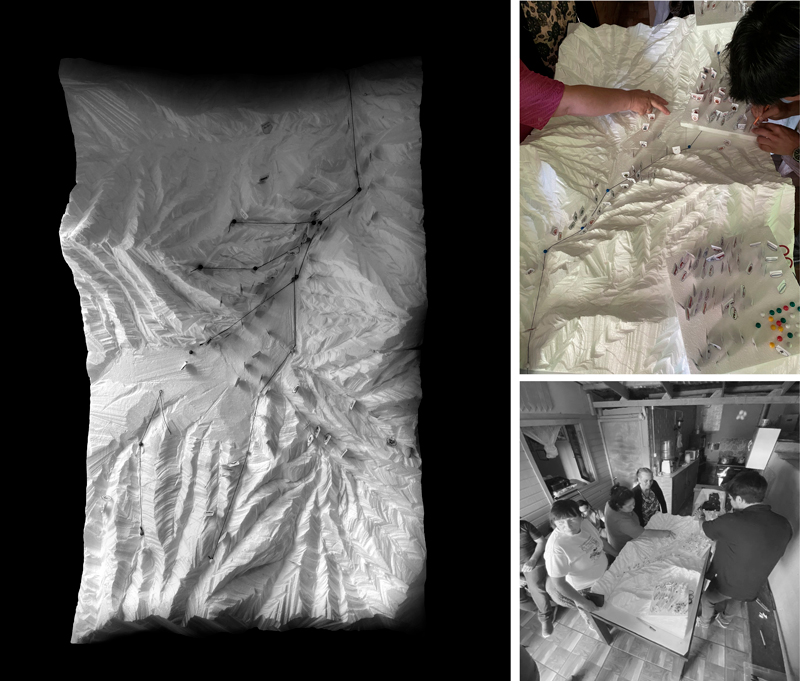
Source: Composition by the authors based on photographic records
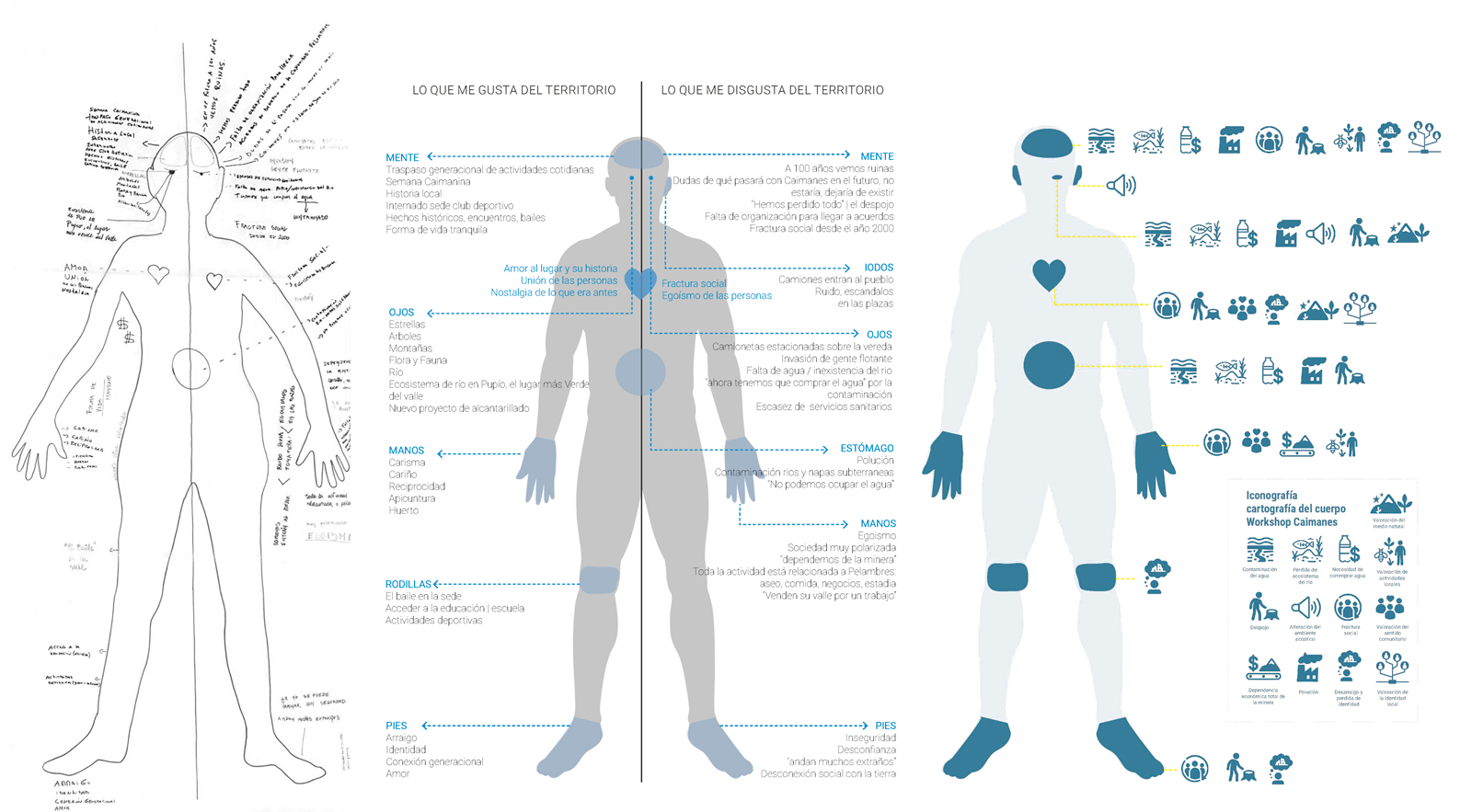
A body mapping technique was applied in Caimanes (Risler & Ares, 2013) [fig. 02], conceived as a workshop that employs the body as a mediator with the territory, recognizing within it the traces of conflict. Five community members, ranging in age from 30 to 70 years, with diverse occupations and social roles, participated.
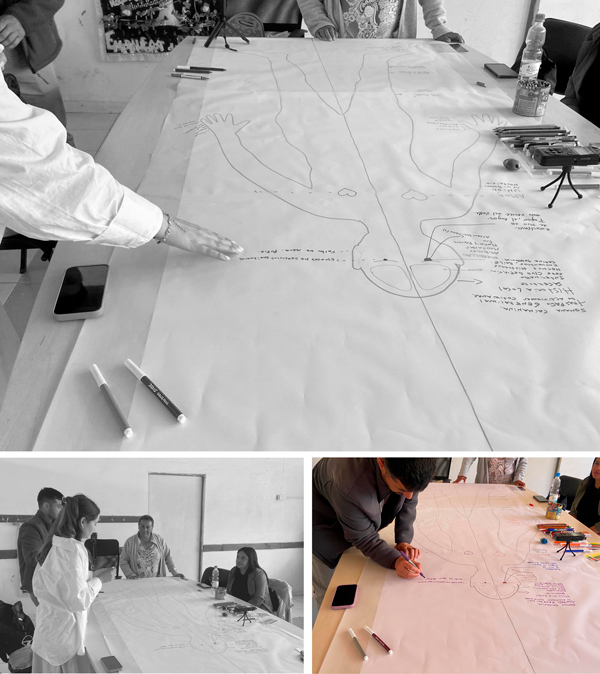
Source: Composition by the authors based on photographic records
The first stage focused on identifying what participants valued and disliked about the territory they inhabited, thereby connecting with the emotions, affections, and discomforts associated with the present landscape. Subsequently, a space for collective speculation was opened through questions on how they envisioned the future of the valley. This methodological sequence enabled a situated analysis of the territory, articulating present and future through the lived experiences of its inhabitants.
Both cartographic experiences were analyzed from a socio-territorial perspective, including a digital systematization of the maps for the georeferencing of significant places associated with situated narratives. Furthermore, the content that emerged from both the documents and the collective work sessions was organized thematically and grouped into structured segments (Braun & Clarke, 2021).
4. Tailings as Agents of Extractive Expansion and Displacement
Based on a review of documents on mining tailings in Chile, this section analyzes how these extractive infrastructures not only store waste from copper production but also configure territories marked by risk, dispossession, and displacement. The El Mauro tailings dam, located in the Pupío Valley, constitutes a paradigmatic case: its storage capacity determines the operational lifespan of the mine and, at the same time, illustrates how such infrastructures radically transform socio-ecological landscapes, generating uncertainty and reconfiguring the existence of both human and extrahuman communities.
4.1. Mining Tailings as Risk-Bearing Extractive Infrastructures
Chile remains the world’s leading copper producer, accounting for 30% of global reserves (CODELCO, n. d.). The extraction of this resource generates massive volumes of mining waste, which are stored in tailings deposits—large infrastructures designed to contain the extracted material, not exported due to its low copper concentration. After China and the United States, Chile ranks as the third country worldwide with the highest number of tailings deposits (National Geological and Mining Service, 2023).
Of the 795 tailings deposits currently existing in Chile, 611 correspond to tailings dams, with 51% located in the Coquimbo Region (National Geological and Mining Service, 2025) [fig. 03]. This uneven distribution of tailings deposits reflects a historical pattern of extractive occupation that has superimposed mining logics on other forms of land use, triggering conflicts over the appropriation of territories and their resources across the main transversal valleys of the region (Tchernitchin & Muñoz, 2012; Ojeda-Pereira et al., 2023).
Tailings deposits represent two primary types of risk. On the one hand, there is concern regarding their chemical stability, aimed at controlling contamination of adjacent ecosystems, since these deposits can concentrate heavy metals and toxic substances. On the other hand, concern arises over their physical stability, as structural failures could result in collapses or overflows (National Geological and Mining Service, 2025).
With regard to the first, various studies have highlighted the health risks posed to communities living near these infrastructures (Tchernitchin & Muñoz, 2012; Vásquez et al., 2015), as well as the impacts on natural ecosystems, soils, watercourses, and biodiversity due to the release of contaminants through airborne dust, infiltration into groundwater, or surface runoff (Carrasco Luna, 2019; Karmy, 2015; Valenzuela-Fuentes et al., 2021). The cumulative effects of these impacts over the course of mining operations are known as environmental liabilities, which constitute the unresolved debts of mining companies toward the communities where they operate (Yurisch, 2016).
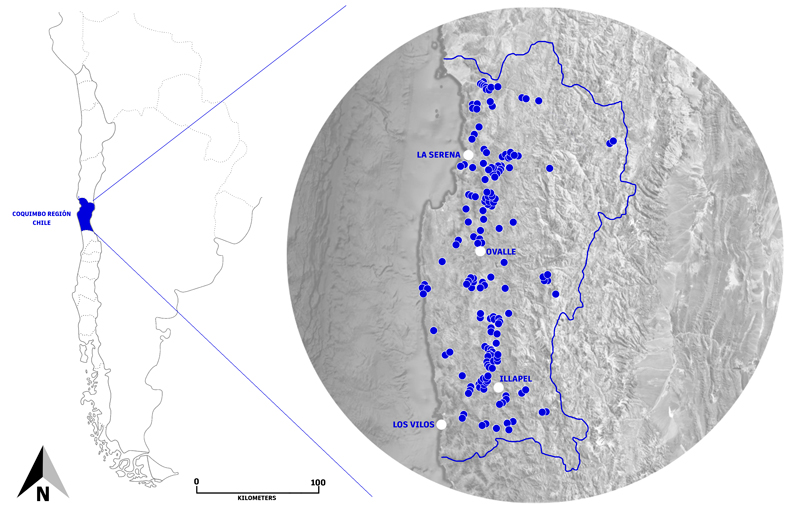
Source: Author’s elaboration based on satellite imagery from Google Earth and GIS data from the 2024 SERNAGEOMIN registry
These socio-ecological impacts are magnified in the event of structural failures, which account for the majority of mining-related disasters (Bustamante Díaz, 2020) and are primarily caused by liquefaction during earthquakes (Yurisch, 2016). Despite recent increases in monitoring and risk management initiatives (Ministerio de Minería, 2019; Yurisch, 2016), Latin America holds a concerning position globally due to the recurrence of tailings dam failures with catastrophic consequences, resulting in irreversible environmental, social, and human losses (WISE Uranium Project, 2025).
Certain territories disproportionately concentrate the risks associated with these infrastructures. Such is the case of the Pupío Valley, where MLP constructed the El Mauro tailings dam. Although MLP declares that the hypothetical failure of the dam’s main wall in the event of a seismic event is of “very low or almost negligible probability” (Los Pelambres, Antofagasta Minerals, n. d.), community and environmental organizations denounce that the emergency plan approved by SERNAGEOMIN and ONEMI was based on manipulated information (Fundación Relaves, 2022).
In 2014, the Supreme Court granted a protection remedy, declaring that El Mauro posed a threat to the physical and psychological integrity of the Caimanes population (Huerta, 2013), located just 8 km away. The ruling necessitated the development of an Early Warning Plan for Caimanes and the Pupío Valley in the event of an unplanned discharge from the El Mauro tailings dam, which has since led to the installation of signage for local residents, improvements to access roads, and the creation of an evacuation plan for the Clara Vial Orrego School.
4.2. The El Mauro Tailings Dam and its Operational Expansion
The arrival of MLP in the Choapa Province and the formal commencement of its operations in 1999 led to a radical transformation in territorial dynamics. The expansion of copper, molybdenum, and gold production required the development of large-scale industrial infrastructure. Within this framework, in 2009, the El Mauro tailings dam was constructed (MLP, n. d.) in the rural sector known as Fundo El Mauro, a sub-valley of approximately 7,000 hectares located at the headwaters of the Pupío stream basin, about 50 kilometers from the coastal town of Los Vilos [fig. 04]. This area constitutes a hydrological node of vital importance for the Pupío Valley, since the tributaries from the sub-basins of the stream converge here, representing nearly 70% of its flow (Derechoalagua.cl, n. d.). Before the project, abundant water was available for human consumption and other uses, whereas today some sectors are supplied by water trucks (Bustamante Díaz, 2014).
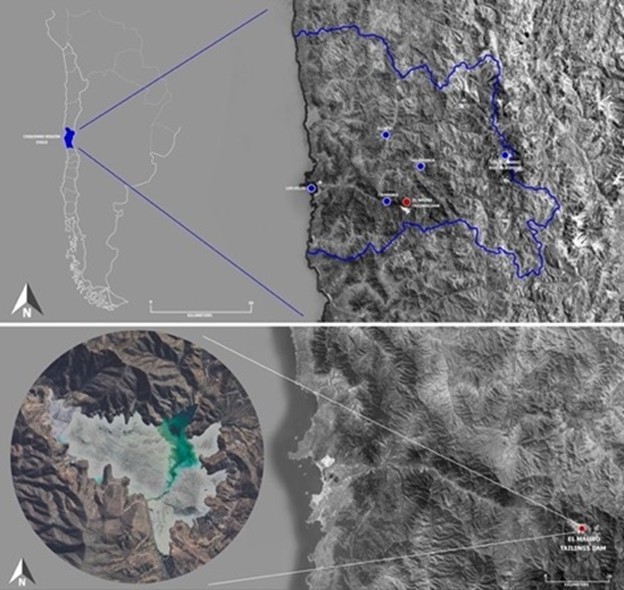
Source: Author’s elaboration based on satellite imagery from Google Earth
El Mauro tailings dam has the capacity to store 1.7 billion tons of toxic tailings, achieved through the construction of a wall 1,400 meters long and 237 meters high (Antofagasta Minerals, n. d.), making it the largest mining waste tailings dam in Latin America (Karmy, 2015; Fundación Relaves, 2022).
This infrastructure constitutes one of MLP’s principal enclaves. To expand its production capacity and operations, the company has developed a series of successive projects to incorporate desalinated seawater into its production matrix, aligned with the new mining cycle in Chile (Carrère, 2024). In 2016, the Complementary Infrastructure Project (INCO) came into operation, which included the construction of a desalination plant and its corresponding pumping system from the coast to the mining site, followed by the Operational Adaptation Project (PAO), linked to the expansion of that infrastructure, which is expected to begin operations in 2027 (Antofagasta Minerals, n. d.).
Both projects laid the groundwork for the most recent proposal: The Life Extension Project (EVU), currently under environmental review, which seeks to extend mining operations until 2051, increasing the capacity of the tailings dam to 2.9 billion tons and doubling the production of desalinated water from 800 l/s to 1,600 l/s, with territorial impacts extending throughout the Pupío Valley (Environmental Assessment Service, IV Coquimbo Región, 2024).
4.3. Fundo El Mauro and Caimanes as Enclaves of Human and Extrahuman Displacement in the Pupío Valley
Historically, the transversal valleys of the Coquimbo Region and their rural localities had been configured as productive spaces sustained by activities dependent on strategic access to freshwater from springs and streams (Tchernitchin & Muñoz, 2012; Ojeda-Pereira et al., 2023; Contreras Painemal et al., 2021). However, the superimposition of the extractive logic onto these territories triggered disputes over the appropriation of resources, redefining land uses and generating a historical tension with the model of economic development promoted by mining.
Discussions about the location of tailings dams in the Choapa Province were marked by tensions between communities, authorities, and the company. In a 2002 community assembly, social leaders stressed the need to join forces to protect the province (Cuevas Gutiérrez, 2024). Nevertheless, local sectors promoted relocating the deposits to Caimanes, justifying the decision on the grounds of its smaller population and reduced impact on agricultural valleys and water basins. MLP had already acquired lands from Fundo El Mauro, which facilitated this alternative (Karmy, 2015).
With 14 votes in favor, two against, and one abstention, environmental approval was granted for the proposal, which opened the way for the El Mauro tailings dam project, replacing the previously active Los Quillayes dam, located in the Cuncumén Valley in the commune of Salamanca (Pérez Valdivia, 2014). Thus, the initial strategy of opposition ultimately consolidated the installation of the dam in Fundo El Mauro, near the locality of Caimanes (Cuevas Gutiérrez, 2024), favoring the company’s interests and marking a turning point in the socio-ecological reconfiguration of the Pupío Valley.
In Fundo El Mauro, the nearly 200 people who had inhabited the area for generations were displaced following the acquisition of their lands by MLP and the subsequent approval for the construction of the tailings dam. They were forced to relocate to nearby localities such as Caimanes, Rincón, Socavón, Las Cañas, El Tambo, Tahuinco, Punta Nueva, Camisas, Los Vilos, among others (Pérez Guerra, 2019). It was at this point that a group of ten families decided to organize and, with the compensation received, purchased land in the commune of Illapel, establishing themselves in the sector known as Entre Cañas, now called Villa El Mauro [fig. 05].
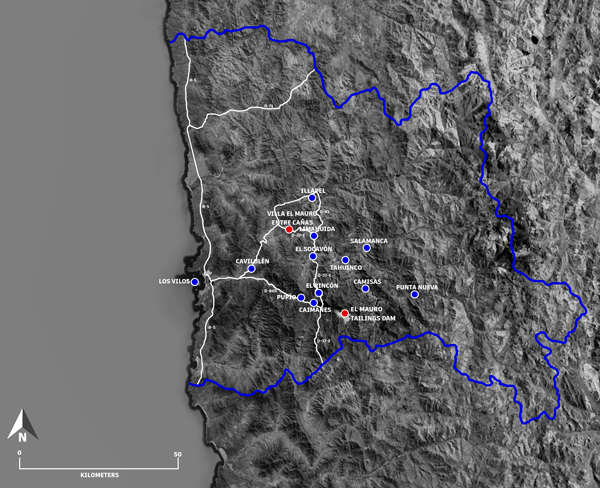
Source: Author’s elaboration based on satellite imagery from Google Earth
In localities near the dam, such as Caimanes and Pupío, the impact has been equally significant. Changes in socio-economic dynamics, combined with the latent risk of dam wall collapse, environmental contamination, and water scarcity, have triggered processes of forced migration to other areas (Karmy, 2015).
At the same time, the arrival of a floating population associated with the construction and operation of the El Mauro tailings dam brought hundreds of workers to the valley, particularly to Caimanes. This gave rise to a population that circulates periodically under a shift system, ensuring the continuity of permanent mining production. Within the framework of the EVU project, approximately 500 workers are projected to arrive during the construction phase, and up to 800 workers are expected to join during the operational phase, starting in the third quarter of 2028 (Environmental Assessment Service, IV Coquimbo Región, 2024).
This situation has not only increased population density during certain periods but has also introduced dynamics of insecurity and uprooting, fostering the fragmentation of community networks, the breakdown of a territorial identity forged over generations, and the dismantling of peasant ways of life (Pérez Guerra, 2019).
The phenomenon of human displacement has been evident since the early 21st century (Pérez Guerra, 2019) and continues to this day. Several studies indicate that the El Mauro tailings dam has not only caused human displacement (Pérez Guerra, 2019) but also extrahuman migrations linked to the valley’s cultural and archaeological dimensions. One example was the intervention over 1,800 hectares that contained 148 archaeological sites, including astronomical alignments and underground structures, from which 448 blocks with 765 petroglyph panels were removed, as well as an Indigenous cemetery. This intervention resulted in the destruction of a complex system of lithic, ceramic, and skeletal materials, as documented in Report No. 19 of the Office of the Comptroller General of the Republic, dated April 6, 2006 (Pérez Valdivia, 2014).
The transfer of petroglyphs from Fundo El Mauro to the Monte Aranda rock art park was carried out in accordance with the requirements of the Regional Environmental Commission of the IV Region, as established in Environmental Qualification Resolution No. 038 of April 2004 (Pérez Valdivia, 2014). This process raised concerns among scientific and heritage circles. In 2004, anthropologist and archaeologist Horacio Larraín Barros (State University of NY) warned that petroglyphs could not be considered isolated blocks but rather sanctuaries formed as integral ensembles. Their removal, therefore, implied not only the physical transfer of archaeological pieces but also the loss of their relational context: their connection with the landscape, pathways, ritual significance, and even possible associated funerary practices (Pérez Valdivia, 2014).
This operation provoked what can be understood as an ontological fracture in the relationship between the peasant community, the territory, and the archaeological elements. Such a rupture is evident in the testimony of a former inhabitant of Fundo El Mauro, who recalls that before the installation of the tailings dam, the petroglyphs were an integral part of everyday life. The community maintained a playful and caring bond with them, in which play and protection coexisted in a single gesture. With their transfer to Monte Aranda, the petroglyphs became inscribed in a different logic: they acquired institutional archaeological value but were stripped of the symbolic and affective dimension that had anchored them to peasant dwelling.
Added to this is the disappearance of local ecosystems, flora, and fauna, as well as the alteration of the ecological and hydrological balance of the Pupío stream sub-basin (Environmental Assessment Service, IV Coquimbo Region, 2024). The impacts extend to both marine and terrestrial ecosystems. On the one hand, Los Pelambres’ operations at Puerto Punta Chungo in the commune of Los Vilos are generating environmental impacts associated with the loading of mineral concentrate onto ships, as well as the presence of the INCO project’s desalination plant, which discharges brine directly into the sea—effects that have been widely studied in other northern Chilean territories (Fragkou & Budds, 2020; Odell, 2021).
On the other hand, several plant and animal species were, or are being, displaced, with their habitats restricted, biodiversity altered, and the natural cycles of the Pupío stream disrupted (Environmental Assessment Service, IV Coquimbo Región, 2024). In 2005, during the construction of the tailings dam in the El Mauro sector, 125 hectares of a relic native forest—remnant of the Late Pleistocene—were affected. This forest housed species such as the chequén cinnamon tree, representing the last and most northern concentration of this species in South America and in northern-central Chile (Pérez Valdivia, 2014), producing a severe biological, ecological, and botanical impact. Currently, the Environmental Impact Study presented to the EIA identified that 70% of the animal species detected are located in the El Mauro sector, which has the richest biodiversity of reptiles, birds, amphibians, mammals, and micromammals, with at least 30 species in a state of conservation. In addition, the presence of unique native forests, xerophytic formations, and threatened vascular flora was recorded, indicating a fragile and high-value ecological system under threat.
Ultimately, the presence of the El Mauro tailings dam in the Pupío Valley clearly reveals the socio-ecological controversies that emerge in contexts of intensive extractivism. Within the framework of large copper corporations, these infrastructures are presented as unavoidable under the narrative of economic development for regions and countries with a mining tradition, such as Chile.
However, at the local scale, the tailings dam constitutes not only a material transformer of the valley but also an apparatus of dispossession and historical, epistemic, and ontological erasure. Its effects fall on living human and extrahuman communities, such as the Maurinos, who have had to organize collectively to confront processes of displacement and forced migration. This scenario can be understood as a living process of deterritorialization and reterritorialization, in which the community articulates broader networks of life that integrate non-human agents into their fabric. These agents form a constitutive part of a relational landscape that sustains identities, cultural practices, and senses of belonging—now threatened by the extractive logic.
5. Memories of Dispossession, Displacement, and Reconfiguration in the Pupío Valley
This section presents collective memories and local narratives regarding potential migrations in response to the advancing operational infrastructure in the Pupío Valley. It highlights the experiences of uprooting and the resistance of the Villa El Mauro community, as well as the reconfiguration of life landscapes.
5.1. Reconstruction of the Displacement Memories of the Maurinos
According to Halbwachs (2004), memory is not an individual phenomenon but a social and collective one; it is constructed and sustained by groups that share a territory, a history, and a common identity. This collective memory is vital to sustaining social cohesion and resistance against processes that seek to fragment these bonds. The memory of El Mauro is not limited to recalling it as a physical place, but it also integrates a sensory and cultural dimension transmitted across generations. The Pupío stream, the corrals, the school, and the cycles of sowing and harvesting form part of a lived landscape that was interrupted by mining extractivism but that endures in narratives and practices. In this sense, the notion of the lived landscape refers to everyday practices in which the environment acquires meaning, in contrast to the notion of valued landscapes, which are taken as fixed within institutional frameworks and public policies (Conti & Núñez, 2016).
In the exercise of reconstruction with the cartographic model, these lived experiences emerged not only as memories but as expressions of a way of life that continues in the everyday practices of Villa El Mauro and that are disregarded by projects such as EVU or by the Environmental Evaluation Service. The collective elaboration of the model allowed the community to reinscribe the relationship between memory and landscape in a tangible object, reaffirming the affections and identities associated with a territory transformed by mining. Each element brought into presence within the model was associated with an act of resistance against the narrative of progress and displacement, while also serving as a way to update and reterritorialize lived experience. In this way, the model does not merely document a past but makes visible a persistence: the continuity of life modes rooted in agricultural knowledge and community relations that endure beyond dispossession.
In the case of Fundo El Mauro, there is a dispossession of memory, since cartographies of the settlements that existed prior to the tailings dam are nearly nonexistent. Thus, the critical cartography developed sought to give voice to local actors and to georeference elements recognized as significant in the territory by the community [fig. 06], while simultaneously fostering the construction of a collective narrative around dispossessed memory.
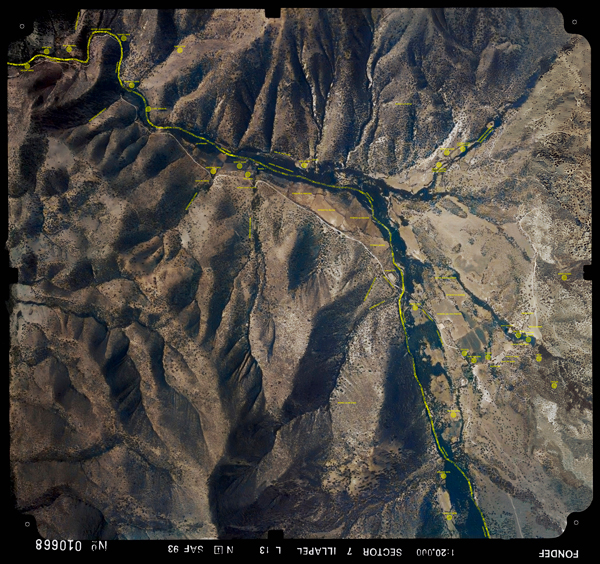
Source: Author’s elaboration adapted from satellite imagery obtained from SERNAGEOMIN
As parts of a network of actors involving both humans and extrahumans, participants brought various objects to the cartography session—objects that the community had carried from Fundo El Mauro to Villa El Mauro [fig. 07] and that became witnesses of the displacement they experienced: Diaguita vestiges, military and religious emblems such as the Virgin of Lourdes, along with domestic items typical of peasant life. In this way, a new reality was woven, where identity is preserved not only in the inhabitants themselves but also in the objects they carry with them—bearers of memory and markers of identity continuity.
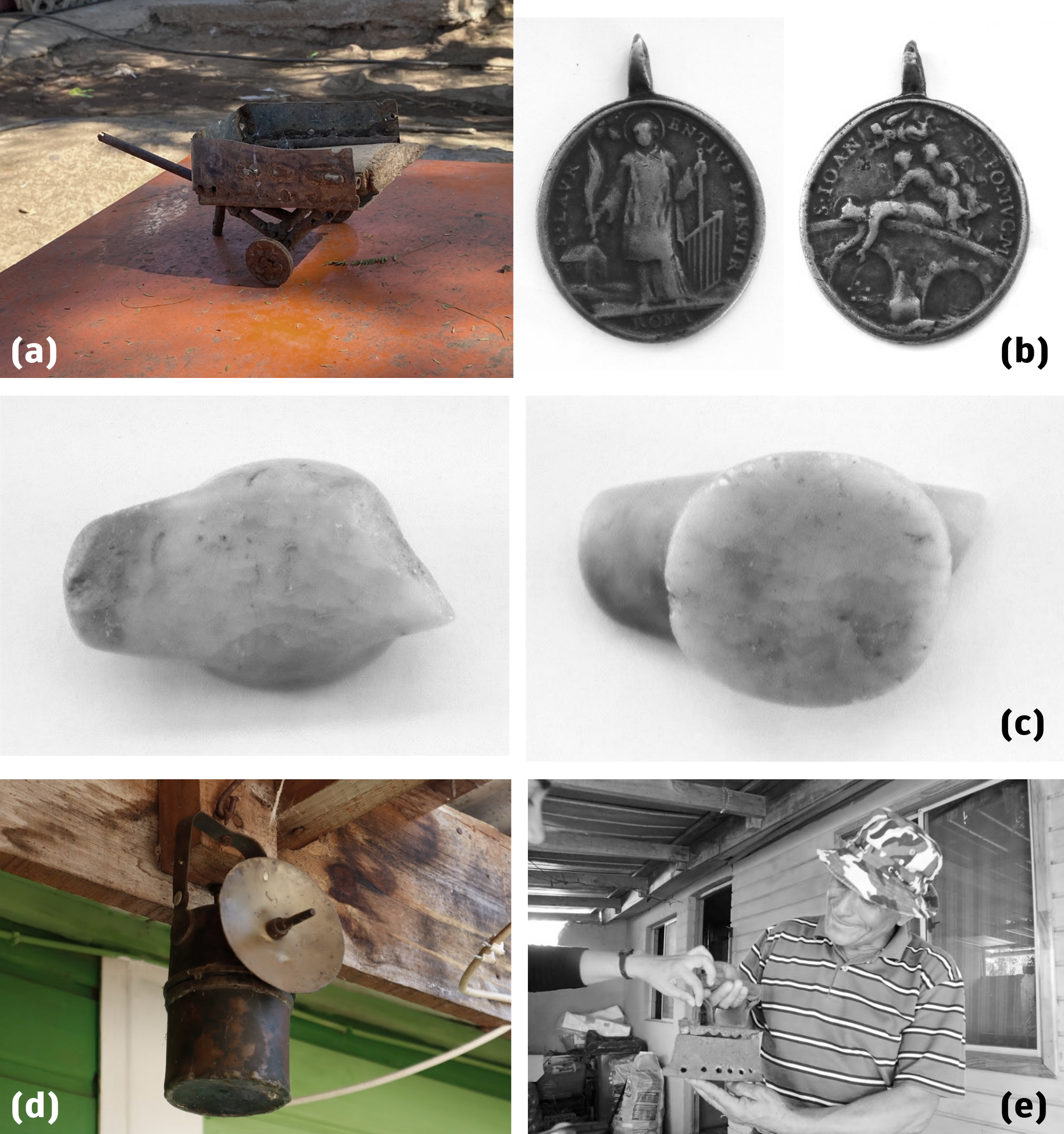
Source: Author’s elaboration based on photographic records
These objects acted as triggers that connected humans and extrahumans, territories, and memories. Through them, the community evoked their uses and attachments in El Fundo El Mauro as a living ecosystem: “It was the most beautiful place I ever saw, so beautiful, open. There were poplars and Canelos. Canelos, Quillayes, and there were also Arrayanes, there were many.” (First Mapping Session, minute 31:40). Similarly, the springs, collectively referred to as “the waters”, were remembered as living entities whose disappearance disrupted long-standing ecological and affective relations:
The waters of the Rains came from there… that was the water of the Fox, the water of the Partridges, which was born up there, from the hills. From Llau Llau and from the Partridges. And there was also water where my father lived […] It was full of water, also in El Durazno, and all of it reached the river. Now the water no longer runs, they blocked it, built roads, and the water no longer runs. (First Mapping Session, minute 34:50)
Water and vegetation thus emerge as central actants within the community’s recollections, embodying an ontological and ecological dispossession in which the loss of living networks is inseparable from territorial displacement and the erasure of interspecies relations. This condition remains materially and symbolically present in the current landscape, where the remaining Natural Sanctuaries of protected species paradoxically belong to MLP.
5.2. Latent migrations and current threats in the Pupío Valley
Using body mapping as a situated, differentiated strategy and as a starting point for understanding the experiences of people in the area, the participants accurately identified the impacts of extractivism on their daily lives [fig. 08], positioning the body as a political space from which to resist oblivion, to reinscribe memory, and to demand eco-social justice in a context of violations of fundamental rights such as access to water, health, and an environment free of pollution (National Institute of Human Rights, 2012). In this way, the body is seen as an archive of affective, social, and ecological tensions.
Source: Author’s elaboration based on body mapping
The mapping carried out revealed that, despite social fragmentation, dispossession, and uprooting, narratives of resistance continue to emerge. The community reveals itself to have a complex but dynamic social fabric, capable of sustaining practices of solidarity, mutual care, and protection of the territory.
In addition, a series of tensions could be identified between the desire to remain and a feared future. Among the main sources of concern, residents highlighted the constant risk associated with the tailings dam, whose eventual rupture, according to their own testimonies, would leave just 10 minutes to evacuate (Monares, 2017).
When asked about the future of the valley, words such as ruin, sorrow, desolation, and abandonment came up. One participant shared:
We cannot imagine ourselves in 100 years' time... if that were to happen and I had to see it... I would not like to see it... this valley would be like all the valleys where there are large mining companies, it would be in ruins, that is how I see it, thinking logically... so, I cannot imagine anything else, and I think that everyone feels the same way. (Caimanes Mapping Session, minute 46)
These words not only express an emotional experience but also shape a territorial narrative about the future. These perceptions reflect the feeling of an unequal struggle, the burden of intergenerational responsibility, and the absence of institutional responses.
This negative perception of the community's future resonates with theories about the incapacity that extractive and colonial projects impose on the population. For example, the concept of defuturization, as presented by Fry (2017), refers to the unsustainable conditions imposed on minorities in the name of global development, which are promoted by a large part of the population. Likewise, this negative perception that emerges from body mapping evidences dispossession through the commodification of bodies, territories, and ways of life, which occurs through the coloniality of nature (Alimonda, 2011) and is embedded in the capitalist extractivist logic of this type of dispossession project. However, it is relevant that, despite this pessimism about the future, the idea of struggle and community practices of resistance remain significant for the community.
5.3. Reconfiguring landscapes of life
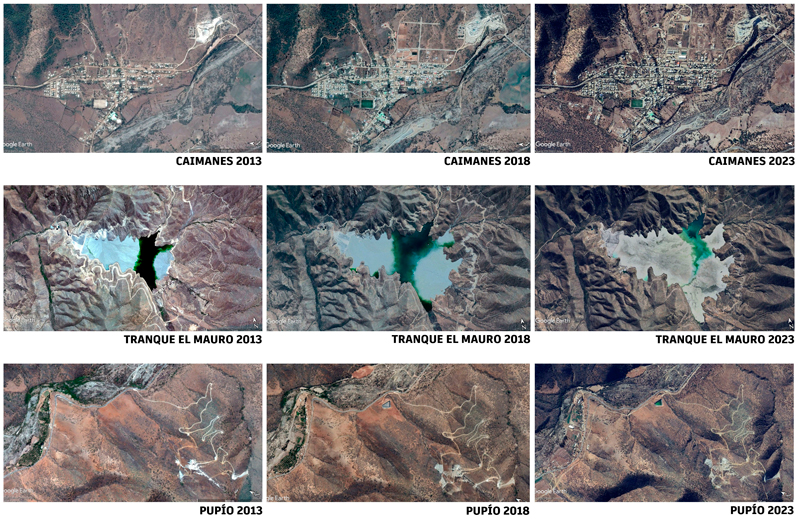
The El Mauro tailings dam and MLP’s EVU project have served as catalysts for socio-ecological transformation in the Pupío Valley and its surrounding communities, reshaping both the physical morphology of the rural landscape and the community's ways of living and perceptions. In El Mauro, the installation of the dam involved replacing an entire community with a mining waste infrastructure (Pérez Guerra, 2019), while in Caimanes and Pupío, this is expressed in the growth and densification of the urban fabric under functional logics of extractive capital, thus displacing the historical rural matrix based on agriculture and livestock [fig.09].
Source: Author’s elaboration based on images obtained from Google Earth
In the case of the El Mauro estate, the construction of the El Mauro tailings dam profoundly transformed the lives of the community, forcing them to abandon their original territory and relocate to a new location in the municipality of Illapel. However, the collective memory (Halbwachs, 2004) of the former inhabitants of the El Mauro estate has served as a central element in sustaining their identity and rebuilding ties with their lost landscape. In this sense, the place exists and is rooted in collective emotional baggage, even though it no longer physically exists (Giraldo, 2018). In its new reality, the community has found ways to reproduce inherited and reterritorialized practices, such as small-scale livestock farming and family agriculture, which operate as anchors of identity and memory by maintaining a peasant way of life that previously structured their rural life and reconfigures their current territory both symbolically and practically.
Intergenerational transmission emerges as a key mechanism of resistance in this process: older generations recall in detail the work of the fields and pass on this knowledge to younger generations. Also, stories and practices that are part of their cultural heritage.
Where people gathered a lot was at the Sports Club headquarters. That was for dancing. Even today, it's kind of strange—when you're so immersed in your culture, it wasn't strange, but when I arrived in the city, I would say to my friends, “No, in Caimanes, people go to the dance. Why?” What kind of dance? Because here, if there's a party at the club, people don't say, “Let's go to the party,” they say, “Let's go to the dance,” and young people, my niece, who is in her twenties and wasn't raised here, says “I go to the dance” (...) we like it. That space has always been a meeting place. (Caimanes Mapping Session, minute 23:50)
Thus, memory is constituted as a dynamic framework in which memories and transmitted experiences are intertwined, allowing the Maurino identity to be maintained and transformed in dialogue with the present.
In this way, territory is conceived as a dynamic network that transcends physical permanence in a specific space, sustained by the continuity of practices that redefine the place, reproducing its landscapes of origin through oral transmission, transferred celebrations, evocative objects, and ways of living that incorporate memory into everyday life.
Extractivist urbanization reflects a structural conflict between territorial planning and local reality, reducing the community's ability to plan sustainable alternatives and participate in decisions that affect their ways of life. The future prospects for the valley and the town are perceived with uncertainty: the population expresses concern about remaining in the area and the well-being of future generations, given scenarios of potential disaster and environmental deterioration. Despite this uncertainty and difficulty in planning life in the territory, critical cartographies serve as a channel for reconstructing memory, affirming desires for permanence, and channeling affections in the face of a changing territory.
6. Conclusion
The review and historical-documentary analysis of the construction process and current expansion of the El Mauro tailings dam reveal how extractivism based on the capitalization, coloniality, and urbanization of nature is developing in the Pupio Valley territory, materializing in the transformation of this rural landscape into a wasteland of mining extractivism (Caroca, 2025; Perreault, 2013). In this process, the community settled on the El Mauro estate, as well as its network of rural life was dispossessed and displaced, turning this sub-basin into a latent sacrifice zone (Arboleda, 2016; Juskus, 2023; Nel, 2015) for mining, and thus into a strategic asset for extractive production.
The dispossession and migration occurring in the Pupío Valley reflect a growing phenomenon in Latin America, exacerbated by the energy transition and the increasing demand for critical minerals such as copper and lithium (Dunlap, 2020; Cabaña & Balcázar, 2024). This tendency aligns with what Svampa (2013) called the “commodity consensus,” referring to a new economic and political-ideological order in Latin America associated with rising international commodity prices and the growing demand from central and emerging economies for minerals required to sustain the so-called just energy transition, one that entails an intensification of mining activities.
In the context of socio-environmental conflicts associated with intensive mining activities and infrastructure in Chile, there is a persistent risk affecting communities, corresponding to the supercycle of global mineral demand that occurred between 2005 and 2014, the period during which the El Mauro tailings dam was constructed and began operations. In this context, the risks are associated with more frequent and dramatic infrastructure failures, stemming from the need to increase the extraction of critical minerals and reduce costs (Ojeda-Pereira et al., 2023). This indicates that dispossession and displacement are integral to historical, political, and economic structural dynamics.
In this logic of displacement linked to power and the capitalization of nature (Moore, 2015), the Mauro tailings dam is currently the key pivot of a large mining industry that is expanding and materializing in industrial and extractive infrastructure distributed extensively between the hinterland and the port. These new landscapes are referred to as operational landscapes by Brenner and Katsikis (2020), alluding to the network of extractive urbanization of nature (Arboleda, 2020; Heynen et al., 2006) associated with the flow of capital, specifically raw materials circulating between the global South and North.
The transformation of the ancestral, rural, and peasant landscape of El Mauro into an operational landscape (Brenner & Katsikis, 2020) represents the political action of thinking about and intervening in the territory as a tabula rasa. However, this contribution enables us to critically examine the displacement of the community and the construction of memory as a dynamic process that is reinterpreted in the cartographic exercise. In this way, memory appears as incomplete and multifaceted, an effect of collective experience (Halbwachs, 2004) and a means of constituting permanence (Harvey, 2018), which enables the community to persist despite displacement. Memory is constituted as resistance, that is, as a collective exercise that strengthens the community and stubbornly maintains it despite displacement. In a certain sense, this very exercise of memory allows for community strengthening (Silva, 2014).
In turn, the cartographic exercise constructs a network of actors where objects assume a central role as witnesses to displacement and narrators of memory. In this way, objects exert an influence that promotes the production of collective memory and affects communities.
Critical mapping permitted the reconstruction of landscapes of life (ancestral, rural, and peasant) as a palimpsest, tracing and describing the historical layers of a territory of dispossession (Seoane et al., 2013) under extractive capitalist urbanization. Similarly, the introduction of the body into the cartographic exercise allowed for highlighting the effects of extractive mining activity and the traces of displacement that are inscribed in it, mobilizing memories and affections (Bonavitta, 2024). The body appears as an entity that expresses the paradoxical dynamics produced by mining activity, integrating sensory, territorial, and affective dimensions (Garay & Viveros, 1999).
Throughout this work, participatory and sensitive methodologies that integrate collective memories and local narratives allowed to highlight the experiences of uprooting and resistance of the communities of Villa El Mauro, Caimanes, and the Pupío Valley as part of processes of deterritorialization and reterritorialization that, on the one hand, reconfigure the inhabitants' ties to their territory and, on the other hand, sustain local identities in contexts of extractivism and socio-ecological crisis. In this framework, the use of critical cartography is valued as an analytical and projective tool for representing the past, understanding the present, and anticipating the future of a territory undergoing transformation due to mining activity.
Finally, since the impacts of mining extractivism on community displacement have been less studied than those on labor migration, this study contributes by offering insights for rethinking local governance and institutional mitigation measures through affective memory processes, amid the exponential expansion of large-scale mining in territories such as Chile’s Norte Chico region and, more broadly, at the global scale.
Data access statement
The data used in this research may be requested directly from the corresponding author, provided that the request is reasonable and justified.
Acknowledgements
This work was supported by the Vicerectorate of Research, Creation and Innovation of the Pontificia Universidad Católica de Valparaíso through the Centenario project “Artifacts of Entanglement: In the Web of Extractive Urbanization” [039.311/2024] and by the Chilean National Agency of Investigation and Development (ANID) through the projects ANILLOS ATE230072 “Climatic Pluriverses: A Decolonial Perspective of Geohumanities for the Design of Alternative Territories in Contexts of Climate” and the FONDECYT Iniciación [11250459] “Planning and Common Landscapes in Chile's Norte Chico: More-than-Urban Agencies in Agricultural Communities”.
References
Acosta, A. (2013). Extractivism and Neoextractivism: Two sides of the same curse. In M. Lang & D. Mokrani (eds.), Beyond Development: Alternative Visions from Latin America (pp. 61-86). Luxemburg/Abya Yala Ediciones.
Alimonda, H. (ed.) (2011). La naturaleza colonizada: Ecología política y minería en América Latina. CLACSO.
Antofagasta Minerals. (n. d.). Estándar de relaves. Minera Los Pelambres. https://web.pelambres.cl/sustentabilidad/estandar-relaves
Antofagasta Minerals. (n. d.). Los Pelambres Futuro. Minera Los Pelambres. https://web.pelambres.cl/nosotros/que-hacemos/los-pelambres-futuro
Arias-Loyola, M., Vergara-Perucich, F., & Encinas, F. (2025). Green(ing) extractivisms: Chile’s mining evolution and adaptation to the global energy transition. The Extractive Industries and Society, 22, 101618. https://doi.org/10.1016/j.exis.2025.101618
Arboleda, M. (2016). In the Nature of the Non-City: Expanded Infrastructural Networks and the Political Ecology of Planetary Urbanisation. Antipode, 48, 233-251. https://doi.org/10.1111/anti.12175
Arboleda, M. (2020). Planetary Mine: Territories of Extraction under Late Capitalism. Verso Books, London.
Ayala, H. (2023). Extractivismo minero y sus efectos sobre el cambio climático en el Chocó biogeográfico colombiano. Boletín de Antropología, 37(64), 14. https://doi.org/10.17533/udea.boan.v37n64a2
Bernal, N. G., & Torres, R. (2021). Minería verde. Descripción conceptual e identificación de iniciativas vinculadas (Asesoría Técnica Parlamentaria No. 130983). Biblioteca del Congreso Nacional de Chile/ BCN.
Bonavitta, P. (2024). Cartografía feminista: una apuesta práctica desde la epistemología de las emociones. EntreDiversidades. Revista de ciencias sociales y humanidades, 21, 1-19. https://doi.org/10.31644/ed.iei.v21.2024.e02
Bowen, G. A. (2009). Document analysis as a qualitative research method. Qualitative Research Journal, 9(2), 27-40. https://doi.org/10.3316/QRJ0902027
Braun, V., & Clarke, V. (2021). Thematic analysis a practical guide. SAGE.
Brenner, N., & Katsikis, N. (2020). Operational landscapes: Hinterlands of the Capitalocene. Architectural Design, 90(1), 22-31. https://doi.org/10.1002/ad.2521
Bryant, R. (1998). Power, Knowledge and Political Ecology in the Third World: A Review. Progress in Physical Geography, 22(1), 7-94. https://doi.org/10.1177/030913339802200104
Bustamante Díaz, P. (2014). Caso: Tranque de relaves El Mauro. Punto de inflexión en la arqueología chilena [Unpublished manuscript].
Bustamante Díaz, P. (2020, November 9). Relaves mineros: Un peligro latente para miles de chilenos. OLCA: Observatorio Latinoamericano de Conflictos Ambientales. https://olca.cl/articulo/nota.php?id=108212
Cabaña, G., & Balcázar, R. (2024). ¿Zonas de sacrificio verde en Chile? Amenazas y riesgos de la expansión minera y energética en territorios y ecosistemas del desierto de Atacama. Fundación Tantí.
Cabanillas Figueroa, P., Colin Altuzarra, J. P., & Donoso Mora, C. (2006). Lucha de Caimanes. Universidad de Chile.
Carraro, V. (2023). The C-word: how critical cartography, critical GIS and critical data studies can repoliticise disaster-related maps. Disaster Prevention and Management, 32(6), 1-13. https://doi.org/10.1108/DPM-04-2023-0077
Carrasco Luna, A. E. (2019). Reconfiguración metabólica y acumulación por desposesión: La industria minera del cobre y el caso de la minera Los Pelambres en la cuenca del río Choapa. Diálogo Andino, 58, 129-138. https://doi.org/10.4067/S0719-26812019000100129
Carrère, M. -S. (2024). Zoom in y zoom out al urbanismo extractivo: Espacialización de las redes y paisajes operacionales del Norte Chico desde los Nómades Industriales del Mar [Unpublished manuscript]. Pontificia Universidad Católica de Valparaíso.
Caroca, A. (2025). The monster has landed: Shifting land tenure regimes and the political ecology of a Chilean mining ‘wasteland’. Geoforum, 159, 1-12. https://doi.org/10.1016/j.geoforum.2025.104202
CODELCO. (n. d.). Presencia mundial. https://www.codelco.com/nosotros/la-corporacion/presencia-mundial
Conti, S., & Núñez, P. (2016). Capítulo 1. El paisaje vivido y los gradientes de ciudadanía. Una reflexión desde la ecología política. In P. Núñez (ed.), Fronteras conceptuales/Fronteras patagónicas (pp. 15-57). Editorial UNRN. https://doi.org/10.4000/books.eunrn.247
Contreras Painemal, C., Godoy Meza, F., & Quitral Manosalva, A. (2021). Historia de Caimanes, patrimonio e identidad. LOP Impresores SPA.
Crampton, J. W., & Krygier, J. (2015). An introduction to critical cartography. ACME: An International Journal for Critical Geographies, 4(1), 11-33. https://doi.org/10.14288/acme.v4i1.723
Cuevas Gutiérrez, C. (2024). Conflictos socioambientales e incidencia local: El conflicto por el relave El Mauro en Choapa. Estado, Gobierno y Gestión Pública, 22(42). https://doi.org/10.5354/0717-8980.2024.73625
Derechoalagua. (n. d.). Tranque El Mauro de minera Los Pelambres destruye los derechos de agua de Caimanes. https://www.derechoalagua.cl/mapa-de-conflictos/tranque-el-mauro-de-minera-los-pelambres-destruye-los-derechos-de-agua-de-caimanes/
Dunlap, A. (2020). Wind, coal, and copper: The politics of land grabbing, counterinsurgency, and the social engineering of extraction. Globalizations, 17(4), 661-682.
Durand, L., & Sundberg, J. (2019). Sobre la ecología política posthumanista. Sociedad y Ambiente, 7(20), 1-20. https://doi.org/10.31840/sya.v0i20.1989
Environmental Assessment Service, IV Coquimbo Región. (2024). Environmental impact study: Project to extend the useful life of Minera los Pelambres (No. 202404001109).
Environmental Assessment Service, IV Coquimbo Región. (2025). Supplementary annex on citizen participation: Consolidated report on requests for clarifications, corrections, and/or additions to the environmental impact study for the project “Extension of the useful life of Minera Los Pelambres.” (No. 20250400168).
Fluxá, B. (2017). El capítulo de los áridos (CaCO3). https://barbarafluxa.com/obras-yproyectos/el-capitulo-de-los-aridos-caco3/
Frayling, C. (1993). Research in art and design. Royal College of Art Research Papers. Royal College of Art.
Fragkou, M. C., & Budds, J. (2020). Desalination and the disarticulation of water resources: Stabilising the neoliberal model in Chile. Transactions of the Institute of British Geographers, 45, 448-463. https://doi.org/10.1111/tran.12351
Fry, R. (2017). Design for/by “The Global South”. Design Philosophy Papers, 15(1), 3-37. https://doi.org/10.1080/14487136.2017.1303242
Fundación Relaves. (2022, August 10). Plan de emergencia por eventual derrumbe de tranque El Mauro fue elaborado con información falsa de Minera Los Pelambres. https://fundacionrelaves.org/plan-de-emergencia-por-eventual-derrumbe-de-tranque-el-mauro-fue-elaborado-con-informacion-falsa-de-minera-los-pelambres
Garay, G., & Viveros, M. (1999). El cuerpo y sus significados. In Vivero & Garay (eds.), Cuerpos, diferencias y desigualdades (pp. 15-27). Centro de Estudios Sociales Universidad Nacional de Colombia.
Giraldo, L. (2018). La espacialidad de la memoria y el recuerdo Los lugares en la memoria y la memoria en los lugares. In América Latina en las últimas décadas: procesos y retos (pp. 1297-1316). Ediciones de la Universidad de Castilla-La Mancha.
Gudynas, E. (2010). The new extractivism of the 21st century: ten urgent theses about extractivism in relation to current South American progressivism. Americas Program Report. Center for International Policy. Washington, DC. https://postdevelopment.net/2010/02/19/new-extractivism-of-the-21st-century-10-urgent-theses
Gudynas, E. (2018). Extractivismos y corrupción: Anatomía de una íntima relación. Quimantú.
Haesbaert, R. (2013). Del mito de la desterritorialización a la multiterritorialidad. Cultura y Representaciones Sociales, 8(15), 9-42.
Halbwachs, M. (2004). La memoria colectiva. Prensas de la Universidad de Zaragoza.
Harvey, D. (1997). Justice, nature and the geography of difference. Wiley.
Harvey, D. (2017). The “new” imperialism: Accumulation by dispossession. In B. Ollman & K. B. Anderson (eds.), Karl Marx (pp. 213-237). Routledge. https://doi.org/10.4324/9781315251196-10
Huerta, H. (2013, July 11). Obligan al Grupo Luksic a crear plan en caso de derrumbe de tranque El Mauro. OLCA: Observatorio Latinoamericano de Conflictos Ambientales. https://olca.cl/articulo/nota.php?id=103292
Heynen, N., Kaika, M., & Swyngedouw, E. (2006). In the Nature of Cities: Urban Political Ecology and the Politics of Urban Metabolism, Questioning Cities. Routledge, Taylor & Francis.
Jurgens, H. (2025, February 7). La basura del mundo. Fundación Relaves. https://fundacionrelaves.org/la-basura-del-mundo/
Juskus, R. (2023). Sacrifice Zones. Environmental Humanities, 15, 3-24. https://doi.org/10.1215/22011919-10216129
Karmy Bolton, J. (2015). Análisis del conflicto entre Minera Los Pelambres y las comunidades del Valle del Choapa (1997–2015) [Thesis for the Master's Degree in Political Communication]. Universidad de Chile.
Kim, A. M. (2015). Critical cartography 2.0: From “participatory mapping” to authored visualizations of power and people. Landscape and Urban Planning, 142, 215-225. https://doi.org/10.1016/j.landurbplan.2015.07.012
Latour, B. (2005). Reassembling the social: An introduction to actor-network-theory. Oxford University Press.
Mc Lean, K. (2018). Sensory maps. https://sensorymaps.com/
Mansilla-Quiñones, P., Pehuén, M. M., & Millanao, A. C. (2024). Confronting coloniality of nature: Strategies to recover water and life in Mapuche territory. Geoforum, 148, 1-14. https://doi.org/10.1016/j.geoforum.2023.103922
Ministerio de Minería. (2019). Plan Nacional de Depósitos de Relaves para una Minería Sostenible.
Monares, A. (dir.) (2017, April 18). Chile se moviliza: “Caimanes” [Video]. YouTube. https://www.youtube.com/watch?v=IF9T162L2YE
Moore, J. W. (2015). Capitalism in the web of life: Ecology and the accumulation of capital. Verso Books.
Moore, J. W. (2016). The rise of cheap nature. In J. Moore (ed.), Anthropocene or Capitalocene?: Nature, history, and the crisis of capitalism (pp. 78-115). PM Press.
Moore, J. W. (2017). World accumulation & planetary life, or, why capitalism will not survive until the “last tree is cut”[WWW Document]. http://www.perc.org.uk/project_posts/world-accumulation-planetary-life-capitalism-will-not-survive-last-tree-cut/#_ftn1
National Institute of Human Rights. (2012). Mapa de conflictos socioambientales en Chile.
National Geology and Mining Service. (2023). Anuario de la minería de Chile. SERNAGEOMIN. https://www.sernageomin.cl/anuario-de-la-mineria-de-chile/
National Geology and Mining Service. (2025). Plataforma pública de relaves. SERNAGEOMIN. https://www.sernageomin.cl/plataforma-publica-de-relaves/
Nel, A. (2015). The choreography of sacrifice: Market environmentalism, biopolitics and environmental damage. Geoforum, 65, 246-254. https://doi.org/10.1016/j.geoforum.2015.08.011
Odell, S. (2021). Desalination in Chile’s mining regions: Global drivers and local impacts of a technological fix to hydrosocial conflict. Journal of Cleaner Production, 323. https://doi.org/10.1016/j.jclepro.2021.129104
Ojeda-Pereira, I., Pezoa-Quevedo, H., & Campos-Medina, F. (2023). Mining tailings dumps and socio-territorial inequalities in Chile: An exploratory study. Journal of Maps, 19(1), 1-11. https://doi.org/10.1080/17445647.2023.2217514
Pérez Guerra, A. (2019, August 28). Comunidad de Mauro, lucha por lo que nos arrebató Luksic. Prensaopal. https://prensaopal.cl/2019/08/27/comunidad-de-mauro-lucha-por-lo-que-nos-arrebato-luksic/
Pérez Valdivia, E. (2014, May 2). El caso del bosque y de los petroglifos de El Mauro. Le Monde Diplomatique. https://www.lemondediplomatique.cl/el-caso-del-bosque-y-de-los-petroglifos-de-el-mauro-por-eduardo-perez-valdivia.html
Perreault, T. (2013). Dispossession by Accumulation? Mining, Water and the Nature of Enclosure on the Bolivian Altiplano. Antipode, 45, 1050-1069. https://doi.org/10.1111/anti.12005
Risler, J., & Ares, P. (2013). Manual de mapeo colectivo: Recursos cartográficos críticos para procesos territoriales de creación colaborativa. Tinta Limón.
Seoane, J., Algranati, C., Borón, A., & Taddei, E. H. (2013). Extractivismo, despojo y crisis climática: desafíos para los movimientos sociales y los proyectos emancipatorios de nuestra América. Herramienta Ediciones.
Silva, D. (2014). Acerca de la relación entre territorio, memoria y resistencia. Una reflexión conceptual derivada de la experiencia campesina en el Sumapaz. Análisis Político, 81, 19-31. https://doi.org/10.15446/anpol.v27n81.45763
Simon, H. A. (1996). The sciences of the artificial. MIT Press.
Smart, S. (2020). The political economy of Latin American conflicts over mining extractivism. The Extractive Industries and Society, 7(2), 767-779. https://doi.org/10.1016/j.exis.2020.02.004
Smart, S. (2025). Justice in Contention: The Dynamics of Legal Mobilisation in Caimanes’ Environmental Struggle. Social & Legal Studies, 34, 43-66. https://doi.org/10.1177/09646639241248915
Stefoni Espinoza, C., Stang Alva, F., & Rojas Varas, P. (2021). Extractivismo y migraciones: Expresiones cambiantes de una desigualdad histórica. La gran minería del cobre en la región chilena de Antofagasta. Rumbos TS, 16(26), 9-35. https://doi.org/10.51188/rrts.num26.549
Svampa, M. N. (2013). Consenso de los commodities y lenguajes de valoración en América Latina. Fundación Friedrich Ebert.
Svampa, M. (2019). Las fronteras del neoextractivismo en América Latina: Conflictos socioambientales, giro ecoterritorial y nuevas dependencias. CALAS.
Tchernitchin, A., & Muñoz, G. (2012). Efectos sobre la salud y el medio ambiente de las actividades mineras en Chile. Contaminación del estero Pupío y agua potable del pueblo de Caimanes: ¿Se origina desde el tranque de relaves minero El Mauro? Cuadernos Médicos Sociales, 52(4), 199-214.
Uribe-Sierra, S. E., Mansilla-Quiñones, P., & Mora-Rojas, A. I. (2022). Latent Rural Depopulation in Latin American Open-Pit Mining Scenarios. Land, 11(8), 1-23. https://doi.org/10.3390/land11081342
Uribe-Sierra, S. E., Panez-Pinto, A., Toscana-Aparicio, A., & Mansilla-Quiñones, P. (2023). Mining, development and unequal regionalization in subnational Latin American contexts. The Extractive Industries and Society, 13, 1-12. https://doi.org/10.1016/j.exis.2022.101209
Uribe-Sierra, S. E., Toscana-Aparicio, A., & Mansilla-Quiñones, P. (2024). Solastalgia y despoblamiento rural en contextos de desplazamiento forzado por minería a cielo abierto. Estudios Demográficos y Urbanos, 39(2), 1-29. https://doi.org/10.24201/edu.v39i2.2184
Valdebenito, F., & Garcés, A. (2023). Conmutaciones mineras en Iquique, Chile (1990–actualidad): Sus conflictos cotidianos en la historicidad urbana local. Revista de Geografía Norte Grande, 86, 1-21. https://doi.org/10.4067/S0718-34022023000300111
Valenzuela-Fuentes, K., Alarcón-Barrueto, E., & Torres-Salinas, R. (2021). From resistance to creation: Socio-environmental activism in Chile’s “sacrifice zones”. Sustainability, 13(6), 3481. https://doi.org/10.3390/su13063481
Vásquez, K. Y., Orellana, S. A., Monsalve, S. M., Vergara, J. K., Zamora, C. S., Muñoz, D. V., & Lillo, D. D. C. (2015). Exposure to fine particles by mine tailing and lung function effects in a panel of schoolchildren, Chañaral, Chile. Journal of Environmental Protection, 6(2), 118-128. https://doi.org/10.4236/jep.2015.62014
WISE Uranium Project. (2025). Chronology of major tailings dam failures. World Information Service on Energy. https://www.wise-uranium.org/mdaf.html
Yurisch, T. (2016). Situación de los pasivos ambientales mineros en Chile. El caso de los depósitos de relaves. Publicaciones fundación TERRAM. APP, 61, 216.