Migración, extractivismo y necropolítica en la Amazonía peruana: la trata de mujeres en enclaves neoextractivos



This article examines migration flows to neoextractivist enclaves within the framework of necropolitics and the political ecology of migration. It explores how degraded territories, shaped by illegal mining, human trafficking, and the sex trade, function as both forces of expulsion and attraction. The theoretical framework integrates concepts of accumulation by dispossession and extractive biopolitics to understand how state control, labor precarization, and violence create differentiated mobility regimes, particularly affecting migrant women. The study focuses on Madre de Dios in the Peruvian Amazon, a region characterized by environmental degradation and territorial control through illicit economies, despite the state's claims of biodiversity protection. Using qualitative methods, including document analysis and interviews with local actors, the research reveals that historical configurations of territorial exploitation influence migration patterns in these enclaves. The article contributes to the political ecology of migration by demonstrating how extractive economies and structural inequalities shape migration flows in necropolitical contexts.
Este artículo examina los flujos migratorios hacia enclaves neoextractivistas dentro del marco de la necropolítica y la ecología política de la migración. Explora cómo los territorios degradados, moldeados por la minería ilegal, la trata de personas y el comercio sexual funcionan tanto como fuerzas de expulsión como de atracción. El marco teórico integra los conceptos de acumulación por desposesión y biopolítica extractiva para entender cómo el control estatal, la precarización laboral y la violencia crean regímenes de movilidad diferenciados, que afectan particularmente a las mujeres migrantes. El estudio se centra en Madre de Dios, en la Amazonía peruana, una región marcada por la degradación ambiental y el control territorial a través de economías ilegales, a pesar de los reclamos estatales de protección de la biodiversidad. Utilizando métodos cualitativos, incluido el análisis de documentos y entrevistas con actores locales, la investigación revela que los patrones migratorios en estos enclaves están influenciados por configuraciones históricas de explotación territorial. El artículo contribuye a la ecología política de la migración al demostrar cómo las economías extractivas y las desigualdades estructurales configuran los flujos migratorios en contextos necropolíticos.

Migration; neo-extractive enclaves; sexual exploitation; necropolitics
Migración; enclaves neoextractivos; explotación sexual; necropolítica

1. Introduction
Over the past three decades, under the legitimizing discourse of responsible development, Latin America has witnessed an unprecedented proliferation of transnational extractive projects. These initiatives concentrate on territories with high ecological diversity and abundant natural resources, places that attract the international market for raw commodities (Gudynas, 2009). Fueled by global demand and the entry of transnational capital, extractive projects operate under the regulatory frameworks and control of host states, making their environmental, economic, and social impacts contingent on the efficiency, political capacity, and will of local administrations. While such projects are often presented as routes to modernization and economic growth, a growing body of scholarship documents their perverse consequences: ecological devastation, economic and gender inequality, and escalating violence in many developing countries where they operate (Asher & Ojeda, 2009; Barrantes & Escalante, 2015; Gudynas, 2012; O’Connell & Silva Santiesteban, 2023; Ojeda et al., 2015; Ojeda, 2025). However, the way these extractive activities and places exert centripetal and centrifugal migration forces is a recent and overlooked social phenomenon.
One of the less explored consequences of these transformations is the reconfiguration of migration flows toward extractive enclaves.1 Historically, internal migration in search of opportunities flowed toward urban centers with concentrated state services (Huarancca et al., 2022). Today, it has highly increased toward remote places or enclaves of extraction such as Madre de Dios, in the Peruvian Amazon, with high levels of ecological devastation, economic and gender inequality, and violence (United Nations Development Programme, 2025). In addition, this migration has also included the attraction of the foreign population. Furthermore, these migration flows have specific migration patterns based on gender dynamics. In this article, we ask: Why have migration flows shifted to these enclaves?
In general, extractive enclaves are territorial, economic, and social nodes embedded in resource-rich frontiers, and are not simply sites of material extraction. They also function as zones of exception where legal norms are suspended and life is governed by its utility to capital (Agamben, 1998; Mbembe, 2003; Ojeda, 2022). Often located in impoverished and dispossessed territories marked by homicidal ecologies (Yashar, 2018), these enclaves have historically been excluded from effective state protection and public policy (Li, 2014; Gómez-Barris, 2019). Within them, colonial legacies of structural gender inequality are reproduced and intensified, mobilizing historical vulnerabilities to sustain circuits of accumulation at the expense of life, territory, and social cohesion (Ojeda, 2025).
The case of Madre de Dios illustrates these processes with particular clarity. Located in southeastern Peru and covering 85,301 km² of tropical and subtropical forest, Madre de Dios was, as of 2007, the country’s least densely populated region (Novak & Namihas, 2009). It is celebrated as the capital of biodiversity and is home to extensive protected areas, including the Manú Biosphere Reserve and Andean ecological corridors. Yet this natural wealth has been described as a resource curse (Svampa, 2019; Valdivia et al., 2022): regions of high biodiversity are often subject to intense exploitation, leading to impoverishment and displacement of local populations. Today, Madre de Dios is not only a site of legal and illegal gold extraction but also a hub for money laundering, drug trafficking, and human trafficking (Barrantes & Escalante, 2015; Cortés-McPherson, 2020). Weak state presence, sometimes absent, sometimes entangled with criminal economies (Váldes et al., 2022), has created fertile ground for illicit economies.
However, this region’s history of dispossession predates current mining booms. Between 1879 and 1914, the rubber industry unleashed widespread violence against Indigenous communities such as the Harakmbut, Ese Ejas, and Matsiguenkas, resulting in forced labor, dispossession, and mass killings. From the 1980s onward, auriferous mining brought further ecological degradation and profound social change, reshaping gender relations and community structures (Reymundo, 2025).
Recent analyses highlight the emergence of violent extractivism, forms of neo-extraction that commodify not only territory and resources but also human lives. These neo-extractive dynamics sustain economies based on the differentiated appropriation of bodies, land, and ecosystems (Gago & Mezzadra, 2017; Valencia, 2016). In such economies, based on historical inequalities, the environment and human life alike are transformed into disposable commodities within circuits of accumulation and dispossession (Ojeda, 2022). The spread of these practices is facilitated by high levels of corruption, entrenched political influence, and weak enforcement capacity, particularly at subnational levels—conditions that allow informal and illegal extractive economies to flourish without legal consequence (Montero & Samuels, 2004; Arellano-Yanguas, 2011). At this enclave with these particular dynamics, sexual trafficking thrives.
Over 90% of trafficking victims in Peru are women, most between 18 and 29 years old or minors, frequently recruited from highland regions like Apurímac, Cusco, and Puno and transported to Madre de Dios for sexual exploitation (Astete & Guerrero, 2021). Field research documents how enclaves such as La Pampa, Laberinto, and Huepetuhe have become key sites for the exploitation of Venezuelan migrant women, many deceived with promises of legitimate work before being coerced into prostitution through debt bondage and threats (Bonafon et al., 2025). Men, for their part, are drawn to exploitative and hazardous mining labor, while women and girls are channeled into forms of labor exploitation or sexual trafficking—both presented as opportunities for economic sustainability, yet often under coercive or violent conditions (Barrantes & Escalante, 2015).
In this context, biodiversity is transformed into natural resources and inserted into a capitalist logic of extraction (Ojeda, 2025). These processes are deeply intertwined with gendered necropolitics—forms of governance that determine whose lives are protected and whose are expendable, shaped by patriarchal and colonial power relations (Islekel, 2022). Migration toward these enclaves reflects and reinforces these dynamics, producing flows marked by specific gender stereotypes and characteristics. However, despite the extensive literature on extractivism and migration, little empirical or theoretical attention has been devoted to understanding migration political ecology flows in the contemporary Peruvian context2 to degraded and impoverished landscapes.
Under these conditions, extractive enclaves become territories embedded in ecologies of death—spaces that sustain life only insofar as it is exploitable and disposable. Migrant women in these economies endure intersecting forms of violence: gender-based, labor-related, and environmental (Monzón, 2017). The exploitation of natural resources is inseparable from the systematic commodification and dehumanization of women’s bodies. Here, extractive biopolitics converges with necropolitical governance to produce regimes of dispossession and differentiated vulnerability.
This article addresses the following questions: What characterizes the migration of women to enclaves embedded in ecologies of death? How are these migratory flows configured through the intersection of gender, resource extraction, and environmental degradation? And, what forces draw specific marginalized populations into these spaces, and what role do migrant women’s bodies play in sustaining extractive economies?
Theoretically, this study integrates the political ecology of migration, necropolitics, and critical studies of neoextractivism, framed through an intersectional, gender-sensitive lens. While prior scholarship examined these dynamics separately, few studies explore their convergence in shaping migration flows. By addressing this gap, the article contributes to a transdisciplinary understanding of migration as a process embedded in regimes of extraction, violence, and inequality. It advances theoretical debates on the gendered dimensions of necropolitics and offers empirical insights into the socio-environmental transformations driving mobility toward extractive frontiers in the Peruvian Amazon. To address these questions, the study adopts a qualitative descriptive design situated within the analytical lens of the political ecology of migration. Ten semi-structured interviews were conducted with state officials, prosecutors, journalists, and researchers in Madre de Dios, complemented by analysis of legal frameworks, policy documents, and investigative reports. Thematic analysis was applied to identify patterns of dispossession, mobility, and gendered violence, triangulated with secondary sources to enhance rigor. This methodological approach foregrounds situated narratives and emphasizes how experiences of migration, extraction, and corporeal capture are articulated within local contexts, while also remaining attentive to power asymmetries through a feminist ethic of care.
2. Theoretical Framework
One productive lens for understanding these transformations is Diana Ojeda’s (2016) notion of landscapes of dispossession, wherein territories subjected to extractive dynamics are traversed by violence, expropriation, and both material and symbolic reconfigurations. These processes extend beyond environmental degradation to actively reshape subjectivities, collective memories, and community bonds. Structural violence becomes inscribed not only upon the land but also upon bodies and social relations, most acutely upon women’s bodies, which are transformed into frontline territories of appropriation and domination.
Within this frame, extractive enclaves are not merely nodes of wealth accumulation but also operate as “zones of exception” (Agamben, 1998), spaces where legal norms are suspended, and life is governed according to its utility within circuits of accumulation. In historically impoverished regions such as Madre de Dios, state abandonment converges with the lure of extractive promises, enabling the expansion of illegal economies. Despite its designation as a protected biodiversity hotspot, Madre de Dios has become an epicenter of illegal mining, human trafficking, and criminal networks that reorganize space through predatory logics (Gudynas, 2013; 2015).
Against this setting, road infrastructures, particularly highways, acquire a dual-use function. While formally conceived to facilitate regulated trade and territorial integration, in contexts of weak governance, they are rapidly appropriated by illicit networks. As Gillies and colleagues (2018) emphasize, such routes can be repurposed through political complicity and corruption, enabling the large-scale circulation of illegal goods, human trafficking, and illicit capital alongside formal economic flows.
Political ecology and necropolitics (Mbembe, 2003) reveal that neo-extractivist dynamics generate “conditioned mobilities” (Gago & Mezzadra, 2017) and differential circulation regimes in which certain bodies, feminized, racialized, and impoverished, are selectively incorporated into reproductive, affective, and sexual labor markets, while being excluded from the core extractive workforce. These enclaves thus produce contradictory migratory dynamics, governed by both centripetal and centrifugal logics: they expel populations through socio-environmental collapse while simultaneously attracting vulnerable labor and exploitable bodies (Sundberg, 2008). In Madre de Dios, this differentiation is stark: men provide precarious labor for gold extraction, while women are positioned as resources themselves, commodified and mined for the service and pleasure of men (Barrantes & Escalante, 2015).
Neo-extractivism is therefore not limited to the exploitation of natural resources but also captures bodies, affects, and forms of social reproduction (Gago & Mezzadra, 2017). Feminist perspectives highlight how gender-based violence is a structural feature of these dynamics (Silva-Santiesteban, 2017). Gudynas (2012) cautions that extractivism produces “sacrifice zones” where environmental degradation and violence disproportionately affect women, indigenous peoples, and other marginalized groups. Li (2014) similarly argues that extractive economies fragment territories and undermine social cohesion, trapping migrant populations into informal circuits of labor and subordination.
Within this logic, gender violence emerges not as a collateral effect but as a central technology of dispossession (Ojeda, 2022), transforming women’s bodies into infrastructures of accumulation. In Madre de Dios, trafficking and forced prostitution are directly linked to the illegal economies surrounding mining (Mamani Zavaleta & Farfán Valer, 2022a). These “body-territories” (Jofré & Chacaltana-Cortez, 2023) condense environmental, labor, and sexual precarities, while simultaneously functioning as living archives of memory, resistance, and political agency (Araya-Morales, 2025).
Neo-extractivist biopolitics (Segato, 2016) renders women as both resource and residue: disposable labor, sexual commodities, and objects of control. In contexts of illegality and state complicity, extraction becomes corporeal and intimate (Gudynas, 2013), aligning with Gómez-Barris’s (2019) concept of “extractive zones”: deeply racialized spaces where all forms of life are reduced to resources. The climate crisis further reinforces this dynamic, generating a double dispossession—ecological and social—that pushes migrant populations into enclaves where environmental degradation, labor exploitation, and sexual violence converge (Sánchez & Riosmena, 2021).
Moreover, symbolic representations—such as media stigma and moral panic toward migrant women—legitimize their marginalization and facilitate their incorporation into extractive and criminal circuits (Pérez & Freier, 2022). From the standpoint of the political ecology of migration, feminized bodies can thus be read as territories traversed by multiple borders—geographic, economic, and symbolic—that define their use value and social legitimacy. These body-territories sustain reproduction through labor, affect, and subordinated presence, while carrying the violence that ensures its continuity.
In sum, the intersection of political ecology, necropolitics, and feminist critiques provides a grounded framework for analyzing contemporary migration. In Madre de Dios, migration stems from systemic logics that simultaneously disposes of territories and bodies. Women’s migrant bodies function as labor, reproductive, and affective infrastructures within criminal economies, rendered fungible yet inscribed with the marks of extractive violence. By integrating these perspectives, this study denaturalizes the extractive capture of life and positions female migrant bodies not only as sites of exploitation but also as archives of survival, dissent, and resistance.
3. Methodology
This study employed a qualitative descriptive design situated within the analytical lens of the political ecology of migration, focusing on the socio-environmental, economic, and gendered dynamics of illegal neoextractive enclaves. This focus was selected because it allows the inclusion of a rich and straightforward description of participants on the social phenomenon studied while staying close to their own words, meanings, and experiences (Colorafi & Evans, 2016; Neergaard et al., 2009; Sandelowski, 2000). This design is particularly suited to contexts where the aim is not an abstract theorization of a social problem, but instead, the identification of complex situated narratives3 that reveal how mobility is embedded in enclaves of dispossession, territorial transformation, and differential bodily governance.
Guided by this framework, the research examines how actors situated within the state, journalistic, judicial, and academic fields draw on local experience and interpret the intersections between environmental degradation, migration flows, and mechanisms of corporeal capture in Madre de Dios. Focusing on these actors allows us to better understand how they perceive the ways in which migration flows to neoextractivist enclaves operate within the framework of necropolitics and become entangled with sex trafficking. In addition, it analyzes the most significant findings from previous research, investigative journalism, protocols, public policy and legal frameworks, articulating these accounts within a political ecology of migration. This perspective enables an analysis on how extractive expansion and criminal economies selectively incorporate feminized bodies, not only as labor but as reproductive, affective and sexual infrastructures sustaining the enclave. The study does not incorporate the perspectives of women victims of human sex trafficking, given ethical concerns about the potential re-traumatization of participants. Finally, it is important to note that both authors are female academics affiliated to a Jesuit university in Lima: one an anthropologist, the other a political scientist. Although they represent two different generations, they share a feminist and intercultural perspective.
A goal-directed sampling strategy was used to identify participants with direct local experience or expertise in the thematic axes of the study (Palinkas et al., 2015). The final sample comprised ten semi-structured interviews with actors with diverse local experiences. These interviews were designed as dialogical spaces allowing participants to elaborate on their situated interpretation. Following the project’s ethical protocol, the interviewers’ names have been anonymized.
| Code | Actor type | Description | Number of actors interviewed |
|---|---|---|---|
| SGOV.MDD | Subnational public officials | Staff from the local and regional government in Madre de Dios | 4 |
| PROS.MDD | Prosecutorial system | Prosecutor specialized in trafficking and gender-based violence | 1 |
| JOUR.MDD | Journalists | Reporters covering illegal mining, trafficking, and territorial conflict | 2 |
| EXPT.MDD | Experts and researchers | Scholars in political ecology, extractivism, necropolitics, and gender | 3 |
The interviews were designed to explore three main topics: (a) perceptions of territorial reconfiguration caused by illegal extractivism; (b) interpretations of migration flows shaped by economic and criminal dynamics and (c) understandings of mechanisms of corporeal capture and gendered violence. Data were transcribed verbatim and analyzed using thematic analysis (Braun & Clarke, 2021), following an inductive, open-ended process to identify patterns, tensions, and emergent categories (Nowell et al., 2017). The analysis was iterative, moving between data and theory to refine codes and themes.
To enhance analytical rigor, data triangulation was performed (Flick, 2018), contrasting interview findings with legal, policy, academic, and journalistic materials. This process allowed for the detection of institutional silences, discursive gaps, and asymmetries in the representation of migration and gendered violence.
The research followed appropriate ethical protocols. Informed consent was obtained prior to each interview, ensuring confidentiality, anonymity, and the protection of participants’ integrity. Although no migrant women were directly interviewed due to the potential risks of revictimization; the study adopted a feminist ethic of care, emphasizing reflexivity, sensitivity to power asymmetries, and responsibility toward vulnerable populations (Hesse-Biber, 2012).
4. Results
4.1. Reconfigured Migration Flows and the Emergence of Neo-Extractivist Enclaves
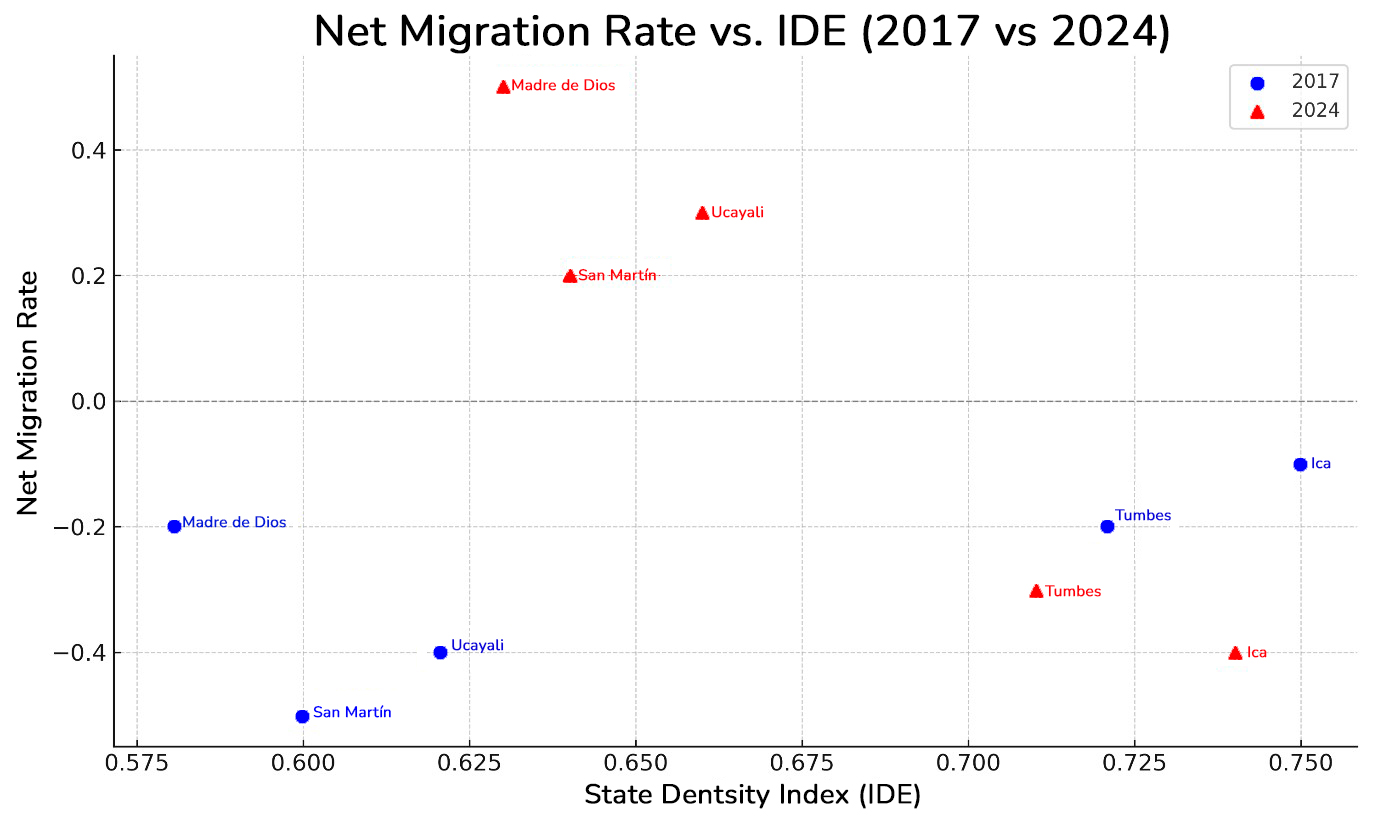
Over the last decade, the map of internal migration in Peru has undergone a substantial reconfiguration, exceeding traditional explanations centered on the attraction of institutionalized urban poles. Regions such as Madre de Dios, Ucayali, and San Martín, historically peripheral due to their geographical distance from political-administrative centers, their weak integration into national infrastructure and market networks, and persistent gaps in the provision of public services have emerged as new migration destinations despite maintaining medium or low levels of state density (IDE)4 (United Nations Development Programme, 2025).
By 2017, Madre de Dios had 141,070 inhabitants and a population density of 1.7 inhabitants/km² (Instituto Nacional de Estadística e Informática, 2018). Today, the figure surpasses 197,000 according to official projections (Instituto Nacional de Estadística e Informática, 2024, p. 32), with more than 80% concentrated in urban areas. Although moderate, this demographic growth has reinforced the role of the illegal mining enclave as a pole of migratory attraction, taking advantage of low density and limited state control over vast rural areas.
In figure 1, we can observe this structural shift. At the national level, regions with higher IDE tend to lose population, while territories with weaker state capacities consolidate as migration poles. This phenomenon contradicts classical logics of territorial development: regions with better services and infrastructure no longer attract migrants that look for a better opportunity; instead, flows concentrate in territories shaped by informal economic circuits, especially illegal mining, which promise quick, though precarious and risky, income.
Source: Based on the Human Development Report 2025 – Act, Trust and Connect Paths (United Nations Development Programme, 2025)
Data reveals a territorial paradox: while regions such as Ica or Tumbes, which traditionally attract populations due to their infrastructure, have negative migration balances, more fragile territories such as Madre de Dios register positive inflows. This shift does not reflect a strengthening of the state apparatus, but rather a reconfiguration functional to the extractive model, where economic attractiveness rests on immediate access to informal incomes rather than on the promise of human development and rights (United Nations Development Programme, 2025).
| Department | IDE 2017 | IDE 2024 | Migration 2017 | Migration 2024 |
|---|---|---|---|---|
| San Martín | Low | Medium | Negative | Positive |
| Ucayali | Low | Medium | Negative | Positive |
| Madre de Dios | Low | Medium | Negative | Positive |
| Ica | High | High | Negative | Negative |
| Tumbes | High | Medium | Negative | Negative |
The reconfiguration of migration is linked to the emergence of neoextractivist enclaves with several characteristics. First, they depend on fluctuations in international gold prices, whose sustained increase in the past decade has multiplied the profitability of illegal mining and, consequently, its capacity to attract migrant labor (Ramos & Canchari, 2025; Svampa, 2012, 2019; Bebbington, 2012). Second, these enclaves are constituted as spaces of informality and illegality,6 where state presence is weak, and governance is exercised through private arrangements, extralegal networks, and criminal actors (De Echave, 2020; O’Donnell, 1993). They are further characterized by accelerated territorial dynamics, involving land transformation, spontaneous settlement growth, and the concentration of improvised infrastructure supporting mineral extraction and trade (Gudynas, 2009).
Finally, the consolidation of Madre de Dios as a neo-extractivist enclave is closely tied to the construction and completion of the Interoceanic Highway in 2011. This infrastructure acted as a catalyst, connecting previously inaccessible territories to national markets and transnational illegal circuits (Johanson, 2024). It created a hybrid mobility corridor: while reducing transportation costs and times for goods and labor from impoverished Andean regions, it also enabled illicit flows of gold, prohibited chemicals, human trafficking, and contraband (Gillies et al., 2018). The coexistence of legal and illegal circuits along the same route reflects structural weaknesses in state control, political complicity, and porous governance, enabling both formal, informal and illegal extractive economies to expand (Global Initiative Against Transnational Organized Crime, 2021; Shaw & Reitano, 2014).
Institutional testimonies confirm that these migration flows are inserted not into regulated economies but into territories captured by criminal networks. A public official noted:
Gold extraction has grown exponentially, as has deforestation in our jungle; […] Today we have approximately 40,000 [miners]. Illegal mining attracts a significant number of people who come to work here, many of whom already have legal problems in other districts or departments of the country.7 (SGOV.MDD.2, 2025)
Similarly, a justice system representative identified two structural vulnerabilities: “First, the entire migration zone: very porous borders, poorly monitored. Second, little or no police presence in the area, they have taken over” (PROS.MDD.1, 2025).
Migration to Madre de Dios cannot be understood as a process of social inclusion, but rather as a survival strategy in response to the collapse of livelihoods in impoverished highland regions such as Cusco and Puno. In this context, migration flows are absorbed into enclaves functional to criminalized economies that do not integrate into the national territory but, as Svampa (2019) argues, fragment it through circuits of dispossession and extralegal control. As one official explained:
Internal migration is very difficult to control or measure with precision, because it is highly dynamic: some come, leave, and return; others stay temporarily or permanently. Currently, many of those who migrate end up involved in illegal activities, especially informal mining. This is why it is complicated to have precise figures or a clear registry. (SGOV.MDD.3, 2025)
This testimony underscores two key points. First, the dynamic and shifting character of migration renders it statistically invisible and difficult to capture in public policy (United Nations Development Programme, 2025; Cresswell, 2010). Second, its predominant insertion into informal mining reinforces the enclave’s condition as a space captured by illegal economies rather than as a pole of socio-economic integration.
Within this broader scenario of precarious mobility, human trafficking emerges as a specific modality of forced migration. Far from being a marginal phenomenon, it constitutes a structural mechanism of the mining enclave, articulating recruitment, transport, and exploitation in contexts of weak institutions (Grados et al., 2021; Díaz & Ruíz, 2024). In this scenario, the opening of the Interoceanic Highway reconfigured access to Madre de Dios, establishing corridors that integrated formal and informal mobility circuits leading to mining enclaves. As noted in a Capital Humano y Social Alternativo report (2017), women’s entry into Madre de Dios frequently occurs through trafficking routes that combine unregulated transportation via parallel paths to main roads, enabling evasion of state controls and ensuring a steady flow into mining camps. These routes employ diverse means such as formal and secondary roads, regional flights, and even river transport, facilitating access from different parts of the country and reinforcing the capacity of criminal networks to sustain exploitation.
As one official observed: “Between kilometers 108 and 112, artisanal mining began on a larger scale, and since then deforestation and crime have grown exponentially” (SGOV.MDD.2, 2025). Similarly, Barrantes and Escalante (2015) highlight that informal and illicit businesses have multiplied along this route to meet the demand for services generated by illegal mining, from hotels and grocery stores to centers of sexual exploitation, which have become fully integrated into the enclave’s political economy. Ultimately, the highway corridor not only consolidated the territorial expansion of mining but also strengthened trafficking routes, connecting Cusco with Madre de Dios and articulating circuits toward epicenters such as Huepetuhe, La Pampa, and Delta 1, where sexual exploitation is concentrated and normalized (Capital Humano y Social Alternativo, 2017).
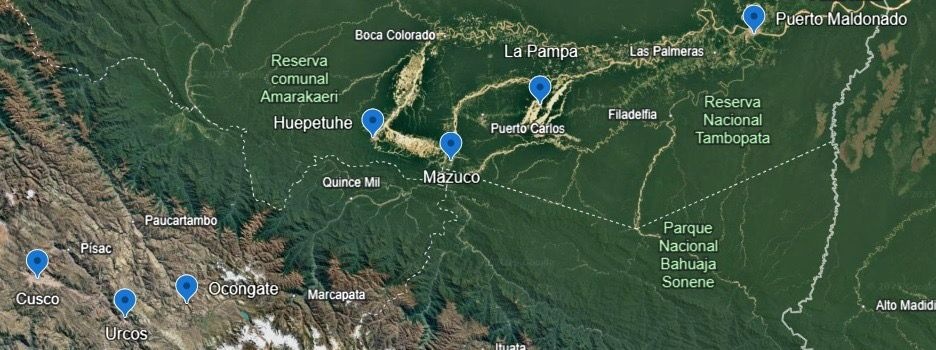
In this context, trafficking routes are not mere geographical displacements but infrastructures of capture that integrate recruitment, transport, and exploitation nodes. Their operability rests on structural conditions: social tolerance of illicit activities, the informality that facilitates unrestricted movement, impunity in the face of weak state controls, and corruption across multiple levels of authority (Capital Humano y Social Alternativo, 2017). The most well-known route connects Cusco–Urcos–Ocongate–Quincemil–Mazuko–Huepetuhe–La Pampa–Puerto Maldonado (see figure 2), where these factors create a criminal corridor operating with minimal regulatory friction. This corridor functions as a space where bodies are captured, classified, and commodified.
Source: Map manufactured on Google Earth (2025); adapted from Capital Humano y Social Alternativo (2025a)
The case of Madre de Dios underscores that migration in extractive contexts cannot be understood solely as a social consequence of mining but as a resource actively mobilized by the enclave. The attraction of vulnerable labor, the creation of hybrid mobility corridors, and the consolidation of trafficking routes demonstrate that demographic precarity constitutes a central input for reproducing the neo-extractivist model. These findings challenge classical frameworks of internal migration in Latin America, showing that contemporary mobility no longer responds to urban integration or citizenship promises but to territorial regimes where movement itself becomes a mechanism of control and accumulation.
4.2. Migrant Bodies as Extractive Infrastructure: Sexual Exploitation and Human Trafficking
Mobility toward neo-extractive enclaves such as Madre de Dios transcends the logic of labour displacement to inscribe itself within a broader process of territorial reconfiguration, in which migrant bodies, particularly feminized ones, are incorporated as strategic resources for the material and symbolic sustainability of the criminal economy. Within this assemblage, human trafficking and sexual exploitation are not marginal activities but structural gears of the illegal gold production circuit, whose profitability depends as much on the extraction of mineral resources as on the capture and commodification of bodies. Under this logic, Madre de Dios consolidates itself as both a destination and an exploitation site for trafficking victims, the majority originating from regions such as Cusco, Puno, and Arequipa (Díaz & Ruíz, 2024; Grados et al., 2021; Sarmiento & Aguilar, 2022).
As mentioned above, most of the trafficking victims in Peru are women between 18 and 29 years old or minors from high-Andean regions such as Apurímac, Cusco, and Puno, and transferred to Madre de Dios for sexual exploitation (Astete & Guerrero, 2021). Field research further confirms that areas such as La Pampa, Laberinto, and Huepetuhe have consolidated as key sites for the exploitation of Venezuelan migrant women, who are frequently deceived with promises of legal employment and subsequently forced into sexual trafficking through coercive debt mechanisms and threats (Bonafon et al., 2025).
Source: Adapted from the Trafficking Visualizer (Capital Humano y Social Alternativo, 2025b)
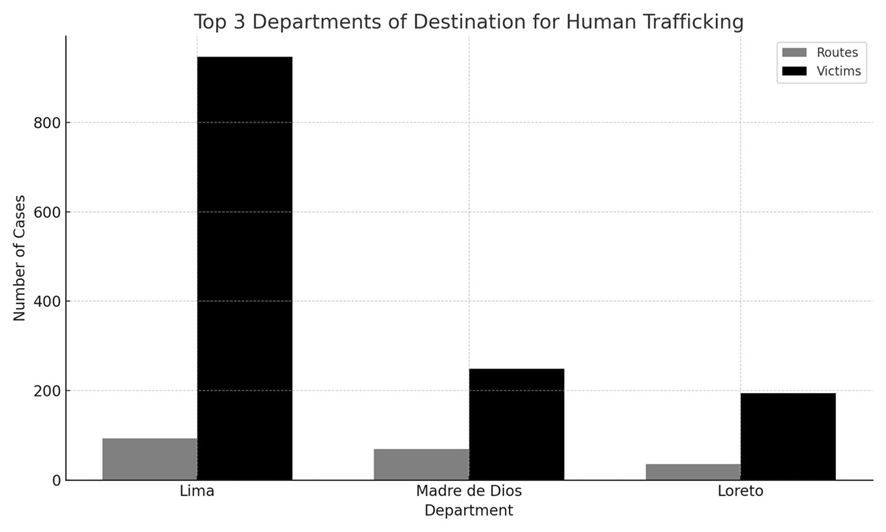
The destination pattern of trafficking victims confirms the centrality of Madre de Dios within the national network (see figure 2). Between 2004 and 2025, the region ranked third as a destination, with 70 transfer routes8 and 249 identified victims, only behind Lima (93 routes, 946 victims) and before Loreto (36 routes, 194 victims). While Lima concentrates the largest absolute number of victims, the relative magnitude in Madre de Dios is significant given its smaller population and the high density of illegal economies. This demonstrates that the mining enclave is not only an illicit economic hub but also a key node of capture and exploitation, where illegal extractivism converges with systematic gender-based violence.
In the sexual market that sustains the economy of illegal mining enclaves, women’s bodies are not treated as homogeneous: they are classified, hierarchized, and valued according to attributes such as gender, age, origin, ethnicity, appearance, and social capital. This logic of differentiation turns the body into a form of mercantile capital whose valuation fluctuates based on racialized and cultural stereotypes, feeding parallel markets that respond to distinct demands. One of these is directed at foreign women, mainly from Venezuela and Colombia, whose presence in these enclaves has visibly increased in recent years. As noted by SGOV.MDD.3:
The number of foreign victims has increased dramatically. We do not have exact figures, but many of them come from Venezuela and Colombia, and they end up in these centres of exploitation, in camps, often because they were recruited and deceived even from their country of origin.
Alongside the influx of foreign women, there is also a specific market for Peruvian women, particularly those from the country’s interior. A widely documented typology distinguishes between ojotitas (from ojota, the traditional Andean sandal), which refers to adolescent and young women of rural Andean origin, with low educational levels and from contexts of extreme poverty, and A1 for young women of urban or semi-urban origin, with greater schooling and social capital (Barrantes & Escalante, 2015). The ojotitas are preferred by lower-status workers, who reproduce relations of domination linked to their vulnerability and peasant origin. The A1, by contrast, are sought by clients with higher purchasing power, such as concessionaires, middle managers, or transport operators, who associate their physical features and ways of speaking or dressing with higher social status. This distinction not only defines the price of sexual services but also determines the position each woman occupies within the structure of exploitation, reinforcing the structural inequality that sustains the enclave.
The place women occupy in this hierarchy is also marked by age. Once they surpass the range considered high demand, many are promoted to roles as cashiers or administrators of brothels, or to functions of recruitment and control of new victims, often relatives or acquaintances, as part of debt repayment (JOUR.MDD2, 2025). This forced ascent, far from implying an improvement in their conditions, deepens psychological and physical subjugation. Victims, in many cases, internalize and reproduce the dynamics of the exploitation system, incorporating its rules and operational mechanisms. Some eventually perform management roles in these spaces of exploitation, including care, surveillance, and recruitment of new victims, perceiving these roles as possible opportunities for upward mobility within the commercial structure of trafficking (Astete & Guerrero, 2021; Sarmiento & Aguilar, 2022).
In parallel, male sexual demand is presented as a natural or culturally legitimized need. As Barrantes and Escalante (2015) indicate, the belief circulates that a miner’s economic success increases if he maintains sexual relations with young women or multiple partners, which intensifies demand for adolescents and young girls. This narrative naturalizes the sexual market as a component of the extractive economy, obscuring the structural violence that sustains it (Sarmiento & Aguilar, 2022).
In addition, there is a stigma that these women are after easy money. This label operates as a technology of control that blames women, denies their condition as victims, and obscures the coercive networks that entrap them (Mamani Zavaleta & Farfán Valer, 2022b). Simultaneously, it ensures their availability as indispensable infrastructure for social, affective, and sexual reproduction within the enclave, in a context where gender violence functions as a disciplinary tool.
These feminized migrant bodies can be read as body-territories, traversed by geographical borders (transfer routes), economic boundaries (the value assigned to sexual and care labor), and symbolic demarcations (their acceptance or exclusion from society), and transformed into commodities. Their circulation is regulated by a regime of differential governmentality: the state does not disappear but rather manages its presence selectively, delegating control to informal and criminal actors. Thus, trafficking and sexual exploitation are not only responses to market demand but operate as technologies of enclave governance, ensuring both the availability and disciplining of these bodies in the service of illegal accumulation.
Within the male segment, hierarchies are shaped by the sexual division of labour. As one expert on human trafficking observes:
Among men, there are also hierarchies. At the bottom are those who do the hardest work, the ones who carry loads, dig, or go into the dredges. Above them are those who operate machinery or handle transportation. And at the top are the armed men, the ones who collect payments and control the territory. (EXPT.MDD.2, 2025)
This informant also mentions that this latter group of men assumes greater risk of death in inter-group conflicts:
The male body may be more exposed to the risk of death, while women’s bodies are subjected to abuse, exploitation, and rape. Perhaps these are also ways of killing people, little by little. (EXPT.MDD.1, 2025)
Therefore, this sexual division of labour configures a regime of differential exploitation: while men are incorporated primarily as disposable physical labour, women are treated as sexual, affective, and reproductive resources indispensable to the enclave’s sustainability. In terms of mobility, men circulate along workforce routes directly tied to extraction, transport, and armed security, while women are mobilized through recruitment networks that ensure their availability for sexual commerce and care work. Male bodily capital is thus measured by strength and endurance, whereas female capital is defined by attributes such as age, appearance, and capacity to sustain the camp’s everyday life, rendering them simultaneously commodities and logistical supports for the permanence of the male labour force.
The political ecology of migration in Madre de Dios demonstrates that the circulation of bodies is not a by-product of illegal extractivism but one of its engines (Bebbington, 2012; Svampa, 2019). The mining enclave reorganizes territory not only to extract gold but also to capture and administer lives according to their economic and reproductive utility, articulating natural and human resources within a single logic of predatory accumulation (Gudynas, 2015).
4.3. Enclaves of Exception and Ecologies of Death
The illegal mining enclaves of Madre de Dios, most emblematically, La Pampa, configure what Agamben (1998) terms zones of exception: territories where the suspension of the legal order does not entail a normative vacuum but rather the installation of a parallel regime that regulates life solely according to its utility for illicit accumulation. Within this framework, state presence does not disappear; it is strategically administered, ceding territorial control to criminal networks that exercise effective sovereignty over space and its populations. As one interviewed official explains:
The police do not enter because there is private security there. Everyone pays to be there: each motor, each dredge, pays on average one thousand soles per week… even the ice cream seller pays 50 soles; the person with a barbershop, 100 soles weekly. Everyone pays. (SGOV. MDD2, 2025)
This system of illegal taxation not only finances a multimillion-dollar flow but also guarantees the enclave’s operational autonomy, shielding it from any state intervention. Violence, in this context, ceases to be a by-product of disorder and becomes a central device of governance: it regulates competition, disciplines the labour force, and secures the continuity of the criminal economy. The figures attest to this lethal normalization:
On average, four deaths per day are recorded in these zones. The Prosecutor’s Office or the state can no longer enter, not even to remove bodies. We are talking about territories where the state has completely lost control, with cases of homicides committed by members of the Armed Forces. (SGOV. MDD2, 2025)
Within this assemblage, mobility emerges as a key technology of criminal government: a device designed to filter, assign, and control who enters the enclave, under what conditions, and with which productive or reproductive roles. Far from a spontaneous flow, it is a planned circulation that orders internal hierarchies and segments the population according to its utility for the illicit economy. As another official explains:
There are criminal organizations—such as the Tren de Aragua—that recruit victims even from the country of origin… Once there, they coerce them by arguing that money was spent on their transfer… these are very remote places, where it is difficult to leave or escape. (SGOV. MDD1, 2025)
For women, this mobility control fulfils a dual function: to supply, on a sustained basis, the sexual market that fuels the enclave’s economy and to ensure that workers arrive under conditions of extreme dependency. Transfers, frequently financed by the criminal organizations themselves, become coercive debts that justify continued exploitation (Capital Humano y Social Alternativo, 2012; Barrantes & Escalante, 2015). At present, as an interviewed journalist notes, “traffickers adapt rapidly to technological advances. They keep adjusting their methods” (JOUR.MDD.1). Recruitment via social media such as Facebook, Instagram, or TikTok has thus become a key strategy: fake profiles, disguised job ads, direct messages, and promises of quick earnings are now recurrent lures (Bonafon et al., 2025). Alongside this digital modality, more traditional forms persist, such as the Loverboy, who, through sustained seduction under the guise of romantic interest, combines courtship with the promise of a shared life at the destination to generate trust and lower resistance to transfer. As the same journalist explains, in such cases “he promised they would live together there… but once they arrived, she was locked in with no way out” (JOURMDD.1).
Minors constitute a particularly vulnerable group. They are recruited through ostensibly safe job offers, such as waitressing without serving alcohol or shop assistance that conceal sexual and labour exploitation. In other cases, they are contacted in school or community settings, or taken by relatives, exploiting informational gaps and household economic needs. Traffickers commonly employ emotional manipulation, gifts, or sponsorship of travel to win the trust of victims and their circles. As one official recalls about young women and minors:
Yes, as nannies, for example, or to staff a store, to work in a restaurant. Most banners say: “You will earn 400, 500, 1000.” That is the dynamic I heard at the shelter where I worked [...] That was the case with adolescents who said they had come to care for a baby, for example. They arrived here, and it was no longer a baby; it was them who they had to serve. They no longer wanted to work and were told: “I’ll take you back to your town, you owe me S/30,000—pay me.” (SGOV. MDD.4, 2025)
In all cases, geographic isolation and economic dependency combine to ensure that, once inside the enclave, escape is nearly impossible.
This form of recruitment reveals that, beyond the initial deception, economic coercion becomes a central tool to ensure the retention of victims, even when they are minors. To this imposed debt are added other control mechanisms: the imposition of fines for alleged infractions or misconduct, the retention of identity documents to impede flight, the use of social stigma as a threat, and constant surveillance by third parties who restrict freedom of movement. These mechanisms, combined with the geographic isolation of the enclaves and the complicity of local actors, reinforce a system in which victims’ permanence depends not only on physical force but on a sophisticated architecture of psychological, economic, and social coercion (Capital Humano y Social Alternativo, 2012, 2017; Barrantes & Escalante, 2015; Mamani Zavaleta & Farfán Valer, 2022a, 2022b).
One of the interviewed journalists (JOUR.MDD.1) explains that victim retention does not occur solely in closed spaces: it is embedded in the improvised urban fabric that enclaves deploy in the middle of the rainforest. Nameless streets, precarious commerce, and temporary housing articulate a landscape designed to maximize the profitability of each body and resource. Surveillance stems not only from armed actors but also from informal social networks that monitor movements and relay information to exploiters. This urban-criminal ecosystem provides trafficking networks with perfect cover, the constant flow of people, the camp’s anonymity, and the rotation of venues hinder victim identification and state intervention.
These camps operate as mini-cities in the rainforest: “You can find DirecTV, Netflix, YouTube—everything—in the heart of the Amazon. When miners are extracting gold, everything is active. But if they know a state operation is coming, they disappear quickly. They pack everything up and leave” (JOUR.MDD.1). In these settings, daily life unfolds in a climate of calculated provisionally: fragile structures and improvised services that can be dismantled within hours, yet that sustain an intense circulation of goods, money, and bodies while active. This normalization of violence and precarity configures what Mbembe (2003) and Gago (2021), from different perspectives, have described as ecologies of death: regimes in which exploitation, disappearance, and the degradation of life are structural conditions, not exceptions.
Within this assemblage, prostibares, canteens, and video-pubs, many unlicensed or in violation of existing permits, occupy a central place in the enclave’s political economy (Capital Humano y Social Alternativo, 2017). They are not mere leisure spaces: they function as nodes of recruitment, control, and rent extraction, interlinking with clandestine bars and shops that reinforce informal surveillance and social control. In these environments, life and health carry no tangible value: deaths caused by work accidents or armed violence do not reach official records, perpetrators go unpunished, and medical certificates conceal the real causes of death.
The urban-criminal landscape of these enclaves combines corner stores, phone centres, pharmacies, restaurants, and hotels, but its gravitational core is the massive sale of alcohol, tightly bound to the provision of sexual services (Capital Humano y Social Alternativo, 2012). A prosecutor summarizes it blatantly:
If there were no alcohol, this would not exist. Because they have to get drunk [...] So, I ask myself: where is the social responsibility of the companies that distribute beer in that area? They know—or should know—that their product ends up in those places, because nobody else goes that far in. We keep feeding the problem. It should be stated: “We do not sell alcohol that contributes to the exploitation of any girl or boy; we only distribute in controlled spaces.” (PROS.MDD.1, 2025)
This economic circuit is not a marginal activity but a central gear in the enclave’s extractive machinery. It supplies leisure, sociability, and commodified affective ties that restore—physically and emotionally—the male labour force, guaranteeing the continuity of the production cycle. Labor precarity, the absence of social protections, and the systematic invisibilisation of deaths and injuries do not operate as failures but as structural conditions that sustain the system’s profitability. Life is thus depreciated until it becomes a fungible, expendable, and replaceable resource.
The ecology of death in illegal mining enclaves is not limited to human bodies: it extends to the territories that sustain them. Massive deforestation, soil removal, and mercury contamination configure a devastated landscape in which environmental destruction operates under the same regime of exception that governs human life. Between 2021 and 2023, gold mining deforested 23,881 hectares of primary forest in Madre de Dios; of this total, 76% occurred within the Mining Corridor and 24% in prohibited zones, including 3,406 hectares in Indigenous communities and buffer areas of the Tambopata National Reserve, the Bahuaja Sonene National Park, and the Amarakaeri Communal Reserve (Finer et al., 2023). Added to this is mercury pollution, which has exposed close to 80% of the adult population to levels above World Health Organization (WHO) recommendations and, in riverine Indigenous communities, up to eight times the permissible limit, with annual discharges estimated at 181 tons (Sociedad Peruana de Derecho Ambiental, 2023a, 2023b). This devastation is a constitutive gear of the enclave, where bodies and ecosystems are degraded under a necropolitical regime that renders all forms of life disposable.
This web is reinforced by the constant circulation of weapons and ammunition, consolidating territorial control based on a permanent threat. Illegal mining acts as a magnet for fugitives, hired killers, and other criminal actors, configuring a network where violence and impunity function as deliberate mechanisms to safeguard the illicit economy. Thus, the illegal mining enclaves of Madre de Dios are not peripheral anomalies but laboratories where exception and the ecology of death intertwine. The former enables the selective suspension of rights and the installation of criminal sovereignties; the latter normalizes the lethal exploitation of bodies and territories as a constitutive part of the extractive cycle. This articulation of material and symbolic dispossession, ecological devastation, and systematic violence demonstrates through the political ecology of migration (Bebbington, 2012; Svampa, 2019; Gudynas, 2015)—that the circulation of bodies is not a side effect of illegal extractivism but one of its structural engines. In doing so, gender hierarchies are consolidated, and violence is entrenched as a tool of territorial governance (Federici, 2010; Segato, 2016; Díaz & Ruíz, 2024; Mamani Zavaleta & Farfán Valer, 2022a).
5. Conclusion
Throughout the eyes of actors situated within the state and based on the analysis of multiple studies and reports, the findings of this research reveal the reasons why migratory flows toward Madre de Dios do not respond to dynamics of integration or upward mobility but to the expansion of illegal extractive economies that reorganize territories and lives according to their utility. Far from being a peripheral hotspot, illegal gold mining has consolidated as a population-attracting centre operating through extra-legal arrangements and criminal networks, configuring spaces where the circulation of people is managed according to criteria of profitability and control. In this context, migration ceases to be a spontaneous movement and becomes an administered resource that ensures the differentiated availability of bodies and labour power in line with the enclave’s sustainability.
The evidence also shows that this logic is not confined to male labour exploitation; it extends to the systematic capture of feminized bodies to sustain sexual, affective, and reproductive markets indispensable to the extractive cycle. Human trafficking and sexual exploitation, far from constituting externalities, are gears that guarantee the enclave’s continuity, disciplining and commodifying bodies through technologies of economic and territorial coercion. Gender-based violence is thereby articulated with structural precarity and the normalization of death as part of the governance of these spaces.
Environmental devastation confirms that value extraction is not restricted to humans. The deforestation of the Amazon and chronic mercury contamination, exposing the local population to levels above recommended thresholds, show how mining enclaves integrate bodies and ecosystems into a single matrix of exploitation. In these territories, human and nonhuman life becomes expendable, converted into inputs that sustain criminal economies thriving under regimes of exception.
Taken together, the case of Madre de Dios reveals that migration is explained by insertion into circuits of dispossession that reconfigure territory through an extractive lens. What emerges is a mobility governed by violence, inequality, and the commodification of life, where bodies and forests are captured as part of the same project of predatory accumulation. These findings challenge conventional readings of internal migration in Latin America and demand that it be understood as a constitutive dimension of illegal enclaves, in which gendered differential exploitation, environmental devastation, and criminal sovereignty intertwine in the contemporary production of Amazonian territories. While this research focuses on specific actors to elucidate the connections among migration, extractivism, and necropolitics in the Peruvian Amazon—and how women’s trafficking is entangled within this political ecology of migration—the authors aim to continue this line of inquiry through further research involving different actors and sites, to deepen the understanding of the political ecology of migration in neo-extractive enclaves such as Madre de Dios.
Artificial Intelligence Declaration
An artificial intelligence tool was used solely for auxiliary task, namely automatic bibliography formatting and literal translation of certain interview excerpts. AI was not used to generate any intellectual content of the manuscript.
Data Access Statements
The data analyzed in this study are not publicly available due to confidentiality constraints and the imperative to safeguard the privacy of the individuals and institutions involved, as well as ethical considerations inherent to the nature of the information collected.
References
Agamben, G. (1998). Homo sacer: El poder soberano y la nuda vida. Pre-Textos.
Araya-Morales, I. (2025). Desde el cuerpo: Desafíos y alcances metodológicos de una etnografía feminista con mujeres migrantes. Estudios Atacameños, 71, e6457. https://doi.org/10.22199/issn.0718-1043-6457
Arellano-Yanguas, J. (2011). Aggravating the resource curse: Decentralisation, mining and conflict in Peru. The Journal of Development Studies, 47(4), 617-638. https://doi.org/10.1080/00220381003706478
Asher, K., & Ojeda, D. (2009). Producing nature and making the state: ordenamiento territorial in the Pacific lowlands of Colombia. Geoforum, 40(3), 292-302. https://doi.org/10.1016/j.geoforum.2008.09.014
Astete, P., & Guerrero, R. (2021). Informe sobre la situación y contexto del delito de trata de personas y la explotación sexual en las regiones de Madre de Dios y Piura en el marco del proyecto “No más mujeres invisibles: Contra la trata, explotación sexual y violencia sexual en zonas de minería informal de Madre de Dios y Piura” (Report). Promsex. https://promsex.org/wp-content/uploads/2022/02/InformeSobreLaSituacionYContextoDelDelitoDeTrataDePersonasYLa ExplotacionSexual.pdf
Barrantes, C., & Escalante, G. (2015). Madre de Dios: La ruta del oro entre el cielo y el infierno. Estudio sobre la trata de adolescentes con fines de explotación sexual (Report). Terre des Hommes Suisse.
Bebbington, A. (2012). Industrias extractivas: conflicto social y dinámicas institucionales en la región andina. Instituto de Estudios Peruanos.
Bonafon, H., Ferrer, R., & Peña Jiménez, O. (2025). Entre la precariedad y la búsqueda de prosperidad: Experiencias de mujeres frente a la trata en contextos amazónicos (Report). Promsex. https://promsex.org/publicaciones/entre-la-precariedad-y-la-busqueda-de-prosperidad-las-redes-sociales-como-espacio-de-riesgo-para-la-captacion-de-victimas-de-trata/
Braun, V., & Clarke, V. (2021). Thematic analysis: A practical guide. SAGE Publications.
Capital Humano y Social Alternativo. (2012). La trata de personas en la región de Madre de Dios 2012 (Report). https://chsalternativo.org/publicaciones/informe-la-trata-de-personas-en-la-region-de-madre-de-dios/
Capital Humano y Social Alternativo. (2017). Rutas de la trata de personas en la Amazonía peruana (Report). https://repositorio.mimp.gob.pe/entities/publication/dd521276-828f-47a0-9620-be57a97b98df
Capital Humano y Social Alternativo. (2025a). Trata de personas. https://chsalternativo.org/trata-de-personas/
Capital Humano y Social Alternativo. (2025b). Visualizador de rutas y trata de personas. https://web-vrtp.chsalternativo.org
Colorafi, K. J., & Evans, B. (2016). Qualitative descriptive methods in health science research. HERD: Health Environments Research & Design Journal, 9(4), 16-25. https://doi.org/10.1177/1937586715614171
Cortés-McPherson, D. (2020). Digging into the Mining Subculture: The Dynamics of Trafficking in Persons in the Artisanal and Small-Scale Gold Mining of Peru’s Madre de Dios. In Y. Zabyelina & D. van Uhm (eds.), Illegal Mining (pp. 359-386). Springer Nature Link. https://doi.org/10.1007/978-3-030-46327-4_13
Cresswell, T. (2010). Towards a politics of mobility. Environment and Planning D: Society and Space, 28(1), 17-31. https://doi.org/10.1068/d11407
De Echave, J. (2020). Estudio de caso sobre la gobernanza del cobre en el Perú. CEPAL.
Díaz, V., & Ruíz, D. (2024). Estudio sobre la relación de la trata de personas y mujeres desaparecidas en Madre de Dios, Lima y Piura (Report). Promsex. https://promsex.org/publicaciones/estudio-sobre-la-relacion-de-la-trata-de-p-ersonas-y-mujeres-desaparecidas-en-madre-de-dios-lima-y-piura/
Federici, S. (2010). Calibán y la bruja: Mujeres, cuerpo y acumulación originaria. Traficantes de Sueños.
Finer, M., Mamani, N., & Ariñez, A. (2023, September 26). MAAP #195: Deforestación minera en la Amazonía peruana sur en 2023. Monitoring of the Andes Amazon Program (MAAP). https://www.maapprogram.org/es/deforestacion-minera-2023-peru/
Flick, U. (2018). An introduction to qualitative research. SAGE Publications. https://doi.org/10.4135/9781529622737
Gago, V., & Mezzadra, S. (2017). A critique of the extractive operations of capital: Toward an expanded concept of extractivism. Rethinking Marxism, 29(4), 574-591. https://doi.org/10.1080/08935696.2017.1417087
Gago, V. (2021). La Potencia Feminista. O el deseo de cambiarlo todo. La Siniestra.
Gillies, A., Collins, J., & Soderholm, A. (2018). Addressing the development implications of illicit economies: The rise of a policy and research agenda. Journal of Illicit Economies and Development, 1(1), 1-8. https://doi.org/10.31389/jied.17
Global Initiative Against Transnational Organized Crime. (2021). The global illicit economy: Trajectories of transnational organized crime (Report). https://globalinitiative.net/wp-content/uploads/2021/03/The-Global-Illicit-Economy-GITOC-Low.pdf
Gómez-Barris, M. (2019). Zonas extractivas: Ecologías sociales y perspectivas decoloniales. Metales Pesados.
Google Earth. (2025, November 10). Ruta de la trata de personas desde Cusco hacia enclave extractivo en Madre de Dios. https://earth.google.com/earth/d/1XihOzugs6--bNQxkh7waAH0kGF6fUi28
Grados, C., Grados, M., & Medina, C. (2021). Balance sobre la situación actual de la trata, explotación sexual y violencia sexual en zonas de minería informal de Madre de Dios y Piura (Report). Promsex. https://promsex.org/publicaciones/balance-sobre-la-situacion-actual-de-la-trata-explotacion-sexual-y-violencia-sexual-en-zonas-de-mineria-informal-de-madre-de-dios-y-piura/
Gudynas, E. (2009). El mandato ecológico. Derechos de la Naturaleza y políticas ambientales en la nueva Constitución. Ediciones Abya Yala.
Gudynas, E. (2012). Estado compensador y nuevos extractivismos. Las ambivalencias del progresismo sudamericano. Nueva Sociedad, 237. https://www.nuso.org/articulo/estado-compensador-y-nuevos-extractivismos-las-ambivalencias-del-progresismo-sudamericano/
Gudynas, E. (2013). Extracciones, extractivismo y extrahecciones: Un marco conceptual sobre la apropiación de recursos naturales (Working paper no. 18). Observatorio del Desarrollo, Universidad de Costa Rica. https://ambiental.net/wp-content/uploads/2015/12/GudynasApropiacionExtractivismoExtraheccionesOdeD2013.pdf
Gudynas, E. (2015). Extractivismos: Ecología, economía y política de un modo de entender el desarrollo y la naturaleza. Centro de Documentación e Información Bolivia (CEDIB).
Haraway, D. (1988). Situated knowledges: The science question in feminism and the privilege of partial perspective. Feminist Studies, 14(3), 575-599. https://doi.org/10.2307/3178066
Hesse-Biber, S. (2012). Feminist approaches to triangulation: Uncovering subjugated knowledge and fostering social change in mixed methods research. Journal of Mixed Methods Research, 6(2), 137-146. https://doi.org/10.1177/1558689812437184
Huarancca, M., Alanya, W., & Castellares, R. (2022). La Migración Interna en el Perú, 2012-2017. Revista Estudios Económicos, 40, 35-58.
Instituto Nacional de Estadística e Informática (INEI). (2018). Censos Nacionales 2017: XII de población, VII de vivienda y III de comunidades indígenas. https://www.censos2017.pe/media/MenuRecursivo/publicaciones_digitales/Est/Lib1539/libro.pdf
Instituto Nacional de Estadística e Informática (INEI). (2024). Madre de Dios, Compendio Estadístico. https://cdn.www.gob.pe/uploads/document/file/7613488/6453865-compendio-madre-de-dios-2024-capitulo-1-al-4.pdf?v=1739224110
Islekel, E. S. (2022). Gender in Necropolitics: Race, Sexuality, and Gendered Death. Philosophy Compass, 17(5), e12827. https://doi.org/10.1111/phc3.12827
Jofré, C., & Chacaltana-Cortez, S. (2023). Imbricaciones entre extractivismos y feminismos desde una perspectiva de las luchas en Abya Yala. Memorias Disidentes: Revista de Estudios Críticos del Patrimonio, Archivos y Memorias, 1(1), 14-40. https://ojs.unsj.edu.ar/index.php/Mdis/article/view/980/1114
Johanson, M. (2024, June 12). Cómo la Carretera Interoceánica marcó el comienzo de una nueva era de deforestación y agitación social en la Amazonía. World Wildlife Fund. https://www.worldwildlife.org/descubre-wwf/historias/como-la-carretera-interoceanica-marco-el-comienzo-de-una-nueva-era-de-deforestacion-y-agitacion-social-en-la-amazonia
Li, T. M. (2014). Land’s end: Capitalist relations on an indigenous frontier. Duke University Press. https://doi.org/10.1215/9780822376460
Mamani Zavaleta, M., & Farfán Valer, C. (2022a). El oscuro vínculo entre la explotación sexual y la minería ilegal. Economía & Sociedad, 102, 18-21.
Mamani Zavaleta, M., & Farfán Valer, C. (2022b). Percepciones de actores involucrados en la lucha contra la trata de personas con fines de explotación sexual, sus vínculos con la minería ilegal y las barreras para combatirla en Madre de Dios (Report). Promsex. https://promsex.org/publicaciones/percepciones-de-actores-involucrados-en-la-lucha-contra-la-trata-de-personas-con-fines-de-explotacion-sexual-sus-vinculos-con-la-mineria-ilegal-y-las-barreras-para-combatirla-en-madre-de-dios/
Mbembe, A. (2003). Necropolitics. Public Culture, 15(1), 11-40. https://doi.org/10.1215/08992363-15-1-11
Montero, A., & Samuels, D. (eds.) (2004). Decentralization and democracy in Latin America. University of Notre Dame Press.
Monzón, A. S. (2017). Mujeres, género y migración: Una perspectiva crítica desde el feminismo. In M. S. Rodríguez (ed.), Feminismos, pensamiento crítico y propuestas alternativas en América Latina (pp. 79-92). CLACSO. https://doi.org/10.2307/j.ctv253f52b.7
Neergaard, M. A., Olesen, F., Andersen, R. S., & Sondergaard, J. (2009). Qualitative description – The poor cousin of health research? BMC Medical Research Methodology, 9, 52. https://doi.org/10.1186/1471-2288-9-52
Novak, F., & Namihas, S. (2009). La trata de personas con fines de explotación laboral: El caso de la minería aurífera y la tala ilegal de madera en Madre de Dios (Report). Organización Internacional para las Migraciones (OIM). https://peru.iom.int/sites/g/files/tmzbdl951/files/Documentos/trata-exlaboral-madredios.pdf
Nowell, L. S., Norris, J. M., White, D. E., & Moules, N. J. (2017). Thematic analysis: Striving to meet the trustworthiness criteria. International Journal of Qualitative Methods, 16(1). https://doi.org/10.1177/1609406917733847
O’Connell, C., & Santiesteban, R. (2023). Environmental colonialism and neocolonialism in Latin America. In B. Bustos, S. Engel Di-Mauro, G. García-López, F. Milanez & D. Ojeda (eds.), Routledge Handbook of Latin America and the Environment (pp. 73-85). Routledge. https://doi.org/10.4324/9780429344428-9
O’Donnell, G. (1993). On the state, democratization and some conceptual problems: A Latin American view with glances at some postcommunist countries. World Development, 21(8), 1355-1369. https://doi.org/10.1016/0305-750X(93)90048-E
Observatorio Nacional de Política Criminal Indaga. (2021). La minería ilegal en la Amazonía peruana (Report). Ministerio de Justicia y Derechos Humanos. https://cdn.www.gob.pe/uploads/document/file/1973114/Documento%20La%20miner%C3%ADa%20ilegal%20en%20la%20Amazon%C3%ADa%20peruana%20-%20versi%C3%B3n%20pdf.pdf.pdf?v=1624644621
Ojeda, D. (2016). Los paisajes del despojo: Propuestas para un análisis desde las reconfiguraciones socioespaciales. Revista Colombiana de Antropología, 52(2), 19-43. https://www.redalyc.org/articulo.oa?id=105049120002
Ojeda, D. (2022). Reproducción social, despojo y el funcionamiento generizado del extractivismo agrario en Colombia. In C. Gras & V. Hernández (comps.), Extractivismo agrario en América Latina (pp. 163-188). CLACSO.
Ojeda, D. (2025). Biodiversidad, Desarrollo local y paz en Colombia: entre el acaparamiento verde y el sostenimiento de la vida (Working paper no. 2). Instituto Colombo-Alemán para la Paz.
Ojeda, D., Petzl, J., Quiroga, C., Rodríguez, A. C., & Rojas, J. G. (2015). Paisajes del despojo cotidiano: acaparamiento de tierra y agua en Montes de María, Colombia. Revista de Estudios Sociales, 1(54), 107-119. https://doi.org/10.7440/res54.2015.08
Palinkas, L. A., Horwitz, S. M., Green, C. A., Wisdom, J. P., Duan, N., & Hoagwood, K. (2015). Purposeful sampling for qualitative data collection and analysis in mixed method implementation research. Administration and Policy in Mental Health and Mental Health Services Research, 42(5), 533-544. https://doi.org/10.1007/s10488-013-0528-y
Pérez, L. M., & Freier, L. F. (2022). My brother the “other”: Use of satire and boundary‐making by Venezuelan migrants in Peru. Social Inclusion, 10(1), 72-83. https://doi.org/10.17645/si.v10i1.4816
Radel, C., Schmook, B., Carte, L., & Mardero, S. (2018). Toward a political ecology of migration: Land, labor migration, and climate change in northwestern Nicaragua. World Development, 108, 263-273. https://doi.org/10.1016/j.worlddev.2017.04.023
Ramos, A., & Canchari, D. (2025, October 30). El precio del oro brilla más que nunca y bate los US$4.000 por primera vez en la historia. La República. https://larepublica.pe/economia/2025/10/07/el-precio-del-oro-brilla-mas-que-nunca-y-bate-los-us4000-por-primera-vez-en-su-historia-hnews-195811
Reymundo, L. (2025). Tiempos de mistura: parentesco y matrimonios entre harakbut y mestizos en el contexto de la minería aurífera en una comunidad indígena de la Amazonía sur peruana. Boletim do Museu Paraense Emílio Goeldi. Ciências Humanas, 20(2), 20230060. https://doi.org/10.1590/2178-2547-BGOELDI-2023-0060
Sánchez, M., & Riosmena, F. (2021). Cambio climático global, ecología política y migración. Revista de Estudios Sociales, 76, 2-6. https://doi.org/10.7440/res76.2021.01
Sandelowski, M. (2000). Whatever happened to qualitative description? Research in Nursing & Health, 23(4), 334-340. https://doi.org/10.1002/1098-240X(200008)23:4
Sarmiento, K., & Aguilar, A. (2022). Aportes a la comprensión de la trata de personas en el Perú: Compendio de Balance de Investigaciones del proyecto No más mujeres invisibles: contra la trata, explotación sexual y violencia sexual en zonas de minería informal de Madre de Dios y Piura (Perú) (Report). Promsex. https://cies.org.pe/publicaciones/aportes-a-la-comprension-de-la-trata-de-personas-en-el-peru-compendio-de-balance-de-investigaciones/
Segato, R. (2016). La guerra contra las mujeres. Traficantes de Sueños.
Shaw, M., & Reitano, T. (2014). The Political Economy of Trafficking and Trade in the Sahara: Instability and Opportunities (Report). World Bank. https://globalinitiative.net/wp-content/uploads/2014/12/Shaw-Reitano-%E2%80%93-The-Political-Economy-of-Trafficking-and-Trade-in-the-Sahara-December-2014.pdf
Silva-Santiesteban, R. (2017). Mujeres y conflictos ecoterritoriales: Impactos, estrategias, resistencias. Agencia Española para la Cooperación Internacional al Desarrollo (AECID) y Estudio para la Defensa de los Derechos de la Mujer (DEMUS). https://www.demus.org.pe/wp-content/uploads/2018/02/Mujeresyconflictos_Convenio.-2017.pdf
Sociedad Peruana de Derecho Ambiental (SPDA). (2023a, May 4). ¿Cómo Madre de Dios se convirtió en un lugar tan inseguro para los defensores ambientales? Actualidad Ambiental. https://www.actualidadambiental.pe/madre-de-dios-se-convirtio-en-un-lugar-tan-inseguro-defensores-ambientales/
Sociedad Peruana de Derecho Ambiental (SPDA). (2023b, November 24). Madre de Dios: Minería deforestó en tres años un área equivalente al distrito de Lurigancho-Chosica. Actualidad Ambiental. https://www.actualidadambiental.pe/madre-de-dios-mineria-deforesto-en-tres-anos-un-area-equivalente-al-distrito-de-lurigancho-chosica/
Sundberg, J. (2008). Gender, nature, and transnational political ecology. Environment and Planning D: Society and Space, 26(3), 313-328. https://doi.org/10.1068/d5207
Svampa, M. (2012). Pensar el desarrollo desde América Latina. In G. Massuh (ed.), Renunciar al bien común. Extractivismo y (pos)desarrollo en América Latina (pp. 27-42). Mardulce.
Svampa, M. (2019). fronteras del neoextractivismo en América Latina: Conflictos socioambientales, giro ecoterritorial y nuevas dependencias. CALAS.
United Nations Development Programme (UNDP). (2025, June 19). Informe sobre Desarrollo Humano 2025: Actuar, confiar y conectar caminos. https://www.undp.org/es/peru/publicaciones/informe-sobre-desarrollo-humano-2025-actuar-confiar-y-conectar-caminos#
Váldes, R., Basombrio, C., & Vera, D. (2022). Las economías criminales y su impacto en el Perú. ¿Cuáles? ¿Cuánto? ¿Dónde? ¿Cómo? Capital Humano y Social Alternativo https://chsalternativo.org/publicaciones/las-economias-criminales-y-su-impacto-en-el-peru-cuales-cuanto-donde-como/
Valdivia, G., Himley, M., & Havice, E. (2022). Critical Resource Geography: An Introduction. In M. Himley, E. Havice & G. Valdivia (eds.), The Routledge Handbook of Critical Resource Geography (pp. 1-20). Routledge.
Valencia, S. (2016). Capitalismo gore. Melusina.
Yashar, D. (2018). Homicidal Ecologies. Cambridge University Press.
Zibechi, R., & Machado, D. (2022). El Estado realmente existente. Del Estado de bienestar al Estado para el despojo. La Vorágine.