Los encuadres de la movilidad climática: un análisis del discurso de la prensa española



In a world increasingly affected by climatic changes, climate mobility has become a topic of growing relevance in the geopolitical context. Spain, as an external border of the European Union with historical ties to regions highly exposed to climate impacts, such as North Africa, offers a critical case study for examining these dynamics. This article applies framing theory to qualitatively analyse how Spanish media construct climate mobility and how both people and spaces are represented. Drawing on 52 articles published between 2021 and 2023 in the six most-read newspapers in Spain, four predominant frames are identified: quantitative-alarmism, securitization, humanitarianism, and vulnerability. Media discourses depict migrants as passive victims or abstract figures, while spaces are portrayed as “in crisis” or “under threat.” Only the vulnerability frame provides a more nuanced perspective by linking exposure to climate change with socio-demographic risks. Yet even here, responsibilities of the Global North remain underdeveloped.
En un mundo cada vez más afectado por el cambio climático, la movilidad climática se ha convertido en un tema de creciente relevancia geopolítica. España, como frontera exterior de la Unión Europea y con vínculos históricos con regiones altamente expuestas a los impactos climáticos, como el Norte de África, constituye un caso crítico para analizar estas dinámicas. Este artículo aplica la teoría del encuadre para examinar cómo los medios españoles construyen la movilidad climática y representan a las personas y espacios implicados. A partir de 52 artículos publicados entre 2021 y 2023 en los seis periódicos más leídos en España, se identifican cuatro marcos predominantes: alarmista-cuantitativo, securitización, humanitario y vulnerabilidad. Los discursos mediáticos presentan a los migrantes como víctimas pasivas o figuras abstractas, y a los espacios como “en crisis” o “amenazados”. Solo el marco de vulnerabilidad ofrece una visión más matizada al vincular la exposición climática con riesgos sociodemográficos, aunque las responsabilidades del Norte Global siguen poco desarrolladas.

Climate mobility; migration; climate change; framing theory; media; Spain
Movilidad climática; migración; cambio climático; teoría del encuadre; medios de comunicación; España

1. Introduction
Climate change and human mobility are inherently political and highly contentious phenomena, generating intense public and political debate worldwide. Climate change is often addressed through technocratic or Malthusian approaches (Svarstad & Benjaminsen, 2024), and migration through securitized or humanitarian logics (Mazzara et al., 2021). Therefore, both perspectives risk depoliticizing the structural inequalities at stake. Political ecology offers a critical lens to move beyond such apolitical or reductionist analyses of human–environment relations, highlighting the unequal power relations that structure access to and control over environmental resources (Bryant, 1997) and emphasizing the role of discourses in shaping hegemonic narratives about nature and society (Adger et al., 2001). This perspective aligns closely with mobility justice (Sheller, 2018), which foregrounds how all movement is political and all politics are mobile, shaping patterns of unequal mobility and immobility in the circulation of people, resources, and information; as well as with climate justice, which argues for “paying attention to how climate change impacts people differently, unevenly, and disproportionately, as well as redressing the resultant injustices in fair and equitable ways” (Sultana, 2022, p. 118). By applying a political ecology perspective to human mobility, media framings of migration can be understood not only as cultural representations but also as rooted in broader political struggles over justice, rights, and responsibility. We rely on this framework to identify and analyse frames, examining how narratives of climate mobility describe migrants and the socio-environmental contexts in which they move.
In media portrayals, frames contribute to defining which aspects of climate mobility are made visible, such as crisis, vulnerability, or security, while obscuring others, including structural inequalities, justice, and responsibility. In this sense, frame analysis serves as a powerful methodological tool to deconstruct how information is selectively highlighted to “call attention to some aspects of a news story while simultaneously directing attention away from other aspects” (Dreher & Voyer, 2015, p. 60). As Entman (1993) argued, framing involves defining problems, diagnosing causes, making moral judgments, and suggesting remedies, which underscores its central role in shaping not only public perception but also political agendas. Examining frames around climate mobilities, therefore, allows us to interrogate how narratives attribute responsibility, distribute agency, and legitimize particular solutions (whether securitization, humanitarian assistance, or justice-oriented responses) while marginalising alternative imaginaries.
The study’s main research question is: how is climate-induced mobility framed in the Spanish media? To address this question, we examine the ways in which both people and spaces are portrayed. This dual framework offers a distinct analytical contribution that reveals how climate mobility is framed and the interplay between human and spatial dimensions in media narratives. We focus on media outlets from Spain as the country occupies a particularly significant position in the study of climate (im)mobilities for several reasons. First, it functions as one of the external borders of the European Union. As such, Spain’s southern borders have undergone a process of securitization aligned with EU migration policies, where acts of solidarity are increasingly criminalized, and public and private militarized actors, alongside humanitarian organizations, operate within a context of “crisis” (Casas-Cortes et al., 2013; Vives, 2023). Second, Spain and the Mediterranean are considered a climate change hotspot (Tuel & Eltahir, 2020). This status is underscored by phenomena such as the increasing frequency and intensity of wildfires: recent studies show that weather conditions fueling wildfires in Spain and Portugal have become more likely due to climate change (Keeping et al., 2025). Moreover, the European Environment Agency (EEA) has warned that one of the most pressing risks in southern Europe would be a reduction in annual rainfall, exacerbating water stress, combined with an increase in the frequency and intensity of torrential rainfall and flooding events, such as those that occurred in eastern Spain (Valencia) in October 2024 (EEA, 2024). Understanding how Spanish media represent climate mobility is therefore essential, as media frames not only reflect public and political debates but also actively shape perceptions, priorities, and policy responses.
In this article, we first present a review of the literature on climate mobility frames, with a particular focus on media representations. We then outline the methodology employed for the analysis of Spanish newspapers. This is followed by a detailed presentation of the results, highlighting the dominant frames identified. Finally, in the conclusion, we address the need for a more nuanced approach that acknowledges the political and socioeconomic dimensions underlying climate mobility.
2. Framing Theory, Climate Change and Migration
Frame theory is one of the most widely used approaches in analyzing the media and the social construction of reality. Its popularization is attributed to Erving Goffman (1974), who, from a symbolic interactionist perspective, defined frames as the basic elements of individual experience through which a situation is interpreted. Frames thus function as cognitive structures that select certain aspects of perceived reality and organize them into coherent narratives, influencing how audiences understand, evaluate, and respond to an issue (Entman, 1993; Ransan-Cooper et al., 2015). In this way, frames do not merely convey information but also guide the interpretation of facts and contribute to setting the public agenda. As Bevitori and Johnson (2022, p. 547) note, the media “act as intermediaries between science, politics, and citizens,” constructing discourses that shape social perception. Applied to the study of climate-induced migration, frame theory makes it possible to uncover how dominant frames not only inform about a phenomenon but also define it and legitimize particular political or social responses. Thus, frame analysis reveals both hegemonic narratives and the absences or silences in the public debate, offering a key tool for understanding the social and media construction of climate mobilities.
In the field of communication, framing involves not only what is said, but how it is said: which aspects are highlighted, which are omitted, and how causal and evaluative relationships are articulated in the discourse. In this sense, headlines are particularly relevant. The increasing digitalization of the media and the growing influence of social platforms have elevated the role of headlines, making them a primary entry point for audiences and shaping how information is perceived and consumed. Headlines not only summarize content but also frame the story, emphasizing certain aspects while downplaying others, and thus play a crucial role in constructing public understanding of an issue. A recent study by Nickl et al. (2025) found that news headlines from traditional media are adopting clickbait dynamics (i.e., providing a full sentence) and becoming more negative. Ng & Zhao’s (2020) study found that alarming headlines connected to threatening news accumulate more likes. Similarly, Xu et al. (2023) note that headlines in support of climate change receive more attention from the audience when they include fear-related words.
Building on frame theory, research on media representations of climate change has highlighted a persistent focus on alarmist and abstract narratives. Studies on climate change coverage reveal a tendency to link environmental issues with potential conflicts and human mobility, often producing contradictory messages that can foster audience distrust or scepticism (Ross & Rivers, 2019). Disaster reporting similarly emphasizes dramatic and distant portrayals: for instance, UK coverage of climate-related events in India often frames affected populations as “other,” geographically and culturally removed from the audience (Solman & Henderson, 2019). In the United States, media coverage of Hurricane Katrina tended to amplify notions of panic, social breakdown, and looting, despite evidence that victims largely relied on social networks and community support (Stock, 2007).
Likewise, media framing of migration frequently mobilizes securitized and alarmist narratives, depriving migrants of citizenship (Fajardo Fernández & Soriano Miras, 2017) and emphasizing the potential threat posed by displaced populations rather than their lived experiences or structural causes of mobility. During the “2015 refugee crisis,” these images were particularly prominent. For example, Georgiou & Zaborowski (2017) trace the evolution of European media coverage during that period, documenting a shift from initial tolerance and solidarity to securitization and narratives of fear. Likewise, Kovář (2020) noted that the security-threat frame was the dominant frame in Czech and Slovak media coverage of the refugee crisis. However, this frame also coexists with humanitarian frames in which migrants are portrayed as victims of the dangerous circumstances they have to overcome, of the authorities, of traffickers, or of unfriendly policies in host countries (Fajardo Fernández & Soriano Miras, 2017; Fotopoulos & Kaimaklioti, 2016; Kirkwood, 2017).
Taken together, these studies show that media frames of both climate change and migration often revolve around portrayals of affected populations as “others,” alongside abstract and alarmist narratives that can justify securitization approaches. Thus, climate and migration, when combined under climate-induced migration narratives, have the potential to generate an inflammatory discourse. Indeed, Giacomelli and Cappi (2025) describe the Panicocene, an imaginary that links climate change and migration under a shared perception of an “us” perpetually besieged by environmental catastrophes or mobile populations.
3. Framing Climate Mobility
Frames around climate mobility showcase certain topics while ignoring others. Research has shown that media narratives often adopt a reductionist perspective, disproportionately emphasizing climatic factors as the sole drivers of mobility and overlooking the complex motivations and lived experiences of affected individuals, including those who remain immobile (Bonneux & Van Praag, 2024; Høeg & Tulloch, 2019; Hoffmann et al., 2023). At the same time, migrant voices are notably absent, as the perspectives and testimonies of affected communities are rarely included in media narratives (Bonneux & Van Praag, 2024; Dreher & Voyer, 2015; Sakellari, 2022). Below, we describe the evolution of interpretive frames associated with climate mobility, drawing on research that analyzes the issue across various forms of communication, policy, technical, and scientific documents and media discourses. We distinguish between frames that construct spaces, often depicted as distant, abstract, or threatened, and those that construct people, who tend to be portrayed as victims, threats, or agents of adaptation.
3.1. Spaces: Abstraction, threats, and securitization
Since the 1980s, the security perspective has occupied a central position in political and academic agendas, oscillating between maximalist stances, which foresee climate change as a principal driver of mass migrations and potential conflicts, and more minimalist views, which emphasize the influence of socioeconomic and political factors (Baldwin et al., 2014). Within the securitization frame, the climate migrant is thus portrayed as a destabilizing element and a potential source of violence in contexts of resource scarcity (Baldwin, 2013; Boas & Wiegel, 2021; Hoffmann et al., 2023; Ransan-Cooper et al., 2015). This construction rests on a distinction between a “Us” and a “They,” operating both at the transnational level and within internal migration (Baldwin, 2016). The securitization frame is reinforced through alarmist narratives (crisis, apocalypse, threatening waves of migrants from the Global South), which, while capable of mobilizing attention, also foster xenophobic reactions, legitimize restrictive policies, and depoliticize the phenomenon (Bettini, 2013; Nash, 2024).
Media representations of climate change and mobility have overwhelmingly reproduced securitization frames (Giacomelli, 2023), depicting climate-induced migration as a threat to the stability of receiving societies and often relying on alarmist expressions such as “mass migration,” “migration waves,” or “migration crises” (Boas et al., 2023). In their study of the Flemish press, Bonneux and Van Praag (2024) observe that climate-induced migration is portrayed as apocalyptic, threatening, and catastrophic, reinforcing the need for protection against large numbers of future arrivals and legitimising imaginaries around securitization. Such alarmism contributes to viewing migration as something to be avoided, reinforcing the stigmatisation of migrants. Similarly, Sakellari (2021) shows that dominant discourses in UK news media frame climate-induced migration primarily in terms of disaster and security risks associated with conflict. Narratives of catastrophe and crisis appear particularly dominant in the United States, the United Kingdom, and Australia, where climate-induced migration is treated as a political issue with limited attention to its human dimension or justice-related frames (Dreher & Voyer, 2015). Even adaptation discourses, when present, can reproduce this logic of danger: migrants are reconceptualised as “economic migrants” once they are seen as attempting to improve their livelihoods in other labour markets. In this reframing, those initially portrayed as victims of climate change re-emerge as potential threats if they fail to integrate successfully (Sakellari, 2021).
On the other hand, several recurring themes reinforce the construction of climate mobility as an abstract and distant issue. First, there is a futurist temporality, which frames climate mobility as a phenomenon yet to come, often presented in alarmist quantitative terms (Baldwin, 2016). As several authors point out (Arnall & Kothari, 2015; Ayeb-Karlsson et al., 2022; Baldwin, 2016), early reports on “climate refugees” frequently projected to the year 2050, circulating a wide range of exorbitant estimates, from 1 billion (Baird et al., 2007) to 200 million (Stern, 2006). Second, the indeterminacy of the climate migrant figure renders it difficult to identify, transforming migrants into an abstract and often threatening entity. Høeg & Tulloch (2019) refer to this as the “abstraction frame.” Finally, media coverage is heavily oriented toward Global South imagery, emphasizing climate impacts in developing countries or among indigenous and marginalized communities, such as those in the Pacific, while largely neglecting experiences in wealthier societies. As Sakellari (2021) notes, this framing generates a limited and partial understanding of climate-induced migration, presenting it as a geographically, socially, and culturally distant phenomenon.
3.2. People: Depoliticized victims and adaptive agents
Alongside these frames, a representation of climate migrants as victims remains: vulnerable subjects deprived of agency, whose primary plight is the loss of human rights protections, and whose situation is to be addressed through international legal frameworks (Baldwin, 2013). This tendency has been evident in United Nations Human Rights bodies, which portray people displaced by climate change primarily as victims in need of the protection of their human rights (Mayrhofer, 2020). This framing has also often been driven by International Non-Governmental Organizations (INGOs) (Ransan-Cooper et al., 2015). Høeg and Tulloch (2019) in their comparative study of the BBC and Al Jazeera, find that climate refugees are predominantly depicted as passive victims suffering the consequences of climate change, a humanitarian discourse often infused with notions of climate justice. These representations emphasise vulnerability and lack of agency, and they are frequently gendered (Høeg & Tulloch, 2019). Prieto-Andrés et al. (2025) also find that the victim frame is the most prevalent in their analysis of the Spanish media, followed closely by the “migrant as a political subject” frame, whereas the “migrants as a threat” frame appears far less frequently. Finally, Jiménez-Gómez et al. (2025), in a detailed study of climate migration coverage in Spanish and Latin American print and digital media, identify a persistent “media paradox” in which journalistic narratives reproduce simplified and paternalistic frameworks, aligning themselves with political and institutional discourses that obscure the complexity of climate-induced mobility. Their findings confirm the prevalence of sensationalist representations, which underpins a victimisation narrative.
This frame emphasizes compassion and care toward displaced populations, highlighting their humanitarian potential, yet it is often applied to communities at the margins of the West, thereby constructing climate-induced migration as a distant and remote (Sakellari, 2022). Dreher and Voyer (2015) identify similar patterns in Australian media, where citizens of Small Island Developing States (SIDS) are framed as “proof” of climate change, as victims of its impacts, as climate refugees, or alternatively objectified as exotic travel destinations. Likewise, Farbotko (2005) shows how Tuvaluans were represented in the Sydney Morning Herald as powerless victims facing inevitable inundation, portrayed as climate refugees while Western governments, particularly in Australia, resisted policies of relocation or refuge. However, this victimization is often combined with a de-individualization that presents displaced persons as homogeneous masses from the Global South (Bettini, 2013) thereby reinforcing the figure of the threatening Other, while the Global North is typically construed as the “saviour” of the Southern environmental migrant: “North is imagined as a space of salvation for victims on the move, as the provider of compassion and protection for helpless ‘Others’” (Ransan-Cooper et al., 2015, p. 109). Furthermore, a racialization of the climate migrant occurs, whereby they are depicted as passive and defenseless (Methmann, 2014). While such a narrative may mobilize humanitarian support, it also obscures individual trajectories and reduces migrants to passive recipients of aid.
Subsequently, a discursive shift emerges toward an adaptation frame, which conceptualizes migration not as a failure of communities to remain in their places of origin, but as a legitimate and potentially beneficial strategy for coping with the impacts of climate change (Bettini, 2014; Hoffmann et al., 2023; Methmann & Oels, 2015). Within this frame, migration is presented as a normal mechanism for enhancing well-being and community resilience and can contribute to reducing vulnerabilities (Wiegel et al., 2019), while migrants are perceived as adaptive agents (Ransan-Cooper et al., 2015). However, this frame has been criticized for depoliticizing the structural causes of vulnerability and transferring the responsibility for adaptation onto the individual, thereby silencing debates on climate justice (Bevitori & Johnson, 2022; Vinke et al., 2020). Accordingly, this frame reorients the security and humanitarian narratives toward a neoliberal logic in which people are expected or compelled to self-manage their adaptation to climate change, leveraging labor migration as a strategy (Bettini et al., 2017; Felli, 2013). Resilience, understood as self-sufficiency, risks becoming a depoliticized notion that absolves the state of ensuring a just distribution of resources (Joseph, 2013).
Despite a shift in political and academic discourses toward this latter frame, public debates remain dominated by simplistic and reductionist narratives (Beyer & Milan, 2023; Hoffmann et al., 2023). Indeed, previous research has highlighted a significant disconnect between how policymakers and scholars frame climate mobility and how it is represented in popular media (Baldwin et al., 2014). Building on these insights, our study examines how Spanish media construct climate-induced migration. In the following section, we outline the methodological approach employed to analyze newspaper coverage, focusing on the frames through which people and spaces are represented.
4. Methods
To examine how climate mobility is framed in online newspaper articles, we employ a qualitative approach, which is well-suited to uncovering the interpretative narratives that shape media representations of this phenomenon (Giacomelli & Cappi, 2025; Ransan-Cooper et al., 2015). The articles were retrieved by searching the My News database. My News is a subscription-based digital press database that provides access to a wide range of international print and online newspapers, allowing for systematic and comprehensive searches. The search included the following terms, on the condition that they appeared in either the headline or the sub-headline of the article: “refugee,” “migrant” or “displaced” (and its variations) together with “clima,” “environment” (and its variations), “climate change” or “global warming” or “climigrantes.”2
The search was limited to articles written in Spanish and published between 2021 and 2023, to capture the most recent trends and debates on climate-induced migration in the Spanish press, in one of the six most widely read newspapers in Spain: El País, El Mundo, ABC, La Vanguardia, eldiario.es, and La Razón, according to the Study on Social Media Audiences conducted by the Centro de Investigaciones Sociológicas (2023). The selection of newspapers also ensures substantial ideological diversity within the Spanish press. According to Eurotopics (2023), El País identifies as centre-left, whereas eldiario.es aligns with the left-wing. On the other hand, El Mundo, ABC, and La Razón are generally classified as conservative, and La Vanguardia occupies a liberal-conservative or centrist position. Ramos Ruiz and Ramos Ruiz (2022) position El País ideologically between the centre-left and the left, and El Mundo on the right. A 2017 survey of 33 experts in political science and information science in Spain (Cardenal et al., 2018) corroborates this classification: El País is perceived as centre-left, eldiario.es as left-wing, El Mundo, ABC, and La Razón as right-wing, and La Vanguardia as centre-right. This spectrum allows our analysis to capture a wide range of editorial perspectives and discursive approaches to climate-induced migration.
Two inclusion criteria guided the selection of articles: first, the primary focus of the article had to be climate-induced migration or climate-related mobility; second, the article had to be fully accessible for reading and downloading. Articles that addressed the topic only superficially or referred to non-human forms of migration were excluded.
| SEARCH CRITERIA | (Refugiad?s OR *migra* OR desplaz*) AND (clima* OR *ambient* OR “cambio climático” OR “calentamiento global”) OR climigrantes |
| TIME PERIOD | January 1, 2021, to December 31, 2023 |
| LANGUAGE | Spanish |
| DATABASE | My News Database |
| NEWSPAPERS | El País, El Mundo, El ABC, La Vanguardia, eldiario.es, La Razón |
| FINAL SAMPLE | 52 articles |
The final sample comprised 52 articles (16 from 2021, 10 from 2022, and 26 from 2023), particularly in the newspapers’ digital editions (40 digital editions, 12 in paper), see Appendix A. Regarding media orientation, newspapers identified as left-leaning, liberal, or neutral, such as El País, La Vanguardia, and eldiario.es, were more prominently represented.
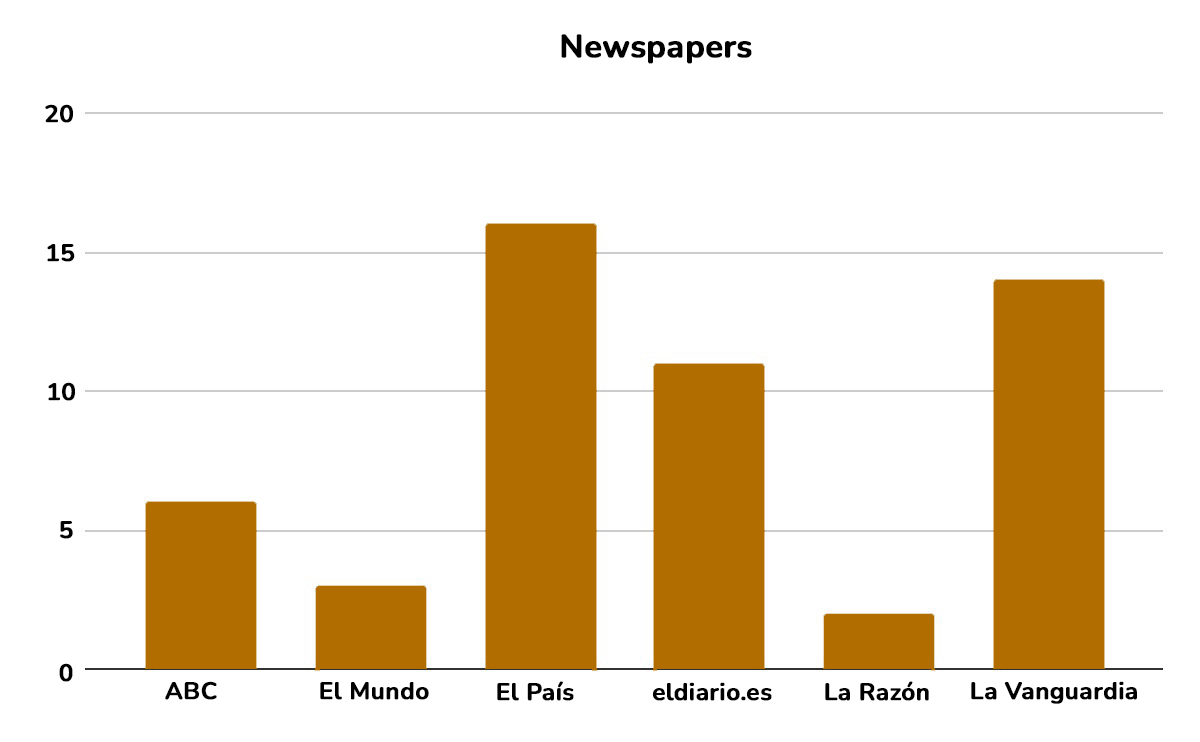
The data analysis was primarily conducted using a qualitative approach. Following an initial literature review, a preliminary codebook was developed and applied to a small subset of articles. This pilot phase enabled the identification of key categories for organizing the codes, with the most recurrent being: descriptions of migrants, causes of displacement, global context, responses to climate-related events, and sources of information. We also included a category called frames, which brings together the main themes around the different frames already established in the literature and other peculiarities of the Spanish case. Insights from this pilot phase informed refinements and expansions to the codebook, which was then applied to the full dataset in the software Atlas.ti. Additional codes that emerged inductively during coding were integrated through iterative discussion and consensus between the two researchers.
Once coding was complete, we identified the most frequent codes and those that consistently co-occurred, analyzing the resulting co-occurrence network to detect patterns and clusters. This quantitative overview provided an initial indication of recurring relationships among codes, which we then complemented with a reflective, interpretive analysis to explore how these clusters contributed to the construction of frames. The analysis combined both deductive and inductive strategies: while some dominant frames were pre-established on the basis of the literature, we remained attentive to emergent patterns in the Spanish press that could extend, nuance, or challenge existing categorizations. This dual approach allowed us to situate the Spanish media discourse within broader international debates on climate mobility, while also identifying its specific features and narrative tendencies.
Four frames were ultimately identified: a quantitative-alarmist frame, a securitization frame, a humanitarian frame, and a vulnerability frame. These frames were then analyzed in greater depth to explore how different representational strategies contribute to shaping public understandings of climate-induced migration, including the ways in which both people and spaces are discursively constructed.
5. Results
In this section, we first present a descriptive analysis of the frames, drawing on code frequencies and headline content. We then provide a detailed discussion of the main frames identified, organized by frequency.
5.1. Frame frequency and headline analysis
Our analysis identified four main frames in Spanish media coverage of climate mobility: vulnerability, quantitative-alarmist, humanitarian, and securitization. In table 2, first, we present the frequency of each frame across the entire corpus of articles, counting all instances in which any segment of news text referred to a particular frame. In this sense, codes could be repeated within the same article. Second, the number of articles in which a given frame appeared at least once, as multiple frames could co-occur within the same news article. This measure provides insight into the breadth of coverage and how widely each frame is represented across articles. And third, the frequency with which the frames are found in the headline, highlighting the frames that are most likely to shape readers’ initial impressions.
| Frequency in the general text | Number of news articles | Frequency in the headline | ||||
|---|---|---|---|---|---|---|
| Frames | Total number | % of total frame codes | Total number | % of total articles | Total number | % of total headlines |
| Vulnerability | 155 | 34.3% | 43 | 82.7% | 9 | 17.3% |
| Quantitative-alarmist | 147 | 32.5% | 39 | 75.2% | 32 | 61.5% |
| Humanitarian | 109 | 24.1% | 35 | 67.3% | 10 | 19.2% |
| Securitization | 41 | 9.1% | 20 | 38.4% | 1 | 1.9% |
Vulnerability emerges as the most frequent frame in our analysis, followed by the quantitative-alarmist, humanitarian, and securitization frames, both in terms of total repetitions and in the number of articles in which each frame appears at least once. However, the examination of headlines reveals a different pattern: the quantitative-alarmist frame appears more than three times as often as any other. Within this frame, headlines not only highlight specific figures, such as “1.1 million displaced in Latin America,” but also allude to numbers in more general terms, using expressions like “records” or “it will continue to increase.”
Although every headline contains an explicit reference to climate mobility, the article body does not always directly engage with climate change. For example, Article EP13 carries the headline “Deadly mistakes in the management of climate migration,” however, the body of the article focuses primarily on human rights violations and humanitarian crises in Global South countries bordering Europe and the United States. The last couple of paragraphs of the four pages article suggest that climate change may worsen existing crises in the Mediterranean and Central America.
Some headlines also rely on rhetorical or creative devices to attract attention. For example, EP15 refers to “climate refugees” to describe Madrid residents in low-income neighborhoods who seek relief from heatwaves in shopping malls. EM3 references the film You to London and I to California to humorously depict Spanish youth joking that they may have to move to Norway or Iceland to escape rising temperatures. LV2, by contrast, attempts to normalize climate-induced migration by invoking examples of climate-related mobility in the 7th century. Finally, ED8 highlights a documentary that “gives a face” to climate migrants, personalizing the issue through storytelling.
ABC (n=6) (% of total news items in the newspaper) | eldiario.es (n=11) (% of total news items in the newspaper) | El Mundo (n=3) (% of total news items in the newspaper) | El País (n=16) (% of total news items in the newspaper) | La Razón (n=2) (% of total news items in the newspaper) | La Vanguardia (n=14) (% of total news items in the newspaper) | |
|---|---|---|---|---|---|---|
| Vulnerability | 5 (83.3%) | 8 (72.7%) | 3 (100%) | 16 (100%) | 2 (100%) | 9 (64.2%) |
Quantitative- alarmist | 4 (66.6%) | 8 (72.7%) | 3 (100%) | 13 (81.2%) | 2 (100%) | 9 (64.2%) |
| Humanitarian | 4 (66.6%) | 6 (54.5%) | 1 (33.3%) | 16 (100%) | 2 (100%) | 6 (42.8%) |
| Securitization | 1 (16.6%) | 4 (36.3%) | 0 (0%) | 10 (62.5%) | 1 (50.0%) | 4 (28.5%) |
When examining the distribution of frames by newspaper in Table 3, some consistent patterns emerge despite differences in sample size across outlets. The vulnerability frame is the most frequently observed, appearing in a majority of articles in all newspapers, which suggests that discussions of exposure and socio-environmental risk are a common thread in Spanish media coverage, regardless of the outlet. The quantitative-alarmist frame is also widely represented. Only in the case of El País, the humanitarian frame surpasses the quantitative one.
5.2. Vulnerability frame
Vulnerability is presented in two related but differentiated forms: sociodemographic and geographic vulnerability.
Under sociodemographic vulnerability, at times, migrants are also referred to as victims. For instance, the headline “the migration crisis pushes more women to migrate” (ED9) frames women as being “pushed” into mobility. The same article later cites a project in southern Italy showing how immigrant women not only suffer the consequences of disasters in their countries of origin, such as walking long distances to reach school. However, these women also face gendered inequalities in host societies, where they are invited into the labor market while at the same time expected to undertake domestic care work. At the same time, while the sociodemographic vulnerabilities of people affected by climate change are highlighted, this frame also refers to migrants as agents. For example, article EP11 focuses on young Somali activists. The article cites an adolescent who wants to become a climate activist, as she states that as children they are “the first ones suffering the consequences of climate change” and that they are “paying for something that [they] haven’t created.”
Within the sociodemographic vulnerability frame, vulnerability is also often interpreted through a climate justice lens, emphasizing that those who contribute least to greenhouse gas emissions are most exposed to its consequences. For example, Article D42 quotes an expert highlighting that lower-income countries “face higher levels of risk and vulnerability to climate change despite contributing only minimally to greenhouse gas emissions.” The responsibility dimension of climate justice, however, is less prominent. One of the few exceptions is Article D32, which cites Oxfam to stress the responsibility of wealthier countries in addressing climate change.
Under geographic vulnerability, the articles tend to refer to places that are more vulnerable to the effects of climate change, i.e., small-island states such as Tuvalu, the dry corridor in Central America, the coast of South Asian regions, and African communities. These narratives often refer to slow-onset climatic events such as coastal erosion in West Africa or recurrent droughts in Honduras, which compound existing fragilities. Climate-related drivers of mobility are also frequently linked to other pressures, such as violent conflict in Ethiopia, Somalia, or Afghanistan. Geographic vulnerability is also the dominant frame when Spanish contexts are discussed. Several articles describe the Canary Islands as particularly exposed, with one citing a public official who warned that “the Canary Islands, as an insular territory, may be one of the first regions to lose the fight against climate change” (ED8).
5.3. Quantitative-Alarmist frame
There are three main trends that define this frame. First, it relies heavily on references to the future, particularly through projections framed in terms of millions of people. For instance, one article states, “in the future we are going to see millions or tens of millions more displaced people” (ED6). The year 2050 features heavily in the sample articles. The newspapers mention figures such as 200 million, 1200 million, or thousands of millions of migrants, often citing sources like the World Bank, United Nations High Commissioner for Refugees (UNHCR), Norman Meyers, and the Instituto para la Economía y la Paz.
Alongside this emphasis on large numbers, the articles tend to depict migrants as an ambiguous and homogenous mass, largely represented as fleeing a Global South in crisis toward a Global North represented as being under threat. Five articles, for instance, reference the projection of 143 million migrants by 2050 from Latin America, Sub-Saharan Africa, and Southeast Asia. When discussing the Global North, however, the focus shifts away from people and toward places. One article, for example, highlights the potential disappearance of 148 beaches in the Canary Islands.
Another recurring theme under this frame is the use of catastrophist metaphors such as “population bomb,” “escape from hell,” “an intolerable sea of people,” “the extreme climate and war kill people,” “the Pacific will devour that island.” Further, this frame showcases descriptions of extreme situations that underline urgency and imminent danger: “the desperate,” “population bomb,” “devoured,” “escape from hell,” “every hour, every day, every week, our lives are in danger” or “water wars.” In this context, there is a focus on extreme weather events as drivers of migration, such as hurricanes, cyclones, and floods. Such catastrophic framings are sometimes followed by explicit calls for action, as in one headline warning: “if we don’t act, the African crisis will be a problem for all soon” (EP10).
5.4. Humanitarian frame
The humanitarian frame is primarily characterized by the representation of migrants as victims deprived of agency, portrayed as forced to migrate, abandoned to their fate, or whose very survival depends on the assistance of others. “Victims/Passive agents” is the most prominent code used to describe migrants in this frame. For instance, in a news report about a documentary on “climate refugees,” the protagonists are described as “forced to abandon their homes and their culture [...] left at the mercy of neglect, blurred in the streets of big cities, and compelled to beg in order to survive” (ED8). Such representations often carry a strong emotional charge, drawing on accounts of pain, loss, and despair to elicit compassion. A striking example can be found in El País, which recounts the case of Fatima, who, “after losing several children to drought, embarked on a three-day journey in a cart pulled by emaciated donkeys until reaching a refugee camp” (EP8). At the same time, the passivity of affected populations is reinforced through expressions such as “[they are] waiting for their destiny” (A5) or “people arrive here with nothing, and many remain for months. But no one will leave because they have nowhere to go” (EP4).
Mentions of minors are frequent under the humanitarian frame, featuring children as malnourished, unprotected, or playing with improvised objects, for example, kicking cylindrical balls or yellow barrels with bare feet (EP8). Children are also depicted in circumstances in which they have to leave their schools and homes, serving as powerful symbols of innocence and suffering that heighten the emotional impact of the discourse. A report in El País includes the testimony of a displaced child in Somalia:
Many children cannot go to school, are forced to marry and have to work like adults. They move from place to place in search of food and water, which uproots them from their social network and prevents them from making friends to play with. They often have to abandon their toys, clothes and other belongings so that their families can carry water and food instead. (EP11)
Geographically, the humanitarian frame frequently centers on African countries, particularly Somalia, which is mentioned in 14 of the 52 articles analyzed, making it the most commonly referenced country. Within this frame, humanitarian aid is presented as the main solution, whether through international cooperation, financial assistance, or food distribution, as illustrated by UNICEF’s appeals regarding the devastating consequences for displaced children (EM2).
Finally, the humanitarian frame also relies on appeals to human rights and moral responsibility. In conservative media in particular, this approach is reinforced by invoking figures of moral authority, such as the Pope, to legitimize the call for solidarity.
5.5. Securitization frame
Within the securitization frame, climate-induced migration is primarily understood as a consequence of climate-induced conflicts and resource scarcity, which are portrayed as triggers of large-scale displacement. In 9 articles, climate conflicts and dwindling resources are directly linked to human mobility, often through alarmist headlines such as “The world is moving toward a water war” (EP5). These depictions foreground the destabilizing potential of climate pressures in countries of origin, which are then presented as generating migratory flows toward Europe.
Southern border states, as Spain, are often framed as vulnerable gateways for such movements. For example, one article from eldiario.es highlights the case of Mali: “Mali, a country embroiled in armed conflict that has caused thousands of people to flee to the Canary Islands in small boats and dinghies in recent years, suffered a severe drought in 2012. These examples help to explain why the Canary Islands have been the destination of hundreds of thousands of people in recent years” (ED6). Media coverage under the securitization frame frequently stresses the geopolitical dimension of these flows, warning that mass arrivals could generate “a major geopolitical crisis” or “test Europe’s moral character and political imagination.” Reception policies and security concerns, such as border externalisation and the role of Frontex, feature prominently in this frame, with Europe repeatedly identified as the primary threatened destination (cited eight times).
The Canary Islands, in particular, are framed as emblematic of this pressure: “The Canary Islands are a gateway to Europe, so the increase in climate refugees will undoubtedly put migratory pressure on a territory such as ours” (ED6). While this securitized outlook dominates, counter-voices also appear. For example, an article in La Vanguardia reports the opinions of several experts who stress the need for a more humanitarian approach, noting that “first world states persist in controlling migratory flows” (LV11). Similarly, mayors from the United States and Latin America, quoted in eldiario.es, argue that “the solution lies in investing in solidarity and inclusion, not in brutally stopping them” (ED4). These perspectives illustrate the tension between security-oriented framings and calls for more inclusive, rights-based approaches to climate mobility.
6. Discussion
The qualitative analysis of the newspaper articles reveals four main frames related to climate mobilities in Spain: vulnerability, quantitative-alarmist, humanitarian, and securitization. These frames present narratives not just about migrants as threats, victims, or adaptive agents (Rasan-Cooper et al., 2015), but also about spaces portrayed as being in crisis, situated within abstract temporalities, and requiring order and control (Baldwin, 2016; Bettini, 2013). Our study confirms previous research on climate mobility discourses in the Spanish press (Prieto-Andrés et al., 2025), e.g. by showing the predominance of vulnerability and quantitative/alarmist narratives, with a marginal presence of the securitization discourse. Additionally, our study adds an explicit political ecology lens that distinguishes how narratives construct both people and spaces, showing how alarmist and humanitarian framings not only shape perceptions of migrants but also produce imaginaries of territories as threatened, unstable, or in need of control. Further, we argue that all of the identified frames, especially the last three (quantitativist/alarmist, humanitarian, and securitization), have the potential to obscure structural drivers of climate mobility. In doing so, they contribute to justifying top-down solutions, including border militarization. Importantly, the intensity and focus of these portrayals vary across frames, offering different levels of visibility, agency, and meaning to both people and places.
The securitization frame most explicitly constructs migrants as threats to spatial stability, particularly that of the Global North. Security risk and risk of conflict are issues emerging as significant in the Global North (Bevitori & Johnson, 2022). Within this framing, space is often depicted in almost apocalyptic terms, as a future landscape of disorder and destabilization. These arguments are often amplified by projections forecasting vast numbers of displaced people, but such projections should be interpreted with caution. As Beyer and Milan (2023) note, although most models developed since the late 2000s broadly support the idea that climate-related effects influence global human mobility, there is still no consensus on the quantitative impact of environmental factors on migration flows. On the other hand, the Global South is portrayed as endangered by climate change, while the Global North appears primarily through the lens of chaotic borders in need of protection. By foregrounding geopolitical risks and crisis logics, whether through the threat of climate change in the South or the pressure of borders in the North, this frame guides audiences toward interpreting climate-induced migration primarily as a security challenge rather than a multidimensional social and political phenomenon.
While the securitization frame is the least frequent in the analyzed text, the alarmist frame engages in othering practices that can depict migration as something to be contained or managed. As several authors claim, alarmist and quantitative frames abstract migrants into numbers, “waves,” or unspecified future beings, creating a depersonalized image that facilitates fear and a sense of urgency (Bettini, 2013) and contributes to “a process of depersonalisation that facilitates “othering” by obscuring individual experiences and humanity” (Giacomelli & Cappi, 2025, p. 3344). In this regard, the fact that the legal context of the concept of climate refugees is presented in the media in a distorted manner and without a clear legal distinction between refugees, displaced persons and migrants (Jiménez-Gómez et al., 2025), may contribute to the depersonalization of potential climate-induced migrants. At the same time, experts and policymakers are depicted as detached managers of climate risk, legitimizing top-down and technocratic solutions. This echoes trends in European borders, for example, in the West-African EU border, “stakeholders have embarked on a ‘war on numbers’: migration is quantified, estimated, categorized, and mapped” (Vives, 2023, p. 212). These representations are tied to space through the concept of the border as a differentiating barrier, sustaining a negative narrative around the image of the “other.” Thus, the spaces climate migrants inhabit, traverse, or arrive at are repeatedly depicted as under threat. In this way, these frames securitize the spaces while simultaneously abstracting the people who move through them. Migrants themselves are often not presented as direct threats, as Prieto-Andrés et al. (2025) argue, but their movement renders spaces “at risk,” highlighting how securitization focuses on territory rather than individuals.
The humanitarian frame aligns with the “migrant as a victim frame” identified in previous literature (Baldwin, 2013; Mayrhofer, 2020), in which migrants are primarily understood in terms of vulnerability and the absence of rights protections. However, unlike the traditional victim frame, the humanitarian framing observed in Spanish media extends beyond portraying migrants as passive victims. We use the notion of a humanitarian frame precisely because it is not limited to highlighting individual suffering but situates migration within a broader drama of human crisis, compassion, and even paternalism. This drama is powerfully conveyed through the focus on children whose suffering elicits empathy and moral responsibility. Many narratives also evoke images of women forced to leave their homes, carrying children and dragging belongings, reinforcing the feminization of vulnerability in the context of climate mobility. This is consistent with other research that argues that migrant children and women are the main faces of victimisation (Amores & Arcila, 2019; Holzberg et al., 2018). The impact lies in the rawness and emotional intensity of these portrayals, which go beyond depicting migrants as mere passive victims to constructing a broader humanitarian narrative strongly shaped by compassion, moral duty, and intervention. Humanitarianism, in this sense, relies on individual sensibilities shaped by notions of who is deemed deserving of compassion in terms of ethnicity and gender (Ticktin, 2015). From the perspective of political ecology, we argue that responses centered on human suffering, drama, and paternalism toward communities affected by climate-related disasters risk displacing debates on structural responsibilities and environmental justice, thereby reproducing hierarchies over who is considered worthy of protection and who remains excluded from ecological policy agendas. In addition, these narratives emphasize not only the individuals affected but also the contexts in which they live and move, spaces marked by crisis, scarcity, or environmental degradation. As such, the space in the Global South is depicted as chaotic, requiring assistance from the Global North.
Compared to the humanitarian frame, the vulnerability frame does not primarily depict migrants as powerless. While this frame highlights socio-demographic and geographic vulnerabilities across different contexts, it also acknowledges agency. As Giacomelli and Cappi (2025, p. 3354) argue, “vulnerability of climate change should not be considered opposite to agency per se.” The vulnerability frame, therefore, offers a more balanced portrayal of people affected by climate change, presenting them as vulnerable and agentic. More importantly, this frame draws attention to the structural drivers of climate mobility by referencing socioeconomic conditions such as poverty, violent conflict, and gender inequalities. Climate justice narratives are also present, emphasizing that those who have contributed least to climate change often suffer its most severe impacts. Both the emphasise of structural factors and the recognition of unequal responsibility for climate change align with the International Organization for Migration (IOM)’s interpretation in its Climate Mobility Road Map. Communities living in fragile and conflict-affected settings, despite contributing the least to the problem, experience some of the most severe consequences of climate change. In such contexts, climate impacts and risks intensify existing vulnerabilities, deepen social and economic inequalities, and contribute to displacement and food insecurity (IOM, 2024). These narratives highlight how migrants are exposed to vulnerabilities not only in their countries of origin but also in host societies. For example, women affected by climate change in their home countries are shown to face the “second shift” in receiving communities (Hochschild & Machung, 2012). The vulnerability frame also encompasses a broader spectrum of climatic threats. It refers to sudden-onset disasters such as floods, but also to slow-onset processes, including coastal erosion. Geographic vulnerability is particularly detailed, with references to specific spaces. These include communities in West Africa or Myanmar, where climate risks intersect with violent conflict, as well as regions in the Global North, such as the Canary Islands or urban spaces in Spain, where coastal erosion and heat waves are presented as significant exposures to climate change.
In line with framing theory (Entman, 1993; Goffman, 1974), each frame foregrounds certain aspects of climate mobility while obscuring others, with important implications when examined through a Political Ecology lens. The securitization frame highlights migrants as threats to stability; the alarmist and quantitative frames abstract them into numbers or faceless flows; and the humanitarian frame emphasizes suffering, vulnerability, and dependence on external aid. While the humanitarian frame can foster empathy and calls to action, it also carries the risk of reducing migrants to passive victims, thereby reproducing some of the limitations noted in previous research (Bettini, 2013; Methmann, 2014). Importantly, these three frames obscure dimensions such as agency, resilience, and the structural drivers of climate-induced migration. In contrast, the vulnerability frame provides a more nuanced account by identifying specific exposures to climate change alongside socio-demographic risks. It also emphasizes the climate injustice dimension, pointing to the mismatch between communities’ low contribution to climate change and their high exposure to its impacts. Yet even here, the responsibilities of the Global North remain underdeveloped.
Moreover, across all four frames, there is a tendency to overlook how border regimes and security institutions actively militarize migration, including climate mobility. This omission is particularly striking given how international security agendas increasingly frame migration and climate change as a threat. For example, at the 2022 North Atlantic Treaty Organization (NATO) summit in Madrid, migration was explicitly categorized as a form of “hybrid threat” and climate change was acknowledged as a “threat multiplier” (NATO, 2022). In this summit, a report was presented that expressed concern around migration linked to the instability in the Middle East and North Africa region, citing climate change as one of the sources of this instability (Gutiérrez, 2022). In this way, climate mobility becomes entangled in a broader security logic, reinforcing representations of migration as destabilizing rather than as a complex social and political process. This dynamic resonates with Kothari’s (2014) argument that climate change discourses are not neutral but constitutive of unequal power relations: by strategically invoking particular narratives, powerful actors shape shared meanings and legitimate interventions that primarily serve their own geopolitical interests.
7. Conclusions, limitations and future research
These results underscore that media discourses on climate mobility simultaneously construct both people and spaces. Media representations frequently portray people affected by climate mobility either as passive victims in need of protection or as abstract figures, such as numbers or “waves,” which can obscure their individual experiences and agency. The frames analyzed also depict spaces as “in crisis” or “under threat,” highlighting that vulnerability and risk are not solely individual but also spatially and socially produced. By emphasizing crisis, disorder, and risk, these frames reinforce border control policies and technocratic management of mobility, legitimizing top-down interventions rather than addressing the structural drivers of climate-induced migration. Even the vulnerability frame pays limited attention to the responsibilities of the Global North, leaving critical dimensions of environmental justice and the redistribution of accountability largely unacknowledged. From a political ecology perspective, such framings reinforce power asymmetries between the Global North and South, normalize paternalistic or securitized interventions, and limit the visibility of alternative narratives centered on resilience, justice, and collective responsibility.
This study has several limitations, which also suggest avenues for future research. First, the analysis is constrained by the terminology used in the Spanish media: while we focused on words such as migrants, refugees, or displacement, many articles address related phenomena without explicitly using these terms. As a result, some relevant cases may have been excluded. Future studies could address these limitations by broadening search strategies to include alternative terms and related concepts that capture how climate-induced migration is articulated in the press. Second, the research is limited to a restricted time period, chosen to capture contemporary debates. Although this approach allowed us to analyze current framings, extending the temporal scope would be necessary to assess whether media narratives have shifted over time. Additionally, future research could examine public perceptions of these media frames, for example, through surveys or interviews, to understand how audiences interpret the representations of climate mobility. Finally, by concentrating on national-level coverage, the analysis may have overlooked more localized perspectives, which can highlight geographically specific vulnerabilities, infrastructural issues, or questions of justice in ways national outlets often underplay. Building on previous scholarship (Roosvall et al., 2020), it would be important to compare national newspapers with local outlets, which often provide more community-centered and justice-oriented narratives.
Acknowledgements
The authors would like to thank fellow researchers for their insightful comments on this project during its presentation in talks and workshops. This paper is part of the grant JDC2022-048239-I and JDC2022-049903-I, funded by MICIU/AEI/10.13039/501100011033 and by the European Union NextGenerationEU/PRTR. This paper is also part of the project TRACHMED supported by HORIZON-MSCA2023-SE-01 (GA: 101182876). It also benefited from the support of the research centers at the University of Huelva “Estudios Sociales E Intervención Social, ESEIS” and “Pensamiento Contemporáneo e Innovación para el Desarrollo Social, COIDESO.”
References
Adger, W. N., Benjaminsen, T. A., Brown, K., & Svarstad, H. (2001). Advancing a Political Ecology of Global Environmental Discourses. Development and Change, 32(4), 681-715. https://doi.org/10.1111/1467-7660.00222
Amores, J. J., & Arcila, C. (2019). Deconstructing the symbolic visual frames of refugees and migrants in the main Western European media [Paper]. Seventh International Conference on Technological Ecosystems for Enhancing Multiculturality, University of Salamanca. https://doi.org/10.1145/3362789.3362896
Arnall, A., & Kothari, U. (2015). Challenging climate change and migration discourse: Different understandings of timescale and temporality in the Maldives. Global Environmental Change, 31, 199-206. https://doi.org/10.1016/j.gloenvcha.2015.01.011
Ayeb-Karlsson, S., Baldwin, A. W., & Kniveton, D. (2022). Who is the climate-induced trapped figure? WIREs Climate Change, 13(6), 803. https://doi.org/10.1002/wcc.803
Baird, R., Migiro, K., Nutt, D., Kwatra, A., Wilson, S., Melby, J., Pendleton, A., Rodgers, M., & Davison, J. (2007). Human Tide: The Real Migration Crisis Informe (Report). Christian Aid. https://documentation.lastradainternational.org/lsidocs/christian_07_human_crisis_0109.pdf
Baldwin, A. (2013). Racialisation and the Figure of the Climate-Change Migrant. Environment and Planning A: Economy and Space, 45(6), 1474-1490. https://doi.org/10.1068/a45388
Baldwin, A. (2016). Premediation and white affect: Climate change and migration in critical perspective. Transactions of the Institute of British Geographers, 41(1), 78-90. https://doi.org/10.1111/tran.12106
Baldwin, A., Methmann, C., & Rothe, D. (2014). Securitizing ‘climate refugees’: The futurology of climate-induced migration. Critical Studies on Security, 2(2), 121-130. https://doi.org/10.1080/21624887.2014.943570
Bettini, G. (2013). Climate Barbarians at the Gate? A critique of apocalyptic narratives on ‘climate refugees’. Geoforum, 45, 63-72. https://doi.org/10.1016/j.geoforum.2012.09.009
Bettini, G. (2014). Climate migration as an adaption strategy: De-securitizing climate-induced migration or making the unruly governable? Critical Studies on Security, 2(2), 180-195. https://doi.org/10.1080/21624887.2014.909225
Bettini, G., Nash, S. L., & Gioli, G. (2017). One step forward, two steps back? The fading contours of (in)justice in competing discourses on climate migration. The Geographical Journal, 183(4), 348-358. https://doi.org/10.1111/geoj.12192
Bevitori, C., & Johnson, J. H. (2022). Risk and resilience in a changing climate: A diachronic analysis in the press across the globe. Text & Talk, 42(4), 547-569. https://doi.org/10.1515/text-2020-0076
Beyer, R., & Milan, A. (2023). Climate Change and Human Mobility: Quantitative evidence on global historical trends and future projections. International Organization for Migration. https://bit.ly/4fMBCN4
Boas, I., de Pater, N., & Furlong, B. T. (2023). Moving beyond stereotypes: The role of gender in the environmental change and human mobility nexus. Climate and Development, 15(1), 1-9. https://doi.org/10.1080/17565529.2022.2032565
Boas, I., & Wiegel, H. (2021). Climate migration between conflictive discourses and empirical realities. In E. Carmel, K. Lenner & R. Paul (eds.), Handbook on the Governance and Politics of Migration (pp. 86-97). Edward Elgar Publishing. https://doi.org/10.4337/9781788117234.00013
Bonneux, I., & Van Praag, L. (2024). Millions of climate refugees are coming!’ A critical media discourse analysis on climate change-induced migrants in Flemish press. Environmental Sociology, 10(4), 486-498. https://doi.org/10.1080/23251042.2024.2369738
Bryant, R. L. (1997). Beyond the impasse: The power of political ecology in Third World environmental research. Area, 29(1), 5-19. https://doi.org/10.1111/j.1475-4762.1997.tb00003.x
Cardenal, A. S., Galais, C., Moré, J., Cristancho, C., & Majó-Vázquez, S. (2018). El reto de medir el sesgo ideológico en los medios escritos digitales. Quaderns del CAC, 44(21), 37-46.
Casas-Cortes, M., Cobarrubias, S., & Pickles, J. (2013). Re-bordering the neighbourhood: Europe’s emerging geographies of non-accession integration. European Urban and Regional Studies, 20(1), 37-58. https://doi.org/10.1177/0969776411434848
Centro de Investigaciones Sociológicas. (2023). Estudio sobre audiencias de medios de comunicación social. https://www.cis.es/documents/d/guest/es3421mar-pdf
Dreher, T., & Voyer, M. (2015). Climate Refugees or Migrants? Contesting Media Frames on Climate Justice in the Pacific. Environmental Communication, 9(1), 58-76. https://doi.org/10.1080/17524032.2014.932818
European Environment Agency. (2024). European Climate Risk Assessment. https://www.eea.europa.eu/en/analysis/publications/european-climate-risk-assessment
Entman, R. M. (1993). Framing: Toward Clarification of a Fractured Paradigm. Journal of Communication, 43(4), 51-58. https://doi.org/10.1111/j.1460-2466.1993.tb01304.x
Eurotropics. (2023, August). Spain: Digitalisation, diversification, politicisation. Eurotopics.Net. https://www.eurotopics.net/en/149427/spain-digitalisation-diversification-politicisation
Fajardo Fernández, R., & Soriano Miras, R. (2017). La construcción mediática de la migración en el Mediterráneo: ¿nociudadanía en la prensa española? RIEM - Revista Internacional de Estudios Migratorios, 6(1), 141-169. https://doi.org/10.25115/riem.v6i1.419
Farbotko, C. (2005). Tuvalu and climate change: Constructions of environmental displacement in the sydney morning herald. Geografiska Annaler: Series B, Human Geography, 87(4), 279-293. https://doi.org/10.1111/j.0435-3684.2005.00199.x
Felli, R. (2013). Managing Climate Insecurity by Ensuring Continuous Capital Accumulation: ‘Climate Refugees’ and ‘Climate Migrants’. New Political Economy, 18(3), 337-363. https://doi.org/10.1080/13563467.2012.687716
Fotopoulos, S., & Kaimaklioti, M. (2016). Media Discourse on the Refugee Crisis: On what have the Greek. German and British Press Focused? European View, 15(2), 265-279. https://doi.org/10.1007/s12290-016-0407-5
Georgiou, M., & Zaborowski, R. (2017). Media coverage of the “refugee crisis”: A cross-European perspective (Council of Europe report DG1(2017)03). Council of Europe. https://rm.coe.int/1680706b00
Giacomelli, E. (2023). Panicocene. Narrazioni su cambiamenti climatici, regimi di mobilità e migrazioni ambientali. FrancoAngeli. https://series.francoangeli.it/index.php/oa/catalog/book/977
Giacomelli, E., & Cappi, V. (2025). ‘Othering’ in the Panicocene: Intergovernmental and non-governmental awareness campaigns on climate change induced-migration. Journal of Ethnic and Migration Studies, 51(13), 3341-3359. https://doi.org/10.1080/1369183X.2025.2468287
Goffman, E. (1974). Frame analysis: An essay on the organization of experience. Harvard University Press.
Gutiérrez, F. (2022). Shared migration challenges: The transatlantic community and the MENA region (Report). NATO Parliamentary Assembly. https://www.nato-pa.int/download-file?filename=/sites/default/files/2023-02/026%20GSM%2022%20E%20rev.%202%20fin%20-%20SHARED%20MIGRATION%20-%20GUTIERREZ.pdf
Hochschild, A. R., & Machung, A. (2012). The second shift: Working families and the revolution. Penguin Books.
Høeg, E., & Tulloch, C. D. (2019). Sinking Strangers: Media Representations of Climate Refugees on the BBC and Al Jazeera. Journal of Communication Inquiry, 43(3), 225-248. https://doi.org/10.1177/0196859918809486
Hoffmann, R., Vinke, K., & Šedová, B. (2023). Strengthening the science–policy interface in the climate migration field. International Migration, 61(5), 75-97. https://doi.org/10.1111/imig.13125
Holzberg, B., Kolbe, K., & Zaborowski, R. (2018). Figures of Crisis: The Delineation of (Un)Deserving Refugees in the German Media. Sociology, 52(3), 534-550. https://doi.org/10.1177/0038038518759460
International Organization for Migration. (2024). Climate Mobility Road Map. IOM MECC 2021-2030 Strategy. https://environmentalmigration.iom.int/sites/g/files/tmzbdl1411/files/documents/2024-06/climate-mobility-road-map-final.pdf
Jiménez-Gómez, I., Martín-Sosa, S., Villaseñor Goyzueta, A., & Garcés Prieto, J. (2025). La paradoja mediática del refugiado climático: diez años de migración climática en la prensa en español. Cuadernos.Info, 61, 94-116. https://doi.org/10.7764/cdi.61.87178
Joseph, J. (2013). Resilience as embedded neoliberalism: A governmentality approach. Resilience, 1(1), 38-52. https://doi.org/10.1080/21693293.2013.765741
Keeping, T., García García, D., Trigo, R., Santos, F. L., Barnes, C., Vahlberg, M., Meyer, R., & Otto, F. (2025). Extreme fire weather conditions in Spain and Portugal now common due to climate change (Report). Imperial College London. https://doi.org/10.25560/123547
Kirkwood, S. (2017). The Humanisation of Refugees: A Discourse Analysis of UK Parliamentary Debates on the European Refugee ‘Crisis’. Journal of Community & Applied Social Psychology, 27(2), 115-125. https://doi.org/10.1002/casp.2298
Kothari, U. (2014). Political discourses of climate change and migration: Resettlement policies in the Maldives. The Geographical Journal, 180(2), 130-140. https://doi.org/10.1111/geoj.12032
Kovář, J. (2020). A security threat or an economic consequence? An analysis of the news framing of the European Union’s refugee crisis. International Communication Gazette, 82(6), 564-587. https://doi.org/10.1177/1748048519832778
Mayrhofer, M. (2020). Victims, Security Threats or Agents? – Framing Climate Change-related Mobility in International Human Rights Documents. International Journal of Law, Language & Discourse, 8(2), 9-33.
Mazzara, B. M., Avdi, E., Kadianaki, I., Koutri, I., Lancia, F., Mannarini, T., Mylona, A., Pop, A., Rochira, A., Redd, R. E., Sammut, G., Suerdem, A., Veltri, G. A., Verbena, S., & Salvatore, S. (2021). The Representation of Immigration. A Retrospective Newspaper Analysis. Journal of Immigrant & Refugee Studies, 19(4), 436-455. https://doi.org/10.1080/15562948.2020.1836299
Methmann, C. (2014). Visualizing Climate-Refugees: Race, Vulnerability, and Resilience in Global Liberal Politics. International Political Sociology, 8(4), 416-435. https://doi.org/10.1111/ips.12071
Methmann, C., & Oels, A. (2015). From ‘fearing’ to ‘empowering’ climate refugees: Governing climate-induced migration in the name of resilience. Security Dialogue, 46(1), 51-68. https://doi.org/10.1177/0967010614552548
Nash, S. L. (2024). Climate Protection for Migration Prevention: Comparison of Policy Discourses on Climate Change and Migration in Austria, Germany, Denmark, and Sweden. Journal of Comparative Policy Analysis: Research and Practice, 26(3-4), 1-29. https://doi.org/10.1080/13876988.2024.2304835
North Atlantic Treaty Organization. (2022). Madrid Summit Declaration issued by NATO Heads of State and Government (2022). https://www.nato.int/cps/en/natohq/official_texts_196951.htm
Ng, Y.-L., & Zhao, X. (2020). The Human Alarm System for Sensational News, Online News Headlines, and Associated Generic Digital Footprints: A Uses and Gratifications Approach. Communication Research, 47(2), 251-275. https://doi.org/10.1177/0093650218793739
Nickl, P., Moussaïd, M., & Lorenz-Spreen, P. (2025). The evolution of online news headlines. Humanities and Social Sciences Communications, 12(1), 364. https://doi.org/10.1057/s41599-025-04514-7
Prieto-Andrés, A., Fernández-Romero, C., & Aguareles, M. (2025). The portrayal in the Spanish press of migration caused by climate change: A moral framework analysis. Frontiers in Communication, 10, 1546804. https://doi.org/10.3389/fcomm.2025.1546804
Ramos Ruiz, Á., & Ramos Ruiz, I. (2022). El sesgo ideológico en el discurso político de la prensa española: la reforma constitucional de 2011. Círculo de Lingüística Aplicada a la Comunicación, 89, 171-182. https://doi.org/10.5209/clac.70743
Ransan-Cooper, H., Farbotko, C., McNamara, K. E., Thornton, F., & Chevalier, E. (2015). Being(s) framed: The means and ends of framing environmental migrants. Global Environmental Change, 35, 106-115. https://doi.org/10.1016/j.gloenvcha.2015.07.013
Roosvall, A., Tegelberg, M., & Enghel, F. (2020). Media and Climate Migration: Transnational and Local Reporting on Vulnerable Island Communities. In J. Matthews & E. Thorsen (eds.), Media, Journalism and Disaster Communities (pp. 83-98). Springer International Publishing. https://doi.org/10.1007/978-3-030-33712-4_6
Ross, A. S., & Rivers, D. J. (2019). Internet Memes, Media Frames, and the Conflicting Logics of Climate Change Discourse. Environmental Communication, 13(7), 975-994. https://doi.org/10.1080/17524032.2018.1560347
Sakellari, M. (2021). Climate change and migration in the UK news media: How the story is told. International Communication Gazette, 83(1), 63-80. https://doi.org/10.1177/1748048519883518
Sakellari, M. (2022). Media coverage of climate change induced migration: Implications for meaningful media discourse. Global Media and Communication, 18(1), 67-89. https://doi.org/10.1177/17427665211064974
Sheller, M. (2018). Theorising mobility justice. Tempo Social, 30(2), 17-34. https://doi.org/10.11606/0103-2070.ts.2018.142763
Solman, P., & Henderson, L. (2019). Flood disasters in the United Kingdom and India: A critical discourse analysis of media reporting. Journalism, 20(12), 1648-1664. https://doi.org/10.1177/1464884918762363
Stern, N. (2006). Stern Review: The economics of climate change. HM Treasury.
Stock, P. V. (2007). Katrina and Anarchy: A Content Analysis of a New Disaster Myth. Sociological Spectrum, 27(6), 705-726. https://doi.org/10.1080/02732170701534218
Sultana, F. (2022). Critical climate justice. The Geographical Journal, 188(1), 118-124. https://doi.org/10.1111/geoj.12417
Svarstad, H., & Benjaminsen, T. A. (2024). Political ecology and the power of sociology. In C. Overdest (ed.), Political ecology and the power of sociology (pp. 447-453). Elgaronline.
Ticktin, M. (2015). Los problemas de las fronteras humanitarias. Disparidades. Revista de Antropología, 70(2), 291-297. https://doi.org/10.3989/rdtp.2015.02.001.03
Tuel, A., & Eltahir, E. a B. (2020). Why Is the Mediterranean a Climate Change Hot Spot? Journal of Climate, 33(14), 5829-5843. https://doi.org/10.1175/JCLI-D-19-0910.1
Vinke, K., Bergmann, J., Blocher, J., Upadhyay, H., & Hoffmann, R. (2020). Migration as Adaptation? Migration Studies, 8(4), 626-634. https://doi.org/10.1093/migration/mnaa029
Vives, L. (2023). Death at Sea: Dismantling the Spanish Search and Rescue System. Geopolitics, 28(2), 641-666. https://doi.org/10.1080/14650045.2021.1973438
Wiegel, H., Boas, I., & Warner, J. (2019). A mobilities perspective on migration in the context of environmental change. WIREs Climate Change, 10(6), e610. https://doi.org/10.1002/wcc.610
Xu, Z., Laffidy, M., & Ellis, L. (2023). Clickbait for climate change: Comparing emotions in headlines and full-texts and their engagement. Information, Communication & Society, 26(10), 1915-1932. https://doi.org/10.1080/1369118X.2022.2050416
Appedix A. Newspaper articles included in the study
| Code | Newspaper | Date | Title |
|---|---|---|---|
| A1 | ABC | 11/11/2023 | Australia acogerá a toda la población de Tuvalu antes de que el archipiélago se hunda |
| A2 | ABC | 10/6/2023 | Unicef alerta que 20.000 menores son desplazados cada día por el cambio climático |
| A3 | ABC | 8/3/2023 | ¿Quiénes son los refugiados climáticos y por qué viven en un limbo legal? |
| A4 | ABC | 4/23/2023 | Otra vez en África |
| A5 | ABC | 10/27/2021 | El Papa recibe a Biden con inquietud por el cambio climático, los refugiados y el rearme |
| A5 | ABC | 3/30/2021 | El Papa advierte que “el número enorme de desplazados climáticos es una gran emergencia de nuestra época” |
| EM1 | El Mundo | 11/17/2023 | ¡Nos estamos hundiendo!: Australia acogerá a los refugiados climáticos de Tuvalu |
| EM2 | El Mundo | 10/6/2023 | Unicef alerta de que más de 43 millones de niños se han convertido en desplazados entre 2016 y 2021 por catástrofes del cambio climático |
| EM3 | El Mundo | 7/24/2022 | Tú a Noruega y yo a Canadá: El futuro que vivirán los “climigrantes” |
| EP1 | El País | 12/17/2023 | La colonia Sinaí, un refugio para los desplazados climáticos en Honduras |
| EP2 | El País | 12/5/2023 | Un laboratorio contra la sequía en Honduras |
| EP3 | El País | 11/22/2023 | América Latina tiene más de 1,1 millones de desplazados climáticos |
| EP4 | El País | 10/29/2023 | Asolado por el calentamiento global y los conflictos armados, Somalia cuenta con tres millones de desplazados por la sequía. Es un claro ejemplo... |
| EP5 | El País | 5/14/2023 | El mundo avanza hacia la guerra del agua |
| EP6 | El País | 4/7/2023 | Colombia prepara la primera ley sobre desplazamiento climático en América Latina |
| EP7 | El País | 3/24/2023 | António Vitorino: Cada vez más migrantes se desplazan por el cambio climático |
| EP8 | El País | 2/6/2023 | El clima extremo y la guerra matan de hambre a Somalia |
| EP9 | El País | 1/25/2023 | Las migraciones como forma de adaptación al cambio climático |
| EP10 | El País | 10/19/2022 | El cambio climático ya empeora la salud y las migraciones en África |
| EP11 | El País | 9/26/2022 | Tres adolescentes alertan al mundo desde el campo de refugiados climáticos más grande de Somalia |
| EP12 | El País | 7/19/2022 | Migrantes ambientales: el rostro humano del cambio climático en América del Sur |
| EP13 | El País | 11/28/2021 | Errores mortales en la gestión de las migraciones climáticas |
| EP14 | El País | 11/4/2021 | Migración climática, la gran ausente de la COP26 |
| EP15 | El País | 8/12/2021 | Refugiados climáticos en el centro comercial: Tenemos... |
| EP16 | El País | 6/17/2021 | Los desastres naturales causan el triple de desplazados que la violencia o los conflictos |
| ED1 | eldiario.es | 10/25/2023 | Somos quizás los primeros, pero no los últimos desplazados climáticos en México |
| ED2 | eldiario.es | 6/19/2023 | Migrar por calor, fumar o no tener hijos: cuando las decisiones vitales se toman mirando al futuro climático |
| ED3 | eldiario.es | 6/17/2023 | Desplazados climáticos, a refugio en los mismos países que amenazan sus vidas |
| ED4 | eldiario.es | 6/7/2022 | Alcaldes debaten sobre migración y cambio climático en la Cumbre de las Américas |
| ED5 | eldiario.es | 5/30/2022 | El cambio climático en Canarias: pérdidas de cuatro millones de euros al año y desplazamiento forzado de 5.000 personas |
| ED6 | eldiario.es | 10/29/2021 | Los desplazados climáticos podrían sumar miles de millones en 2050 |
| ED7 | eldiario.es | 9/17/2021 | El cambio climático multiplicará por seis las migraciones a Canarias, según el consejero de Transición Ecológica del Gobierno regional |
| ED8 | eldiario.es | 9/16/2021 | Inundaciones, huracanes y sequía: el cineasta tinerfeño David Baute presenta un documental que pone rostro a los refugiados climáticos |
| ED9 | eldiario.es | 7/25/2021 | La crisis climática empuja a más mujeres a migrar |
| ED10 | eldiario.es | 3/30/2021 | El papa pide respuestas globales ante el drama de los desplazados climáticos |
| ED11 | eldiario.es | 1/18/2021 | Los desplazados climáticos, envueltos en un vacío legal ante la próxima emigración masiva por un fenómeno irreversible |
| LR1 | La Razón | 5/9/2021 | Obligados a abandonar sus hogares por el clima |
| LR2 | La Razón | 2/5/2021 | El cambio climático amenaza con desplazar a 140 millones de personas |
| LV1 | La Vanguardia | 12/15/2023 | La IA demuestra que el nivel socioeconómico condiciona las migraciones por catástrofes ambientales |
| LV2 | La Vanguardia | 10/22/2023 | Las migraciones climáticas crecen ahora, pero han sido constantes en la historia: una de ellas afectó a la Península en el siglo VIII |
| LV3 | La Vanguardia | 10/10/2023 | El CES vaticina que el vínculo entre cambio climático migraciones irá en aumento |
| LV4 | La Vanguardia | 10/6/2023 | Cuba y Honduras, países con más niñez desplazada por eventos climáticos en América Latina |
| LV5 | La Vanguardia | 9/4/2023 | Los niños desplazados internos por causa del clima en África subsahariana se duplican en 2022, hasta los 1,85 millones |
| LV6 | La Vanguardia | 5/4/2023 | El cambio climático provoca ya movimientos migratorios, sobre todo en África |
| LV7 | La Vanguardia | 1/28/2023 | El defensor de los refugiados climáticos |
| LV8 | La Vanguardia | 1/26/2023 | La emergencia climática provoca la migración de miles de jóvenes etíopes |
| LV9 | La Vanguardia | 11/3/2022 | Europa se calienta 0,5ºC por década, más del doble de la media mundial |
| LV10 | La Vanguardia | 7/20/2022 | El cambio climático golpea medios de vida e impulsa a migrar en Centroamérica |
| LV11 | La Vanguardia | 7/5/2022 | La globalización y el cambio climático intensifican las tendencias migratorias, señalan en UNIR expertos en la materia |
| LV12 | La Vanguardia | 6/24/2022 | Relator ONU: el cambio climático causa ya más desplazados que los conflictos |
| LV13 | La Vanguardia | 6/11/2021 | Las migraciones por causas climáticas se disparan a niveles récord |
| LV14 | La Vanguardia | 1/27/2021 | El cambio climático influye en la migración de hondureños, alerta ONG Oxfam |