Desigualdades na mobilidade acadêmica internacional de brasileiros (2012-2022): uma análise de dados das agências federais de fomento à ciência (Capes e CNPq)



Driven in Brazil by the internationalization of graduate education, the international academic mobility of Brazilians has been promoted since the 1960s and is currently implemented mainly at the federal level by the Ministries of Education and of Science, Technology and Innovation, through Capes and CNPq. This study investigates—within the broader context of graduate internationalization and international “brain circulation”—the dynamics and profile of Brazilian academic mobility over the past decade, with particular attention to social inequalities. Drawing on public quantitative data, we analyze how academic mobility patterns intersect with categories such as race, gender, and geopolitical destination. Between 2012 and 2022, approximately 64,000 Brazilians received government support to conduct academic research abroad. Most of these scholars were hosted by institutions in Global North countries, highlighting persistent asymmetries in the international academic system. Although distribution of scholarships between men and women is relatively balanced, gender disparities remain across specific fields of knowledge. Racial inequalities are more pronounced: the majority of scholarships were awarded to white individuals, revealing limited racial diversity among beneficiaries. These findings suggest that, despite efforts to democratize access to international academic opportunities, structural barriers related to race and global hierarchies continue to shape who benefits from state-sponsored mobility programs in Brazil and their destinations abroad.
Impulsionada no Brasil pela internacionalização da pós-graduação, a mobilidade acadêmica internacional de brasileiros vem sendo promovida desde a década de 1960 e atualmente é implementada, principalmente, em nível federal, pelos Ministérios da Educação e da Ciência, Tecnologia e Inovação, por meio da Capes e do CNPq. Este estudo investiga—no contexto mais amplo da internacionalização da pós-graduação e da “circulação de cérebros” internacional—as dinâmicas e o perfil da mobilidade acadêmica brasileira na última década, com especial atenção às desigualdades sociais. Com base em dados quantitativos públicos, analisamos como os padrões de mobilidade acadêmica se cruzam com categorias como raça, gênero e destino geopolítico. Entre 2012 e 2022, aproximadamente 64 mil brasileiros receberam apoio governamental para realizar pesquisas acadêmicas no exterior. A maioria desses pesquisadores foi acolhida por instituições em países do Norte Global, evidenciando assimetrias persistentes no sistema acadêmico internacional. Embora a distribuição de bolsas entre homens e mulheres seja relativamente equilibrada, permanecem disparidades de gênero em campos específicos do conhecimento. As desigualdades raciais são ainda mais acentuadas: a maioria das bolsas foi concedida a pessoas brancas, revelando uma diversidade racial limitada entre os beneficiários. Esses resultados sugerem que, apesar dos esforços para democratizar o acesso a oportunidades acadêmicas internacionais, barreiras estruturais relacionadas à raça e às hierarquias globais continuam a determinar quem se beneficia dos programas de mobilidade financiados pelo Estado no Brasil e seus destinos no exterior.

Internationalization of graduate education; international academic mobility; brain circulation; international graduate scholarships; academic inequalities; Brazilian higher education
Internacionalização da pós-graduação; mobilidade acadêmica internacional; circulação de cérebros; bolsas internacionais de pós-graduação; desigualdades acadêmicas; educação superior brasileira

1. Introduction
Globalization has not only accelerated the circulation of goods and capital but also intensified the international movement of people (Sassen, 1993). Advances in transportation and telecommunication technologies have profoundly transformed the temporal and spatial dimensions of cross-border mobility, compressing distances, intensifying mobility, and enabling virtual contact across the globe (Valderrama, 2007). International mobility and migration processes1 are often analyzed through classification systems based on the predominant characteristics of specific groups, typically associated with the socioeconomic, geographic, or temporal dimensions of their movement. Among the various typological possibilities—such as voluntary or forced, internal or external, and seasonal or permanent migration—lies academic mobility or migration. This category involves highly skilled individuals who, embedded in a global academic system composed of universities, research centers and institutes, funding agencies, scientific networks, and other actors, generate transnational flows of people centered on knowledge production and scientific and technological development.
The growing academic international mobility directly contributes to the formation of the “academic diaspora” (Özbilgin et al., 2025), a term used to designate nationals with a master’s and/or doctoral degree residing abroad (Cruz et al., 2025).23 In Brazil, despite modest research investment compared to developed countries, it can be said that the country has a structured academic diaspora (cf. Cruz et al., 2025), largely based on public policies for the internationalization of graduate education, implemented particularly within the Ministry of Education (Ministério da Educação - ME)4 and the Ministry of Science, Technology, and Innovation (Ministério da Ciência, Tecnologia e Inovação - MCTI),5 through the Coordination for the Improvement of Higher Education Personnel (Coordenação de Aperfeiçoamento de Pessoal de Nível Superior - Capes) and the National Council for Scientific and Technological Development (Conselho Nacional de Desenvolvimento Científico e Tecnológico - CNPQ), as well as at the state level through the secretariats of education and science, technology and innovation (STI), via local research funding agencies. These initiatives are intrinsically related to the development of graduate education in the country, tracing back to the Legal Framework for Brazilian Graduate Education (Marco Legal da Pós-Graduação Brasileira) of 1965 and its Sucupira Report (Parecer Sucupira), which, according to Cury (2005), remains an important reference for the organization, implementation, and functioning of the Brazilian graduate system at the stricto sensu level.
It is essential to deepen our understanding of the magnitude, direction, and composition of flows of highly skilled professionals, particularly in developing countries, where available data remain scarce or nonexistent (Solimano, 2006). In this context, the present study6 aims to collect and analyze quantitative data on the international mobility of Brazilian academics, with the objective of highlighting the main characteristics of individuals benefiting from federal graduate scholarship programs abroad—Capes and CNPq—between 2012 and 2022, situated within a historical process of graduate education internationalization in the country. The analysis focuses particularly on the dimensions of gender, race, destination countries, and fields of study.
As a theoretical framework, we critically adopt the concept of “brain circulation” (Daugeliene & Marcinkeviciene, 2009; Meyer, 2003; Meyer et al., 2001; Saxenian, 2002), situated within the context of the “knowledge and information society” defined by Castells (1999), characterized by economic and cultural globalization, which redefines traditional geopolitical issues and enables new forms of flows of people, communication, transportation, and the circulation of goods, services, and knowledge. Regarding methodology, we conducted a descriptive, exploratory study (Gil, 2002), based on data obtained through the Access to Information Law (Lei de Acesso à Informação - LAI).7 This procedure allowed for a systematic analysis of the quantity, composition, and flows of Brazilian researchers abroad, providing insights to understand international academic mobility in the Brazilian context and its theoretical implications for “brain circulation.”
This article is divided into four sections, in addition to this Introduction and the Conclusion. In the first two sections, we provide a brief literature review on the internationalization of higher education in Brazil, with an emphasis on graduate studies, incorporating the concept of “brain circulation” into the discussion. The third section briefly outlines the methodological procedures adopted. Finally, in the fourth section, we present the data obtained, interpreting the main results considering the existing literature.
2. International Academic Mobility as “Brain Circulation”
The term international mobility refers to the crossing of borders with a defined purpose, such as study or work. In most cases, it involves temporary movements, such as exchanges, full-degree programs abroad, short-term international experiences, or temporary employment in another country. In contrast, migration emphasizes permanent or long-term changes of residence (Teichler, 2015). In this context, the concept of international academic mobility refers to the movement of students, faculty, and researchers between different countries, involving both the circulation of material elements (such as infrastructure, resources, and equipment) and immaterial dimensions (such as ideas, information, knowledge, skills, emotions, and imaginations) within higher education (Shen et al., 2022). From the 1990s onward, there has been a significant expansion in both the scale and speed of these flows, with a growing number of academics adopting more mobile and transnational trajectories in pursuit of consolidating their careers in a global academic environment (Kim, 2009; Lombas, 2017). This context has contributed to the formation of “academic diasporas” (Özbilgin et al., 2025).
Initial discussions on international academic mobility emerged in the 1960s, a period marked by a significant increase in the emigration of European faculty and researchers—particularly British—to the United States. In response to this movement, the Royal Society of London published a report in 1963 characterizing the movement of scientists from the United Kingdom to the United States as a “brain drain” (Brandi, 2006). In the following decades, attention shifted to the outflow of academics and professionals from developing countries toward developed nations (França & Padilla, 2019), consolidating the use of the term “brain drain” to describe these migratory flows (Brandi, 2006). This interpretation, predominant until the early 1990s, viewed the phenomenon as a unidirectional, permanent, and definitive movement of highly skilled individuals from the Global South to the industrialized North (Meyer, 2003). From this perspective, migration was considered advantageous for receiving countries but detrimental to sending countries, representing a loss of human capital essential for national development (Brzozowski, 2008; Meyer, 2003). Consequently, this approach reinforced an essentially negative view of skilled migration, focusing exclusively on its adverse effects on sending nations (Meyer, 2003; Santos, 2021).
Currently, the prevailing understanding is that the most appropriate term to describe this phenomenon is “brain circulation” rather than “brain drain.” In the contemporary knowledge society, globalization has expanded international mobility, making it an increasingly common practice (Daugeliene & Marcinkeviciene, 2009). According to Meyer (2003), this paradigm shifts results from changes in the conditions shaping international mobility—such as advances in communication and transportation, new geopolitical dynamics, the strengthening of intercultural interactions, and the intensification of international trade. Castells (1999) adds that we are living in an era marked by the valorization of education, research, and innovation, as well as the capacity to mobilize, process, and apply technical and human resources in the pursuit of solutions to complex problems. Knowledge is no longer predominantly produced by traditional sectors such as industry and agriculture, but increasingly emerges from human mobility and information and communication technologies (ICTs), which have become key drivers of wealth generation and development.
In this context, academic careers have increasingly pressured individuals to move abroad to access better opportunities and enhance their skills. Consequently, researchers’ movements abroad have ceased to be isolated events in their scientific trajectories. Such mobility constitutes a continuous process of international engagement, recurring at different stages of a career, with variations in duration, destination, and purpose. Researchers seek environments that provide adequate cognitive and material resources for research, as well as sustained interaction with foreign scientific communities. Therefore, this dynamic tends to concentrate in knowledge hubs, where the main scientific standards and paradigms are established and which, due to their structure and prestige, exert a strong attraction on academic work and international collaborations. Added to this is the increasingly frequent participation in conferences, seminars, and other short-term activities that also involve international mobility (Ackers, 2005; Jöns, 2007; Lombas, 2017; Meyer et al., 2001).
From this perspective, “brain circulation” tends to generate mutual benefits for countries, institutions, and individuals (Daugeliene & Marcinkeviciene, 2009; Meyer, 2003; Saxenian, 2002). For this purpose, it is not necessary for migrants to return permanently to their countries of origin; it is sufficient that they maintain active and continuous economic, political and social ties with them (Saxenian, 2002; Brooks & Waters, 2021). Nationals living abroad can contribute through so-called “technical remittances,” referring to the flows of knowledge, skills, and technology that arise from migration (Kshetri et al., 2015). In this context, the concept of “brain networks” becomes prominent, referring to the connections established between academics and other highly skilled professionals across different countries (Ciumasu, 2010). Such networks foster technical cooperation, the transfer of financial and technological resources between countries, and the implementation of scientific and technological development projects (Santos, 2021).
This shift in paradigm—from “brain drain” to “brain circulation”—has shaped the policy responses of countries of origin toward academic diasporas (Brum, 2024). There are two main ways of generating positive externalities from these migratory flows: the return of emigrants to their country of origin (the return option) or their engagement from abroad (the diaspora option) (Meyer & Brown, 1999). While return policies were widely implemented in the 1980s and 1990s with the aim of encouraging the return of researchers trained in strategic fields (Olarte, 2015), the diaspora option is more recent and seeks to foster linkages that enable their effective contribution to the development of the country of origin, even without physical return. Through diaspora engagement policies, countries of origin can access not only the knowledge of emigrants but also the socio-professional networks in which they are embedded abroad (Meyer & Brown, 1999). Such initiatives may include diaspora mapping, the creation of formal and informal networks, the granting of awards, the organization of events both in the country of origin and in destination countries (Olarte, 2015), and the integration of the scientific diaspora into science diplomacy efforts (Pandey, Srinivas, & Deepthi, 2022).
In Brazil, however, the state was slow to recognize the Brazilian academic diaspora as an object of public policy. The so-called “diaspora option” was only adopted in 2012 with the creation of the Brazil Diaspora Network (Rede Diáspora Brasil), which was discontinued a few years later.8 Currently, the country has three main initiatives targeting its academic diaspora. The first, and longest-standing, is the adoption by major scientific funding agencies—such as Capes and CNPq—of contractual clauses in scholarship programs requiring the immediate return of recipients to Brazil upon completion of their studies, as well as their residence in the country for a period equivalent to the duration of the scholarship, the so-called “interstice period” (Balbachevsky & Marques, 2009). In 2017, the Ministry of Foreign Affairs established the Innovation Diplomacy Program (Programa Diplomacia da Inovação - PDI), aimed at promoting an international image of Brazil associated with science, technology, and innovation (ST&I), with one of its lines of action focused on mobilizing Brazilian researchers abroad. To this end, embassies and consulates began mapping the Brazilian diaspora and organizing events for its members (Brasil, 2022; Brum, 2024). More recently, in 2024, the Knowledge Brazil Program (Programa Conhecimento Brasil) was launched and is implemented by CNPq, with the objective of supporting research projects that contribute to Brazil’s scientific and technological development. The initiative is structured around two main pillars: the repatriation of Brazilian scientists working abroad and the promotion of international cooperation between researchers in Brazil and members of the scientific diaspora (Brasil, 2024).
Although “brain circulation” can generate positive externalities, this does not imply that skilled emigration is inherently beneficial for developing countries (Santos, 2021). By overemphasizing the positive aspects and advantages of this mobility, this perspective tends to minimize and depoliticize the discussion of the potential negative impacts resulting from skilled emigration (Padilla & França, 2015). As Meyer et al. (2001) observe, these flows follow a defined direction, reflecting a geopolitical logic that guides movements from less developed to more developed countries—generally those with a higher concentration of knowledge and scientific capacity. At the base are nations whose academic institutions and productive structures are weak, making it difficult to retain highly skilled professionals. Thus, although there is currently no single center nor a clearly defined periphery, academic “nomadism” still reflects asymmetrical relationships, in which power and wealth shape mobility flows. “Brain circulation,” therefore, tends to reinforce global inequalities, while simultaneously arising from them, particularly due to disparities in salaries and opportunities between the Global South and North (Meyer et al., 2001).
3. The Passive Internationalization of Graduate Education in The World and in Brazil
Higher education and science are, by definition, international in nature, as they are based on the principle that the generation, dissemination, and pursuit of systematic knowledge recognize no borders (Teichler, 2015). Although the international mobility of academics and the global dimension of research have for centuries been part of the dynamics of scientific knowledge (Knight, 1999), there is no doubt that internationalization has reached a new level of maturity, ceasing to be a sporadic or peripheral activity within higher education. University strategic plans, national policy guidelines, regional initiatives, international declarations, and academic studies all demonstrate the central position that internationalization has come to occupy in the global landscape of higher education (Knight & De Wit, 2018). In the contemporary era of the “knowledge economy,” the global economy is increasingly structured around knowledge and depends on competencies in science and technology (S&T) (Meyer & Brown, 1999). In this context, higher education has become an indicator of economic competitiveness, and its internationalization is often viewed as a strategy for seizing opportunities in the global market (Kim, 2009).
The meaning of “becoming international” or “internationalizing” can be understood through an analysis of the objectives guiding the internationalization of higher education, which unfold along two main dimensions: one predominantly institutional and the other essentially academic. From an institutional perspective, internationalization can be interpreted as a process aimed at enhancing the prestige and global visibility of a given higher education institution (HEI), functioning as a strategy for positioning and recognition on the international stage. In contrast, from an academic perspective, internationalization policies assume a formative role, acting as instruments for the qualification and development of faculty, researchers, and students (Marrara, 2007).
The process of internationalization manifests in different ways (Luce et al., 2016). In practice, for most institutions worldwide, internationalization still takes the form of a fragmented and loosely coordinated set of activities (Knight & De Wit, 2018). Marrara (2007) proposes understanding it through two distinct modalities: active and passive. Passive internationalization corresponds to the movement originating from the national HEI toward foreign institutions, primarily manifested in the sending of students, faculty, and researchers abroad, as well as the publication of their scientific output in international journals. In contrast, active internationalization occurs when the national HEI receives foreign faculty, researchers, and students, promoting their participation in courses, research projects, and journals linked to the institution itself (Marrara, 2007). In response to this mobility-centered approach, the concept of “internationalization at home” emerged in the 2000s to draw attention to dimensions of internationalization that take place within the home campus. It emphasizes the integration of international and intercultural dimensions into the domestic academic environment and encompasses initiatives such as curriculum internationalization, engagement with local and ethnic communities, and the integration of international students and scholars into campus life (Knight, 2008).
However, physical mobility—especially of students, but also of faculty and, occasionally, administrative staff—constitutes the most visible form of international activity, occupying a frontline position in programs aimed at promoting internationalization (Teichler, 2015). Considered the primary instrument for fostering transnational teaching activities, scientific cooperation, and research networks, international mobility is expected to enhance the impact of academic outputs and strengthen the international profile of institutions and researchers (Ramos, 2018). In this regard, student and faculty mobility has intensified due to the dynamics of global trade, economic and political integration, and the growing demand for intercultural competencies (Chaves & Castro, 2016). This type of international movement encompasses a variety of practices, including short-term student exchanges or full-degree programs abroad, researchers’ participation in conferences, visits to partner institutions, extended research stays in other countries, and, in some cases, professional migration (Teichler, 2015).
The concept of “brain circulation” should not lead us to overlook that these flows follow specific directions, aligned with the global hierarchy of higher education, as demonstrated earlier. This observation highlights the limitations of analyzing international student mobility solely from economic or sociocultural perspectives (Jaeger, 2014). Moreover, internationalization reflects preexisting inequalities among nations and regions, as approximately three-quarters of global mobility occurs vertically—that is, from peripheral countries to more established academic centers in the Global North (Kehm & Teichler, 2007)—further reinforcing global inequalities (Bilecen & Van Mol, 2017). It is evident that a specific group of countries, mostly members of the Organisation for Economic Co-operation and Development (OECD), has proven particularly successful in attracting talent from around the world. This capacity further strengthens their research and development (R&D) structures and enhances the prestige of their institutions. Consequently, there is an even greater concentration of resources and opportunities, deepening global inequalities (Der Wende, 2015). Thus, globalization tends to concentrate wealth, knowledge, and power among actors who already possess these resources. Similarly, international academic mobility primarily benefits the most developed higher education systems and institutions, thereby reinforcing preexisting inequalities (Altbach & Knight, 2007).
For developing countries, investing in the internationalization of higher education is seen as a fundamental effort for achieving sovereign participation in the globalized world (Luce et al., 2016). Currently, Latin American countries have recognized the importance of integrating their institutions into the process of internationalization (Ramos & Velho, 2011). To this end, countries in the region have largely focused on student mobility as the primary mechanism of internationalization (Reinoso & Torres, 2025; Echeverría-King et al., 2023; Gacel-Ávila, 2022), even though overall levels of international student mobility remain relatively low across the continent (Coronel, 2025). This emphasis on mobility is evident in countries such as Peru (Reinoso & Torres, 2025), Brazil (Azevedo, 2025), and Mexico (Nigra & Lima, 2025). As noted by Nigra and Lima (2025) in the Mexican case, this emphasis tends to marginalize more recent and inclusive strategies, such as internationalization at home, thereby overlooking their potential to expand access at lower cost. Moreover, according to Gacel-Ávila (2022), curriculum internationalization remains largely absent as a strategy across the region. In contrast, Paraguay has adopted a broader approach through the Higher Education Modernization Project in Paraguay (Proyecto de Modernización de la Educación Superior en Paraguay - ModESPar), funded by the European Union, which incorporates elements of internationalization at home, including curriculum internationalization (Coronel, 2025).
In Brazil, until the first decade of the 21st century, internationalization was characterized by individually driven mobility of faculty members and students abroad (Woicolesco et al., 2022). In recent years, the country has implemented policies aimed at promoting academic mobility, with priority given to student mobility. Among these initiatives, the Science Without Borders program (Ciência sem Fronteiras - CsF) stands out, as it gave new momentum to this movement by promoting, through substantial public investment, the scientific and technological training of students in areas strategic for national development. Its main actions included the provision of scholarships both domestically and abroad, as well as support for research projects (Chaves & Castro, 2016). At the same time, Brazil has progressively sent fewer students to full-degree programs abroad, particularly at the doctoral level. Training at national institutions, complemented by periods of study or research abroad—such as in sandwich PhD programs and postdoctoral fellowships—has become the main model for advanced training (Ramos, 2018). The more recent internationalization initiative funded by the Brazilian government, known as the CAPES PrInt Program (2018-2022), aims to move beyond an individual-centered approach and promote a broader, institutional perspective. It focuses on strengthening the internationalization strategies of selected Brazilian universities, requiring them to develop and implement formal institutional internationalization plans (Woicolesco et al., 2022). In this context, as across Latin America, international mobility has consolidated itself as a central axis of the internationalization of Brazilian higher education, fostering cultural exchange, academic qualification, and the advancement of scientific innovation (Chaves & Castro, 2016).
In Brazil, despite continuous and significant investments in human resource development in science and technology (S&T) (Ramos & Velho, 2011) and the implementation of various internationalization initiatives, the country’s participation in this process remains relatively limited compared to developed nations. This situation can be attributed to several factors, including the relative youth of the Brazilian higher education system compared to those of developed countries; its peripheral position in the so-called “geopolitics of knowledge,” with few universities able to attract foreign students; limited infrastructure to support internationally mobile students; and language barriers (Chaves & Castro, 2016). In Brazil, internationalization is predominantly understood in terms of the mobility of students, faculty, and researchers, while less emphasis is placed on the formation of research teams and international cooperation initiatives (Luce et al., 2016).
4. Methodology
This study adopts an exploratory approach and relies on descriptive data research. According to Gil (2002, p. 42), its primary goal is “to describe the characteristics of a given population or phenomenon, or to establish relationships between variables.” In other words, it is an investigative process aimed at understanding the main features of a research object through the visualization and description of data, to identify patterns, detect anomalies, test assumptions, and prepare information for more in-depth future analyses.
The data analyzed were obtained in 2024 through Brazil’s Freedom of Information Act (Lei de Acesso à Informação - LAI) and from public open-data platforms managed by Capes and CNPq. The study covers a ten-year period, from 2012 to 2022, and includes the following types of international research scholarships funded by both agencies: Training or Capacity-Building, Chair, Sandwich PhD,9 Full PhD (or PhD Abroad), Senior Internship, Sandwich Master’s, Professional Master’s, Postdoctoral (or Postdoctoral Internship), and Visiting Professor/Researcher. It is important to note that undergraduate and sandwich undergraduate scholarships listed in the Capes and CNPq databases were excluded from the analysis, as it was not possible to determine whether they originated from the Science Without Borders program, which was primarily targeted undergraduate students.
The data were processed in .csv spreadsheets and manually analyzed according to the following categories: number of scholarships, gender, race, destination country of Brazilian researchers, and fields of knowledge involved. The next section presents the main results, illustrated through graphs and tables, followed by their interpretation considering the literature.
5. Results and Discussion
5.1. Empirical Findings and Discussion
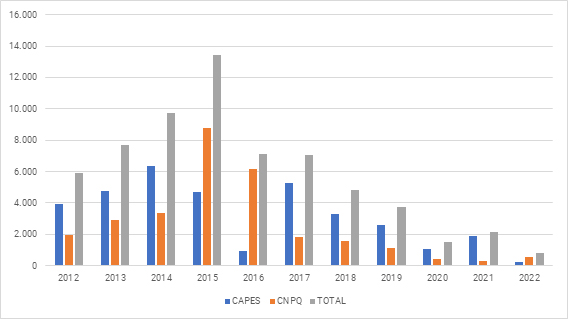
Between 2012 and 2022, 64,000 Brazilians received funding from Capes or CNPq to pursue graduate studies and research abroad under the modalities described in the previous section. Within this ten-year period, 2015 recorded the highest number of scholarships, totaling 13,458 (Capes: 4,669; CNPq: 8,789). In contrast, 2022 marked the lowest point, with only 832 scholarships awarded—a difference of approximately sixteenfold between the two years.
These data reflect the impacts of the economic crisis that began in 2015. Until then, the continuous expansion of the National Graduate Education System (Sistema Nacional de Pós-Graduação - SNPG) had increased the country’s capacity for knowledge production and strengthened the internationalization of academic training. However, with the sharp reduction in public spending during the crisis, science and technology (S&T) policies were particularly affected more severely than other areas of public administration (De Negri, 2022). This context of budgetary constraints materialized in successive cuts to the main funding agencies (Dellagostin, 2021): Capes saw its budget fall from R$ 5.13 billion in 2012 to R$ 2.48 billion in 2022, while CNPq’s resources were halved, dropping from R$ 2.04 billion to R$ 1.02 billion (Alfano, 2022). As De Negri (2022, p. 113, our translation) observes, funding for S&T in Brazil “occurs in leaps, with moments of prosperity followed by long periods of scarcity.” Thus, the data indicate that Brazilian academic international mobility is highly sensitive to budgetary and political fluctuations, showing how financial limitations directly affect internationalization and the development of scientific capital in the country.
Source: The Authors
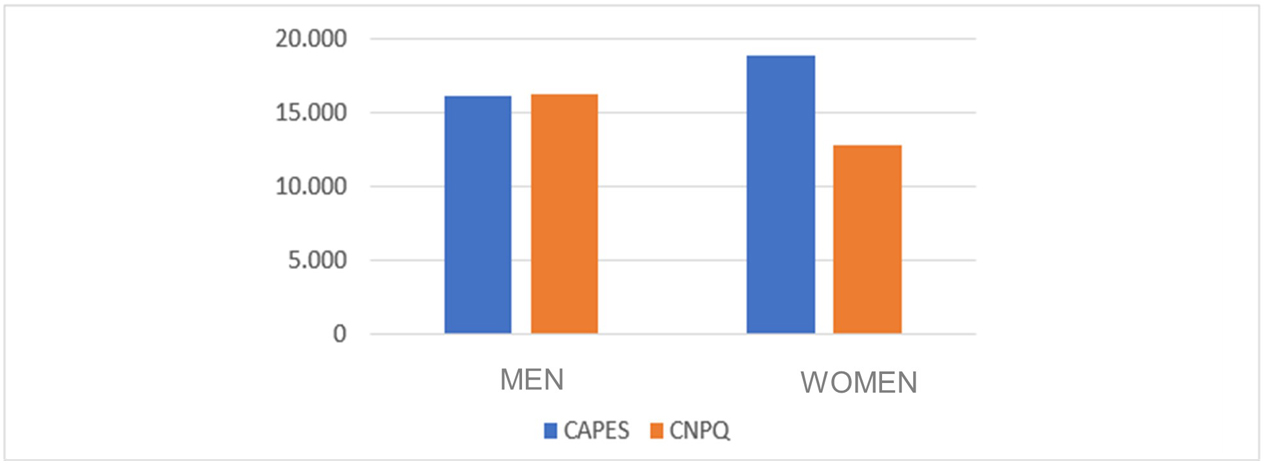
Of the total 64,000 scholarships awarded, perhaps the most significant progress of the decade was the relative balance achieved in terms of gender distribution. A total of 32,332 scholarships were granted to men (50.5%) and 31,668 to women (49.4%).
Although men still represent a slight majority, this result reveals a trend toward greater balance and an increasing female participation in international academic mobility. This trend is consistent with recent data presented by Cruz et al. (2025) on the Brazilian academic diaspora, which indicate that there are now more women than men holding master’s and/or doctoral degrees abroad.10 This expansion, in turn, reflects a broader process of feminization of Brazilian emigration, identified by Queiroz et al. (2020), Costa and Ruviaro (2020), and Assis and Siqueira (2021).
Historically, in Brazil, men predominated among those seeking complementary training abroad (Lombas, 2017), which makes the current gender balance a significant achievement. In parallel, the number of women enrolled in graduate programs increased from 145,939 in 2013 to 194,576 in 2022, a 33.3% rise. Despite this growth, female participation varied only from 53.75% to 54.77% over the same period (Carvalho & Auad, 2025). According to data collected by the Center for Management and Strategic Studies (Centro de Gestão e Estudos Estratégicos - CGEE, 2024), women have been the majority among master’s degree holders since 1997 and among doctoral degree holders since 2003. In 2021, their participation exceeded that of men by 13.6 and 11.2 percentage points, respectively. This trend observed in Brazil mirrors a global movement toward expanding the female presence in academia, particularly in access to opportunities for qualification and international mobility (Ackers, 2004).
Source: The Authors
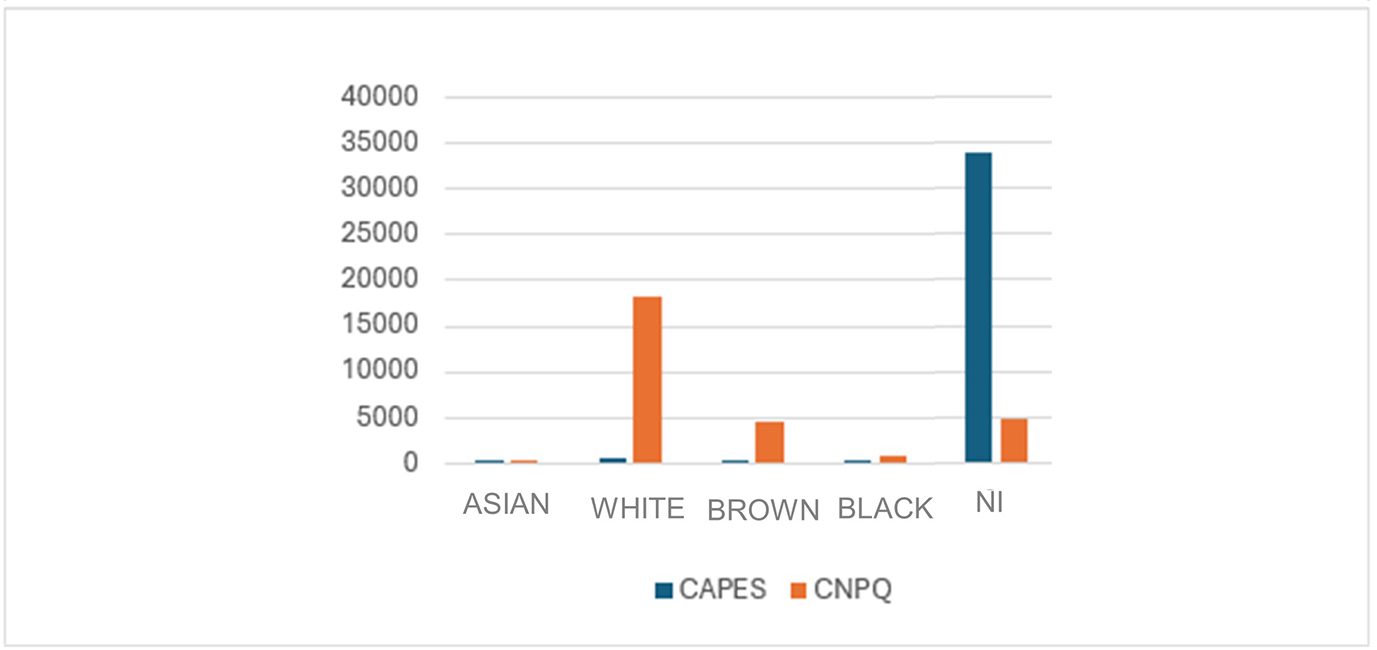
Regarding race, inconsistencies were observed in the data provided by Capes, which makes precise analysis impossible. Considering only the information from CNPq, it appears that, over the analyzed decade, the beneficiaries were predominantly white individuals. To illustrate, the categories “Asian,” “Brown,” and “Black” together account for 5,897 individuals (20.3% of the total), while the “White” category corresponds to 18,150 (62.5% of the total).11 The category indigenous does not appear.
This characteristic permeates the entire Brazilian graduate education system. Gonçalves et al. (2019) analyze access to graduate programs in Brazil according to ethnic-racial criteria in the previous decade and indicate an increase in the enrollment of the Black population. However, they argue that this growth remains insufficient, given that over 50% of the Brazilian population identifies as Black or Brown, thereby highlighting the persistence of a historical and systemic pattern of racial exclusion that marks education in the country. Data from CGEE (2024) corroborate this trend, showing that master’s and doctoral degrees remain concentrated among individuals who self-identify as White, despite the progress associated with the increased presence of the Black population among degree holders since the 2000s.12
Source: The Authors
Also, during the analyzed decade, scholarships were awarded for studies in nearly 100 different countries. Greater country diversity is observed in the case of Capes, which funded Brazilian projects in 90 different countries, compared to 52 for CNPq. However, Brazilian academic mobility is highly concentrated in Global North countries. In both cases, the ten countries hosting the largest number of Brazilian scholars are the same and are primarily located in North America and Europe (with Australia as the only exception). Excluding Australia, approximately 86% of the scholarship recipients were concentrated in these regions of the Global North, namely the United States, Canada, the United Kingdom, Germany, France, Portugal, Spain, Italy, and the Netherlands (Table 1).
| CNPq | CAPES | |||
|---|---|---|---|---|
| Countries | Number of Scholarships | Countries | Number of Scholarships | |
| United States | 7.272 | United States | 9.011 | |
| United Kingdom | 4.101 | Portugal | 4.571 | |
| Germany | 2.873 | France | 4.180 | |
| France | 2.688 | Spain | 3.231 | |
| Portugal | 2.355 | United Kingdom | 2.975 | |
| Spain | 2.120 | Germany | 2.349 | |
| Canada | 1.950 | Canada | 1.833 | |
| Italy | 889 | Italy | 1.215 | |
| Australia | 880 | The Netherlands | 764 | |
| The Netherlands | 871 | Australia | 690 | |
| TOTAL | 25.999 | TOTAL | 30.819 | |
Regarding Global South countries, combining the five nations with the highest number of Capes and CNPq scholarships during the period totals 1,769, corresponding to only 2.7% of all scholarships awarded (Table 2).
| CNPq | CAPES | |||
|---|---|---|---|---|
| Countries | Number of Scholarships | Countries | Number of Scholarships | |
| New Zealand | 92 | Argentina | 686 | |
| Argentina | 67 | Mexico | 325 | |
| China | 64 | Mozambique | 196 | |
| Mexico | 56 | Timor-Leste | 128 | |
| South Africa | 28 | Uruguay | 127 | |
| Total | 307 | Total | 1.462 | |
Data on the concentration of Capes and CNPq scholarships in Global North countries reveal that Brazilian academic mobility reproduces the international hierarchy of knowledge and science. This pattern confirms the observations of Kehm and Teichler (2007), Bilecen and Van Mol (2017), and Lima and Maranhão (2009), who note that academic mobility tends to be directed primarily toward central countries, thereby intensifying existing global inequalities, including in economic and military spheres. As Martinez (2018) observes, Brazilian students show a clear predisposition to seek destinations in North America and Western Europe, while, in parallel, Brazil has historically acted as a regional host for Latin American and Lusophone African students, an asymmetry that reinforces the country’s peripheral role in the global circulation of knowledge.
Der Wende (2015) argues that the concentration of talent in a few OECD countries strengthens their research and innovation capacities, generating a cumulative cycle of prestige and resources that deepens disparities between regions. This dynamic, visible in the predominance of elite universities located in North America, Europe, and parts of Asia and Oceania, transforms these hubs into “global magnets” for academic talent, as the author describes. Thus, even when speaking of “brain circulation,” Jaeger (2014) warns that this circulation follows specific directions aligned with the hierarchy of global higher education. Therefore, the global higher education system continues to reveal itself as hierarchical and geopolitically unequal (Marginson, 2025).
Regarding the distribution of scholarship recipients across fields of knowledge, there is a clear predominance of exact sciences, engineering, and natural sciences in CNPq-funded scholarships (accounting for 37.5% of the scholarships during the period). In contrast, Capes-funded scholarships show greater representation of the Humanities and Health fields (35.3% of the scholarships during the period) (see Table 3). Overall, 99 fields received CNPq scholarships, compared to 49 fields supported by Capes between 2012 and 2022.
| CNPq | CAPES | |||
|---|---|---|---|---|
| Knowledge Areas | Number of Scholarships | Knowledge Areas | Number of Scholarships | |
| Computer Science | 1.870 | Linguistics and literature | 1.904 | |
| Chemistry | 1.636 | Agricultural sciences I | 1.902 | |
| Physics | 1.559 | Biodiversity | 1.550 | |
| Biochemistry | 935 | Education | 1.357 | |
| Genetics | 853 | Biological sciences II | 1.048 | |
| Chemical Engineering | 849 | Chemistry | 971 | |
| Materials and Metallurgic Engineering | 819 | History | 972 | |
| Geosciences | 790 | Interdisciplinary | 901 | |
| Agronomy | 788 | Psychology | 899 | |
| Ecology | 785 | Biological sciences I | 844 | |
| Total | 10.884 | Total | 12.348 | |
The predominance of exact sciences, engineering, and natural sciences among CNPq scholarships is supported by the critiques of Chaves and Castro (2016) regarding the Science Without Borders (CsF) Program. According to the authors, by prioritizing the so-called “Hard Sciences,”13 the Brazilian government adopted a development logic aligned with capital, in which education is also treated as a commodity and technological competitiveness is highly valued. This political choice, by insufficiently supporting areas such as the Humanities and Applied Social Sciences, highlights an emphasis on technical and technological training at the expense of ethical and humanistic education (Chaves & Castro, 2016).
Similarly, Lopes and Lopes (2019) argue that, as occurred with CsF, the most significant funding resources in Brazilian research policies remain concentrated in the “Hard Sciences,” considered more relevant to economic growth. Since science and technology policies play a fundamental role in national scientific development, the prioritization of certain fields contributes to reproducing inequalities among disciplines and limits the advancement of areas receiving less institutional and budgetary attention (Lopes & Lopes, 2019). In the case of Capes, however, a more balanced profile is observed, with greater attention to the Humanities and Health fields, suggesting a more diversified institutional strategy.
Historically, Brazil has exhibited deep socioeconomic inequalities, and recent initiatives aimed at reducing them have proven insufficient to change this scenario (Chaves & Castro, 2016). Regarding the international mobility of Brazilian academics, the data indicate that it is also marked by inequalities, reflected in the predominance of white beneficiaries, the concentration of scholarships in the fields of exact sciences, engineering, and natural sciences, and the greater presence of countries in the Global North. During the period analyzed, the main progress observed was the achievement of greater gender balance. In addition to these inequalities, although no specific data were collected on the topic, Martinez (2018) highlights the strong concentration of access to resources in large urban centers and leading universities. Institutions with dedicated international relations structures tend to promote scientific cooperation, attract foreign researchers, and consolidate a culture of internationalization, thereby expanding the reach and impact of these policies (Martinez, 2018). In sum, these results indicate that international academic mobility both reflects and, to some extent, reproduces the structural inequalities of Brazilian society.
5.2. Limitations and Policy Implications
We have thus far sought to present descriptive characteristics in terms of demographics (mainly gender and race), fields of study, and destination countries of scholarships awarded to Brazilian graduate students to conduct research activities abroad. These programs depend on substantial government investment (Woicolesco et al., 2022), as the funding of international academic mobility has historically been conceived as a state strategy, grounded in the expectation that individuals, upon returning to Brazil after their training abroad, would disseminate a particular scientific ethos and the knowledge acquired in the United States and Western Europe (Azevedo, 2025). This dynamic reflects the strong influence of the Brazilian state on the direction of internationalization and higher education in the country, reinforcing a longstanding pattern in which higher education has been conceived as a strategic instrument for national development (Leal, 2019). Without such initiatives, the national research and graduate education system as we know it would not exist, nor would Brazil’s significant international presence across various fields of scientific knowledge (Azevedo, 2025).
However, three key points deserve particular attention. First, as shown, the programs analyzed are not capable of disrupting the cycle of reproduction of existing inequalities in the Brazilian education system. This article was unable to examine the application and selection processes for these scholarships, nor to analyze participants’ family or individual income backgrounds, due to data limitations. Nevertheless, given the pronounced racial and structural inequalities identified, there is no evidence to suggest that these programs differ from broader patterns already observed in educational and socioeconomic inequalities, including in other domains such as the labor market and political participation. As Zunino and Maggi (2025) argue, attention should be paid to the selectivity of these programs, as international academic mobility is embedded in stratified spaces of circulation, shaped both by institutional dynamics and by the forms of capital (e.g., language proficiency, financial resources, and social networks) possessed by individuals, which ultimately influence their mobility trajectories. From a policy perspective, one possible approach would be the introduction of affirmative action mechanisms, similar to those adopted in undergraduate education.14 Another alternative would be to promote more recent and inclusive forms of internationalization, such as “internationalization at home,” which have the potential to expand access at relatively low cost (Nigra & Lima, 2025).
The second point that deserves attention is the insufficiency of these initiatives in overcoming inequalities between countries in the Global North and Brazil. Although student mobility is the primary mechanism of internationalization in Latin America (Reinoso & Torres, 2025; Echeverría-King et al., 2023; Gacel-Ávila, 2022; Nigra & Lima, 2025), including in Brazil (Azevedo, 2025), the literature suggests that this “brain circulation” follows specific directions aligned with the hierarchy of global higher education, thus reflecting and reproducing a system that remains structurally hierarchical and geopolitically unequal (Jaeger, 2014; Marginson, 2025). This is corroborated by the data collected, which show that 86% of scholarship recipients went to countries in North America and Europe. According to Mendes and Finardi (2025), this pattern marginalizes academic exchange with countries in the Global South and reinforces the country’s position as a peripheral actor in the knowledge society. Moreover, this focus hinders the consolidation of higher education internationalization as a vector of regional integration (Woicolesco et al., 2022). In this context, one policy alternative for Brazil would be to strengthen the role of internationalization within the regional agenda by promoting its incorporation into existing regional integration mechanisms, as well as into Brazil’s bilateral cooperation initiatives with countries in Latin America and other regions of the Global South.
The third and final point raised is that, although the passive internationalization of higher education has historically been a strategy of the Brazilian state (Azevedo, 2025), the country still lacks a robust and integrated policy framework for higher education internationalization. As argued by Woicolesco et al. (2022), historically, and up to the present, internationalization has been conceived primarily as individually driven mobility of faculty members and students abroad; although more comprehensive programs have emerged in recent years, such as CsF and CAPES PrInt, these have already been discontinued. Moreover, these intersectoral policies remain poorly articulated with those targeting the Brazilian academic diaspora, despite their significant points of intersection. Although they do not share exactly the same target population, many students initially enter destination countries on temporary visas and remain after their expiration (Brooks & Waters, 2025), thereby becoming part of the academic diaspora. More broadly, a tension can be observed: on the one hand, federal scientific funding agencies seek to position Brazil within the global knowledge economy through passive internationalization, primarily by promoting outbound student mobility; on the other hand, as discussed in Section 2, these same agencies attempt to prevent these students from becoming part of the academic diaspora by adopting returns policies in order to avoid “brain drain.” At the same time, as Brum (2024) shows, the Ministry of Foreign Affairs (Itamaraty) frames the academic diaspora as a strategic asset abroad to enhance Brazil’s international image in science, technology, and innovation (ST&I). These dynamics highlight the need for greater coordination within the federal executive branch.
In light of these findings, particularly considering the inequalities and gaps identified, an important question arises: do these policies make sense as public policies? This article argues that they do, insofar as they contribute to Brazil’s integration into global knowledge economy and have historically been essential to the development of the country’s higher education and research system. However, their improvement requires policymakers to address several key dimensions. First, greater attention should be paid to the profile of scholarship recipients in the design and implementation of these programs, with a view to expanding and democratizing access. Second, efforts should be made to strengthen cooperation with countries in Latin America and other regions of the Global South. Third, enhancing coordination among public agencies involved in both internationalization policies and initiatives targeting the academic diaspora is essential.
6. Final Considerations
This study aimed to gather and analyze quantitative data on the international mobility of Brazilian academics, with the purpose of highlighting the main characteristics of individuals benefiting from federal graduate scholarship programs abroad—offered by Capes and CNPq—between 2012 and 2022, considering gender, race, destination countries, and fields of study. This flow is part of both the process of graduate internationalization and the dynamics of “brain circulation,” and can be better understood considering these global transformations. The continuous international mobility of researchers occurs in pursuit of better opportunities, resources, and scientific networks, concentrating in centers of excellence and integrating academic trajectories through long and short-term stays. Similarly, the internationalization of graduate education involves the temporary international mobility of students and researchers, strengthening institutions and enhancing individuals’ qualifications through exchanges and federal programs. However, as the literature points out, both “brain circulation” and graduate internationalization predominantly benefit countries in the Global North, reproducing structural inequalities of power, wealth, and opportunities between more and less developed nations.
The data analysis indicates that the quantitative balance of scholarships between Capes and CNPq shows that, despite the crisis beginning in 2015, the internationalization of graduate education in Brazil has remained supported over the past decade, reflecting a process of historical continuity. Regarding inequalities, the main progress observed was the gender balance of scholarships, which contributes to a more equitable profile of beneficiaries. Nevertheless, gender concentration persists across fields of knowledge, reinforcing meritocratic and ableist assumptions about male predominance in the so-called “hard sciences.” A similar pattern is observed in terms of race: although the number of Black and Brown students enrolled in graduate programs and holding master’s and doctoral degrees has increased, scholarship recipients remain predominantly White. In this context, there is a clear need for public policies that more effectively address patriarchy, racism, and other forms of marginalization that continue to disadvantage specific social groups.
Furthermore, the bipolar dynamic of academic mobility from Brazil to central countries stands out within the context of South-North Global relations. Mobility is primarily concentrated in North America and Western Europe, reinforcing global inequalities and Brazil’s peripheral position in the international circulation of knowledge. Elite universities in these countries act as “global magnets” for talent, strengthening their research and innovation capacities and highlighting the hierarchy and inequality inherent in the global higher education system. Considering this, it is urgent to expand the Brazilian educational system, promote scientific cooperation with other developing countries—including South American neighbors—strengthen transnational “brain networks,” and advance a critical understanding of “brain circulation” and higher education internationalization. International academic mobility should be seen as an opportunity for mutual development for beneficiaries, institutions, and countries of origin and destination, while simultaneously acknowledging its structural limitations and underlying inequalities.
Finally, it is important to emphasize the need to collect and analyze more data on the international mobility of Brazilian academics, including information on the profiles and trajectories of beneficiaries of federal graduate scholarship programs abroad, such as income and places of origin and destination—cities, regions, and institutions. This would allow for a more precise understanding of Brazil’s position in the debate on “brain circulation” and higher education internationalization, as well as provide support for the formulation and improvement of public policies.
References
Ackers, L. (2004). Managing relationships in peripatetic careers: Scientific mobility in the European Union. Women’s Studies International Forum, 27(3), 189-201. https://doi.org/10.1016/j.wsif.2004.03.001
Ackers, L. (2005). Moving people and knowledge: Scientific mobility in the European Union. International Migration, 43(5), 99-131. https://doi.org/10.1111/j.1468-2435.2005.00343.x
Alfano, B. (2022). Com verba cada vez menor para pesquisa, Brasil vê fuga de cérebros se intensificar e virar “diáspora”. O Globo. https://oglobo.globo.com/brasil/educacao/com-verba-cada-vez-menor-para-pesquisa-brasil-ve-fuga-de-cerebros-se-intensificar-virar- diaspora-25386290
Altbach, P. G., & Knight, J. (2007). The internationalization of higher education: Motivations and realities. Journal of Studies in International Education, 11(3-4), 290-305. https://doi.org/10.1177/1028315307303542
Assis, G. O., & Siqueira, S. (2021). Entre o Brasil e a Europa: Brasileiras negociando gênero e raça nas representações sobre “a mulher brasileira”. Cadernos Pagu, 63, 1-22. https://doi.org/10.1590/18094449202100630006
Azevedo, L. F. D. (2025). Policies of international academic mobility, processes of elite and state formation, and “returning” to Brazil. Vibrant, 22, e00505. https://doi.org/10.1590/1809-4341.2025v22e00505
Balbachevsky, E., & Marques, F. (2009). “Fuga de cerebros” en Brasil: los costos públicos del errado entendimiento de una realidad acadêmica. In S. D. Aupetit & E. Gérard (eds.), Fuga de cerebros, movilidad académica, redes científicas: perspectivas latinoamericanas (pp. 161-173). Cinvestav. https://unesdoc.unesco.org/ark:/48223/pf0000186433
Bilecen, B., & Van Mol, C. (2017). Introduction: International academic mobility and inequalities. Journal of Ethnic and Migration Studies, 43(8), 1241-1255. https://doi.org/10.1080/1369183X.2017.1300225
Brandi, M. (2006). La historia del brain drain. CTS, 3(7), 65-85. https://doi.org/10.52712/issn.1850-0013-965
Brasil, CNPq. (2024, April 16). Fixação de pesquisadores no país – Nota da CNPq. https://www.gov.br/cnpq/pt-br/assuntos/noticias/cnpq-em-acao/ fixacao-de-pesquisadores-no-pais-nota-do-cnpq
Brasil. Ministério das Relações Exteriores. (2022). Panorama Internacional de Políticas de Mobilização de Diásporas Científicas, Tecnológicas e em Inovação. Ministério das Relações Exteriores. https://www.gov.br/mre/pt-br/assuntos/ciencia-tecnologia-e-inovacao/27.04.22_PanoramaInternacionaldePolticasdeMobilizaodeDisporasCientficas TecnolgicaseemInovao.pdf
Brooks, R., & Waters, J. (2021). International students and alternative visions of diaspora. British Journal of Educational Studies, 69(5), 557-577. https://doi.org/10.1080/00071005.2021.1948501
Brum, A. G. (2018). As políticas de vinculação do Brasil para os brasileiros e seus descendentes no exterior. O Social em Questão, 21(41), 65-86.
Brum, A. G. (2019). As políticas de vinculação do Brasil e da Turquia para suas comunidades no exterior no pós-Guerra Fria: uma análise comparativa. Revista de Relações Internacionais da UFGD, 8(16), 335-360. https://doi.org/10.30612/rmufgd.v8i16.9869
Brum, A. G. (2024). The history of Brazil’s policies for its scientific and technological diaspora. Revista Educação e Políticas em Debate, 13(2), 1-20. https://doi.org/10.14393/REPOD-v13n2a2024-70518
Brzozowski, J. (2008). Brain drain or brain gain? The new economics of brain drain reconsidered. The New Economics of Brain Drain Reconsidered. https://doi.org/10.2139/ssrn.1288043
Carvalho, P., & Auad, D. (2025). Mulheres na pós-graduação: Conquistas e desafios à equidade. Educação em Foco, 28(54), 1-18. https://doi.org/10.36704/eef.v28i54.9210
Castells, M. (1999). A sociedade em rede. A era da informação: Economia, sociedade e cultura. Paz e Terra.
CGEE – Centro de Gestão e Estudos Estratégicos. (2024). Brasil: Mestres e doutores 2024. CGEE. https://mestresdoutores2024.cgee.org.br
Chaves, V. L. J., & Castro, A. M. D. A. (2016). Internacionalização da educação superior no Brasil: Programas de indução à mobilidade estudantil. Revista Internacional de Educação Superior, 2(1), 118-137. https://doi.org/10.22348/riesup.v2i1.7531
Ciumasu, I. M. (2010). Turning brain drain into brain networking. Science and Public Policy, 37(2), 135-146. https://doi.org/10.3152/030234210X489572
Cohen, R. (2008). Global diasporas: An introduction. Routledge. https://doi.org/10.4324/9780203928943
Cohen, R. (2019). Diasporas: Changing meanings and limits of the concept. In J. Retis & R. Tsagarousianou (eds.), The Handbook of Diasporas, Media, and Culture (pp. 15-30). John Wiley & Sons. https://doi.org/10.1002/9781119236771.ch2
Coronel, D. O. (2025). ModESPar y la internacionalización: primeros pasos hacia la movilidad académica y el reconocimiento de créditos en Paraguay. Cadernos de Pesquisa, 32(4), 1-23. https://doi.org/10.18764/2178-2229v32n4e26141
Costa, A. P., & Ruviaro, R. (2020). Estereótipos e migração: A mulher brasileira em Portugal. In F. P. Coutinho, E. Oliveira & M. J. Carapêto (dirs.), Atas da Conferência: Igualdade de Género e Mobilidade. Cedis.
Cruz, E. P., Falcão, R. P. Q., Brum, A. G., & Marins, D. M. (2025). Diáspora acadêmica brasileira: Perfil e mobilidade de pesquisadores no exterior. Educação: Teoria e Prática, 35(69), e74. https://doi.org/10.18675/1981-8106.v35.n.69.s18144
Cury, C. R. J. (2025). Quadragésimo ano do parecer CFE nº 977/65. Revista Brasileira de Educação, 30(Esp.), 7-20.
Daugeliene, R., & Marcinkeviciene, R. (2009). Brain circulation: Theoretical considerations. Engineering Economics, 63(3), 49-57. https://doi.org/10.5755/j01.ee.63.3.11646
De Nigri, F. (2022). Financiando a ciência e a infraestrutura de pesquisa em tempos de crise. Revista USP, 135, 110-118. https://doi.org/10.11606/issn.2316-9036.i135p101-118
De Wende, M. V. (2015). International academic mobility: Towards a concentration of the minds in Europe. European Review, 23, 70-88. https://doi.org/10.1017/S1062798714000799
Dellagostin, O. A. (2021). Análise do fomento à pesquisa no país e a contribuição das agências federais e estaduais. Revista Inovação e Desenvolvimento, 2(6), 6-12.
Echeverría-King, L. F., Chiappa, R., Leal, F., & Castiello-Gutiérrez, S. (2023). Análisis de políticas públicas de apoyo a la internacionalización de la educación superior en América Latina: un balance. Revista de Educación Superior en América Latina, 13(2), 35-40.
França, T., & Padilla, B. (2019). ¿Por qué seguimos estudiando y debatiendo la movilidad académica internacional? In S. D. Aupetit, T. França & B. Padilla (eds.), Geoestrategia de la internacionalización y espacialidad de las migraciones académicas (pp. 15-24) UDUAL.
Gacel-Ávila, J. (2022). Internacionalización inclusiva en América Latina y el Caribe Desafíos y factibilidad. Revista Educación Superior y Sociedad (ESS), 34(1), 401-421. https://doi.org/10.54674/ess.v34i1.570
Gil, A. (2002). Como elaborar projetos de pesquisa. Atlas.
Gonçalves, L. A. de O., Pereira Jr., A., Coutinho, F. A., & Pereira, J. G. (2019). Acesso de negros e negras à pós-graduação. Revista da ABPN, 11(Esp.), 176-206. https://doi.org/10.31418/2177-2770.2019.v11.c.1.p176-206
International Organization for Migration. (2019). Glossary on Migration. IOM.
Jaeger, K. (2014). Brain circulation or brain concentration – The politics of knowledge in international education. In Z. Güler (ed.), New opportunities and impasses: Theorizing and experiencing politics (pp. 396-411). DAKAM Publishing. https://www.academia.edu/37571536/NEW_ OPPORTUNITIES_AND_IMPASSES_THEORIZING_AND_EXPERIENCING_ POLITICS
Jöns, H. (2007). Transnational mobility and the spaces of knowledge production: A comparison of global patterns, motivations and collaborations in different academic fields. Social Geography, 2(2), 97-114. https://doi.org/10.5194/sg-2-97-2007
Kehm, B. M., & Teichler, U. (2007). Research on internationalisation in higher education. Journal of Studies in International Education, 11(3-4), 260-273. https://doi.org/10.1177/10283153073035
Kim, T. (2009). Transnational academic mobility, internationalization and interculturality in higher education. Intercultural Education, 20(5), 395-405. https://doi.org/10.1080/14675980903371241
Knight, J. (1999). Issues and trends in internationalization: A comparative perspective. In S. Bond & J. Lemasson (eds.), A new world of knowledge: Canadian universities and globalization (pp. 201-238). International Development Research Centre.
Knight, J. (2008). Higher education in turmoil: The changing world of internationalization. Brill. https://doi.org/10.1163/9789087905224
Knight, J., & De Wit, H. (2018). Internationalization of higher education: Past and future. International Higher Education, 95, 2-4. https://doi.org/10.6017/ihe.2018.95.10715
Kshetri, N., Rojas-Torres, D., & Acevedo, M. C. (2015). Diaspora networks, non-economic remittances and entrepreneurship development: Evidence from some economies in Latin America. Journal of Developmental Entrepreneurship, 20(1), 1550005. https://doi.org/10.1142/S1084946715500053
Leal, F. G. (2019). Os caminhos recentes da internacionalização da educação superior brasileira. Revista de Educación Superior en América Latina, 6, 31-35.
Lima, M. C., & Maranhão, C. M. S. de A. (2009). O sistema de educação superior mundial entre a internacionalização ativa e passiva. Avaliação, 14(3), 583-610. https://doi.org/10.1590/S1414-40772009000300004
Lombas, M. L. S. (2017). A mobilidade internacional acadêmica: Características dos percursos de pesquisadores brasileiros. Sociologias, 19, 308-333. https://doi.org/10.1590/15174522-019004413
Lopes, P. R. M., & Lopes, A. B. (2019). Ciências naturais x ciências sociais: As desigualdades entre as grandes áreas do conhecimento na Bahia. Revista RBBA, 8(1), 297-326. https://doi.org/10.22481/rbba.v8i1.5174
Luce, M. B., Fagundes, C. V., & Mediel, O. G. (2016). Internacionalização da educação superior: A dimensão intercultural e o suporte institucional na avaliação da mobilidade acadêmica. Avaliação, 21(2), 317-339. https://doi.org/10.1590/S1414-40772016000200002
Marginson, S. (2025). Globalisation and the geopolitics of higher education. The Centre for Global Higher Education (CGHE).
Marrara, T. (2007). Internacionalização da pós-graduação: Objetivos, formas e avaliação. Revista Brasileira de Pós-Graduação, 4(8), 245-262. https://doi.org/10.21713/2358-2332.2007.v4.132
Martinez, C. A. F. (2018). Geografias da mobilidade acadêmica internacional brasileira (ou Por que a internacionalização da educação superior é um problema geográfico?). Terra Livre, 1(50), 13-33. https://doi.org/10.62516/terra_livre.2018.1433
Mendes, A. R. M., & Finardi, K. R. (2025). Mobility “On Paper” and “In the Field:” Contrasting Institutional Policies and International Students’ Experiences. In X. Liu (ed.), Mobility, Study, and Cultural Conflicts of International Students (pp. 1-12). IntechOpen.
Meyer, J. (2003). Policy implications of the brain drain’s changing face. Policy Briefs, Science and Development Network.
Meyer, J., & Brown, M. (1999). Scientific diasporas: A new approach to the brain drain. UNESCO.
Meyer, J., Kaplan, D., & Charum, J. (2001). Scientific nomadism and the new geopolitics of knowledge. International Social Science Journal, 53(168). https://doi.org/10.1111/1468-2451.00317
Nigra, S., & Lima, L. R. (2025). Estrategias de internacionalización en las instituciones de educación superior en México. IE Revista de Investigación Educativa de la REDIECH, 16, 2518. https://doi.org/10.33010/ie_rie_rediech.v16i0.2518
Olarte, O. L. (2015). Evaluación del Programa de la Diáspora de Alto Reconocimiento. Departamento Administrativo de Ciencia. https://www.colciencias.gov.co/sites/default/files/seriesesteva052014.pdf
Özbilgin, M. F., Yıldız, H., Erbil, C., & Bağlama, S. H. (2025). Formation of an academic diaspora: A study of scholars from Turkey in the higher education sector in Britain. International Migration, 63(2), e70010. https://doi.org/10.1111/imig.70010
Padilla, B., & França, T. (2015). Mobilidade científica e imigração qualificada: Situando o debate. Forum Sociológico, 27, 7-10. https://doi.org/10.4000/sociologico.1323
Pandey, N., Srinivas, K. R., & Deepthi, T. R. (2022). Emerging technologies, STI diaspora and science diplomacy in India: Towards a new approach. Frontiers in Research Metrics and Analytics, 7, 904100. https://doi.org/10.3389/frma.2022.904100
Queiroz, C. C., Cabecinhas, R., & Cerqueira, C. (2020). Migração feminina brasileira e a experiência do envelhecimento em Portugal: Sexismo e outros “ismos”. Equatorial – Revista do Programa de Pós-Graduação em Antropologia Social, 7(12), 1-23. https://doi.org/10.21680/2446-5674.2020v7n12ID17914
Ramos, M. Y. (2018). Internacionalização da pós-graduação no Brasil: Lógica e mecanismos. Educação e Pesquisa, 44, 161579. https://doi.org/10.1590/S1517-9702201706161579
Ramos, M. Y., & Velho, L. (2011). Formação de doutores no Brasil e no exterior: Impactos na propensão de migrar. Educação e Sociedade, 32(117), 933-951. https://doi.org/10.1590/S0101-73302011000400003
Reinoso, A. F., & Torres, J. P. (2025). Internacionalización en los programas de posgrado del Perú. Avances y desafíos, 55(3), 335-374.
Rocha, G. F., & Campos, M. C. (2024). Racial quotas and democratization of higher education. Geosaberes, 15, 61-76. https://doi.org/10.26895/geosaberes.v15i0.1283
Santos, A. N. (2021). Fuga de cérebros, circulação internacional da ciência e diáspora científica de pesquisadores brasileiros: Contribuições para o debate. https://drive.google.com/file/d/1I9z2J2L3QbHEmtpGqWayBg3t7JwLJ0ou/viewCEMJ.
Sassen, S. (1993). Rebuilding the Global City: Economy, Ethnicity, and Space. Social Justice, 20(3-4), 32-50.
Saxenian, A. (2002). Brain circulation: How high-skill immigration makes everyone better off. Brookings Review, 20(1), 28-31. https://doi.org/10.2307/20081018
Shapin, S. (2022). Hard science, soft science: A political history of a disciplinary array. History of Science, 60(3), 287-328. https://doi.org/10.1177/00732753221094739
Shen, W., Xu, X., & Wang, X. (2022). Reconceptualising international academic mobility in the global knowledge system: Towards a new research agenda. Higher Education, 84(6), 1317-1342. https://doi.org/10.1007/s10734-022-00931-8
Solimano, A. (2006). Mobilizing talent for global development, 7. UNU-WIDER Policy Brief.
Sousa, V. M. F. (2014). Qual o significado de “diáspora” em tempo de globalização? A relação controversa entre Império, lusofonia e “portugalidade”. In IV Congresso Internacional em Estudos Culturais [Anais]. Universidade do Minho.
Teichler, U. (2015). Academic mobility and migration: What we know and what we do not know. European Review, 23, 70-88. https://doi.org/10.1017/S1062798714000787
United Nations. (1998). Recommendations on statistics of international migration: Revision 1 (Statistical Papers, 58, rev.1). United Nations.
Valderrama, C. B. F. (2007). Transnacionalismo: Emergencia y fundamentos de una nueva perspectiva migratoria. Papers: revista de sociologia, 85, 13-29. https://doi.org/10.5565/rev/papers/v85n0.2008
Woicolesco, V. G., Camargo Cassol-Silva, C., & Morosini, M. (2022). Internationalization at home and virtual: A sustainable model for Brazilian higher education. Journal of Studies in International Education, 26(2), 222-239. https://doi.org/10.1177/10283153221076898
Zunino, C. J., & Maggi, M. F. (2025). Desigualdades sociales en las trayectorias de movilidad internacional de estudiantes en universidades argentinas. Perfiles Educativos, 15, 1-26. https://doi.org/10.22201/iisue.24486167e.2025.47.61881