La representación social de Japón entre inmigrantes hispanoamericanos profesionales: dimensiones simbólicas trascendiendo motivaciones económicas



This article examines how Hispano-American professionals constructed pre-migration representations of Japan as a meaningful destination, and how cultural exposure shaped symbolic imaginaries of aspirational mobility. Drawing on Social Representations Theory and a mixed-methods design (prototypical analysis, semantic network analysis, interviews, and surveys with 181 Japan residents who arrived in the twenty-first century), the study reveals a hierarchically structured image anchored in excellence, visual culture, learning, and safety. These reflect core cultural and growth-learning orientations with peripheral economic elements. Early and sustained exposure to Japanese media emerges as a key mechanism of objectification and anchoring, positioning Japan as a desirable destination in the absence of ethnic or institutional networks. Findings demonstrate that migration involves meaning-making, where cultural fascination, personal development, and aspirational identity coalesce, contributing a symbolic and cognitive dimension to migration theory.
Este artículo examina cómo profesionales hispanoamericanos construyeron representaciones premigratorias de Japón como un destino significativo y cómo la exposición cultural configuró imaginarios simbólicos de movilidad aspiracional. Fundamentado en la Teoría de Representaciones Sociales y un diseño metodológico mixto (análisis prototípico, análisis de redes semánticas, entrevista y encuesta a 181 residentes en Japón llegados en el siglo XXI), el estudio revela una representación jerárquicamente estructurada, anclada en nociones de excelencia, cultura visual, aprendizaje y seguridad. Manifiestan orientaciones culturales y de aprendizaje-crecimiento como centrales, con elementos económicos periféricos. La exposición temprana y sostenida a medios japoneses emerge como mecanismo clave de objetivación y anclaje, posicionando a Japón como destino deseable en ausencia de redes étnicas o institucionales. Los hallazgos demuestran que la migración implica un proceso de construcción de significados, donde la fascinación cultural, el desarrollo personal y la identidad aspiracional se entrelazan, aportando una dimensión simbólica y cognitiva a la teoría migratoria.

International migration; social representation; foreign professionals; Japan; Hispano-Americans
Migración internacional; representación social; profesionales extranjeros; Japón; hispanoamericanos

1. Introduction
International migration continues to reshape contemporary societies, with 281 million people residing outside their country of origin in 2022 (International Organization for Migration [IOM], 2022). While migration is often analysed through demographic trends, labour market dynamics, and structural inequalities (Castles et al., 2014), mobility also depends on how destinations become imaginable, desirable, and meaningful to prospective migrants. Before relocation occurs, individuals develop symbolic understandings of places that frame migration not merely as economic movement but as a pathway toward self-development, recognition, or personal transformation (Neubauer, 2024).
Japan provides a particularly instructive context for examining these processes. Long portrayed as ethnically homogeneous and institutionally cautious toward immigration, it has nonetheless experienced steady growth in foreign residents since the late twentieth century, reaching 2.85 million in 2021 and 3.95 million in 2025 (Statistics Bureau, Ministry of Justice, 2025). Although policymakers have avoided framing Japan as an immigration country (Roberts, 2018), demographic pressures and labour needs have produced a de facto immigration reality (Hollifield & Sharpe, 2017). Beyond policy debates, however, less attention has been paid to how Japan is imagined abroad by those who eventually choose to relocate there.
Scholarship on immigration to Japan has primarily examined long-established groups such as Zainichi Koreans and South American Nikkei,1 whose large-scale arrival since the late 1980s reflected labour shortages and ethnic return policies (Higuchi et al., 2003; Tsuda, 2003, 2022). Research has addressed identity, belonging, and socioeconomic incorporation (e.g., de Carvalho, 2003; Kajita et al., 2005; Tsuda, 2003, 2022; Yamanaka, 1996), as well as brokerage mechanisms facilitating migration from South America (Higuchi, 2002).2 Studies of Asian migration have further emphasised segmented labour markets, gendered mobility, and state-regulated employment schemes (e.g., Hashimoto, 2017; Higuchi, 2010; Kajita, 1994; Kamibayashi, 2015; Takenaka et al., 2016; Takenoshita, 2006, 2013).
By contrast, professional migrants from regions outside Asia remain understudied. In particular, the recent arrival of largely non-Nikkei Hispano-Americans3 has developed independently of co-ethnic return frameworks and temporary labour systems (Piffaut Gálvez, 2023a). This absence leaves unexplored how such migrants conceptualise Japan prior to relocation and how these conceptualisations shape their mobility trajectories.
Theoretical debates in migration studies have gradually moved beyond demographic and economic determinism (Ravenstein, 1885), assimilation theory (Morawska, 1990; Thomas & Znaniecki, 1918/2006), and transnationalism (Portes, 1997) toward greater attention to cultural, discursive, and symbolic dimensions of mobility. Recent scholarship highlights the role of social media usage (McGregor & Siegel, 2013), discursive framings (Viola & Musolff, 2019), cultural flows and imaginaries (King & Wood, 2013) in shaping migration aspirations. Destinations are not only labour markets but also symbolic spaces constructed through narratives, consumption, and affective attachments.
In Latin America, Japanese popular culture has long circulated as a significant symbolic reference, influencing perceptions of the country among younger generations (Piffaut Gálvez, 2020a, 2023e). Similar processes have been observed among Hispano-American migrants in China and South Korea (Piffaut Gálvez, 2023b, 2023c), suggesting that East Asia may function as an aspirational horizon beyond traditional migration circuits.
Skilled migration from Hispanic America has historically been directed toward the United States and Europe (United Nations, Department of Economic and Social Affairs, Population Division, 2024). This process must be read against the backdrop of higher education expansion since the mid-twentieth century, which produced graduate oversupply beyond local labour markets (Burgos & López, 2010; Filgueira, 1976). Coupled with crises, instability, and corruption, this mismatch drove successive waves of professional emigration (Pizarro, 2009). Once framed as “brain drain” and later as “brain circulation” (Pellegrino, 2001a, 2001b), such mobility persists amid institutional fragility and limited meritocratic opportunities (Docquier & Rapoport, 2012). Recent evidence suggests that out-migration from the Global South continues to surpass return migration from the North (Herman et al., 2024).
While these structural factors remain relevant, they do not fully explain long-distance mobility toward East Asia, a region geographically and culturally distant from established migration corridors. The presence of non-Nikkei Hispano-American professionals in Japan thus raises questions that extend beyond structural accounts centred on economic differentials and established migration corridors. While structural explanations remain indispensable, this case invites closer examination of how symbolic and aspirational dimensions shape long-distance mobility toward culturally and geographically distant destinations.
This study examines the pre-migration social representations of Japan among non-Nikkei Hispano-American professionals (hereafter NNHAPs) who relocated in the twenty-first century. Grounded in Social Representations Theory (Moscovici, 1961, 2001), it analyses how cultural flows, media consumption, and early symbolic experiences contributed to the construction of Japan as a meaningful destination prior to migration. Rather than providing a structural explanation of migration flows, the article focuses on the symbolic-cognitive infrastructure through which Japan became imaginable as a pathway for self-development and professional realisation. By foregrounding these pre-migratory imaginaries, the study contributes to migration research by illuminating how long-term cultural exposure shapes aspirational mobility beyond immediate economic calculation and outside more conventional migration circuits.
2. Social Representation
This study frames the analysis through Social Representations Theory (SRT), developed by Moscovici (1961) and rooted in Durkheim’s concept of collective representations. Moscovici reconceptualised shared knowledge as continuously produced and transformed through communication. Social representations constitute “the content of everyday thinking” (Moscovici, 1988, p. 214), functioning as systems of values, ideas, and images through which individuals and groups interpret reality, guide action, and negotiate social change.
Unlike static cultural models, SRT emphasises plurality and fluidity through the concept of cognitive polyphasia, which refers to the coexistence of multiple, sometimes contradictory, forms of knowledge within the same social group (Moscovici, 2001). Representations may be hegemonic (widely shared and dominant), emancipated (developed within particular subgroups), or polemic (conflictual and contested) (Moscovici, 1988). They emerge at the intersection of scientific, political, and everyday discourses and become particularly salient in contexts marked by novelty, uncertainty, or social transformation (Höijer & Olausson, 2012; Olausson, 2011).
Two mechanisms explain how social representations are formed: anchoring and objectification. Anchoring incorporates unfamiliar phenomena into existing categories through naming, metaphor, or affective association (Höijer, 2010; Moscovici, 2001). Objectification transforms abstract ideas into concrete images or symbols, rendering them communicable in everyday discourse. Through these processes, unfamiliar objects become intelligible within shared systems of meaning (Moscovici, 1984).
Central Nucleus Theory (CNT) further specifies the internal structure of social representations (Abric & Moscovici, 1993; Abric, 2001; Flament, 1994). Representations are organised around a central nucleus composed of stable, frequently evoked elements that anchor the identity and collective memory associated with the represented object (Abric, 2001; Jodelet, 2008). Surrounding this core is a peripheral zone of more flexible elements that adapt to contextual experiences. The periphery protects the stability of the nucleus while allowing representations to accommodate new information and social conditions (Flament, 1994; Rateau et al., 2011).
Within this framework, migration destinations can be approached as socially constructed symbolic objects whose meanings emerge through communication, media circulation, and shared discourse. Examining the processes of anchoring and objectification, as well as the structural organisation of representational elements, allows analysis of how particular places acquire meaning within collective imaginaries prior to direct experience. While SRT constitutes the primary analytical framework of this study, additional perspectives are used in a complementary capacity when interpreting the results. Self-Determination Theory is selectively employed to illuminate motivational orientations emerging from the data, while Bourdieu’s notion of illusio (1979/1998) serves as an analytical metaphor for forms of symbolic investment. These perspectives do not function as co-equal theoretical frameworks but rather provide contextual interpretive support for the SRT-based analysis.
3. Methodology
This study employed a multi-step design integrating qualitative and quantitative methods to examine the pre-migratory social representations of Japan among NNHAPs. The focus of analysis is the representation constructed prior to relocation rather than post-migration experiences or structural determinants of mobility. Reliability and validity were strengthened through careful sampling, triangulation, and iterative analysis. Fieldwork was conducted in the Keihanshin Metropolitan Area (Osaka, Kyoto, Kobe) and the Tokyo Metropolitan Area (Tokyo, Kanagawa, Chiba, Saitama), selected due to their concentration of professional migrants. While data were collected in these urban regions, the object of analysis is Japan as a symbolic national entity rather than specific local contexts. All data presented reflect conditions at the time of collection. A non-probability sampling strategy combined snowball, purposive, and quota techniques.
This approach, appropriate for niche yet diverse populations, prioritised theoretical saturation (Rahimi & Khatooni, 2024) and analytical generalisation (Yin, 2014). Snowball sampling improved access to a hard-to-reach population (Voicu & Babonea, 2011) but carried risks of community bias and anchoring (Parker et al., 2019). To mitigate these issues, purposive sampling targeted variation in residence duration, socioeconomic status, and occupation (Etikan, Alkassim, & Abubakar, 2016), while gender and nationality quotas helped balance subgroup representation (Steinke, 2004). All participants received full information about the study’s aims, scope, and privacy protections prior to providing consent.
3.1. Mixed-Method Approach
To examine the structure and content of pre-migratory social representations, four techniques were applied: word evocation with Vergès’ quadrant, semantic network analysis, complementary semantic analysis, and a contextualisation survey. This triangulation (Denzin, 2012) enhanced both structural rigour and interpretive depth.
Vergès’ quadrant distinguishes central from peripheral elements of representations (Vergès, 2003). Evoked words were first analysed in Spanish, classified into semantic categories by similarity, and lemmatised to unify synonyms, gender forms, and plurals. Each category was labelled with its most frequent word. Three indicators were then calculated. The Total Frequency of Evocation (TFE) summed evocations per category, with the mean serving as the cut-off for quadrant inclusion. The Average Order of Evocation (AOE) recorded the position in which categories were listed (1-5 scale, with 1 indicating the strongest association). The Average Order of Importance (AOI) reflected retrospective judgements, as participants ranked categories by importance. AOI refined and validated AOE by capturing reflective evaluations (Abric, 2003). Final quadrant placement combined TFE and AOI values.
Semantic network analysis validated these results by mapping co-occurrence patterns and associative links (Stella & Kenett, 2019; Wachelke & Contarello, 2011). Categorised words were imported into IRaMuTeQ, a text-analysis software based on R (Ratinaud & Marchand, 2012). Co-occurrence similarity indices were calculated with Russell’s algorithm (Russell & Rao, 1940) and processed in R (Csardi & Nepusz, 2006). A 2×2 contingency matrix recorded co-occurrence, single occurrence, and non-occurrence frequencies. The resulting similarity matrix was treated as an adjacency matrix, with node size proportional to degree centrality and edge weights reflecting similarity indices. Visualisation used a Sugiyama-type layout (Sugiyama & Misue, 1991) to optimise readability. The resulting network displayed salience and connections, with circle diameter indicating node importance and link thickness association strength (Flament, 1981; Joia, Michelotto, & Lorenzo, 2022; Sá, 1996).
Complementary semantic analysis and a contextualisation survey further enriched interpretation. Interviews were narratively analysed following Grounded Theory coding (Glaser & Strauss, 2017), and a follow-up questionnaire quantified elements identified in narratives (Mellenbergh, 2008). Variables were inductively derived through the constant comparative method (Glaser, 2008), ensuring consistency between qualitative insights and quantitative measures. This stage clarified the interpretive significance of categories and the origins of representational components.
3.2. Participant Characterisation
The study included 181 NNHAPs who had held legal residence status permitting work in Japan for at least three years. Participants were nearly evenly distributed between the Kansai (91) and Kanto (90) regions. The majority were in their 30s (young adult cohort, M = 32), with a smaller group of middle-aged participants (M = 49). Gender distribution was 56.4% male and 43.6% female. Most participants held an “Engineer/Specialist in Humanities/International Services” visa (97.2%) at the time of the study and had university-level education (89.5%) at the time of migration. National backgrounds were diverse, with the largest groups originating from Peru, Mexico, and Bolivia.
Pre-migration household income was standardised relative to the national median income of each participant’s country of origin in the corresponding year, following the OECD (2019) framework. Households earning between 75% and 200% of the national median are categorised as middle-class income, and those above 200% as upper income. Participants were further classified into middle (1.0–1.5× median), upper-middle (1.5–2.0×), and upper income (>2.0×). These thresholds were applied because no participants fell below the national median, and to distinguish those who were more economically advantaged from those closer to the median level. This relative classification enables cross-national comparability and provides a robust indicator of socioeconomic positioning prior to migration.
Following this classification, 40.9% of participants came from middle-income households, 47.5% from upper-middle-income households, and 11.6% from upper-income households, indicating that most originated from relatively economically secure backgrounds rather than marginalised sectors. This class positioning likely broadened their international options, including destinations such as Europe or North America. Additional indicators reinforce this profile: 63.5% had prior international tourism experience, suggesting familiarity with transnational mobility. Although few had previous migrant or international student experience (3.9%) and none had visited Japan before migrating, 93.9% reported not having seriously considered alternative destinations. These findings suggest that Japan functioned as a primary aspirational anchor rather than one option among multiple actively evaluated migration projects. A detailed breakdown of demographic, educational, and occupational characteristics is presented in Table 1.
| Category | Detail | n | % |
|---|---|---|---|
| Demographics | Total participants | 181 | 100 |
| Age range 29-37 years (Group 1) | 171 | 94.5 | |
| Age range 43-53 years (Group 2) | 10 | 5.5 | |
| Male | 102 | 56.4 | |
| Female | 79 | 43.6 | |
| Arrival periods | |||
| Group 1: 2016-2019 | 171 | 94.5 | |
| Group 2: 2007-2012 | 10 | 5.5 | |
| Residence | |||
| Kansai region | 91 | 50.3 | |
| Kanto region | 90 | 49.7 | |
| Pre-migration socioeconomic profile | Education (at time of migration) | ||
| University graduate and above | 162 | 89.5 | |
| Vocational school | 19 | 10.5 | |
| Socioeconomic class | |||
| Middle | 74 | 40.9 | |
| Upper-middle | 86 | 47.5 | |
| Upper income | 21 | 11.6 | |
| Pre-migration international experiences | |||
| International tourism | 115 | 63.5 | |
| Prior migrant or international student experience | 7 | 3.9 | |
| Previous visits to Japan | 0 | 0.0 | |
| No prior international travel | 66 | 36.5 | |
| Considered destinations other than Japan | 11 | 6.1 | |
| Nationality | Argentina | 15 | 8.3 |
| Bolivia | 25 | 13.8 | |
| Chile | 11 | 6.1 | |
| Colombia | 9 | 5.0 | |
| Costa Rica | 2 | 1.1 | |
| Cuba | 1 | 0.6 | |
| Dominican Republic | 2 | 1.1 | |
| Ecuador | 15 | 8.3 | |
| El Salvador | 1 | 0.6 | |
| Guatemala | 2 | 1.1 | |
| Honduras | 1 | 0.6 | |
| Mexico | 43 | 23.8 | |
| Nicaragua | 2 | 1.1 | |
| Panama | 1 | 0.6 | |
| Paraguay | 4 | 2.2 | |
| Peru | 33 | 18.2 | |
| Uruguay | 1 | 0.6 | |
| Venezuela | 9 | 5.0 | |
| Occupational Distribution | Engineering | 39 | 21.5 |
| Mechanical / Technical Specialist | 27 | 14.9 | |
| Planning / Project Specialist | 13 | 7.2 | |
| Accounting / Administration | 50 | 27.6 | |
| Sales / Business | 19 | 10.5 | |
| Language Teacher | 11 | 6.1 | |
| Interpreter / Translator | 9 | 5.0 | |
| Designer | 8 | 4.4 | |
| Chef | 5 | 2.8 |
Although all participants currently hold work-permitting residence statuses, differentiated migration pathways and funding sources were identified (see Figure 1). A significant proportion initially entered Japan as international students (graduate or language school students) (55.2%) or through trainee programmes (20.4%), and subsequently transitioned to work visas after completing their academic or training programmes. Others engaged in independent job-seeking to secure employment that enabled their migration (21.0%), and a small minority voluntarily took intra-company transfer opportunities (3.3%).4 Funding sources included home-country institutional funding (34.3%), destination-country institutional funding (4.4%), corporate sponsorship (5.0%), personal bank loans (17.7%), and personal-family savings (38.7%).
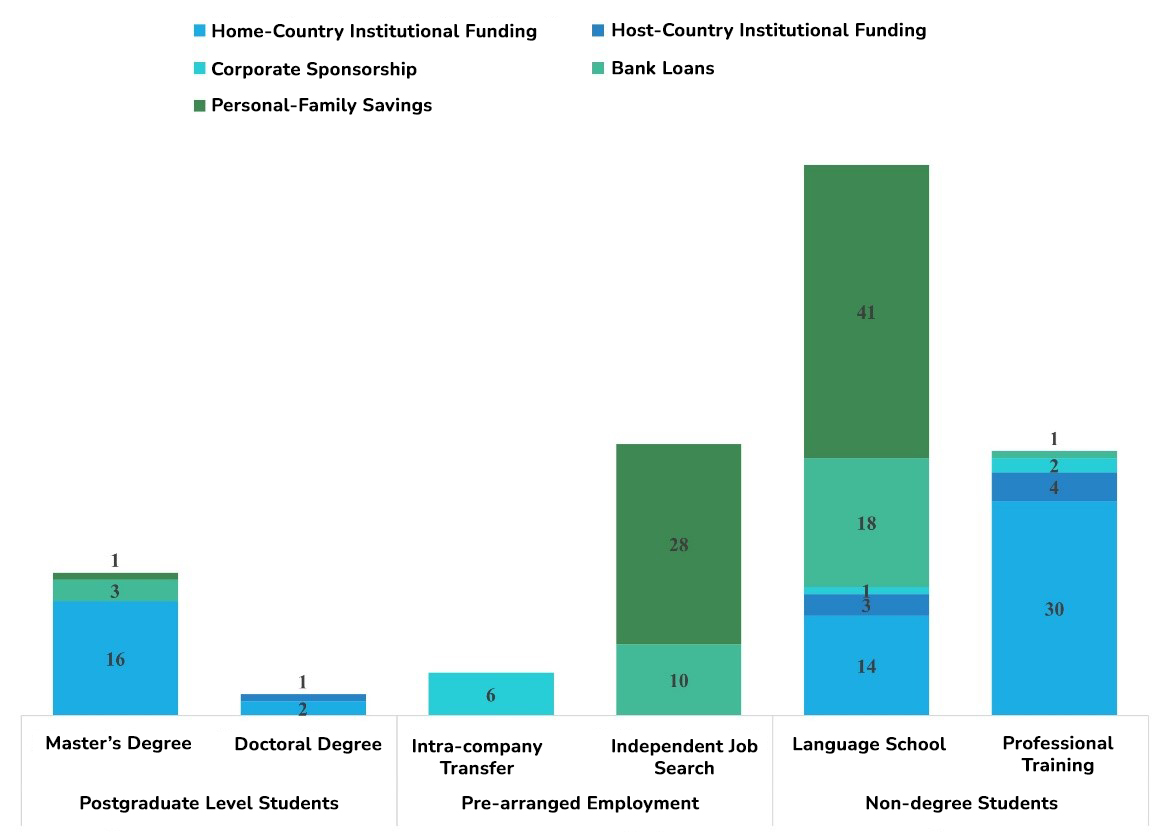
Source: Created by author
Thus, this migration was embedded within specific conditions and layered filters. Educational credentials were essential for visa eligibility. Financial capital was necessary to access entry routes. Corporate transfers required prior integration into multinational firms. Even independent job-seeking pathways presupposed the linguistic skills, savings, and professional qualifications needed to remain legally compliant during the search process.
Access to mobility, therefore, emerged from the interaction between class position, educational capital, and legal opportunity regimes. Participants’ aspirations and destination choices must be understood within this framework of stratified access. Their relatively secure socioeconomic origins facilitated entry into Japan’s skilled migration channels, while the host country’s legal framework shaped the forms of incorporation available to them.
Additionally, as shown in Table 1, the vast majority of participants (94.5%) arrived in Japan as young adults between 2016 and 2019, representing a relatively homogeneous generational cohort. A small minority (5.5%) arrived earlier (2007-2012) and are now part of an older, middle-aged cohort. Given this proportion, year of arrival was not treated as a primary variable. Instead, analysis focused on age of first exposure to Japanese cultural products, which is more theoretically relevant for the formation of social representations.
4. Results
This section analyses the formation of the “representation of Japan” among NNHAPs residing in Japan. The analysis unfolds in four stages: (1) describing the representational domain through prototypical analysis of evocations using the importance-frequency method, (2) mapping connections between categories through semantic network analysis, (3) identifying symbolic orientations via semantic content analysis, and (4) examining the origins of the representation.
4.1. Representational Quadrants
First, this subsection applies the classical quadrant model (Abric, 2001; Vergès, 2003) to construct the structure of social representations. A prototypical analysis of evoked responses was based on the prompt: “Before migrating, what were the most prominent characteristics of Japan that stood out when you considered it as a destination?” For each category, the Total Frequency of Evocation (TFE) and the Average Order of Evocation (AOE) were calculated. Categories below the mean TFE (176.0) were excluded, ensuring data consistency and highlighting those with cognitive salience for further analysis.
Next, the Importance-Frequency method (Abric, 2003) was then applied, replacing evocation order with importance ranking. Participants assigned scores to the categories they had evoked, responding to: “Among the mentioned features of Japan, which are the most important? Please rank them in order of importance.” In total, 24 categories, representational elements, were identified and their aggregated data are presented below.
| Category | Original label in Spanish | TFE | AOE | AOI |
|---|---|---|---|---|
| Excellence | Excelencia | 398 | 2.31 | 2.26 |
| MAG* | Anime, manga y videojuegos | 389 | 2.45 | 2.63 |
| Professionalism | Profesionalismo | 380 | 3.22 | 3.12 |
| Learning | Aprendizaje | 379 | 2.71 | 2.22 |
| Safe | Seguro | 362 | 3.12 | 2.88 |
| Japanese Language | Idioma Japonés | 360 | 3.44 | 3.19 |
| Low immigration | Baja inmigración | 342 | 3.51 | 3.13 |
| Technological | Tecnológico | 233 | 3.12 | 3.12 |
| Economic development | Desarrollo económico | 225 | 3.32 | 3.28 |
| Overwork | Exceso de trabajo | 205 | 2.52 | 2.92 |
| Tradition | Tradición | 205 | 3.29 | 3.14 |
| Conservatism | Conservadurismo | 205 | 3.41 | 3.33 |
| Politeness | Cortesía | 110 | 2.37 | - |
| (Japanese) Food | Comida (japonesa) | 81 | 3.24 | - |
| Beauty | Belleza | 79 | 2.55 | - |
| Outdoors | Aire libre | 79 | 3.72 | - |
| Friendly | Amigable | 75 | 3.65 | - |
| Suicide | Suicidio | 72 | 3.81 | - |
| Earthquake | Terremoto | 12 | 2.71 | - |
| Tsunami | Tsunami | 10 | 2.79 | - |
| Island | Isla | 9 | 3.10 | - |
| Train | Tren | 8 | 2.91 | - |
| Atomic | Atómica | 3 | 3.31 | - |
| Expensive | Costoso | 3 | 3.84 | - |
| Mean | 176.0 | 3.10 | 2.24 |
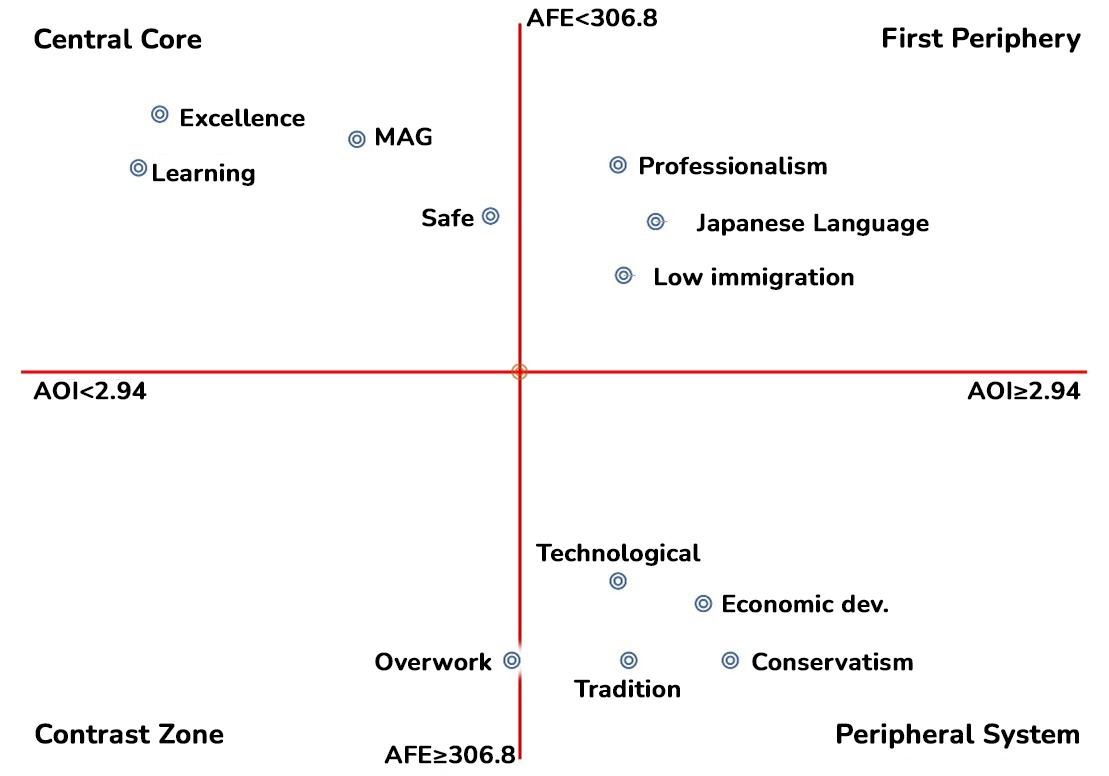
Finally, the quadrant was constructed by combining the Average Order of Importance (AOI) with a recalculated Average Frequency of Evocation (AFE) for the 12 categories above the frequency threshold. Once these thresholds were set, categories were classified according to their updated AFE and AOI values. According to the structural approach to social representations proposed by Jean-Claude Abric, which expands and operationalises the theory developed by Moscovici, the quadrant model is used to analyse the internal organisation of representational content (Abric & Moscovici, 1993; Abric, 2001; Flament, 1994). This model distributes evoked elements into four zones based on two criteria: the frequency of evocation, which reflects the degree of sharedness among participants, and the rank or cognitive importance attributed to each term. The intersection of these two dimensions generates a four-quadrant structure that allows the identification of different representational zones. The distribution of the evoked elements within the four representational zones is presented in Figure 2 below.
The central core (upper left quadrant) comprises elements that are both highly frequent and important, which are stable and foundational to the collective representation. Here, excellence, MAG, learning, and safe form the nucleus, reflecting core values organising perceptions of Japan. The first periphery (upper right) contains frequently evoked but relatively less important elements, professionalism, Japanese language, and low immigration. Positioned near the core, they may reinforce or integrate into it over time, illustrating representational dynamism.
The peripheral system (lower right) includes elements low in both frequency and importance, commonly more dispersed across the population. Economic development, technology, tradition, and conservatism fall here, carrying meaning but lacking centrality, making them more open to change. The contrast zone (lower left) holds elements deemed important but mentioned less frequently, often specific to subgroups. Only overwork appears here, socially recognised yet marginal within the representation. Its limited content underscores the relative weakness of this zone.
The contrast zone (lower left) includes elements considered important but mentioned less frequently, often specific to subgroups. Only overwork appears here, suggesting it is socially recognised yet marginal within the representation. The limited content highlights the relative weakness of this zone. Overall, the quadrants reveal the hierarchical organisation of the representation and set the stage for analysing relational dynamics through semantic network analysis. Overall, the quadrant framework underscores the hierarchical organisation of the representation and provides the basis for examining relational dynamics through semantic network analysis.
Source: Created by the author
4.2. Semantic Network
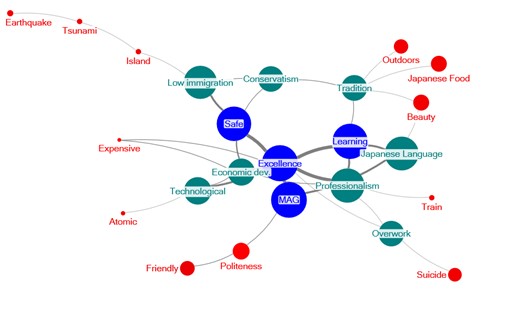
This subsection presents the semantic network comprising all 24 categories identified in the initial analysis, based on the original evocation criteria. The network both validates the previously established social representations and reveals interrelationships among categories. As shown in Figure 3, the visualisation highlights two key dimensions: category importance, indicated by circle diameter, and interconnection, reflected in link presence and thickness. Colour coding follows the quadrant results: core categories in blue, the peripheral system in green, and categories below threshold in red.
Source: Created by the author
The network displays a tightly interlinked cluster of four core categories, excellence, safe, learning, and MAG. These occupy central positions and exhibit strong mutual connections, underscoring their function as backbone signifiers of the representation. Their centrality reflects not only high recall and importance but also a high degree of semantic co-occurrence across participants’ representations. In this sense, they constitute the stable symbolic nucleus that orients the entire representation.
Surrounding the core are several green-coded categories, including Japanese language, professionalism, technological, economic development, tradition, low immigration, and overwork. Although less central, these elements connect to multiple core nodes, indicating their role as mediators that expand the representational meaning system. For example, Japanese language bridges learning and tradition, whereas professionalism links MAG and excellence. This pattern supports the quadrant-based interpretation, in which peripheral elements contribute to the flexibility and adaptability of the representation over time (Abric, 2003). Professionalism is especially notable: its size and the thickness of its core connections suggest its potential to transition into the central structure of the representation.
Red-coded categories (e.g., suicide, expensive, politeness, earthquake) cluster at the network’s margins. Their relative isolation indicates weak integration into the dominant representational structure. However, some, such as suicide, remain loosely connected to important elements (e.g., to professionalism through overwork), revealing a latent ambivalence: while professionalism is valued as part of Japan’s excellence, it is simultaneously shadowed by awareness of its costs. This ambivalence characterises the contrasting zone, where minority perspectives enter the representational field but remain peripheral.
Overall, this case shows a relatively dense and cohesive network, with multiple reinforcing links around the core categories. This suggests a relatively stable representational structure, characterised by internal coherence. Core categories are large, centrally positioned, and strongly interconnected. At the same time, the presence of numerous below-threshold but emotionally charged categories suggests that the representation integrates not only positive symbolic orientations but also latent anxieties, reflecting the ambivalence of Japan’s global image.
4.3. Thematic Orientations
This stage introduces a classification of thematic macro-categories of orientation as an interpretive framework for decoding the symbolic meanings embedded in representational elements. These categories emerged inductively through Grounded Theory coding (Glaser & Strauss, 2017), allowing higher-order symbolic structures to be identified rather than imposed.
The aim is to clarify the meanings expressed by specific elements of representation and the cultural orientations they evoke. Five thematic orientations were identified (Table 3). Cultural Orientation (CO) encompasses identity symbols, traditions, language, and aesthetic codes. Institutional Trust Orientation (ITO) reflects expectations toward formal structures such as government, education, and social norms. Growth-Learning Orientation (GLO) includes values linked to development, learning, and mastery. Risk Aversion Orientation (RAO) emphasises safety, stability, and conservatism. Economic Trust Orientation (ETO) signals confidence in economic systems, productivity, and meritocratic advancement.
| Thematic Orientation | ||||||
|---|---|---|---|---|---|---|
| Representational Elements | TFE | CO | ITO | GLO | RAO | ETO |
| Excellence | 398 | • | • | • | ||
| MAG | 389 | • | ||||
| Professionalism | 380 | • | • | • | ||
| Learning | 379 | • | • | |||
| Safe | 362 | • | • | |||
| Japanese Language | 360 | • | • | |||
| Low immigration | 342 | • | • | |||
| Technological | 233 | • | • | |||
| Economic development | 225 | • | • | |||
| Overwork | 205 | • | ||||
| Tradition | 205 | • | • | • | ||
| Conservatism | 205 | • | • | • | ||
| Category Frequency Weight | 2,521 33.34% | 1,114 14.73% | 1,975 26.12% | 1,114 14.73% | 838 11.08% | |
These orientations show that the image of Japan is composite rather than monolithic: culturally rich, institutionally structured, and future-oriented. Excellence, professionalism, and learning lie at the intersection of CO, GLO, and ITO, signifying legitimacy derived from labour, discipline, and growth: symbolic logics tied to the moralisation of work and validation of skill. Within ITO, excellence also reflects the perceived robustness of institutions, reinforcing the idea that legitimacy is symbolically associated with both cultural values and perceived institutional stability.
MAG falls exclusively within CO, and beyond entertainment, it anchors audio-visual culture and its products. Japanese language bridges CO and GLO by reshaping identity while enabling adaptability through linguistic competence. Safety and low immigration span ITO and RAO, symbolising order and population control. Technological and economic development align with GLO and ETO, highlighting innovation, productivity, and their role as aspirational models of progress. Overwork, primarily within CO, reflects culturally embedded concerns linking productivity and sacrifice to daily life. Tradition and conservatism, spanning CO, ITO, and RAO, illustrate how developmental ideals coexist with valued notions of continuity and structure. Rather than opposing modernity, these elements legitimise it by grounding progress in familiar cultural frameworks.
Frequency counts (Table 3) show that CO dominates the symbolic landscape (2,521), indicating Japan is primarily perceived as a cultural project rooted in heritage and aesthetics. GLO follows (1,975), reinforcing an image of Japan as dynamic, aspirational, and meritocratic. Together, CO and GLO constitute the ideological core, merging tradition with personal development and self-improvement. ETO (838) affirms the link between symbolic value and material legitimacy. ITO and RAO (each 1,114) are less prominent but act as stabilising frameworks, reinforcing perceptions of predictability, structure, and control.
Finally, this raises the question of how such a dense symbolic representation of Japan becomes accessible to individuals without direct ethnic-cultural, geographical, or linguistic base ties. The following section explores the channels through which participants engage with Japan from a distance.
4.4. Origins: Media-Based Engagement
As the historical trajectory has been well documented (Ángulo, 2010; Papalini, 2006), only a brief overview is offered here. Japanese productions entered Latin America in the mid-1960s, when Toei Animation partnered with Mexico’s Televisa to broadcast anime at low cost. During the 1970s and 1980s, series such as Heidi: Girl of the Alps, Candy Candy, and Mazinger Z spread widely across the region. The 1990s marked a peak, with Dragon Ball, Saint Seiya, and Sailor Moon becoming cultural references. In the 2000s, the expansion of cable television, increased internet access, and the rise of online piracy further embedded Japanese visual culture in the everyday lives of Latin American youth.
Generation Y in Hispanic America, defined as those born between 1984 and 1996 (Novella et al., 2018) and forming the majority of this study’s participants, grew up during this digital transformation. Their first encounters with Japan occurred predominantly through animation. Survey data confirm this (see Table 4): nearly 90% of participants identified anime as their initial point of contact with Japanese culture, typically during early childhood (under age 10), with only a small minority first exposed during adolescence or adulthood.
| Media of First Contact | n | % | Age at First Contact | n | % |
|---|---|---|---|---|---|
| Anime | 162 | 89.5 | Under 10 years | 160 | 88.4 |
| Manga | 2 | 1.1 | 10-18 years | 20 | 11 |
| Music | 2 | 1.1 | 18+ years | 1 | 0.6 |
| Movies | 3 | 1.7 | |||
| TV Drama | 8 | 4.4 | |||
| Martial Arts | 4 | 2.2 |
These early encounters fostered enduring interests and attachments to Japan and its cultural products, often framing Japan as a natural migration destination and an integral part of participants’ personal life narratives. A testimony representative of our participants explained.
When I was a kid, anime was always on TV, and almost everyone at school watched the same shows. We’d talk about each episode the next day, and for many of us it became more than just entertainment, it was a kind of refuge from the harder parts of life. That constant exposure is what first got me interested in Japan, and soon I began researching more, even imagining that I might live there someday. Of course, back then it felt strange to say that out loud, as watching anime like everyone else was fine, but wanting to move to Japan because of it was seen as unusual. Still, what’s funny is that once in Japan, when you meet other foreigners your age, the conversation almost naturally turns to the anime and movies we all grew up with, showing how much those childhood experiences shaped our later decisions. (Participant 71, personal communication, January 1, 2024)
Alternatively, participants from the preceding generation (born in the 1960s-70s) described more limited access to Japanese culture. Their encounters, often through series such as Ultraman, Oshin, or Kurosawa films, were sporadic and frequently regarded as niche interests within their peer groups.
I was still a child when I first encountered Japanese shows. Oshin was broadcast in Mexico in the late ’80s, and I remember watching it with my grandmother. Others saw series like Ultraman in the late ’70s or early ’80s. They left a strong impression, but at the time Japan wasn’t nearly as popular as it is today, and without the internet those interests were hard to pursue further. Most kids around us preferred U.S. stuff, so being drawn to Japanese culture felt like a niche fascination. Even so, the idea of going to Japan stayed with us from adolescence, though it only began to feel realistic and accessible much later, around the late 1990s. (Participant 89, personal communication, January 3, 2024)
For the older cohort, Japanese media offered only a distant and marginal cultural reference, overshadowed by the dominant presence of U.S. culture. Generation Y, by contrast, grew up with anime and related media that were widely accessible and socially normalised. Yet, even for this cohort, Japan remained a niche migratory aspiration compared with the far more common orientation toward the United States or Europe.
This generational contrast illustrates how varying socio-cultural contexts conditioned the modes of access to Japanese cultural content. For the older generation, exposure to Japan was limited, individualised, and slow to generate concrete outcomes. Generation Y’s early and collective engagement with Japanese visual culture, however, fostered enduring symbolic attachments that embedded Japan in the affective worlds of Hispanic-American youth and became part of the representational background against which later migration decisions were articulated.
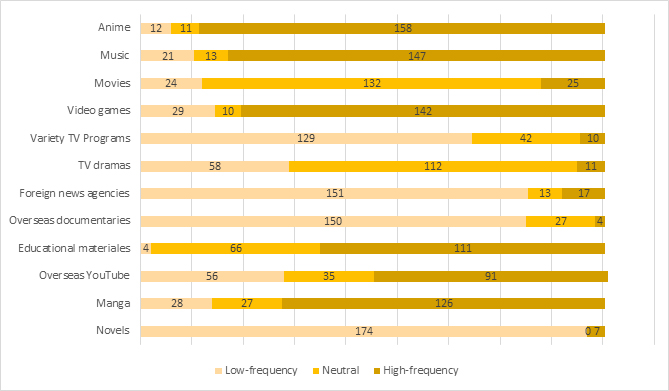
Building on these initial encounters, this sub-section now examines the types of media most actively consumed in the years immediately preceding migration. To analyse this more qualitatively, media, understood as distinct channels of cultural contact, were classified into twelve categories derived from interview coding. A questionnaire administered to all 181 participants measured frequency of use on a five-point Likert scale, later regrouped into three bands for clarity: low (never/rarely), neutral (sometimes), and high (often/always). Responses refer to the five-year period prior to migration.
The results (Figure 4) show a clear hierarchy. The most intensively consumed media were anime (87.3%), music (81.2%), games (78.5%), manga (69.6%), educational institutions/materials (61.3%), and overseas YouTube (50.3%). In contrast, overseas documentaries (82.9%), novels (96.1%), foreign news outlets (83.4%), and general television programs (71.3%) were predominantly low-frequency. Films (72.9%) and dramas (61.9%) occupied an intermediate, neutral-frequency position.
Source: Created by author
Taken together, the findings show that visual and entertainment media were the primary and sustained points of contact with Japan before migration. Rather than isolated encounters, these media became part of participants’ daily routines, carrying early childhood interests into adulthood and serving both as cultural information sources and affective bridges that deepened attachment over time.
No substantial generational differences emerged: participants across age groups consistently engaged with the same media categories. This continuity suggests that their knowledge and images of Japan developed organically through habitual entertainment consumption rather than through deliberate searches for migration-related information. Long-term immersion in popular culture fostered emotionally charged attachments that coexisted with later evaluative considerations.
4.5. Integrative Note
The findings across subsections reveal a coherent social representation of Japan. Quadrant analysis identifies the central nucleus and peripheries, while the semantic network confirms the hierarchical organisation and relationships among representational elements. Thematic orientations clarify the symbolic logic underlying these elements. Early exposure to Japanese media served as a key symbolic entry point for engagement with Japan and its cultural content. Despite generational differences in access, a persistent attachment to Japan appears across cohorts. These results provide the empirical basis for the subsequent discussion, which analyses anchoring and objectification through Social Representations Theory.
5. Discussion
This study examined the pre-migratory social representation of Japan among NNHAPs. The findings reveal a structured symbolic field through which Japan was imagined prior to migration. Cultural products, particularly animation, were incorporated into everyday practices and familiar cognitive categories. For Generation Y, these media became embedded in youth culture and peer interaction, while older participants encountered Japan through more limited but still formative cultural media such as serialised dramas like Oshin. In both cases, cultural consumption anchored and normalised Japan as an object of conversation, curiosity, and aspiration.
Cultural images thus became stable and emotionally charged symbolic references reinforced through repeated media exposure. Abstract notions such as discipline, excellence, safety, and cultural uniqueness were objectified into recognisable symbolic forms, whether through the perceived quality of anime, images of social order, or narratives of mastery and dedication. These representational elements provided interpretive coherence and a normative orientation for participants’ imaginaries of Japan. Migration can therefore be interpreted as the realisation of a previously objectified and internalised symbolic horizon.
Quadrant and semantic network analyses confirm the stability of the representation’s internal structure. The central core, excellence, MAG (contemporary Japan’s global cultural capital), learning, and safety, anchors the representational system. The first periphery, professionalism, Japanese language, and low immigration, reinforces the nucleus with meanings related to discipline, integration, and institutional regulation. Peripheral and contrast elements, such as overwork, reflect more flexible or ambivalent aspects of the representation. From the standpoint of representational typology (Moscovici, 1988), this configuration is best understood as emancipated: it is shared primarily within this subgroup and functions as an internally meaningful interpretive framework. It is neither constructed in opposition to representations of more conventional migration destinations nor does it appear to directly challenge broader hegemonic depictions of Japan. At the same time, admiration for cultural and institutional strengths coexists with awareness of potential tensions, illustrating how diverse symbolic orientations coexist within a relatively coherent representational structure, which is an expression of cognitive polyphasia.
This structural configuration helps explain the thematic orientations that organise participants’ imaginaries of Japan. Cultural and growth-learning orientations dominate, positioning Japan as a site of discipline, identity formation, and self-development. Economic and institutional trust, together with risk awareness, provide stabilising background meanings that frame Japan as (more) predictable and meritocratic. Within this symbolic configuration, Japan emerges not simply as a labour market but as a valued horizon of aspiration. Consistent with this interpretation, only 6.1% of participants reported having considered other destinations prior to migration, indicating that mobility was oriented toward a specific imagined social and cultural order rather than toward a set of interchangeable migration alternatives.
While Social Representations Theory provides the primary analytical framework, complementary perspectives help illuminate particular dimensions of the findings. Self-Determination Theory (SDT) (Deci & Ryan, 2000) helps interpret the motivational orientations expressed in participants’ narratives. Engagement with cultural knowledge, language learning, and professional preparation prior to relocation can be understood as expressions of autonomy, competence, and relatedness. At the same time, Bourdieu’s notion of illusio (1979/1998) provides a metaphorical lens for understanding the intensity of symbolic investment observed in participants’ accounts. Pre-migration engagement can be interpreted as a form of symbolic investment in a valued social field, where cultural familiarity, linguistic competence, and media literacy function as markers of imagined legitimacy.
These perspectives suggest that pre-migratory representations operated as symbolic prefiguration of migration within participants’ imaginaries. Cultural fascination, media engagement, and skill acquisition prior to relocation were not merely informational activities but socially embedded practices through which participants oriented themselves toward a desired future trajectory. Although subsequent experiences in Japan may reshape these representations, early symbolic investments appear to have provided a durable interpretive template through which migration decisions were later articulated.
Historical comparison further contextualises these findings. Nikkei migration to Japan was structured largely through family networks and intermediary organisations (Higuchi, 2002; Higuchi et al., 2003). In contrast, the contemporary non-Nikkei professionals examined here operate outside these historical frameworks, reflecting a distinct migration context. Cultural consumption instead functioned as a key symbolic intermediary, illustrating how representational infrastructures can substitute for traditional migration networks in shaping mobility trajectories.
At a broader contextual level, these patterns resonate with discussions of soft power (Nye, 2004), which describe how states project cultural influence internationally, as well as with cultural consumption theory (Canclini, 2012), which emphasises how media participation contributes to the development of identity and personal narratives. From a macro-sociological perspective, processes of individualisation of contemporary human experience (Beck & Beck-Gernsheim, 2002) suggest that migration aspirations may be framed as highly personal life projects. However, the present findings indicate that immigrants from diverse backgrounds share a remarkably coherent representation of Japan, raising the question of how far individualisation operates within contexts of shared cultural consumption and soft power. In the present study, these macro-level dynamics primarily serve as contextual background, while the analytical focus remains on how individuals and subgroups appropriate, reinterpret, and stabilise circulating symbols within shared representational systems, through which migration imaginaries acquire meaning and coherence.
The relationship between structural conditions and symbolic imaginaries is therefore best understood as a process of mediated articulation. Structural opportunities acquire aspirational meaning through shared symbolic imaginaries. Macro-level dynamics, such as global media circulation, digital globalisation, and shifting geopolitical imaginaries, shape the broader environment in which representations emerge. Yet it is through socially shared systems of meaning that these contexts become emotionally invested and collectively legitimised as migration horizons.
More broadly, the findings contribute to migration scholarship by highlighting the role of culturally mediated imaginaries in shaping migration aspirations. Long-term cultural engagement formed part of the symbolic and emotional scaffolding through which migration projects were later articulated, suggesting that migration decisions are embedded in shared systems of meaning rather than emerging solely from structural opportunity or economic calculation.
6. Conclusion
This study shows that Japan occupies a distinctive place in the pre-migratory imaginaries of non-Nikkei Hispano-American professionals. Participants constructed a relatively stable representation linking the country to discipline, excellence, safety, and opportunities for personal and professional development. Early and sustained engagement with Japanese visual culture contributed to consolidating these meanings, allowing Japan to emerge as a horizon of aspiration long before direct experience.
The representational structure identified through quadrant and semantic network analyses reveals both coherence and plurality. Cultural and growth-learning orientations occupy a central position, while institutional trust, economic confidence, and risk awareness provide complementary meanings that stabilise the representation. In this configuration, Japan appears not only as an employment destination but as a valued space associated with mastery, self-formation, and social recognition.
Generational comparison indicates that whereas older participants encountered Japan through more limited media channels, younger cohorts experienced more pervasive and normalised forms of cultural exposure. Despite these differences in intensity, the shared representational structure persisted across cohorts, supporting its characterisation as a subgroup-specific interpretive framework.
By focusing on non-Nikkei Hispanic American professionals, this study draws attention to a migration corridor that remains largely underexplored in existing research. More broadly, the findings highlight the importance of symbolic and cultural processes in shaping how migration destinations acquire aspirational meaning. Migration aspirations emerge not only from structural opportunities but also from shared systems of meaning that precede and orient mobility projects.
Some limitations should be acknowledged. The qualitative case-study design and focus on highly educated professionals limit the generalisability of the findings to other migrant populations. The study focuses on migrants’ own meaning-making processes and does not directly examine the content produced by media industries or institutional actors. In addition, the data are retrospective: participants can only reconstruct their pre-migratory perceptions once they have settled in Japan. The findings are also historically situated, reflecting cohorts socialised under conditions of digital globalisation and specific regional transformations in Hispanic America.
Future research could extend this line of inquiry through longitudinal designs that trace how representations evolve across the full migration trajectory, including post-migration transformations. Comparative research across different social groups and migration destinations would also help clarify how symbolic imaginaries vary across contexts. Methodological diversification, including computational approaches to discourse analysis, may further expand analytical depth. Greater attention to the tensions between migration imaginaries, expectations, and lived experiences also represents a promising direction for further research.
Overall, the findings suggest that understanding contemporary migration requires attention not only to structural conditions but also to the symbolic frameworks through which destinations become meaningful in aspirational terms. By foregrounding the representational dimensions of pre-migratory engagement, this study contributes to a more culturally and cognitively informed understanding of long-distance professional mobility.
Ethical Considerations
All research adheres to Kyoto University’s ethical guidelines and those of the Japanese Sociological Society (JSS). Purpose and privacy measures were explained, and prior informed consent was obtained.
Disclosure AI usage
Claude AI (Anthropic, Claude 4, August 2025) was used to assist with compression of paragraphs during manuscript preparation. All text was carefully reviewed, corrected, and revised by the author as needed. The author takes full responsibility for the accuracy, interpretation, and final content of the manuscript.
Data Availability Statement
All information supporting this research will be archived as a PhD dissertation at the Graduate School of Education Library, Kyoto University, in accordance with the university’s regulations. The data have been anonymised following the guidelines of the university and the Japanese Sociological Society (JSS). The data can be accessed under the author’s name.
Acknowledgements
Thanks to the Graduate School of Education, Kyoto University, for academic guidance.
References
Abric, J. C. (2001). A structural approach to social representations. In K. Deaux & G. Philogène (eds.), Representations of the social (pp. 42-47). Blackwell.
Abric, J. C. (2003). La recherche du noyau central et de la zone muette des représentations sociales. In J. C. Abric (dir.), Méthodes d’étude des représentations sociales (pp. 59-80). ERES. https://doi.org/10.3917/eres.abric.2003.01.0059
Abric, J. C., & Moscovici, S. (1993). Central system, peripheral system: Their functions and roles in the dynamics of social representations. Papers on Social Representations, 2, 75-78.
Ángulo, M. (2010). La conquista de América Latina por el anime. JSpot Panamá.
Beck, U., & Beck-Gernsheim, E. (2002). Individualization: Institutionalized individualism and its social and political consequences. SAGE Publications Ltd. https://doi.org/10.4135/9781446218693
Bourdieu, P. (1979/1998). La Distinción. Criterio y bases sociales del gusto. Taurus.
Burgos Flores, B., & López Montes, K. (2010). La situación del mercado laboral de profesionistas. Revista de la Educación Superior, 39(156), 19-33.
Canclini, N. G. (2012). Consumidores y ciudadanos: Conflictos multiculturales de la globalización. Grijalbo, Debolsillo.
Castles, S., Haas, H., & Miller, M. J. (2014). The age of migration: International population movements in the modern world (5th ed.). The Guilford Press.
Csardi, G., & Nepusz, T. (2006). The igraph software package for complex network research. InterJournal, Complex Systems, 1695, 1-9.
De Carvalho, D. (2003). Migrants and identity in Japan and Brazil: The Nikkeijin. Routledge. https://doi.org/10.4324/9780203220719
Deci, E. L., & Ryan, R. M. (2000). The “what” and “why” of goal pursuits: Human needs and the self-determination of behavior. Psychological Inquiry, 11(4), 227-268. https://doi.org/10.1207/S15327965PLI1104_01
Denzin, N. K. (2012). Triangulation 2.0. Journal of Mixed Methods Research, 6(1), 80-88. https://doi.org/10.1177/1558689812437186
Docquier, F., & Rapoport, H. (2012). Globalization, brain drain, and development. Journal of Economic Literature, 50(3), 681-730. https://doi.org/10.1257/jel.50.3.681
Etikan, I., Alkassim, R., & Abubakar, S. (2016). Comparison of snowball sampling and sequential sampling technique. Biometrics and Biostatistics International Journal, 3(1), 55-61. https://doi.org/10.15406/bbij.2016.03.00055
Filgueira, C. (1976). Predisposición migratoria: La situación de egresados profesionales [Migratory predisposition: The situation of professional graduates]. Centro de Informaciones y Estudios del Uruguay (CIESU)s.
Flament, C. (1981). L’analyse de similitude: Une technique pour les recherches sur les représentations sociales. Cahiers de Psychologie Cognitive, 1, 375-395.
Flament, C. (1994). Structure et dynamique des représentations sociales. In D. Jodelet (ed.), Les représentations sociales (pp. 204-219). Presses Universitaires de France.
Glaser, B. G. (2008). The constant comparative method of qualitative analysis. Grounded Theory Review, 7(3), 3-12.
Glaser, B. G., & Strauss, A. L. (2017). The discovery of grounded theory: Strategies for qualitative research. Routledge. https://doi.org/10.4324/9780203793206
Hashimoto, Y. (2017). Highly skilled immigrants’ occupational choices and the Japanese employment system (RIETI Discussion Paper Series 17-E-059). Research Institute of Economy, Trade and Industry. https://www.rieti.go.jp/jp/publications/dp/17e059.pdf
Herman, A., Andersen, J. P., & Nielsen, M. W. (2024). Brain drain outweighs brain circulation between the Global North and South [Preprint]. https://doi.org/10.31219/osf.io/a7fcm
Higuchi, N. (2002). Kokusai imin ni okeru mezo-reberu no ichizuke: Makuromikuro moderu o koete. Shakaigaku Hyōron [The meso-level in international migration: Beyond the macro-micro model], 52(4), 558-572. https://doi.org/10.4057/jsr.52.558
Higuchi, N. (2010). Toshi esunishiti kenkyū no saikōchiku ni mukete: Toshi shakai gakusha wa nani o minai dekita no ka [Toward a reconstruction of urban ethnic studies: A critique]. Nenpō Shakaigakuron-shū, (23), 153-164.
Higuchi, N., Higuchi, K., & Tanno, K. (2003). What’s driving Brazil-Japan migration? The making and remaking of the Brazilian niche in Japan. International Journal of Japanese Sociology, 12(1), 33-47. https://doi.org/10.1111/j.1475-6781.2003.00041.x
Höijer, B. (2010). Emotional anchoring and objectification in the media reporting on climate change. Public Understanding of Science, 19(6), 717-731. https://doi.org/10.1177/0963662509348863
Höijer, B., & Olausson, U. (2012). The role of the media in the transformation of citizens’ social representations of suffering. In M. M. Jovchelovitch & B. G. Moscovici (eds.), Education, professionalization and social representations (pp. 224-241). Routledge.
Hollifield, J. F., & Sharpe, M. O. (2017). Japan as an “emerging migration state”. International Relations of the Asia-Pacific, 17(3), 371-400. https://doi.org/10.1093/irap/lcx013
International Organization for Migration. (2022). World migration report 2022 (M. McAuliffe & A. Triandafyllidou, eds.). https://publications.iom.int/books/world-migration-report-2022
Ishida, C. (2009). The dynamism of the “Nikkei” category after the amendment of Japanese immigration law in 1990: The process of “giving names”. Core Ethics, 5.
Jodelet, D. (2008). Social representations: The beautiful invention. Journal for the Theory of Social Behaviour, 38(4), 411-430. https://doi.org/10.1111/j.1468-5914.2008.00383.x
Joia, L. A., Michelotto, F., & Lorenzo, M. (2022). Sustainability and the social representation of the COVID-19 pandemic: A missing link. Sustainability, 14(17), 10527. https://doi.org/10.3390/su141710527
Kajita, T. (1994). Gaikokujin rōdōsha to Nihon [Foreign workers and Japan]. Nihon Hōsō Shuppan Kyōkai.
Kajita, T., Tanno, K., & Higuchi, N. (2005). Kao no mienai teijūka: Nikkei Burajirujin to kokka, shijō, imin nettowāku [Invisible settlement: Japanese Brazilians, the state, market, and migration networks]. Nagoya University Press.
Kamibayashi, C. (2015). Gaikokujin rōdōsha ukeire to Nihon shakai: Ginō jisshū seido no tenkai to jirenma [Acceptance of foreign workers and Japanese society: Development and dilemma of the technical intern training program]. Tōkyō Daigaku Shuppankai.
King, R., & Wood, N. (2013). Media and migration: Constructions of mobility and difference. Routledge. https://doi.org/10.4324/9780203458549
Liu, T., Chen, X., & Lin, Z. (2024). Mainstreams, mavericks, misfits, and amphibians: On the mainstreaming, platformisation, and re-conventionalisation of the former home of Chinese ACGN. China Perspectives, 136, 75-86. https://doi.org/10.4000/chinaperspectives.16627
McGregor, E., & Siegel, M. (2013). Social media and migration research. United Nations University - Maastricht Economic and Social Research Institute on Innovation and Technology (MERIT).
Mellenbergh, G. J. (2008). Tests and questionnaires: Construction and administration. In H. J. Adèr (ed.), Advising on research methods: A consultant’s companion (pp. 211-236). Johannes van Kessel Publishing.
Morawska, E. (1990). The sociology and historiography of immigration. In V. Yans-McLaughlin (ed.), Immigration reconsidered: History, sociology, and politics. Oxford University Press. https://doi.org/10.1093/acprof:oso/9780195055108.003.0008
Moscovici, S. (1961). La psychanalyse, son image et son public. Presses Universitaires de France.
Moscovici, S. (1984). The phenomenon of social representation. In R. M. Farr & S. Moscovici (eds.), Social representations. Cambridge University Press.
Moscovici, S. (1988). Notes towards a description of social representations. European Journal of Social Psychology, 18(3), 211-250. https://doi.org/10.1002/ejsp.2420180303
Moscovici, S. (2001). Social representations: Explorations in social psychology. New York University Press.
Neubauer, J. (2024). Envisioning futures at new destinations: geographical imaginaries and migration aspirations of Nepali migrants moving to Malta. Journal of Ethnic and Migration Studies, 50(12), 3049-3068. https://doi.org/10.1080/1369183X.2024.2305281
Novella, R., Repetto, A., Robino, C., & Rucci, G. (2018). Millennials en América Latina y el Caribe: ¿Trabajar o estudiar? Inter-American Development Bank. https://doi.org/10.18235/0001410
Nye, J. S. (2004). Soft power: The means to success in world politics (Y. Yamaoka, Trans.). Nikkei BP Marketing Inc.
Olausson, U. (2011). “We’re the ones to blame:” Citizens’ representations of climate change and the role of the media. Environmental Communication, 5(3), 281-299. https://doi.org/10.1080/17524032.2011.585026
Papalini, V. (2006). Anime: Mundos tecnológicos, animación japonesa e imaginario social. Editorial La Crujía.
Parker, C., Scott, S., & Geddes, A. (2019). Snowball sampling. In P. Atkinson, S. Delamont, A. Cernat, J. W. Sakshaug & R. A. Williams (eds.), SAGE research methods foundations. SAGE.
Pellegrino, A. (2001a). ¿Drenaje o éxodo? Reflexiones sobre la migración calificada. Universidad de la República de Uruguay, Facultad de Ciencias Sociales - Programa Población.
Pellegrino, A. (2001b). Drenaje, movilidad, circulación: Nuevas modalidades de la migración calificada. Notas de Población, 73(September), 129-162.
Piffaut Gálvez, M. A. (2020a). Nihon ni okeru Isupano-Amerika-jin Nihon bunka fan no jissen to aidentiti: Fan bunka no naibuteki na bunri to kyōtsūten no jirei [Identity and practice of Hispanoamerican fans of Japanese culture in Japan: A case of separation and common points within fan culture]. Kyōiku Shakai Bunka: Kenkyū Kiyō, 20, 29-48. http://hdl.handle.net/2433/250844
Piffaut Gálvez, M. A. (2020b). Iminsha dōshi no aidentiti kōchiku katei ni okeru shakō: Kansai chihō ni kyoju suru isupanoamericajin no jirei ni chakumokushite [Sociability in the identity building process among immigrants: Focusing on the case of Hispano-Americans living in the Kansai region] (Master’s thesis). Kyoto University.
Piffaut Gálvez, M. A. (2023a). Exploring migration profiles of professional Hispano-Americans in Japan, China, and South Korea: Socio-structural tensions in Hispano-America and aspirations in East Asia. Journal of Identity and Migration Studies, 17(2), 17-164.
Piffaut Gálvez, M. A. (2023b). Professional Hispano-Americans in China: Influence of Chinese soft power on immigration motivation. Culturales, 11, 1-32. https://doi.org/10.22234/recu.20231101.e759
Piffaut Gálvez, M. A. (2023c). Professional Hispano-American immigrants in South Korea: A case study of the influence of Korean mass media on Generation Y immigration motivation. Journal of Identity and Migration Studies, 17(1), 2-20.
Piffaut Gálvez, M. A. (2023d). Zainichi hi nikkei isupanoamerika hito no burakkuyūmoa: Toransunashonaruna shakai-teki sōgo sayō e no eikyō [Black humor among non-Nikkei Hispano-Americans in Japan: Its influence on transnational social interactions]. Kyōiku Shakai Bunka: Kenkyū Kiyō, 23, 1-13. http://hdl.handle.net/2433/279546
Piffaut Gálvez, M. A. (2023e). Zainichi hi-Nikkei Isupanoamerikajin to Nihon eizō bunka: Eizō bunka ga imin dōkitsuke ni oyobosu eikyōryoku ni tsuite no kōsatsu [Non-Nikkei Hispano-Americans in Japan and Japanese visual culture: Consideration of the influence of visual culture on immigration motivation]. Kyoto Daigaku Daigakuin Kyōikugaku Kenkyū-ka Kiyō, 69, 95-108. http://hdl.handle.net/2433/281954
Pizarro, J. M. (2009). What is the future for Latin American migration? OECD Journal: General Papers, 4, 129-159.
Portes, A. (1997). Immigration theory for a new century: Some problems and opportunities. International Migration Review, 31(4), 799-825. https://doi.org/10.1177/019791839703100402
Rahimi, S., & Khatooni, M. (2024). Saturation in qualitative research: An evolutionary concept analysis. International Journal of Nursing Studies Advances, 6, 100174. https://doi.org/10.1016/j.ijnsa.2024.100174
Rateau, P., Moliner, P., Guimelli, C., & Abric, J. C. (2011). Social representation theory. In P. A. M. Van Lange, A. W. Kruglanski & E. T. Higgins (eds.), Handbook of theories of social psychology (Vol. 2, pp. 477-497). Sage Publications. https://doi.org/10.4135/9781446249222.n50
Ratinaud, P., & Marchand, P. (2012). Application de la méthode ALCESTE à de “gros” corpus et stabilité des “mondes lexicaux:” Analyse du “CableGate” avec IRaMuTeQ. Actes des 11èmes Journées Internationales d’Analyse Statistique des Données Textuelles, 835-844.
Ravenstein, E. G. (1885). The laws of migration. Journal of the Statistical Society of London, 48(2), 167-235. https://doi.org/10.2307/2979181
Roberts, G. S. (2018). An immigration policy by any other name: Semantics of immigration to Japan. Social Science Japan Journal, 21(1), 89-102. https://doi.org/10.1093/ssjj/jyx033
Russell, P. F., & Rao, T. R. (1940). On habitat and association of species of anopheline larvae in south-eastern Madras. Journal of the Malaria Institute of India, 3, 153-178.
Sá, C. P. D. (1996). Representações sociais: Teoria e pesquisa do núcleo central. Temas em Psicologia, 4(2), 19-33.
Statistics Bureau, Ministry of Justice. (2025). Zairyū gaikokujin tōkei [Statistics on foreign residents 2025].
Steinke, I. (2004). Quality criteria in qualitative research. In U. Flick, E. Kardorff & I. Steinke (eds.), A companion to qualitative research (pp. 184-190). Sage Publications.
Stella, M., & Kenett, Y. N. (2019). Viability in multiplex lexical networks and machine learning characterizes human creativity. Big Data and Cognitive Computing, 3(1), 1-19. https://doi.org/10.3390/bdcc3030045
Sugiyama, K., & Misue, K. (1991). Visualization of structural information: Automatic drawing of compound digraphs. IEEE Transactions on Systems, Man, and Cybernetics, 21(4), 876-892. https://doi.org/10.1109/21.108304
Takenaka, A., Nakamuro, M., & Ishida, K. (2016). Negative assimilation: How immigrants experience economic mobility in Japan. International Migration Review, 50(2), 506-533. https://doi.org/10.1111/imre.12129
Takenoshita, H. (2006). The differential incorporation into Japanese labor market: A comparative study of Japanese Brazilians and professional Chinese migrants. The Japanese Journal of Population, 4(1), 56-77.
Takenoshita, H. (2013). Labour market flexibilisation and the disadvantages of immigrant employment: Japanese-Brazilian immigrants in Japan. Journal of Ethnic and Migration Studies, 39(7), 1177-1195. https://doi.org/10.1080/1369183X.2013.778140
Thomas, W. I., & Znaniecki, F. (2006). The Polish peasant in Europe and America (vol. 3). Boletín Oficial del Estado.
Torres Martínez, R. (2016). Sobre el concepto de América Latina ¿Invención francesa? Cahiers d’Études Romanes, 32, 89-98. https://doi.org/10.4000/etudesromanes.5141
Tsuda, T. (2003). Strangers in the ethnic homeland: Japanese Brazilian return migration in transnational perspective. Columbia University Press. https://doi.org/10.7312/tsud12838
Tsuda, T. (2022). Racism without racial difference? Co-ethnic racism and national hierarchies among Nikkeijin ethnic return migrants in Japan. Ethnic and Racial Studies, 45(4), 595-615. https://doi.org/10.1080/01419870.2021.1993296
United Nations, Department of Economic and Social Affairs, Population Division. (2024). International migration and sustainable development (UN DESA/POP/2023/TR/NO. 7).
Urbanski, E. (1978). Hispanic America and its civilization: Spanish Americans and Anglo-Americans. University of Oklahoma Press.
Vergès, P. (2003). Set of programs for analysis of evocations: Manual version October 15. Laboratoire Méditerranéen de Sociologie (LAMES).
Viola, L., & Musolff, A. (2019). Migration and media: Discourses about identities in crisis. John Benjamins Publishing Company. https://doi.org/10.1075/dapsac.81
Voicu, M., & Babonea, A. (2011). Using the snowball method in marketing research on hidden populations. Challenges of the Knowledge Society, 1, 1335-1349.
Wachelke, J., & Contarello, A. (2011). Italian students’ social representation on aging: An exploratory study of a representational system. Psicologia: Reflexão e Crítica, 24, 551-560. https://doi.org/10.1590/S0102-79722011000300016
Yamanaka, K. (1996). Return migration of Japanese-Brazilians to Japan: The Nikkeijin as ethnic minority and political construct. Diaspora: A Journal of Transnational Studies, 5(1), 65-97. https://doi.org/10.3138/diaspora.5.1.65
Yin, R. K. (2014). Case study research: Design and methods (5th ed.). Sage Publications.