Insularidad, movilidad humana y desfase: perspectivas desde El Hierro, Islas Canarias, España



The relationship between left-behindness and islandness is intricate and multifaceted. Small and peripheral islands are particularly susceptible to environmental challenges and economic downturns due to their limited resources for survival, which have historically shaped them as left-behind areas. However, while islands have long been viewed as places of departure, they also function as hubs for migrants, asylum seekers, tourists, and returnees, i.e., as spaces collectively modelled by human mobility. Therefore, islands are both peripheral and interconnected spaces, with relationality forming the core of islandness. The “relational isolation” is exemplified by the case of El Hierro in the Canary Islands, where human mobility may contribute to the mitigation of left-behindness.
This analytical perspective is explored using statistical data that elucidates trends in human mobility, complemented by interviews with both migrants and stayers. These qualitative accounts offer critical insights into the migratory experience and its complex relationship with islandness.
La relación entre la condición de área rezagada (left-behindness) y la insularidad es compleja y multifacética. Las islas pequeñas y periféricas son especialmente vulnerables a los desafíos medioambientales y a las crisis económicas debido a la limitada disponibilidad de recursos para la subsistencia, lo que históricamente ha contribuido a configurarlas como lugares rezagados. Sin embargo, si bien las islas han sido tradicionalmente concebidas como espacios de partida, también funcionan como nodos de tránsito y recepción de migrantes, solicitantes de asilo, turistas y retornados; es decir, como espacios configurados colectivamente por la movilidad humana. Por tanto, las islas son espacios simultáneamente periféricos e interconectados, donde la relacionalidad constituye el núcleo mismo de la insularidad. Esta “insularidad relacional” se ejemplifica en el caso de El Hierro, en las Islas Canarias, donde la movilidad humana puede contribuir a mitigar la condición de espacio rezagado.
Esta perspectiva analítica se aborda a partir de datos estadísticos que revelan las tendencias de la movilidad y que se complementan con entrevistas tanto a migrantes como a quienes permanecen en la isla. Estos testimonios cualitativos aportan matices fundamentales para comprender la experiencia migratoria y su compleja relación con la insularidad.

Left-behindness; islandness; human mobility; El Hierro (Canary Islands -Spain)
Left-behindness; insularidad; movilidad humana; El Hierro (Canarias-España)

1. Introduction
Small and peripheral islands are often boxed into narratives that cast them as marginal, fragile, or lagging behind the centres of political and economic power. Anchored in geography and history, this framing has highlighted structural constraints—a narrow productive base, scarce natural resources, external dependence—while overlooking their capacity for connection and transformation. Recent shifts in island studies and migration research argue for a relational lens: islands are not isolated territories but nodes of mobility that continually recalibrate their place in global space (Stratford et al., 2011). From this perspective, the central question is not simply why islands are considered “left behind,” but under what conditions human mobility can help to reverse this situation.
This article turns to El Hierro, the smallest and most peripheral of the Canary Islands, long defined by mass out-migration, population ageing, and a lack of economic opportunities. Yet in recent decades it has seen diverse migratory flows—return migration, international immigration, lifestyle migration, tourist mobilities—alongside significant shifts in its development model. Hence the guiding research question: to what extent, and through which mechanisms, can human mobility help an island space such as El Hierro overcome a left-behind status?
Our aim is to analyse the impact that human mobility has had—and continues to have—on the island, testing the hypothesis that mobility helps surmount its lagging condition. Specifically, we examine the deferred effects of historical emigration ties; the interconnection between tourist and labour mobilities; and the sustained external attraction exerted on young people with higher levels of education. All this within a context of improving wellbeing indicators and island-wide socio-economic development. Empirically, our findings reconceptualise left-behindness and islandness not as static conditions of peripherality, but as dynamic, mobility-shaped processes through which external ties, circulation, and aspirations actively reconfigure insular development trajectories.
Statistical evidence revealing these trends is paired with the views, observations, and assessments of interviewees (residents, emigrants, and immigrants) regarding migration itself. On this basis, the study proceeds as follows: first, a review of the state of the art, centred on key concepts such as left-behindness and islandness; second, a presentation of sources and methods. Then the results are set out, distinguishing quantitative findings from qualitative insights, with particular attention to first-person accounts of migration and to interviewees’ appraisals of immigration’s imprint on everyday island life. The discussion and conclusions return to the central claim: that human mobility enables a supposed left-behind island to rework its condition and, in doing so, to raise levels of wellbeing.
2. Background
This study is part of a growing field that examines how human mobility can, at least partially, offset the condition of backwardness often associated with island spaces. Research in the mid-Atlantic and northern Europe has shown that return migration and diasporas act as levers for investment and territorial regeneration. In European contexts, the case of Pico (Azores) illustrates how immigration, linked to low-density tourism, helps diversify the productive base and fosters entrepreneurial ventures that revitalise stagnant economies (Mendoza et al., 2025a). In Madeira, mobility and transnational trajectories have proved crucial in the creation of business initiatives within a peripheral territory marked by structural limitations (Freitas, 2024). Finally, experiences in Gozo (Malta) and in Orkney and Shetland (Scotland) show how the circular mobility of young professionals and the role of diasporas can redefine the position of these islands, shifting them from narratives of left-behindness towards that of “active peripheries,” strategically interconnected. Taken together, these studies converge in demonstrating that islandness does not necessarily mean immobility or underdevelopment; rather, it can become a relational advantage, provided that mobility translates into local capacities and can be supported by policies that anchor human, economic, and cultural capital.
Within this theoretical framework, we will explore in greater depth the two key concepts guiding this research—left-behindness and islandness—before presenting some territorial features of the island under analysis.
2.1. Left-Behindness
The term left-behindness has gained increasing traction in scientific debate since the economic crisis of 2008, coming to describe the condition of places where development has been minimal, stalled, or slowed in contrast to more successful areas that have emerged as protagonists of socio-economic progress. It is a global phenomenon, but one that has become particularly salient in European academic debate, with specific manifestations across different states. In Spain, for instance, it resonates strongly within the context of the so-called España vaciada (emptied Spain) (Pike et al., 2024; Pulido Fernández et al., 2022; Cortés-Ruiz & Ibar-Alonso, 2021).
Yet left-behindness is not an entirely new concept. It has long circulated in political discourse, gaining greater visibility from the second decade of the twenty-first century onwards. It often invokes a collective moral responsibility towards socially disadvantaged areas and, by extension, towards discontented social groups (Fiorentino et al., 2024; Karasz et al., 2025). Empirical studies across Europe show how long-term deprivation, perceived decline, and uneven development trajectories nurture sentiments of abandonment closely tied to broader geographies of discontent (Le Petit-Guerin et al., 2025; Royer & Leibert, 2024; Houlden et al., 2024).
In today’s context, the phenomenon points to situations of divergence that challenge territorial cohesion—situations that extend beyond economic disparities and foreground demographic and social factors (Velthuis et al., 2025). This makes it essential to ground any analysis of lagging regions in data that capture wellbeing conditions. A useful tool for identifying such areas is the Regional Human Development Index (Sandu, 2024), which assesses human progress in terms of health, human capital, and material capital.1
Equally important are the qualitative insights provided by residents’ views, assessments, and feelings, which help clarify how the dynamics of left-behindness evolve over time (Panori et al., 2025) and, in turn, how such conditions might be overcome.
Traditionally, the notion of left-behind has been linked to the disadvantage of immobility. Migration research has often focused on areas of high out-migration where older, less skilled populations—with fewer transformative initiatives than younger cohorts typically undertake—have contributed to a persistent decline. Some studies still use the term “abandoned” to describe rural areas and small towns that have endured decades of depopulation and entrenched problems, such as poverty and low skills (Martin et al., 2021). For this reason, any discussion of left-behindness must be tied to a longitudinal analysis of human mobility.
2.2. Islandness
Many small islands have historically faced disadvantages tied to their limited size, isolation, remoteness, and scarce resources for survival—a geographic handicap defined by location and by the relationship between resources and population. Since the second decade of the twenty-first century, however, a significant shift has emerged in the way island spaces are conceptualised. This perspective stresses their relational character (Stratford et al., 2011; Pugh, 2013, 2018) as the very essence that allows us to move beyond static notions of islands, highlighting instead their mobile, multiple, and interconnected forms of contact. In this light, islands exemplify how uniqueness, culture, and even isolation is shaped by complex material and social interrelations forged through a long history of connections with other geographical spaces (Baldacchino & Starc, 2021).
This relational dimension is closely bound to human mobility. For island societies, oceans and migration are not exceptions: ocean, land, migration, and non-migration are central to what it means to be an islander (Kelman & Stojanov, 2023). A characterisation of an island territory as left-behind must therefore be grounded in a geographical perspective that links the essence of islandness with that of migration. As Russell King (2009) argued, it is necessary to parallel the relationality of island studies with that of migration studies.
In this sense, despite the negative readings often provided by regional and local development indicators for many island spaces, it is crucial to examine the role of human mobility in this context through a longitudinal analysis. Only by considering the relational ties islands build through mobility can we grasp their capacity to overcome the limitations inherent in their potential left-behind condition. Islands are only isolated when they are closed; otherwise, they operate as nerve centres in a web of connections, part of an expanding territory (Giuffré, 2021).
2.3. El Hierro: Left-Behindness and Islandness
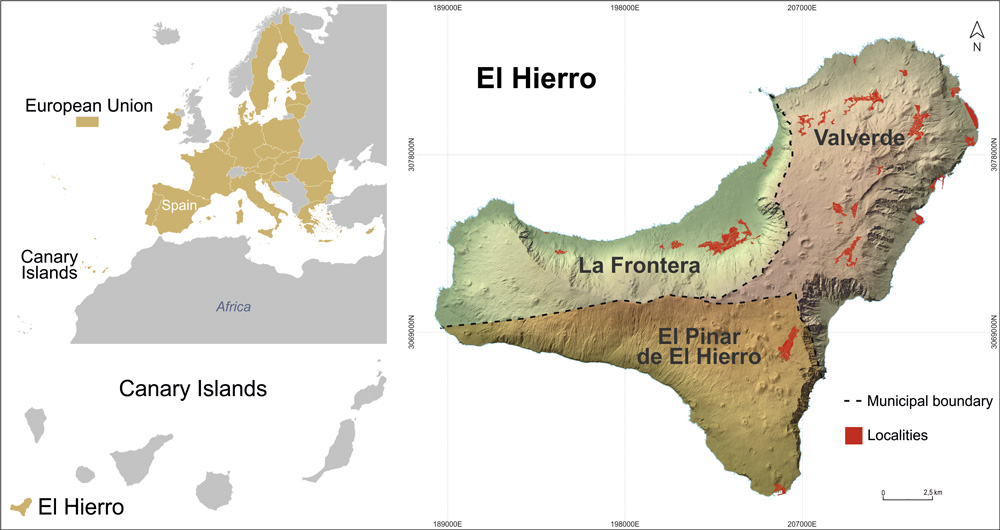
El Hierro lies at the south-western edge of the Canary Archipelago, a territory designated as an outermost region of the European Union (Figure 1). The island covers 268.71 km², rises to a maximum altitude of 1,501 m above sea level, and had an estimated population of 12,083 on 1 July 2025 (INE, 2025a). Its landscape is strikingly distinctive, shaped both by volcanic morphology and by relict flora, factors that led UNESCO to designate El Hierro a Biosphere Reserve in 2000 and a Geopark in 2014 (Mendoza et al., 2025b). These features, together with the island’s proactive environmental management policies, have consolidated its reputation as a sustainable destination within the broader framework of Canary Islands tourism specialisation.
Source: Own elaboration
Historically, El Hierro’s small size, limited water for irrigation, and lack of fertile land severely constrained living conditions, to the point that emigration reached remarkable levels until the 1980s. Between 1961 and 1970 alone, the annual population variation rate stood at –3.91 percent, a dramatic demographic loss that set the island on a path of ageing only slightly offset in recent years thanks to renewed population growth driven by immigration.
In terms of human development, El Hierro ranks in the second quintile of the Regional Human Development Index as a NUTS 3 region of the European Union—the same position as the Canary Islands overall. While this placement suggests a moderate level of wellbeing, it conceals structural constraints linked to the island’s outermost and peripheral condition, both within the archipelago and in relation to Europe. Distance from major economic centres, limited transport connectivity, and fragile communication infrastructures continue to shape its development prospects.
Although recent strategies centred on sustainability, renewable energy, and economic diversification have begun to challenge its long-standing marginality, significant vulnerabilities persist. The island retains a narrow productive base, a strong dependence on public-sector employment and external transfers, limited career opportunities for highly qualified young people—many of whom still leave—and mounting housing pressures associated with tourism. Taken together, these features align with contemporary understandings of left-behindness as a condition marked not only by income gaps, but by constrained opportunity structures, demographic fragility, and enduring territorial inequalities despite acceptable aggregate wellbeing indicators.
3. Sources and Methodology of Analysis
The statistical data compiled for this study come from INE and the Instituto Canario de Estadística (ISTAC, 2025), covering both population stocks and mobility flows. The period analysed is subject to data availability: in the case of stocks, only census data were available until 1998, when the INE began publishing annual figures through the Continuous Register Statistics (up to 2022) and the Annual Population Census (from 2021 onwards). These sources provide detailed year-by-year information, not only on demographic variables such as total population size, sex, and age, but also on residents’ countries of birth and nationality.
As for mobility flows, detailed data are only available from 2013 onwards, thanks to the Residential Variation Statistics (up to 2021) and the Statistics on Migration and Residential Changes (2021-2023), since it was only from that year that such statistics were processed at the island level.
Another cornerstone of this research lies in the qualitative analysis of in-depth interviews, each lasting on average one hour. Interviewees were selected through a snowball sampling technique initiated through multiple entry points. Given the potential selection biases associated with this method, initial contacts were diversified across different social networks and migrant profiles, and efforts were made to include participants with varied age, origins, occupations and migration trajectories. In a comprehensive fieldwork effort, 12 experts, 20 international immigrants, 6 immigrants from other parts of Spain, 3 international emigrants, another 3 emigrants living in other parts of Spain (one in Tenerife, another in Gran Canaria, and a third in Madrid), and 12 non-migrants were interviewed.
The migrants interviewed came from a range of countries and regions, or had emigrated to different parts of the world, with their numbers reflecting the patterns observed in the statistical data. Efforts were made to balance representation by sex and age, though the sample included a slightly higher proportion of women and older adults. The result was a broad spectrum of migrants and residents, all of whom were assured that the data collected would remain anonymous.
The interviews were transcribed using automatic speech recognition systems (Whisper AI and PinPoint), generating preliminary versions in plain text that were subsequently reviewed. For the labelling and data extraction phase, the material was segmented and coded following a set of analytical categories designed for the content analysis with the use of specialised open-source platforms, such as Label Studio. The information was organized according to the main sections of the interview guide, which included: introductory questions regarding personal characteristics and household composition; place attachment and identity; household strategies; migration trajectories; future mobility intentions; and perceived impacts of migration. Subsequently, the selected excerpts were transformed into illustrative quotations to capture the informants’ testimonies and assessments more accurately and to support the interpretation of the qualitative findings.
4. Socio-Demographic Evolution of El Hierro’s Population: The Role of the Migration Balance
Although no detailed information on the island’s population is available prior to the 1991 census, historical records allow us to trace the demographic scale and evolution of El Hierro from the late eighteenth century onwards. From the so-called Conde de Aranda Census of 1768 until 1860, when Spain conducted its second census, the island’s population remained between 4,000 and 5,000 inhabitants, with only minor fluctuations. From then until 1940, change was gradual and slightly positive, though we estimate it was lower than the natural growth that might have been expected for that period. This is evident from the discrepancy between the de facto and de jure populations, pointing to a large number of absent residents as a result of emigration2 (Table 1).
| Years | De jure population | De facto population |
|---|---|---|
| 1887 | 6,238 | 5,897 |
| 1900 | 6,789 | 6,508 |
| 1910 | 7,667 | 6,827 |
| 1920 | 8,344 | 7,225 |
| 1930 | 9,500 | 8,071 |
| 1940 | 9,810 | 8,849 |
| 1950 | 8,723 | 8,182 |
| 1960 | 9,521 | 7,957 |
| 1970 | 5,800 | 5,503 |
| 1981 | 6,507 | 6,408 |
| 1991 | 7,162 | 6,995 |
The intensity of this emigration becomes particularly clear after 1940, when the island experienced a marked demographic decline between 1940 and 1950. A moderate increase followed between 1950 and 1960, only to give way to another sharp population loss in the 1960s. This was a decade of heavy outflows, especially to the capital islands of the Canary Archipelago and to Venezuela, during which the population shrank by 39.1 percent. Emigration was heavily male dominated, as reflected in the predominance of women among island residents in 1970 and the significant number of men recorded as absent (Table 2).
| Men | Women | |
|---|---|---|
| Absent | 339 | 120 |
| Present | 2,619 | 2,722 |
| Passers-by | 102 | 60 |
| De facto population | 2,721 | 2,782 |
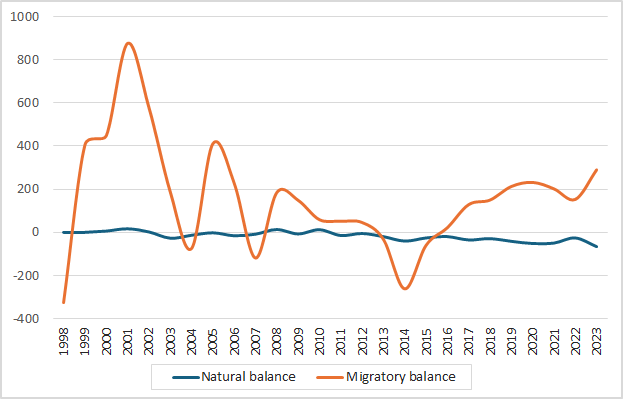
In the last three decades of the twentieth century, the intensity of this historical emigration declined, while natural population growth also contracted. On the eve of the new century, both natural balance—slightly negative—and migration balance—erratic until the mid-2010s—combined to produce only moderate population growth. From 2015 onwards, however, El Hierro entered a migratory transition: sustained population growth has since been driven by significant levels of immigration, especially striking given the island’s demographic scale3 (Figure 2).
Sources: INE (2025a). Continuous Register Statistics. ISTAC (2025). Vital statistics
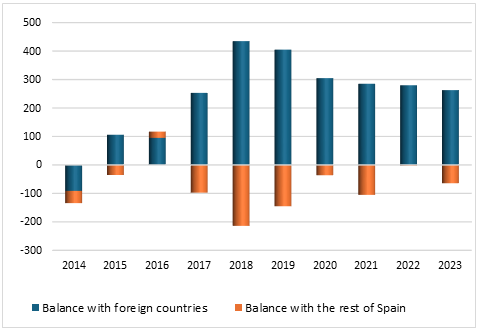
A closer look at migration flows since then (Figure 3) shows that the external migration balance is clearly positive, while the balance with the rest of Spain (internal) is slightly negative. This points, on the one hand, to the growing importance of immigration from abroad—already significant in previous decades, particularly lifestyle migrants from Europe, foreign entrepreneurs, and returnees or descendants of emigrants—and, on the other hand, to the persistent emigration of young adults, aged 25 to 34, to other parts of Spain, especially those with higher education (García Rodríguez & Zapata Hernández, 2001). This is confirmed by age-group data from the Residential Variation Statistics (INE, 2025d), which reveal that the largest outflows from El Hierro correspond to the 25-34 cohort.
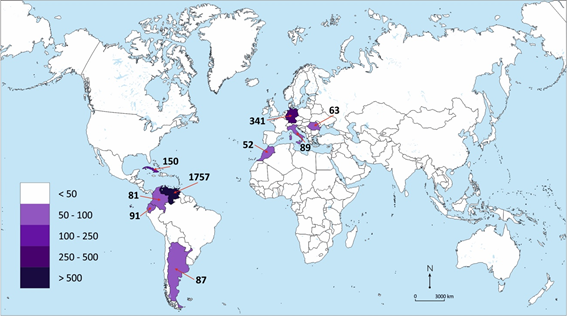
To better understand the island’s appeal for international immigrants, it is useful to examine their countries of origin, a factor that shapes this migratory profile. As shown in Figure 4, the Venezuelan-born population recorded the highest numbers in 2022: more than half of all foreign-born residents were from Venezuela (1,757 of 3,188). This group alone represented 15.4 percent of the island’s total population. At a considerable distance followed Germans, Italians, and Romanians from Europe, and Cubans, Ecuadorians, Colombians, and Argentinians from the Americas. Among African nationals, only Moroccans held a notable presence, while residents born in Asia and Oceania remained scarce.
Sources: INE (2025d). Residential Variation Statistics and Statistics on Migration and Changes of Residence
Source: INE (2025a). Continuous Register Statistics
Among Spanish-born residents, aside from native herreños, those born in Tenerife hold a prominent share (likely many of them descendants of emigrants from El Hierro), followed by those from Gran Canaria and La Palma. Beyond the archipelago, Andalusia and the Region of Madrid stand out—Spain’s first and third most populous regions—a pattern visible since the late 1980s (Martín Ruiz, 2002). The interpretation of these migratory ties will be developed later, drawing on the qualitative fieldwork conducted.
5. Migration in the Past and Present in the Words of Its Protagonists4
This section explores how migration is narrated, remembered, and experienced by its protagonists, moving from the historical legacy of emigration to the contemporary diversification of mobility flows. To guide the reader, we identify three main migratory pathways that structure these accounts: returnees and descendants of earlier emigrants; labour migrants without prior ties to the island; and lifestyle migrants linked to tourism and amenity-led mobility. While the section retains a chronological narrative—beginning with memories of past departures and their long-term effects—this typology provides an analytical framework that clarifies how different trajectories intersect, overlap, and collectively reshape El Hierro’s social, economic, and demographic landscape.
5.1. The Memory of Historical Emigration and Its Repercussions
As already noted, living conditions in the past were extremely harsh. The scarcity of fertile land for cultivation, due to the volcanic nature of the soils, and the limited water available for irrigation made farming difficult, forcing the population to specialise in pastoralism. In this context, during the post-war years and especially in the 1960s, the urban development of the Canary capitals as well as Venezuela emerged as the main destinations for emigrants from El Hierro. In the latter case, established Atlantic navigation routes linking the Canary Islands with Caribbean and Venezuelan ports, together with long-standing colonial ties, shared language and culture, strong diaspora networks, and labour demand generated by the oil-fuelled economic boom, drove intense emigration.
In the words of one emigrant who settled in Las Palmas de Gran Canaria: “In the 1950s, in El Hierro there was no work, only looking after a few animals or small plots of land; there was no industry, nowhere to go…” (Man, 83, emigrant, permanent resident in Gran Canaria). Another emigrant, with a long migratory trajectory, recalled: “In the 1960s, life in El Hierro was very hard. There was no electricity, no airport… and Venezuela saved us all from hunger.” (Man, 74, emigrant, temporary resident in Australia and El Hierro).
In many cases, migration proved successful and generated economic benefits that, over the years, had a positive impact on El Hierro, with investments in housing, renovations of family homes, and the creation of small businesses. As one interviewee, born and permanently residing on the island, explained: “My grandparents emigrated to Cuba and my parents to Venezuela. Many of those who left kept sending money, thanks to which many houses and water cisterns were built to cope with the drought.” (Woman, 45, permanent resident). Another interviewee, who emigrated to Venezuela at the age of four, shared:
My parents went to Venezuela in 1956. At that time, money had a lot of value, and my father owned tuna-fishing boats… After a long time, I persuaded him to invest here [in La Frontera, El Hierro]. First, he built a house and then this tourist apartment building, which I now run. (Woman, 74, return migrant, permanent resident)
Source: authors
Source: authors
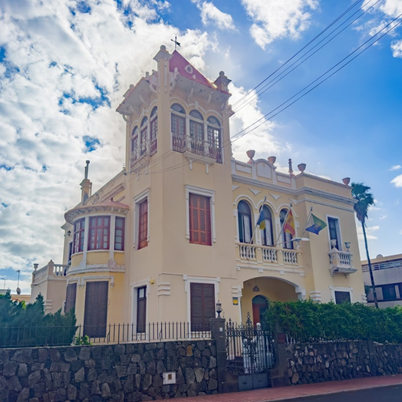
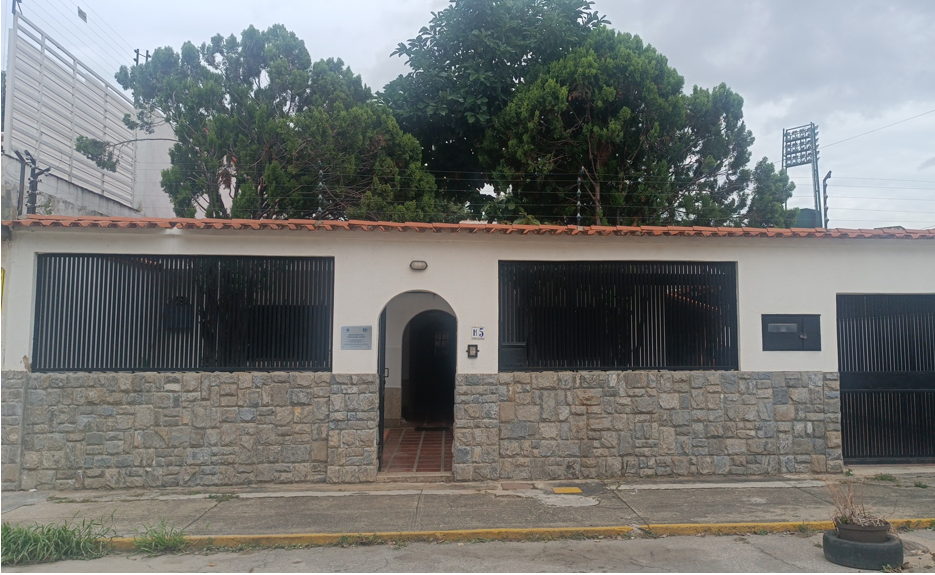
The island’s relationship with the outside world has always been fluid, forging strong transnational ties through the constant contact maintained among members of the El Hierro diaspora. This was achieved through associations founded in host destinations—such as the Casa de El Hierro in Gran Canaria (1981) and the Asociación Civil Amigos del Garoé in Caracas (1989) (Figures 5 and 6)—as well as through periodic family visits between places of emigration and El Hierro. In many cases, these visits took place annually or every four years, coinciding with the religious festivity Bajada de la Virgen de Los Reyes. This stands as clear evidence of the island’s enduring ability to maintain external connections, despite the absence of an airport until 1972 and the challenges of maritime travel when rough seas prevented ships from docking at the port of La Estaca, the only island port from which regular passenger and freight transport is carried out.
According to the testimony of a Venezuelan woman of El Hierro ancestry who arrived on the island in 1990:
I remember that my father, in Venezuela, always spoke to us about his homeland. He left very young, at only 17, and he always carried that longing with him. I remember that at weekends he would always prepare the traditional food from here, gofio amasado… He tried to return in 1983, but it was not until 1989 that he came back, intending to settle in El Hierro. And in fact, the following year, his five children and my mother came with him. But even before that, we used to spend our summers in El Hierro. (Woman, 61, Venezuelan emigrant, permanent resident)
Another interviewee, now residing in Gran Canaria, recalled: “I always spent my holidays in El Hierro, with my grandparents” (Man, 79, emigrant, permanent resident in Gran Canaria).
In short, these strong ties helped ease the island’s economic hardship and, over the years, made possible the long-awaited return of many emigrants, especially from the late 1980s, when hundreds began to make their way back (Ascanio Sánchez, 2008). Today, it is impossible to understand the island’s reality without paying close attention to immigration from the places that once received its emigrants. This perspective shows how memories of past migrations have shaped current mobility practices (Carling & Erdal, 2014). It highlights the role of place—the role of the island in memory—thanks to its relational capacity, which allows us to bring together the “relational turn” in island studies and the “placial turn” or “local turn” in migration studies (Gielis, 2009). In this sense, islands are not merely passive backdrops for migratory movements; they function as active factors that shape routes, timings, and broader patterns of mobility and return. Their geography, degree of isolation or connectivity, social and economic structures, and historical memory all influence migrants’ mobility imaginaries. Spatial power relations, transnational ties, and expectations of “returning” are negotiated within this insular context, which conditions decisions, opportunities, and constraints.
In this way, the island shapes not only how and when people migrate or return, but also why, and which trajectories become possible or foreclosed. This perspective aligns with King and Kılınç’s statement (2025) to ground and spatialise migration studies by attending to the role of place and its dynamics in migratory processes.
5.2. The complexity of island population’s mobility
Fieldwork on the island has revealed how difficult it is to find residents without a migratory background. Migration emerges as a constant in the life histories of interviewees, confirming the premise of relationality in this insular space—a quality that helps us understand the interaction between different groups of migrants as these unfold in specific spatial-temporal contexts (Jerez-Darias & Domínguez-Mujica, 2024).
Among residents, three broad migratory pathways stand out: a) returnees or descendants of emigrants; b) labour migrants with no prior links to the island; and c) lifestyle migrants, many of whom have become tourism entrepreneurs.
Among the first group, three testimonies illustrate these experiences:
I was born here in El Pinar and emigrated to Venezuela when I was three. I came back at fifteen with my parents and a sister… One day my father simply said: we’re going back to El Hierro. So, we returned to the village where he was born and where I was born, to the little house he had built with what he had earned in Venezuela. (Woman, 77, permanent resident)
I was born in 1972 into a poor, humble, large family working the land… At 19 I left for Madrid, where I built a career as a photographer. I had a gallery there, another in Bogotá, one in Miami, one in Tenerife, another in Las Palmas. Thirteen years ago, I decided to return, to come back to a lost village on a lost island—my village and my island. (Man, 54, permanent resident)
I was born in Buenos Aires, in 1981, in the city of La Plata. As my mother was from El Hierro, I decided to move here in 2001... I worked for an electricity company operating worldwide, but after eight years I left for mainland Spain—first to Catalonia, then the Basque Country. Eventually I returned to El Hierro and have now settled here permanently. I work in a paragliding company for tourists and in the Island Council’s public energy company, Gorona del Viento. (Man, 44, permanent resident)
Turning to labour migrants without family ties to the island, examples include a Czech woman, a Venezuelan woman, a Romanian man, and a Ukrainian woman. Their accounts underscore the importance of developing a tourist destination distinct from mass tourism, and the opportunities in sectors such as hospitality and agriculture—areas that have lost appeal for El Hierro natives—which have strengthened the island’s relational capacity and helped it to overcome its left-behind condition.
I was born in Czechia and later studied in Poland and England. After spending almost ten years in London, I moved to Tenerife and eventually settled in Echedo. I now live in a small house on a vineyard with my two cats, and I enjoy farming—planting vegetables, watering them, watching them grow, and eating what I harvest. I work as a tour guide. (Woman, 41, permanent resident)
I was born in Caracas and worked there as a lawyer. After my divorce, I decided to migrate to El Hierro to find better living conditions for myself and my daughter. The beginning was very hard, but I was determined to build a better life here. With the financial support of my aunt in Canada, I eventually managed to open a small hotel, which I now run as a family business. (Woman, 30, hotel manager, permanent resident)
I was born in a village in Romania and worked in agriculture. In 2003, I joined a Spanish employment program and came directly to El Hierro. My family joined me in 2006 through family reunification. I currently work cultivating tropical pineapples. (Man, 48, permanent resident)
I was born in Alexandria, in Ukraine. I came to El Hierro in 2005 through family reunification, after my husband had been hired to work on the construction of Carrefour on the island. I started working in the kitchen of a bar with almost no experience, later worked in hotels, and eventually became a cook. In 2011, I opened my own restaurant. (Woman, 68, permanent resident)
These four narratives highlight migration journeys driven by the search for stability, better opportunities, and a more peaceful life. Despite initial challenges, adaptation, family separation, economic hardship, or professional reinvention, each story reflects integration, strong resilience and personal growth despite their diverse origins, and how El Hierro becomes a place where people can rebuild their lives, start new careers or businesses, and contribute meaningfully to the local community.
As for lifestyle migrants, it is worth recalling that until the 1990s El Hierro had, in both quantitative and qualitative terms, virtually no tourism facilities or leisure infrastructure. From the consolidation of Spain’s regional autonomy system and the strengthening of island institutions, however, roads were built, healthcare provision was expanded, scenic viewpoints were developed, beaches and natural pools were refurbished, the spa at Pozo de la Salud (Sabinosa) was constructed, and by the end of the twentieth century most of the island had access to basic services such as electricity, running water, and telephone lines (Martín, 2009). Since the early twenty-first century, new territorial and tourism planning initiatives have also been introduced. Yet many lifestyle migrants had already settled on the island before these measures, becoming entrepreneurs and contributing directly to tourism development. This is reflected in the testimonies of a German tourist accommodation owner and a German organic wine producer:
I was born in Hamburg, and the first time I visited El Hierro was in 1978, on holiday with my family. In 1989 my husband and I decided to build a house here by the sea. After my divorce, in 2001 I left my job as a civil servant in Germany and settled permanently in El Hierro. By then I had already invested in another house, which I restored and now run as tourist accommodation offering meditation and yoga services. (Woman, 69, permanent resident)
I was born in Bavaria and, from an early age, worked in construction, eventually running a specialised company with 20 employees. I first came to the island in 1989 already thinking about buying something. When I arrived, I fell in love with the island. I bought a plot of land, began building and taking on construction projects, and later acquired a vineyard, which I developed… to produce organic wine. (Man, 68, permanent resident)
These entrepreneurial initiatives and testimonies show a clear connection between the desire to live on El Hierro—valuing a slower, nature-oriented lifestyle—and the decision to start a business (Mendoza et al., 2025a; Stone & Stubbs, 2007). In these cases, migration and entrepreneurship are driven not by the pursuit of profit but by the search for a better lifestyle (Benson & O’Reilly, 2016; Dinis, 2021). Their experiences reflect how meaningful, passion-based work (such as hiking or diving) aligns with small-scale, sustainable tourism initiatives, fostering a sense of belonging and long-term commitment to the island. Ultimately, these narratives illustrate how lifestyle motivations can shape entrepreneurial projects that support alternative tourism models and contribute to El Hierro’s development
I am from Trieste and have done many different jobs, but I’ve spent the last twenty years working as a hiking guide. In 2008, my Italian partner and I founded Atlantidea, a hiking company in El Hierro. I first came to the island through my partner’s mother, and although I had no intention of changing my life, the island ended up changing everything. (Man, 63, permanent resident)
I am French, born in Paris... After studying Chemistry and working in Paris, diving was just a hobby until I met my future husband during a course in Egypt. In 2018, we bought a diving business in El Hierro to offer an alternative to mass tourism. We have no intention of leaving—the underwater world is amazing, and life on the island is peaceful and complete. (Woman, 44, permanent resident)
In short, past emigration and the development of a sustainable tourism destination have become the driving forces behind the diversity that characterises immigration to El Hierro—a diversity that has grown in recent years and contributed to economic dynamism. As one young woman from El Hierro, who has travelled the world since the age of 18 combining work and higher education (as an au pair in Italy and Ireland, and later studying journalism in Madrid and Buenos Aires), put it: “During my last stay in El Hierro I realised there is a great deal of immigration. I see the island as more alive, with new people—positive, friendly, and pleasant” (Woman, 21, out migrant).
This supports King’s argument that while superdiverse societies are often associated with large cosmopolitan cities, they can also emerge in smaller places shaped by successive layers of migration (2025, p. 7). In El Hierro, not only are there many residents arriving from former destinations of the island’s historical emigration, such as Cuba and Venezuela, but diversification is further enhanced by newcomers attracted to the island’s natural landscape, social environment, and quality of life as illustrated in the following testimonies:
We fell in love with the island and then started coming and going. (Woman, 66, Italian resident)
My daughter’s husband, a Canadian, fell completely in love with the island and, although they live in Berlin, he wanted to do something here with vineyards, producing wine. (Woman, 69, German resident)
I am in love with the island, with the quality of life it offers, because you can still leave your house door open, or your car with the keys inside. It’s a place of tranquillity. (Man, 53, Italian resident)
Their emotional attachment to the island (“to fall in love,” “to be in love”) has become a key driver in these mobility flows that contribute to build a more varied social landscape.
5.3. Assessing the recent impact of immigration
Overall, interviewees—immigrants, emigrants, stayers, and especially experts—concur in their views on the defining features of current immigration, largely confirming the statistical data presented earlier. Regarding temporality, one interviewee noted: “Most foreigners residing on the island have their permanent home here, although there are also foreigners who live outside El Hierro for half of the year—predominantly Europeans, many of them retired” (Woman, Public Authority).
In terms of labour market integration, experts point to a clear socio-occupational stratification depending on residents’ geographic origin. Many European migrants have been drivers of active tourism: “Activities such as paragliding, hiking, and diving are created by Germans, Swedes… Organic farming was also initiated by European migrants” (Man, Public Authority). By contrast, Latin American migrants tend to play other roles:
Those arriving from South America are partly returnees or descendants of Canarians… and partly people without family ties who know someone here, decide to take a chance, and find an opportunity to make a living. (Man, Public Authority)
Returnees often already own land or a house to refurbish, and there is always demand for labour: “In farms, accommodation, restaurants… they find work. In fact, the restaurant sector is in the hands of Latin American immigrants. But active tourism—paragliding, diving, hiking—is run by Europeans or mainland Spaniards who live here” (Woman, Public Authority).
Virtually all Venezuelans and Cubans in El Hierro are, if not children, then grandchildren of El Hierro natives. This has provided us with labour. And there are also many Venezuelans, without previous ties, who come here and set up businesses, mostly in catering or small shops. That has brought real movement to the island’s economy. (Man, Agricultural Association leader)
As for El Hierro natives or long-term Spanish residents, interviewees again agreed: “Many of us came as civil servants from other parts of Spain, and a significant proportion has stayed on” (Man, Head of School). “El Hierro lives on public-sector employment, on jobs in the Council, healthcare, and education… It is an island that survives on public incoming funds” (Man, Public Authority).
Young people form another key dimension of social dynamics linked to mobility. For secondary school graduates in El Hierro, further education almost always means leaving the island, and many never return. Yet there is also a strong sense of island identity, prompting some to express—and sometimes realise—their wish to return once they find work, often in public administration. As one interviewee explained:
Many youngsters, my children, for instance, want to live here—and when I talk with other parents, they say the same about theirs. And I tell them: “Come on, the world starts out there.” It’s curious: my sons, who have been with me in Mexico, Venezuela, the United States, who have travelled widely, now don’t want to leave here because they feel good, they feel happy. (Man, Public Authority)
It’s true that young people from El Hierro who study abroad find it harder to return, because alongside their degree, they want to specialise and build a career. And it’s true that highly qualified people struggle to find work within the island’s economic structure… which delays their return. (Man, Public Authority)
These testimonies show that many young people from El Hierro must leave the island to study and train but later find it difficult to return due to the lack of qualified employment. However, they also reveal a strong emotional attachment: some feel deeply connected to family land, others idealise coming back, and many value the island’s tranquillity and quality of life. Taken together, the quotes highlight a clear tension between external opportunities and the desire to return and remain on El Hierro.
Another key dimension in assessing immigration’s impact is social integration. Interviews with migrants revealed no negative experiences upon settling on the island. The only concerns mentioned involved the recognition of academic qualifications, the legalisation of work status, or the difficulty of finding rental housing. In the words of an Asturian migrant woman, who has lived on the island since 2001:
Immigrants arrive with varying levels of education; some haven’t studied, others hold university degrees, but the latter face the barrier of having their qualifications recognised. In general, everyone who comes to work does find work, though many unfortunately cannot do so legally because they lack work permits, which fosters a certain informal economy, especially in care and agriculture. (Woman, Head of Social Care Centres)
Her comments on labour integration were echoed by several experts, consistent with patterns observed across Southern Europe, where migrant workers’ socio-economic integration often entails downward levelling in occupational hierarchies, regardless of education or social background (Piccitto et al., 2025).
Difficulties in connecting the island by air with the outside world as well as housing were another pressing concern. With respect to this last: “Many migrants struggle to find housing because homes of a certain quality are dedicated to holiday rentals or rural tourism” (Man, Public Authority). “Today, families arriving here often cannot find a place to live. Even civil servants, teachers, and doctors struggle to secure an apartment when they come to work on the island” (Man, Public Authority). This challenge mirrors that of many tourist destinations across Spain, as several studies have shown (De la Encarnación, 2023; González-Morales et al., 2021; Jiménez Barrado et al., 2025).
Initiatives to foster immigrant integration and social cohesion remain scarce, though the testimonies suggest that meaningful interaction often emerges naturally through everyday community spaces such as music groups, sports clubs, and local festivities. These activities bring migrants and locals together in shared practices that encourage cooperation, mutual recognition, and a growing sense of belonging. However, as participants note, this organic integration would benefit from more sustained and structured initiatives to reinforce long-term inclusion on the island.
Musical groups are now incorporating migrants, especially children… In my son’s tambor herreño [drum] group, you can see them playing together, bringing different rhythms. They are integrating… And in pito [flute] groups, many foreigners are fully included. In Concepción’s Canarian wrestling team, the other day there were eight black players and only two white. (Man, Public Authority)
Sports help bring migrants together, as seen in Valverde’s softball club, mostly formed by Venezuelans. Although there are no formal migrant associations, Frontera holds a yearly “Nationalities Day,” where people of many origins share food, traditions, and culture. (Man, Public Authority)
In 2023 and 2024 we organised intercultural events in La Frontera, with participation from people of various countries. These events, including food fairs and personal testimonies, were enriching, though they lack continuity and should become more frequent. (Woman, Cultural Association Leader)
6. Discussion of Results and Conclusions
The results presented show that El Hierro embodies a form of relational islandness in which human mobility operates as a mechanism of socio-spatial reconfiguration and, consequently, as a factor for the partial overcoming of its condition of left-behindness. In contrast to approaches that define insular peripherality in terms of structural deficits—small size, remoteness, limited economic base—the case of El Hierro demonstrates that the historical and contemporary interconnection of flows (emigration, return, international immigration, inter-island migration and tourism) reshapes demographic structures, labour markets and even cultural environments. This finding resonates with the relational turn in island studies, which conceives islands as nodes in multiscale networks rather than as closed units (Pugh, 2013; 2018; Baldacchino & Starc, 2021), and with the placial or local turn in migration studies, which restores analytical centrality to place in the production of mobility (King & Kılınç, 2025).
Tourism is not external to islandness but a key mechanism through which island peripherality is reworked. In El Hierro, tourism contributes to a more relational islandness by intensifying connections (transport links, services, visibility and networks) that can partially counter left-behindness via diversification, small-scale entrepreneurship and renewed demographic dynamism. Yet tourism may also reproduce vulnerabilities through seasonality, dependency, uneven value capture and housing pressures, generating new internal frictions and exclusions. In this sense, tourism simultaneously mitigates and reshapes left-behindness, rather than simply “solving” it.
On the demographic level, the island has undergone a transition from a cycle dominated by emigration—with its legacies of ageing and loss of human capital—to another characterised by a positive external migration balance, which has driven recent population growth, reconfigured the age pyramid and diversified households and labour trajectories. This transition, mediated by migration, does not eliminate entrenched dynamics, such as the continued outflow of qualified young people to other Spanish regions, but it does mitigate the classic effects of backwardness associated with depopulation and prolonged immobility (Velthuis et al., 2025; Panori et al., 2025).
From the New Mobilities Paradigm, tourism and migration should be conceptualised as intertwined mobilities within the same “mobility system,” where movements of people are co-produced with infrastructures, imaginaries, and institutional arrangements (Sheller & Urry, 2006). Tourist mobilities can open pathways for other forms of movement—temporary labour circulation, return visits that become return migration, and lifestyle migration—while migrants often sustain and service tourist economies, creating feedback loops. This perspective helps explain how mobility assemblages can transform island trajectories: the island becomes a node of circulation whose connections can both expand opportunities and generate new inequalities.
From an economic perspective, human mobility has expanded productive niches in line with a model of low-density tourism and specific agri-food activities. The testimonies gathered illustrate how lifestyle migrants and entrepreneurial returnees have fostered initiatives in tourist accommodation, diving, hiking, paragliding, gastronomy and viticulture, linking local resources with transnational circuits of demand (Stone & Stubbs, 2007; Benson & O’Reilly, 2016; Mendoza et al., 2025a). Rather than a simple population replacement, what emerges is a recombination of capitals—economic, social, cultural and environmental—that strengthens neo-endogenous development trajectories (Mendoza et al., 2025b). However, this dynamism coexists with a pronounced occupational stratification by origin, typical of Southern European contexts (Piccitto et al., 2025), and with obstacles linked to accreditation and administrative precarity that particularly affect Latin American and third-country immigrants.
On the sociocultural sphere, the qualitative evidence highlights the persistence of a transnational memory—sustained by associations, periodic returns and shared traditions—that nurtures a deterritorialised sense of belonging. Arriving in or returning to El Hierro thus acquires a strong symbolic imprint, as the island becomes an active agent in structuring expectations, narratives and ties. At the same time, everyday life incorporates practices of coexistence and hybridisation—festivals, clubs, sports, music—which show that the contribution of mobility is not limited to “filling gaps” but reorders the sociocultural space in line with the paradigm of mobilities, where movement and stasis are co-constitutive factors (Sheller & Urry, 2006).
Conceptually, the case validates the parallel between the relational turns in island and migration studies (King, 2009; Jerez-Darias & Domínguez-Mujica, 2024): islandness is not a fixed essence but a spatiotemporal regime of connections whose intensity varies historically. El Hierro does not overcome its status as a lagging region because it ceases to be an island, but because it activates its insularity as relational infrastructure. Diasporic networks that channel capital back to the island, tourism flows compatible with its ecological base, migrant enterprises that valorise local resources, and direct or deferred returns are all examples of this activation.
Nevertheless, the findings also highlight limits and contradictions. Dependence on public employment and a small private sector dampens the internalisation of benefits. Ethnic-occupational segmentation and regulatory bottlenecks—credential recognition, permits—devalue human capital and restrict upward mobility. The continued outflow of qualified youth keeps open the risk of medium-term social unsustainability and the tension between housing and tourism threatens social cohesion and risks displacing new residents and essential workers.
At the same time, the very dynamism generated by human mobility introduces ambivalent effects that are increasingly visible in the housing sphere. While the arrival of new residents—returnees, lifestyle migrants and foreign workers—has contributed to revitalising local communities and diversifying the economy, it has also intensified pressure on an already limited housing stock. In recent years, the difficulty of securing long-term rental accommodation has become a critical constraint, as much of the available supply has shifted towards rural tourism or short-stay markets. This shortage is compounded by the rising price of property, which increasingly places home ownership beyond the reach of young residents, newcomers and even essential workers temporarily relocated to the island. As a result, the revitalising effects of mobility coexist with emerging forms of residential vulnerability: demographic recovery and economic dynamism are accompanied by risks of exclusion, displacement and growing socio-spatial inequalities. Housing thus becomes a key lens through which the ambivalence of migration’s impact becomes evident, highlighting the need for policies that safeguard accessibility and social cohesion.
Looking ahead, the sustainability of El Hierro’s current trajectory will depend on its capacity to manage the delicate equilibrium between demographic revitalisation and the structural constraints of an insular territory. If present mobility trends persist, the island will continue to benefit from the infusion of human, economic and cultural capital, yet the pressure on essential resources—especially housing, labour market opportunities and environmental carrying capacity—may intensify. The challenge, therefore, lies not in halting these flows but in regulating them through policies that reinforce residential stability, diversify the economic base and protect ecological and social balances. In this sense, the future of El Hierro will hinge on its ability to transform mobility into a long-term asset rather than a source of cumulative tensions, ensuring that the relational advantages derived from migration do not undermine the conditions that make the island an attractive and liveable place.
Taken together, El Hierro illustrates that human mobility is both condition and consequence of an insular reterritorialisation process: the island converts its “structural disadvantage” into relational advantage. Public policy should, therefore, consolidate this conversion by strengthening residential anchoring (affordable housing), optimising migrant capital (degree recognition, support for entrepreneurship), safeguarding ecological balances within the tourism model, and designing pathways for the return of qualified youth.
A comparative perspective also suggests that the role of mobility in mitigating left-behindness is contingent on territorial specificities. In the case of El Hierro, the articulation between mobility and development is closely linked to a low-density tourism model, an environmental brand internationally recognised, and a social landscape that favours lifestyle migration and small-scale entrepreneurship. In islands with fewer tourism assets or weaker external visibility, mobility may play a more limited or qualitatively different role, generating fewer opportunities for economic diversification or attraction of lifestyle migrants, and relying more heavily on return migration or labour inflows in specific sectors. The El Hierro experience therefore cannot be assumed to be universal: it illustrates the potential of mobility to foster revitalisation but also underscores that such outcomes depend on the interplay between migratory flows, territorial resources, and the development model adopted in each island context.
In sum, this study seeks to contribute to the broader theoretical framework by showing that islandness can be understood as a relational condition while also nurturing the placial turn in migration studies. It provides empirical evidence of how demographic transitions can be mediated by migration and of how phenomena such as superdiversity, usually associated with large cities, also manifest and stratify in micro island contexts. Ultimately, the analysis contributes to theory by emphasising the relational mobility of island spaces as a factor in the partial overcoming of left-behindness.
Acknowledgments
This article is based on two projects: RE-PLACE project (Reframing Non-Metropolitan Left Behind Places Through Mobility and Alternative Development), EU Horizon Framework Programme for Research and Innovation (Agreement no. 101094087) and ELDEMOR (Endogenous Local Development and Mobilities in Rural Areas of Spanish and Portuguese Peripherical Regions) project that has been funded by the Spanish Ministry of Science, Innovation and Universities (CNS2022-135614).
References
Ascanio Sánchez, C. (2008). Migración, trabajo e identidad: canarios en Venezuela. Cuadernos Americanos, (126), 193-208. http://www.cialc.unam.mx/cuadamer/textos/ca126-193.pdf
Baldacchino, G., & Starc, N. (2021). The virtues of insularity: Pondering a new chapter in the historical geography of islands. Geography Compass, 15(12), e12596. https://doi.org/10.1111/gec3.12596
Benson, M., & O’Reilly, K. (2016). From lifestyle migration to lifestyle in migration: Categories, concepts and ways of thinking. Migration Studies, 4(1), 20-37. https://doi.org/10.1093/migration/mnv015
Carling, J., & Erdal, M. B. (2014). Return migration and transnationalism: how are the two connected? International Migration, 52(6), 2-12. https://doi.org/10.1111/imig.12180
Cortés-Ruiz, M., & Ibar-Alonso, R. (2021). Vulnerabilidad y resiliencia en la España vaciada. Revista Electrónica de Comunicaciones y Trabajos de ASEPUMA, 22(2), 63-75. https://doi.org/10.24310/recta.22.2.2021.19879
De la Encarnación, A. M. (2023). Las cicatrices de la vivienda turística. Revista de Estudios de la Administración Local y Autonómica, 19, 137-160. https://doi.org/10.24965/reala.11218
Dinis, A. (2021). Tourism, immigrants and lifestyle entrepreneurship: The (In) coming of people as a key factor for sustainability of low-density territories—A case study in Portugal. In R. Marques, A. Melo, M. Natário & R. Biscaia (eds.), The Impact of Tourist Activities on Low-Density Territories: Evaluation Frameworks, Lessons, and Policy Recommendations (pp. 149-182). Springer International Publishing. https://doi.org/10.1007/978-3-030-65524-2_7
Fiorentino, S., Glasmeier, A. K., Lobao, L., Martin, R., & Tyler, P. (2024). “Left behind places:” What are they and why do they matter? Cambridge Journal of Regions, Economy and Society, 17(1), 1-16. https://doi.org/10.1093/cjres/rsad044
Freitas, C. (2024). The entrepreneurial process in a remote island context: the case of Madeira. Island Studies Journal, 19(1). https://doi.org/10.24043/001c.90535
García Rodríguez, J. L., & Zapata Hernández, V. M. (2001). Evolución futura de la población de la Isla de El Hierro. Revista de Historia Canaria, (183), 139-173.
Gielis, R. (2009). A global sense of migrant places: Towards a place perspective in the study of migrant transnationalism. Global Networks, 9(2), 271-287. https://doi.org/10.1111/j.1471-0374.2009.00254.x
Giuffrè, M. (2021). Female migration in the Cape Verde islands: From islandness to transnationalism. Island Studies Journal, 16(2), 117-135. https://doi.org/10.24043/isj.180
González-Morales, J. G., Checa-Olivares, M., & Cano-Guervos, R. (2021). Impact of Evictions and Tourist Apartments on the Residential Rental Market in Spain (2015-2018). Sustainability, 13(13), 7485. https://doi.org/10.3390/su13137485
Houlden, V., Robinson, C., Franklin, R., Rowe, F., & Pike, A. (2024). “Left behind” neighbourhoods in England: Where they are and why they matter. The Geographical Journal, 190(4), 1-20. https://doi.org/10.1111/geoj.12583
INE (Instituto Nacional de Estadística). (2025a). Continuous Register Statistics. https://www.ine.es/dynt3/inebase/en/index.htm?padre=6237&capsel=6239
INE. (2025b). Alterations to the municipalities in the Population Censuses since 1842. https://www.ine.es/intercensal/?L=1
INE. (202c5). Population Census. https://www.ine.es/inebaseweb/treeNavigation.do?tn=92693&L=0
INE. (2025d). Residential Variation Statistics. https://www.ine.es/dyngs/INEbase/en/operacion.htm?c=Estadistica_C&cid=1254736177013&menu=ultiDatos&idp=1254734710990
ISTAC. (2025). Vital Statistics. Gobierno de Canarias. https://www3.gobiernodecanarias.org/istac/statistical-visualizer/visualizer/collection.html?resourceType=collection&agencyId=ISTAC&resourceId=C00042A_000001
Jerez-Darías, L. M., & Domínguez-Mujica, J. (2024). The time-space regimes of human mobility in the North Atlantic island spaces (Iceland, Azores, Madeira, the Canary Islands, and Cape Verde). Island Studies Journal, 20(1), 100-123. https://doi.org/10.24043/001c.120293
Jiménez Barrado, V., Hernández Luis, J. Á., Ramón Ojeda, A. Á., & Moreno Medina, C. (2025). Living on the Edge: The Precariat Amid the Rental Crisis in the Metropolitan Area of Las Palmas de Gran Canaria (Spain). Urban Science, 9(5), 156. https://doi.org/10.3390/urbansci9050156
Karasz, D., Homberger, A., & Güntner, S. (2025). Working definition of ‘left behindness’ as a form of territorial inequality (EXIT Working Papers – Exploring sustainable strategies to counteract territorial inequalities from an intersectional approach, Vol. 1). EXIT Working Papers. http://hdl.handle.net/20.500.12708/215424
Kelman, I., & Stojanov, R. (2023). Islander migrations and the oceans: From hopes to fears? Island Studies Journal, 16(1), 23-42. https://doi.org/10.24043/isj.120
King, R. (2009). Geography, islands and migration in an era of global mobility. Island Studies Journal, 4(1), 53-84. https://doi.org/10.24043/isj.228
King, R., & Kılınç, N. (2025). Introduction: “Placing” return migration. Population, Space and Place, 31(6), e70065. https://doi.org/10.1002/psp.70065
Le Petit-Guerin, M., Velthuis, S., Royer, J., Cauchi-Duval, N., Franklin, R., Leibert, T., MacKinnon, D., & Pike, A. (2025). Identifying trajectories of regional “left-behindness” in EU15 from 1982 to 2017. ZFW – Advances in Economic Geography, 69(4), 177-190. https://doi.org/10.1515/zfw-2023-0068
Martin, R., Gardiner, B., Pike, A., Sunley, P., & Tyler, P. (2021). Levelling up left behind places: The scale and nature of the economic and policy challenge. Routledge. https://doi.org/10.4324/9781032244341
Martín, C. S. (2009). Evolución del sistema turístico de la isla de El Hierro (Canarias). Cuadernos de Turismo, (24), 111-133. https://revistas.um.es/turismo/article/view/92681
Martín Ruiz, J. F. (2002, October). El modelo migratorio de Canarias en el contexto español: el proceso inmigratorio actual. In XV Coloquio de Historia Canario-Americana. Cabildo de Gran Canaria - Casa Colón. https://revistas.grancanaria.com/index.php/CHCA/article/view/8544/7751
Mendoza, C., Domínguez-Mujica, J., & Parreño-Castellano, J. M. (2025a). Islands on the move: Non-mass tourism and migration in El Hierro (Spain) and Pico (Portugal). Annals of Tourism Research Empirical Insights, 6(1), 100171. https://doi.org/10.1016/j.annale.2025.100171
Mendoza, C., Domínguez-Mujica, J., Parreño-Castellano, J. M., & Moreno-Medina, C. (2025b). Neo-endogenous local development, tourism, and international immigration in El Hierro, Spain. Tijdschrift voor Economische en Sociale Geografie, 116(2), 131-145. https://doi.org/10.1111/tesg.12653
Panori, A., Kalogeresis, A., Papastergiou, E., Ziogas, T., & Ballas, D. (2025). Unraveling the nexus: Subjective well-being and left-behind places. Regional Science Policy & Practice, 17(10), 100222. https://doi.org/10.1016/j.rspp.2025.100222
Piccitto, G., Avola, M., & Panichella, N. (2025). Migration, social stratification, and labor market attainment: An analysis of the ethnic penalty in 12 Western European countries. International Journal of Comparative Sociology, 66(2), 121-139. https://doi.org/10.1177/00207152241246166
Pike, A., Béal, V., Cauchi-Duval, N., Franklin, R., Kinossian, N., Lang, T., Leibert, T., MacKinnon, D., Rousseau, M., Royer, J., Servillo, L., Tomaney, J., & Velthuis, S. (2024). “Left behind places:” a geographical etymology. Regional Studies, 58(6), 1167-1179. https://doi.org/10.1080/00343404.2023.2167972
Pugh, J. (2013). Island movements: Thinking with the archipelago. Island Studies Journal, 8(1), 9-24. https://doi.org/10.24043/isj.273
Pugh, J. (2018). Relationality and island studies in the Anthropocene. Island Studies Journal, 13(2), 93-110. https://doi.org/10.24043/isj.48
Pulido Fernández, M., Stavi, I., & Barrena González, J. (2022). Is land abandonment remarkable in the so-called Empty Spain? Investigaciones Geográficas: Una Mirada Desde el Sur, (63), 77-88. https://doi.org/10.5354/0719-5370.2022.67759
Royer, J., & Leibert, T. (2024). Suspended in time? Peripheralised and “left behind” places in Germany. Geographica Helvetica, 79(3), 221-237. https://doi.org/10.5194/gh-79-221-2024
Sandu, D. (2024). Understanding Left-Behind Places in a Contrastive Approach. Comparative Sociology, 23(3), 360. https://doi.org/10.1163/15691330-bja10109
Sheller, M., & Urry, J. (2006). The New Mobilities Paradigm. Environment and Planning A: Economy and Space, 38(2), 207-226. https://doi.org/10.1068/a37268
Stone, I., & Stubbs, C. (2007). Enterprising expatriates: Lifestyle migration and entrepreneurship in rural southern Europe. Entrepreneurship and Regional Development, 19(5), 433-450. https://doi.org/10.1080/08985620701552389
Stratford, E., Baldacchino, G., McMahon, E., Farbotko, C., & Harwood, A. (2011). Envisioning the archipelago. Island Studies Journal, 6(2), 113-130. https://doi.org/10.24043/isj.253
Velthuis, S., Royer, J., Le Petit-Guerin, M., Cauchi-Duval, N., Franklin, R., Leibert, T., MacKinnon, D., & Pike, A. (2025). Regional varieties of “left-behindness” in the EU15. Regional Studies, 59(1), 2417704. https://doi.org/10.1080/00343404.2024.2417704